Team Development
Overview
 What is a Team?
 What is Team Development?
 Benefits of Team Development
 Key Steps and Traits Required for Success:
 Team Building
 Favorable Traits
 Four Stages of Team Development
 Three Possible Strategies for Development
 Challenges:
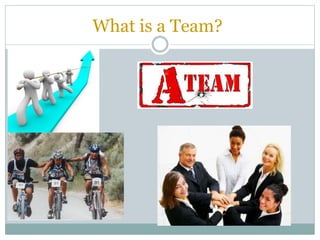
What is a Team?
What is a Team?
What is a Team?
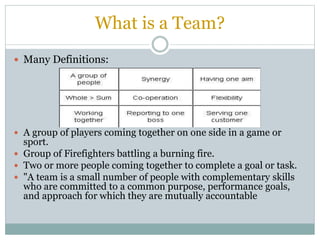
 Many Definitions:
 A group of players coming together on one side in a game or
sport.
 Group of Firefighters battling a burning fire.
 Two or more people coming together to complete a goal or task.
 "A team is a small number of people with complementary skills
who are committed to a common purpose, performance goals,
and approach for which they are mutually accountable
What is Team Development?
 “Team Development’s purpose is to help a team in
the process of self-examination to gain awareness of
those conditions which are the source of it’s strength
and those conditions that keep it from functioning
effectively.”
 “Through the team development process, the group
learns how to make decisions and take those actions
that will lead to better efficiency, productivity,
product quality, and quality of work life.”
Benefits of Team Development
 Allows for different perspectives in reaching a goal.
 Increased potential for information gathering.
 Learning from other team members.
 Improves the chances of problem solving.
 When a team works on achieving a goal, there is
more discussion and increased chance for success.
 Team bonding can lead to friendship.
Team Building
 Team building is a very important part of successful
team development.
 It can make or break a team.
 Can be achieved in many different ways:
 Meetings
 Activities
 Team Motivation
 Bonding trips
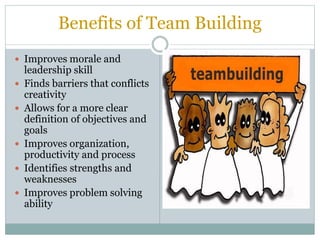
Benefits of Team Building
 Improves morale and
leadership skill
 Finds barriers that conflicts
creativity
 Allows for a more clear
definition of objectives and
goals
 Improves organization,
productivity and process
 Identifies strengths and
weaknesses
 Improves problem solving
ability
Traits for Success
 In order for a team to be successful it must possess
certain qualities:
 Capable Leadership
 Team leader must be active within the team:
 Motivate team members
 Ensure a positive team attitude
 Help with solving problems
 Must be dedicated to both team and project goals
 Must monitor teams progress
 High amounts of motivation and team dedication
 Teams must always stay focused on the goal of the project
 Teams must always work together
Four Stages of Team Development
 There are four main stages of team development,
known as Tuckman’s Four Stages of Development.
 Forming
 Storming
 Norming
 Preforming
Stage 1: Forming
 Involves the team members getting to know one
another.
 Members learn exactly what it is they are doing and
how the team leader plans to run things.
 Team building is very important in this stage.
 Stage ends when members begin to see themselves as
part of the group.
Stage 2: Storming
 Is a sorting out period where members begin to find
their place in the group.
 This stage is the start of intragroup conflict.
 All about exchanging ideas, good or bad on how to
reach the goal.
Stage 3: Norming
 Team members use past experiences to solve their
problems and pull together as a cohesive group.
 Results in team handling procedures in solving
conflicts, decisions, and methods to reach the goal.
Stage 4: Preforming
 Team has achieved harmony, defined its tasks,
worked out its relationships, and started producing
results.
 Members have learned to work together and
contribute their resources to achieve the goal.
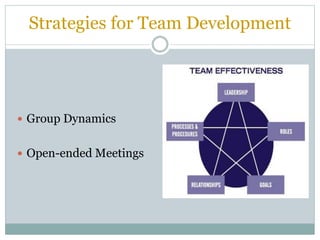
Strategies for Team Development
 Group Dynamics
 Open-ended Meetings
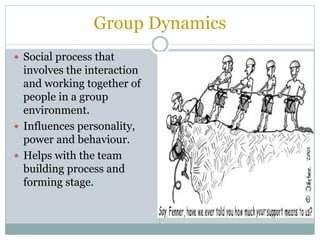
Group Dynamics
 Social process that
involves the interaction
and working together of
people in a group
environment.
 Influences personality,
power and behaviour.
 Helps with the team
building process and
forming stage.
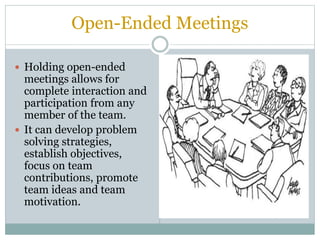
Open-Ended Meetings
 Holding open-ended
meetings allows for
complete interaction and
participation from any
member of the team.
 It can develop problem
solving strategies,
establish objectives,
focus on team
contributions, promote
team ideas and team
motivation.
Challenges
 Major challenges related to Team Development
occur as a result of the dependence on a team.
 Trust is a major issue
 Choosing the right team
 Keeping the team on track
 Space challenges
 Knowing when it is over
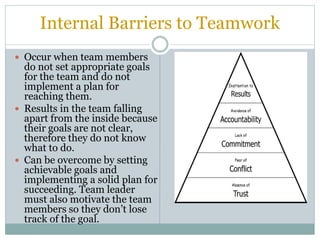
Internal Barriers to Teamwork
 Occur when team members
do not set appropriate goals
for the team and do not
implement a plan for
reaching them.
 Results in the team falling
apart from the inside because
their goals are not clear,
therefore they do not know
what to do.
 Can be overcome by setting
achievable goals and
implementing a solid plan for
succeeding. Team leader
must also motivate the team
members so they don’t lose
track of the goal.
Trust
 Trust is an extremely important aspect of any team
or group.
 To overcome the challenge associated with gaining
trust one could:
 Implement team building activities
 Allow involvement of all parties on the team
 Provide help to those who need it
External Barriers to Teamwork
 Occur when team members are required to work on
the team project, but also have to work on outside
projects such as school work or family issues.
 Results in team members being unable to dedicate
their time to the project.
 Can be overcome by only choosing team members
that can be 100% dedicated to the project.
Choosing the Right Team
 Choosing the right team is also important. The
choices you make have the ability to make or break
your project.
 To overcome this challenge you can:
 Choose members that are diverse, dedicated, and have
knowledge of the project.
 Members should not be selected based on their position within
the system because, while they may be knowledgeable, they
may not be dedicated to researching information and
collecting raw data.
Keeping the Team on Track
 If a team loses track of their projected goal, problems
will begin to occur. To prevent this:
 The leader must maintain the groups concentration as
workload increases.
 Motivation can be used to boost the teams morale.
 Clear stated goals and objectives also keep the team on
track.
Space Challenges
 A challenge of team development that is not directly
related to team performance is the matter of space;
where the team will meet.
 This can be overcome by a team member providing a
meeting area or room for the team.
 If a team member does not have access to a sufficient
meeting area, the team can look to outside sources
for help; donation of room by outside businesses or
organizations.
 Electronic sources are also available.
Groupthink
 When team members attempt to
conform their ideas to what they
believe to be the consensus of the
group.
 Emerges when the view of a few
members dominates the discussion.
 Can be overcome by the team
leader. The leader can spot this and
make changes that will discourage
the domination of discussion.
 Best ways to avoid is to have small
group sizes, give everyone
opportunity to speak, and
encourage the challenging of other
ideas.
How to Know When It’s Over?
 There are three ways that can lead to the demise of a
team:
 External Barriers to Teamwork
 Internal Barriers to Teamwork
 Groupthink
Thank You

Team Development plan with new ideas.ppt

  • 1.
  • 2.
    Overview  What isa Team?  What is Team Development?  Benefits of Team Development  Key Steps and Traits Required for Success:  Team Building  Favorable Traits  Four Stages of Team Development  Three Possible Strategies for Development  Challenges:
  • 3.
    What is aTeam?
  • 4.
    What is aTeam?
  • 5.
    What is aTeam?  Many Definitions:  A group of players coming together on one side in a game or sport.  Group of Firefighters battling a burning fire.  Two or more people coming together to complete a goal or task.  "A team is a small number of people with complementary skills who are committed to a common purpose, performance goals, and approach for which they are mutually accountable
  • 6.
    What is TeamDevelopment?  “Team Development’s purpose is to help a team in the process of self-examination to gain awareness of those conditions which are the source of it’s strength and those conditions that keep it from functioning effectively.”  “Through the team development process, the group learns how to make decisions and take those actions that will lead to better efficiency, productivity, product quality, and quality of work life.”
  • 7.
    Benefits of TeamDevelopment  Allows for different perspectives in reaching a goal.  Increased potential for information gathering.  Learning from other team members.  Improves the chances of problem solving.  When a team works on achieving a goal, there is more discussion and increased chance for success.  Team bonding can lead to friendship.
  • 8.
    Team Building  Teambuilding is a very important part of successful team development.  It can make or break a team.  Can be achieved in many different ways:  Meetings  Activities  Team Motivation  Bonding trips
  • 9.
    Benefits of TeamBuilding  Improves morale and leadership skill  Finds barriers that conflicts creativity  Allows for a more clear definition of objectives and goals  Improves organization, productivity and process  Identifies strengths and weaknesses  Improves problem solving ability
  • 10.
    Traits for Success In order for a team to be successful it must possess certain qualities:  Capable Leadership  Team leader must be active within the team:  Motivate team members  Ensure a positive team attitude  Help with solving problems  Must be dedicated to both team and project goals  Must monitor teams progress  High amounts of motivation and team dedication  Teams must always stay focused on the goal of the project  Teams must always work together
  • 11.
    Four Stages ofTeam Development  There are four main stages of team development, known as Tuckman’s Four Stages of Development.  Forming  Storming  Norming  Preforming
  • 12.
    Stage 1: Forming Involves the team members getting to know one another.  Members learn exactly what it is they are doing and how the team leader plans to run things.  Team building is very important in this stage.  Stage ends when members begin to see themselves as part of the group.
  • 13.
    Stage 2: Storming Is a sorting out period where members begin to find their place in the group.  This stage is the start of intragroup conflict.  All about exchanging ideas, good or bad on how to reach the goal.
  • 14.
    Stage 3: Norming Team members use past experiences to solve their problems and pull together as a cohesive group.  Results in team handling procedures in solving conflicts, decisions, and methods to reach the goal.
  • 15.
    Stage 4: Preforming Team has achieved harmony, defined its tasks, worked out its relationships, and started producing results.  Members have learned to work together and contribute their resources to achieve the goal.
  • 16.
    Strategies for TeamDevelopment  Group Dynamics  Open-ended Meetings
  • 17.
    Group Dynamics  Socialprocess that involves the interaction and working together of people in a group environment.  Influences personality, power and behaviour.  Helps with the team building process and forming stage.
  • 18.
    Open-Ended Meetings  Holdingopen-ended meetings allows for complete interaction and participation from any member of the team.  It can develop problem solving strategies, establish objectives, focus on team contributions, promote team ideas and team motivation.
  • 19.
    Challenges  Major challengesrelated to Team Development occur as a result of the dependence on a team.  Trust is a major issue  Choosing the right team  Keeping the team on track  Space challenges  Knowing when it is over
  • 20.
    Internal Barriers toTeamwork  Occur when team members do not set appropriate goals for the team and do not implement a plan for reaching them.  Results in the team falling apart from the inside because their goals are not clear, therefore they do not know what to do.  Can be overcome by setting achievable goals and implementing a solid plan for succeeding. Team leader must also motivate the team members so they don’t lose track of the goal.
  • 21.
    Trust  Trust isan extremely important aspect of any team or group.  To overcome the challenge associated with gaining trust one could:  Implement team building activities  Allow involvement of all parties on the team  Provide help to those who need it
  • 22.
    External Barriers toTeamwork  Occur when team members are required to work on the team project, but also have to work on outside projects such as school work or family issues.  Results in team members being unable to dedicate their time to the project.  Can be overcome by only choosing team members that can be 100% dedicated to the project.
  • 23.
    Choosing the RightTeam  Choosing the right team is also important. The choices you make have the ability to make or break your project.  To overcome this challenge you can:  Choose members that are diverse, dedicated, and have knowledge of the project.  Members should not be selected based on their position within the system because, while they may be knowledgeable, they may not be dedicated to researching information and collecting raw data.
  • 24.
    Keeping the Teamon Track  If a team loses track of their projected goal, problems will begin to occur. To prevent this:  The leader must maintain the groups concentration as workload increases.  Motivation can be used to boost the teams morale.  Clear stated goals and objectives also keep the team on track.
  • 25.
    Space Challenges  Achallenge of team development that is not directly related to team performance is the matter of space; where the team will meet.  This can be overcome by a team member providing a meeting area or room for the team.  If a team member does not have access to a sufficient meeting area, the team can look to outside sources for help; donation of room by outside businesses or organizations.  Electronic sources are also available.
  • 26.
    Groupthink  When teammembers attempt to conform their ideas to what they believe to be the consensus of the group.  Emerges when the view of a few members dominates the discussion.  Can be overcome by the team leader. The leader can spot this and make changes that will discourage the domination of discussion.  Best ways to avoid is to have small group sizes, give everyone opportunity to speak, and encourage the challenging of other ideas.
  • 27.
    How to KnowWhen It’s Over?  There are three ways that can lead to the demise of a team:  External Barriers to Teamwork  Internal Barriers to Teamwork  Groupthink
  • 28.