Team Dynamics in Process
     Simplification
 Understanding the Basics of Team Development


                                       Introduction to Process Improvement
                                                                    Slide 1
Teams are all around us…


                   Introduction to Process Improvement
                                                Slide 2
Each team should:

• Define their principles in alignment with organizational
  vision
• Clarify roles and responsibilities
• Identify key customers
• Develop a balanced scorecard
• Analyze current work processes
• Prioritize and work on most critical problems
• Give recognition
• Evaluate periodically
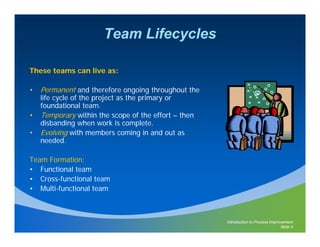
Team Lifecycles

These teams can live as:

•   Permanent and therefore ongoing throughout the
    life cycle of the project as the primary or
    foundational team.
•   Temporary within the scope of the effort – then
    disbanding when work is complete.
•   Evolving with members coming in and out as
    needed.
    needed

Team Formation:
• Functional team
• Cross-functional team
• Multi-functional team


                                                      Introduction to Process Improvement
                                                                                   Slide 4
Team Functions


•   Define requirements of their work
•   Study and improve processes
•   Develop scorecards and set performance goals
•   Solve problems
•   Develop and implement action plans
Common questions people have
       during team formation…

•   Who are these people?
•   Who are we together?
•   Why should we be a team?
•   What if we aren’t all alike?
•   Whom do we trust?
•   Where are we going and what is our path?
•   How can we work together?
•   What lies ahead?
•   How can we support each other?


                                               Introduction to Process Improvement
                                                                            Slide 6
Critical Success Factors

•   Results Based
•   Customer Focused
•   Team Scorekeeping
                  p g
•   Continuous Improvement
•   Reward and Recognition
•   Systems Alignment
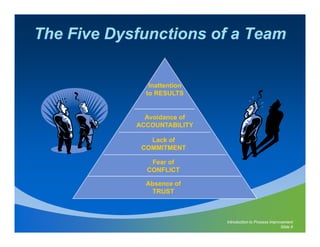
The Five Dysfunctions of a Team

               Inattention
              to RESULTS


              Avoidance of
            ACCOUNTABILITY

               Lack of
             COMMITMENT

               Fear of
              CONFLICT

              Absence of
               TRUST


                             Introduction to Process Improvement
                                                          Slide 8
Building A Team


•   Clear sense of purpose
•   Clear performance goals
•   Understand value of a team
•   Sense of interdependence
•   Hold each other accountable
       ld    h h             bl
Team Activities

•   Consistent time and place for team meetings
•   Purpose and principles
•   Ground rules and begin using action record
•   Identify customers
•   Identify products and services
•   Roles d
    R l and responsibilities
                      ibiliti
•   Identify key players
•   Interview customers
Team Activities


•   Identify key processes
•   Analyze processes
•   Identify business measures
•   Analyze customer feedback
•   Develop scorecard
         l           d
•   Monitor results
•   Recognition
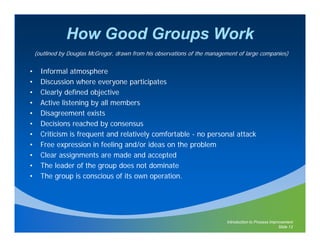
How Good Groups Work
    (outlined by Douglas McGregor, drawn from his observations of the management of large companies)


•     Informal atmosphere
•     Discussion where everyone participates
•     Clearly defined objective
•     Active listening by all members
•     Disagreement exists
•     Decisions reached by consensus
•     Criticism is frequent and relatively comfortable - no personal attack
•     Free expression in feeling and/or ideas on the problem
•     Clear assignments are made and accepted
•     The leader of the group does not dominate
•     The group is conscious of its own operation.


                                                                            Introduction to Process Improvement
                                                                                                        Slide 12
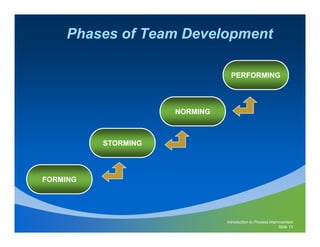
Phases of Team Development

                                 PERFORMING


                     NORMING


          STORMING


FORMING


                               Introduction to Process Improvement
                                                           Slide 13
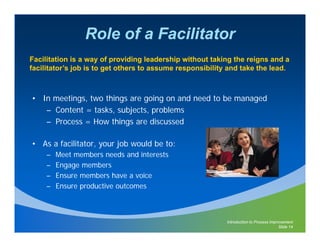
Role of a Facilitator
Facilitation is a way of providing leadership without taking the reigns and a
facilitator’s job is to get others to assume responsibility and take the lead.


• In meetings, two things are going on and need to be managed
   – C t t = t k subjects, problems
     Content tasks, bj t           bl
   – Process = How things are discussed

• As a facilitator, your job would be to:
     –   Meet members needs and interests
     –   Engage members
     –   Ensure members have a voice
     –   Ensure productive outcomes


                                                           Introduction to Process Improvement
                                                                                       Slide 14
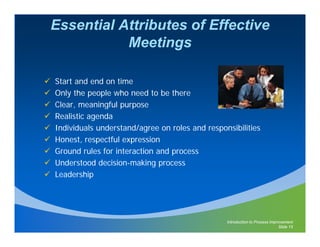
Essential Attributes of Effective
           Meetings

Start and end on time
Only the people who need to be there
Clear, meaningful purpose
     ,        g p p
Realistic agenda
Individuals understand/agree on roles and responsibilities
Honest,
Honest respectful expression
Ground rules for interaction and process
Understood decision-making process
Leadership


                                                Introduction to Process Improvement
                                                                            Slide 15
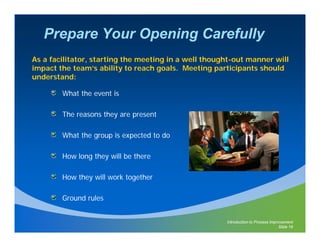
Prepare Your Opening Carefully
As a facilitator, starting the meeting in a well thought-out manner will
impact the team’s ability to reach goals. Meeting participants should
understand:

        What the event is

        The reasons they are present

        What the group is expected to do
                 g p        p

        How long they will be there

        How they will work together

        Ground rules


                                                      Introduction to Process Improvement
                                                                                  Slide 16
Making Interventions
There are often various roles people fall into naturally based on their
personality, place in the organization, status, expertise, or relationship to the
work at hand. A skilled facilitator must be able to “manage” various aspects
                                                      manage
of the discussion as they are brought into play during the meeting.


       Dealing with ideas not in line with meeting objectives:
           Accept an idea without agreeing or disagreeing
           Legitimize the idea by writing it down
           Decide as a team whether it is a priority
           Deal with it or defer the idea to the “parking lot”


       Review of Common Disruptive Behaviors


                                                                 Introduction to Process Improvement
                                                                                             Slide 17
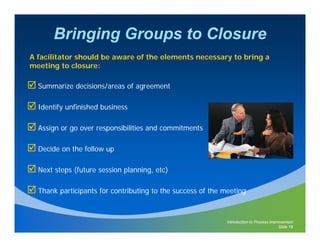
Bringing Groups to Closure
A facilitator should be aware of the elements necessary to bring a
meeting to closure:

  Summarize decisions/areas of agreement

  Identify unfinished business

  Assign or go over responsibilities and commitments

  Decide on the follow up

  Next steps (future session planning etc)
                             planning,

  Thank participants for contributing to the success of the meeting


                                                             Introduction to Process Improvement
                                                                                         Slide 18

Team dynamics

  • 1.
    Team Dynamics inProcess Simplification Understanding the Basics of Team Development Introduction to Process Improvement Slide 1
  • 2.
    Teams are allaround us… Introduction to Process Improvement Slide 2
  • 3.
    Each team should: •Define their principles in alignment with organizational vision • Clarify roles and responsibilities • Identify key customers • Develop a balanced scorecard • Analyze current work processes • Prioritize and work on most critical problems • Give recognition • Evaluate periodically
  • 4.
    Team Lifecycles These teamscan live as: • Permanent and therefore ongoing throughout the life cycle of the project as the primary or foundational team. • Temporary within the scope of the effort – then disbanding when work is complete. • Evolving with members coming in and out as needed. needed Team Formation: • Functional team • Cross-functional team • Multi-functional team Introduction to Process Improvement Slide 4
  • 5.
    Team Functions • Define requirements of their work • Study and improve processes • Develop scorecards and set performance goals • Solve problems • Develop and implement action plans
  • 6.
    Common questions peoplehave during team formation… • Who are these people? • Who are we together? • Why should we be a team? • What if we aren’t all alike? • Whom do we trust? • Where are we going and what is our path? • How can we work together? • What lies ahead? • How can we support each other? Introduction to Process Improvement Slide 6
  • 7.
    Critical Success Factors • Results Based • Customer Focused • Team Scorekeeping p g • Continuous Improvement • Reward and Recognition • Systems Alignment
  • 8.
    The Five Dysfunctionsof a Team Inattention to RESULTS Avoidance of ACCOUNTABILITY Lack of COMMITMENT Fear of CONFLICT Absence of TRUST Introduction to Process Improvement Slide 8
  • 9.
    Building A Team • Clear sense of purpose • Clear performance goals • Understand value of a team • Sense of interdependence • Hold each other accountable ld h h bl
  • 10.
    Team Activities • Consistent time and place for team meetings • Purpose and principles • Ground rules and begin using action record • Identify customers • Identify products and services • Roles d R l and responsibilities ibiliti • Identify key players • Interview customers
  • 11.
    Team Activities • Identify key processes • Analyze processes • Identify business measures • Analyze customer feedback • Develop scorecard l d • Monitor results • Recognition
  • 12.
    How Good GroupsWork (outlined by Douglas McGregor, drawn from his observations of the management of large companies) • Informal atmosphere • Discussion where everyone participates • Clearly defined objective • Active listening by all members • Disagreement exists • Decisions reached by consensus • Criticism is frequent and relatively comfortable - no personal attack • Free expression in feeling and/or ideas on the problem • Clear assignments are made and accepted • The leader of the group does not dominate • The group is conscious of its own operation. Introduction to Process Improvement Slide 12
  • 13.
    Phases of TeamDevelopment PERFORMING NORMING STORMING FORMING Introduction to Process Improvement Slide 13
  • 14.
    Role of aFacilitator Facilitation is a way of providing leadership without taking the reigns and a facilitator’s job is to get others to assume responsibility and take the lead. • In meetings, two things are going on and need to be managed – C t t = t k subjects, problems Content tasks, bj t bl – Process = How things are discussed • As a facilitator, your job would be to: – Meet members needs and interests – Engage members – Ensure members have a voice – Ensure productive outcomes Introduction to Process Improvement Slide 14
  • 15.
    Essential Attributes ofEffective Meetings Start and end on time Only the people who need to be there Clear, meaningful purpose , g p p Realistic agenda Individuals understand/agree on roles and responsibilities Honest, Honest respectful expression Ground rules for interaction and process Understood decision-making process Leadership Introduction to Process Improvement Slide 15
  • 16.
    Prepare Your OpeningCarefully As a facilitator, starting the meeting in a well thought-out manner will impact the team’s ability to reach goals. Meeting participants should understand: What the event is The reasons they are present What the group is expected to do g p p How long they will be there How they will work together Ground rules Introduction to Process Improvement Slide 16
  • 17.
    Making Interventions There areoften various roles people fall into naturally based on their personality, place in the organization, status, expertise, or relationship to the work at hand. A skilled facilitator must be able to “manage” various aspects manage of the discussion as they are brought into play during the meeting. Dealing with ideas not in line with meeting objectives: Accept an idea without agreeing or disagreeing Legitimize the idea by writing it down Decide as a team whether it is a priority Deal with it or defer the idea to the “parking lot” Review of Common Disruptive Behaviors Introduction to Process Improvement Slide 17
  • 18.
    Bringing Groups toClosure A facilitator should be aware of the elements necessary to bring a meeting to closure: Summarize decisions/areas of agreement Identify unfinished business Assign or go over responsibilities and commitments Decide on the follow up Next steps (future session planning etc) planning, Thank participants for contributing to the success of the meeting Introduction to Process Improvement Slide 18