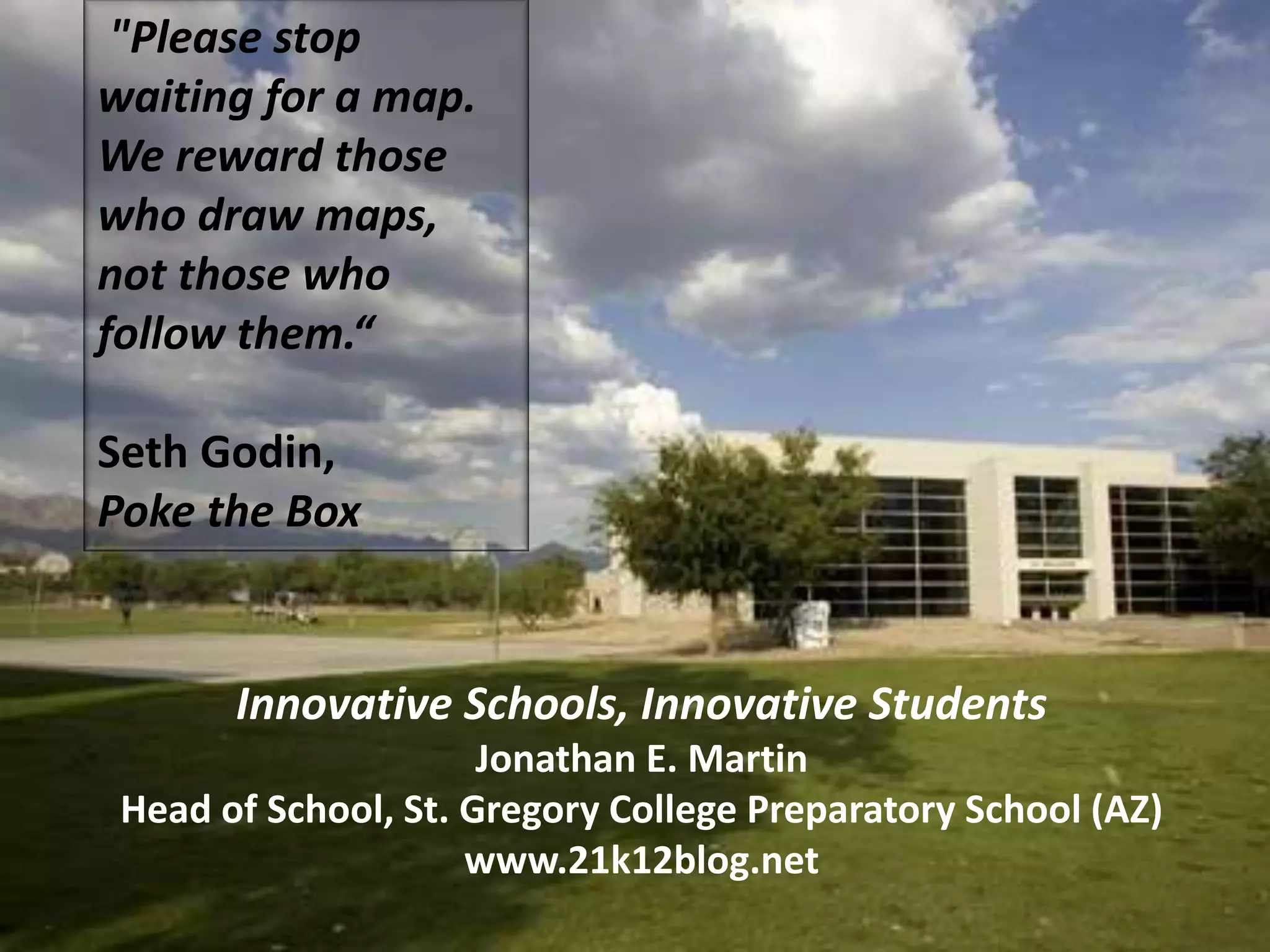
"Please stop
waiting for a map.
We reward those
who draw maps,
not those who
follow them.“

Seth Godin,
Poke the Box


       Innovative Schools, Innovative Students
                      Jonathan E. Martin
 Head of School, St. Gregory College Preparatory School (AZ)
                     www.21k12blog.net
Why Innovate?


      Why innovate?
Richard Florida: “Human
creativity is the ultimate
source of economic resource.”
My Job requires I be creative


    1977   2002
                                                 45


                      20


                       percentage strongly agreeing
                                                      Source: Jerald, Defining a
                                                      21st century education
Win the Future
Flow
“the prep school
tradition is, in
fact, traditional.”
Visiting Schools
                        The good high
                        school project
• Picture– bored kids
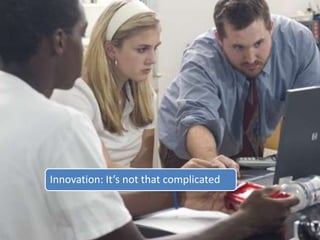
Innovation: It’s not that complicated
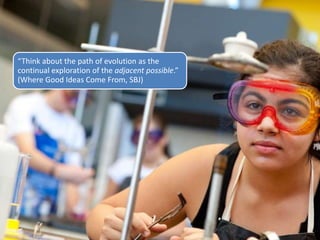
“Think about the path of evolution as the
continual exploration of the adjacent possible.”
(Where Good Ideas Come From, SBJ)
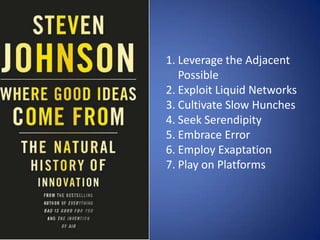
1. Leverage the Adjacent
   Possible
2. Exploit Liquid Networks
3. Cultivate Slow Hunches
4. Seek Serendipity
5. Embrace Error
6. Employ Exaptation
7. Play on Platforms
the answers to our
                       dilemmas are not to be
                       found on Twitter. They
 Solitude                  can only be found
             William        within—without
     &     Deresiewicz
Leadership                  distractions, in
                                solitude.
Twitter is a “coral reef”
for nurturing creativity.
Steven Johnson


                            only_point_five
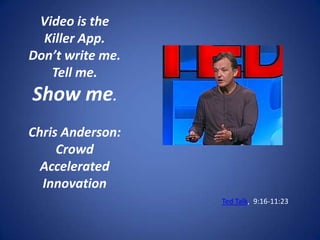
Video is the
  Killer App.
Don’t write me.
   Tell me.
Show me.
Chris Anderson:
     Crowd
  Accelerated
  Innovation
                  Ted Talk, 9:16-11:23
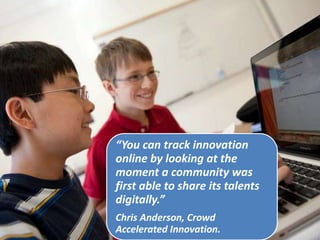
“You can track innovation
online by looking at the
moment a community was
first able to share its talents
digitally.”
Chris Anderson, Crowd
Accelerated Innovation.
6b. Reverse Instruction: Do the Flip
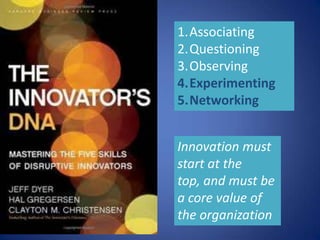
1.Associating
2.Questioning
3.Observing
4.Experimenting
5.Networking


Innovation must
start at the
top, and must be
a core value of
the organization
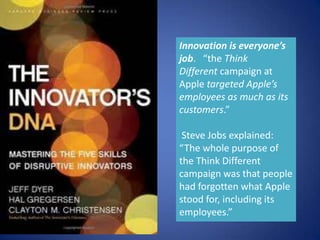
Innovation is everyone’s
job. “the Think
Different campaign at
Apple targeted Apple’s
employees as much as its
customers.”

 Steve Jobs explained:
“The whole purpose of
the Think Different
campaign was that people
had forgotten what Apple
stood for, including its
employees.”
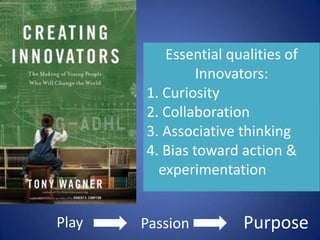
Essential qualities of
                Innovators:
       1. Curiosity
       2. Collaboration
       3. Associative thinking
       4. Bias toward action &
         experimentation


Play   Passion         Purpose
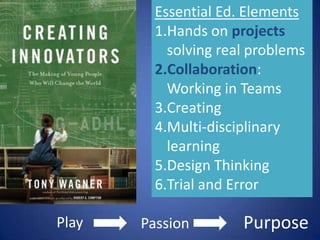
Essential Ed. Elements
         1.Hands on projects
           solving real problems
         2.Collaboration:
           Working in Teams
         3.Creating
         4.Multi-disciplinary
           learning
         5.Design Thinking
         6.Trial and Error

Play   Passion        Purpose
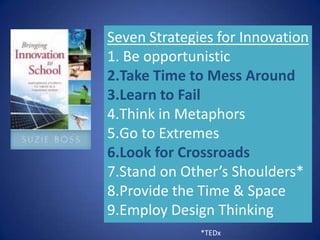
Seven Strategies for Innovation
1. Be opportunistic
2.Take Time to Mess Around
3.Learn to Fail
4.Think in Metaphors
5.Go to Extremes
6.Look for Crossroads
7.Stand on Other’s Shoulders*
8.Provide the Time & Space
9.Employ Design Thinking
              *TEDx
“Good Ideas are not
  conjured out of thin air–
they are built of a collection
   of existing parts.” (SBJ)
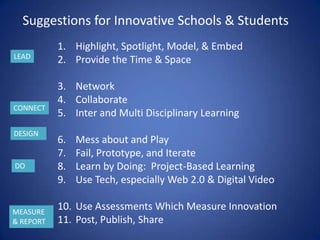
Suggestions for Innovative Schools & Students
           1. Highlight, Spotlight, Model, & Embed
LEAD
           2. Provide the Time & Space

           3. Network
           4. Collaborate
CONNECT
           5. Inter and Multi Disciplinary Learning
DESIGN
           6.   Mess about and Play
           7.   Fail, Prototype, and Iterate
DO         8.   Learn by Doing: Project-Based Learning
           9.   Use Tech, especially Web 2.0 & Digital Video

MEASURE
           10. Use Assessments Which Measure Innovation
& REPORT   11. Post, Publish, Share
Lead

                    Connect
Measure &
Report

      Do           Design
Lead
Spotlight, Highlight, Inform
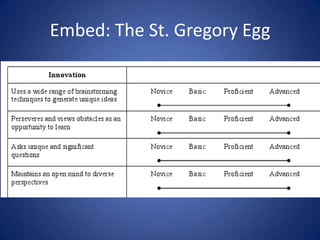
Embed: The St. Gregory Egg
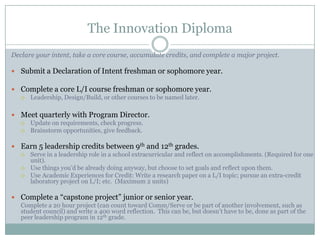
The Innovation Diploma
Declare your intent, take a core course, accumulate credits, and complete a major project.

 Submit a Declaration of Intent freshman or sophomore year.

 Complete a core L/I course freshman or sophomore year.
   Leadership, Design/Build, or other courses to be named later.


 Meet quarterly with Program Director.
   Update on requirements, check progress.
   Brainstorm opportunities, give feedback.


 Earn 5 leadership credits between 9th and 12th grades.
   Serve in a leadership role in a school extracurricular and reflect on accomplishments. (Required for one
    unit).
   Use things you’d be already doing anyway, but choose to set goals and reflect upon them.
   Use Academic Experiences for Credit: Write a research paper on a L/I topic; pursue an extra-credit
    laboratory project on L/I; etc. (Maximum 2 units)

 Complete a “capstone project” junior or senior year.
  Complete a 20 hour project (can count toward Comm/Serve or be part of another involvement, such as
  student council) and write a 400 word reflection. This can be, but doesn’t have to be, done as part of the
  peer leadership program in 12th grade.
Connect
Open the Network
No medium in history has ever offered
such unlikely trails of connection in such
an accessible form… An online
newspaper, [compared to a dead-tree
paper], is ten times more serendipitous.
(SJB)
“Environments
that block or
limit new
combinations–
by punishing
experimentation
or by obscuring
certain branches
of
possibility, will, o
n
average, genera
te and circulate
fewer
innovations than
environments
that encourage
exploration.”
SJB
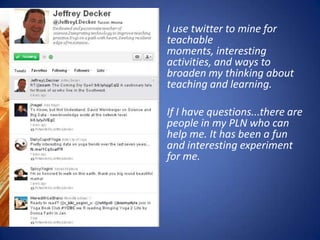
I use twitter to mine for
teachable
moments, interesting
activities, and ways to
broaden my thinking about
teaching and learning.

If I have questions...there are
people in my PLN who can
help me. It has been a fun
and interesting experiment
for me.
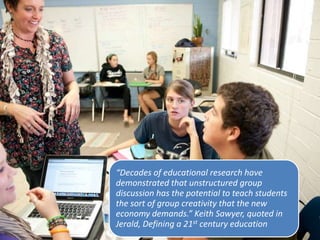
“Decades of educational research have
demonstrated that unstructured group
discussion has the potential to teach students
the sort of group creativity that the new
economy demands.” Keith Sawyer, quoted in
Jerald, Defining a 21st century education
Collaborate
Cross Disciplinary Projects
Design
Do
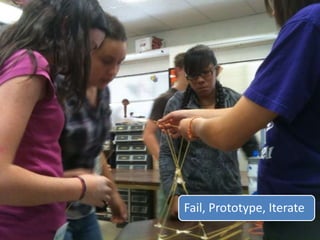
Fail, Prototype, Iterate
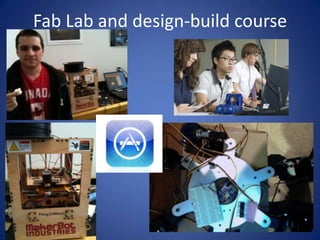
Fab Lab and design-build course
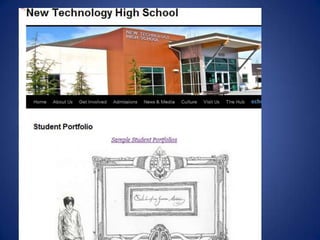
Measure, Report, Publish,
    Post, and Share
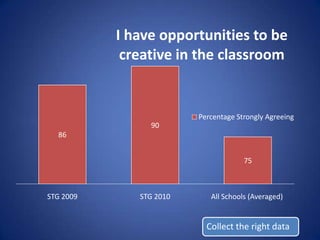
I have opportunities to be
            creative in the classroom


                         Percentage Strongly Agreeing
                90
  86


                                      75


STG 2009      STG 2010      All Schools (Averaged)


                           Collect the right data
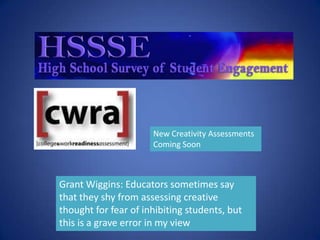
New Creativity Assessments
                      Coming Soon


Grant Wiggins: Educators sometimes say
that they shy from assessing creative
thought for fear of inhibiting students, but
this is a grave error in my view
We regularly discuss questions
    with no clear answers


                                       92
                      82
       72


   All Schools   St. Gregory 09   St. Gregory 10
What Excites & Engages Me?

All HSSSE students


                          65
                                           60
                                                              55


       28


     Lecture         Discussion and   Group Projects   Projects Involving
                         Debate                           Technology
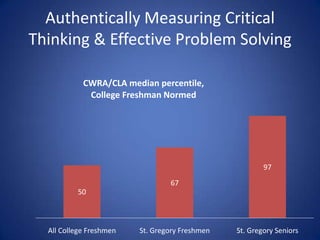
Authentically Measuring Critical
Thinking & Effective Problem Solving

            CWRA/CLA median percentile,
             College Freshman Normed


                                                        97
                                 67
          50


  All College Freshmen   St. Gregory Freshmen   St. Gregory Seniors
Video


Video

Innovative schools, innovative students for isast

  • 1.
    "Please stop waiting fora map. We reward those who draw maps, not those who follow them.“ Seth Godin, Poke the Box Innovative Schools, Innovative Students Jonathan E. Martin Head of School, St. Gregory College Preparatory School (AZ) www.21k12blog.net
  • 2.
    Why Innovate? Why innovate?
  • 3.
    Richard Florida: “Human creativityis the ultimate source of economic resource.”
  • 4.
    My Job requiresI be creative 1977 2002 45 20 percentage strongly agreeing Source: Jerald, Defining a 21st century education
  • 5.
  • 6.
  • 7.
    “the prep school traditionis, in fact, traditional.”
  • 8.
    Visiting Schools The good high school project • Picture– bored kids
  • 9.
    Innovation: It’s notthat complicated
  • 10.
    “Think about thepath of evolution as the continual exploration of the adjacent possible.” (Where Good Ideas Come From, SBJ)
  • 12.
    1. Leverage theAdjacent Possible 2. Exploit Liquid Networks 3. Cultivate Slow Hunches 4. Seek Serendipity 5. Embrace Error 6. Employ Exaptation 7. Play on Platforms
  • 13.
    the answers toour dilemmas are not to be found on Twitter. They Solitude can only be found William within—without & Deresiewicz Leadership distractions, in solitude.
  • 14.
    Twitter is a“coral reef” for nurturing creativity. Steven Johnson only_point_five
  • 15.
    Video is the Killer App. Don’t write me. Tell me. Show me. Chris Anderson: Crowd Accelerated Innovation Ted Talk, 9:16-11:23
  • 16.
    “You can trackinnovation online by looking at the moment a community was first able to share its talents digitally.” Chris Anderson, Crowd Accelerated Innovation.
  • 17.
  • 18.
  • 19.
    Innovation is everyone’s job.“the Think Different campaign at Apple targeted Apple’s employees as much as its customers.” Steve Jobs explained: “The whole purpose of the Think Different campaign was that people had forgotten what Apple stood for, including its employees.”
  • 20.
    Essential qualities of Innovators: 1. Curiosity 2. Collaboration 3. Associative thinking 4. Bias toward action & experimentation Play Passion Purpose
  • 21.
    Essential Ed. Elements 1.Hands on projects solving real problems 2.Collaboration: Working in Teams 3.Creating 4.Multi-disciplinary learning 5.Design Thinking 6.Trial and Error Play Passion Purpose
  • 23.
    Seven Strategies forInnovation 1. Be opportunistic 2.Take Time to Mess Around 3.Learn to Fail 4.Think in Metaphors 5.Go to Extremes 6.Look for Crossroads 7.Stand on Other’s Shoulders* 8.Provide the Time & Space 9.Employ Design Thinking *TEDx
  • 24.
    “Good Ideas arenot conjured out of thin air– they are built of a collection of existing parts.” (SBJ)
  • 25.
    Suggestions for InnovativeSchools & Students 1. Highlight, Spotlight, Model, & Embed LEAD 2. Provide the Time & Space 3. Network 4. Collaborate CONNECT 5. Inter and Multi Disciplinary Learning DESIGN 6. Mess about and Play 7. Fail, Prototype, and Iterate DO 8. Learn by Doing: Project-Based Learning 9. Use Tech, especially Web 2.0 & Digital Video MEASURE 10. Use Assessments Which Measure Innovation & REPORT 11. Post, Publish, Share
  • 26.
    Lead Connect Measure & Report Do Design
  • 27.
  • 29.
  • 30.
    Embed: The St.Gregory Egg
  • 31.
    The Innovation Diploma Declareyour intent, take a core course, accumulate credits, and complete a major project.  Submit a Declaration of Intent freshman or sophomore year.  Complete a core L/I course freshman or sophomore year.  Leadership, Design/Build, or other courses to be named later.  Meet quarterly with Program Director.  Update on requirements, check progress.  Brainstorm opportunities, give feedback.  Earn 5 leadership credits between 9th and 12th grades.  Serve in a leadership role in a school extracurricular and reflect on accomplishments. (Required for one unit).  Use things you’d be already doing anyway, but choose to set goals and reflect upon them.  Use Academic Experiences for Credit: Write a research paper on a L/I topic; pursue an extra-credit laboratory project on L/I; etc. (Maximum 2 units)  Complete a “capstone project” junior or senior year. Complete a 20 hour project (can count toward Comm/Serve or be part of another involvement, such as student council) and write a 400 word reflection. This can be, but doesn’t have to be, done as part of the peer leadership program in 12th grade.
  • 33.
  • 34.
  • 35.
    No medium inhistory has ever offered such unlikely trails of connection in such an accessible form… An online newspaper, [compared to a dead-tree paper], is ten times more serendipitous. (SJB)
  • 36.
    “Environments that block or limitnew combinations– by punishing experimentation or by obscuring certain branches of possibility, will, o n average, genera te and circulate fewer innovations than environments that encourage exploration.” SJB
  • 37.
    I use twitterto mine for teachable moments, interesting activities, and ways to broaden my thinking about teaching and learning. If I have questions...there are people in my PLN who can help me. It has been a fun and interesting experiment for me.
  • 38.
    “Decades of educationalresearch have demonstrated that unstructured group discussion has the potential to teach students the sort of group creativity that the new economy demands.” Keith Sawyer, quoted in Jerald, Defining a 21st century education
  • 39.
  • 40.
  • 41.
  • 42.
  • 43.
  • 46.
    Fab Lab anddesign-build course
  • 47.
  • 48.
    I have opportunitiesto be creative in the classroom Percentage Strongly Agreeing 90 86 75 STG 2009 STG 2010 All Schools (Averaged) Collect the right data
  • 49.
    New Creativity Assessments Coming Soon Grant Wiggins: Educators sometimes say that they shy from assessing creative thought for fear of inhibiting students, but this is a grave error in my view
  • 50.
    We regularly discussquestions with no clear answers 92 82 72 All Schools St. Gregory 09 St. Gregory 10
  • 51.
    What Excites &Engages Me? All HSSSE students 65 60 55 28 Lecture Discussion and Group Projects Projects Involving Debate Technology
  • 52.
    Authentically Measuring Critical Thinking& Effective Problem Solving CWRA/CLA median percentile, College Freshman Normed 97 67 50 All College Freshmen St. Gregory Freshmen St. Gregory Seniors
  • 54.

Editor's Notes

  • #5 Economics, yes, though I know this bothers people. But what I love is that the things I want for our students anyway, creativity and innovative problem solving, are what the economy wants too– what a win-win combination. Dan Pink’s book Whole New Mind first revealed this to me, and I am forever in his debt.But not just for economics.
  • #6 Hate the phrase? Many do, I am not sure if I do. But hate the phrase or not, Obama and Friedman are right– We are in a battle (we always have been, and probably always will be), a battle fierce challenges to making the world a better place– and the only way we can possibly win this battle, and win a more positive future, is by identifying better ways of doing things– by innovation.
  • #7 We know from Chick sent me hi that flow is the greatest source of happiness and fulfillment, and we know from him too that creativity and innovation is a terrific source of happiness.
  • #8 But independent schools are often not innovativeJust show the quote
  • #9 It was my own experience, visiting 21 schools in the fall of 2008, that the independent schools were far less innovative.
  • #10 We can daunt ourselves if we think it only something that happens in the most expensive R&D labs–
  • #11 It lies instead in the “adjacent possible.” SJ
  • #12 What is exciting is how many great and accessible thinkers there are right now to inspire and inform us: including Dan Pink, the Heath brothers, Carol Dweck, and for me especially Steven Johnson and Chris Anderson of TED. However, we can’t teach it. We can only create cultures which make it more possible.
  • #14 Some disagree. This essay in the American Scholar last year received a lot of attention, and has been much cited. Read the quote. I think he is so wrong– not to say that solitude is a bad thing, but to say that the answers can only be found within– I can’t begin to accept.
  • #16 The sharing of ideas in general is often best done through direct speech—we’ve evolved over eons to subconsciously grasp the subtleties of a face-to-face conversation. In all these cases, for remote audiences video is the killer app. Don’t write me. Tell me. Show me.
  • #25 I want to share with you 7 “existing parts” we have available to us in our schools by which we can better build good ideas. These 8 are not at all limiting; there are certainly many others. I should warn you that only a few are specifically technology related, but that is OK, because I think technologydirectors are, more than anyone else in our schools, our innovation directors generally, even if they lack that name. I am only going to offer a few specific suggestions, but I am going to ask you to consider for yourself applications, and then on my blog I am posting a set of slides of the implications.
  • #29 We’ve made it a priority for our school in the way we think about and talk about ourselves, and I myself as Head of School make it job one.
  • #35 Go 1:1.
  • #37 Also a major theme of Christensen’s– to be more innovative we must plug into networks, help our teachers and students plug into networksSuzie Boss also writes about Looking for the crossroads and standing on shoulders
  • #40 http://www.flickr.com/photos/sbeez/6537134617/sizes/l/in/photostream/
  • #44 How many people have done the marshmallow challenge? It so fascinating.
  • #55 On an ending note, I want to share a short video from a new course we are offering at St. Gregory, Design Build Te ch Innovation.