Out of the Starting Gate: Preparing for a Year of Hands-On,  Brains-On Mathematics Cranbrook, August 27, 2009
Summer Institute Presenters Sally McLean  -  Numeracy Facilitator, School District 10 Denise Flick  -  Curriculum Coordinator, School District 20
Learning Intentions for Today Connect to the new pedagogy; Reconnect to the IRP; Investigate rich tasks and problems; Become familiar with the YMAW resources; Consider ways to plan math lessons; Discover relevant games and activities; Get revved up for the new school year.
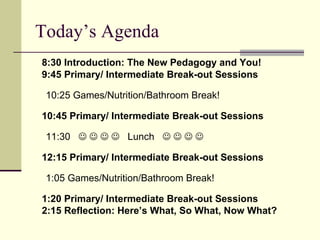
Today’s Agenda 8:30 Introduction: The New Pedagogy and You! 9:45 Primary/ Intermediate Break-out Sessions 10:25 Games/Nutrition/Bathroom Break! 10:45 Primary/ Intermediate Break-out Sessions 11:30              Lunch              12:15 Primary/ Intermediate Break-out Sessions 1:05 Games/Nutrition/Bathroom Break! 1:20 Primary/ Intermediate Break-out Sessions 2:15 Reflection: Here’s What, So What, Now What?
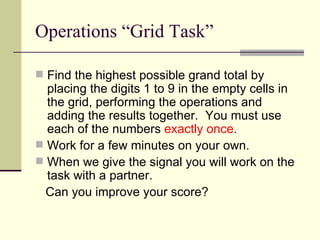
Operations “Grid Task” Find the highest possible grand total by placing the digits 1 to 9 in the empty cells in the grid, performing the operations and adding the results together.  You must use each of the numbers  exactly once . Work for a few minutes on your own. When we give the signal you will work on the task with a partner.  Can you improve your score?
Reflection How is starting a lesson with a task like this the same or different from what you have been doing with your students? How does a “rich task” such as this effect how kids feel and think about Math? How is this task differentiated? How could it be differentiated further?
Mathematical Processes (from our IRP) Students are expected to: Communicate in order to learn and express their understanding. Connect mathematical ideas to other concepts in mathematics, to everyday experiences and to other disciplines. Demonstrate fluency with mental mathematics and estimation. Develop and apply new mathematical knowledge through problem solving .
Mathematical Processes (cont.) Develop mathematical reasoning. Select and use technologies as tools for learning and solving problems. Develop visualization skills to assist in processing information, making connections and solving problems. These are critical components that students must encounter in a mathematics program in order to achieve the goals of mathematics education and encourage lifelong learning in mathematics.
Which of these processes did the Grid Task address? Communication Mental mathematics and estimation Problem solving
Begin with a “Rich Learning Task” Rich problems are: Interesting – students are engaged; Vehicles for “authenticity” – a real reason for doing math;  Opportunities for communication; Opportunities for thinking and “thinking about thinking”.
The New Pedagogy Changes were originally developed by the WNCP (Western and Northern Canadian Protocol for Collaboration in Education)  Groups from 4 Western provinces and 3 territories collaborated for 15 years to develop common curriculum and common learning outcomes. Led by Alberta, the revisions were based on international research in mathematics learning. Special attention was paid to exactly when students are developmentally best prepared to learn specific math concepts.
Thinning Out of Curriculum The “old” curriculum was criticized for being “a mile wide and an inch deep”. One of the most significant changes was to reduce the number of topics to aim for “deeper learning”.
Numerate Students “A Numerate student is someone who is able to use whatever skills they have available to solve whatever problem is at hand.”
Primary and intermediate  break-out sessions  begin at 9:45! (We will all meet again at 2:15)
End of the Day Reflections Here’s what! So what? Now what?
Here’s what! What stands out in your mind? So what? What was your “shift” in thinking about math?  What do you want to learn more about? Now what? What will you do in September in your classroom to use what you learned?

Summer Math Whole Group Sessions

  • 1.
    Out of theStarting Gate: Preparing for a Year of Hands-On, Brains-On Mathematics Cranbrook, August 27, 2009
  • 2.
    Summer Institute PresentersSally McLean - Numeracy Facilitator, School District 10 Denise Flick - Curriculum Coordinator, School District 20
  • 3.
    Learning Intentions forToday Connect to the new pedagogy; Reconnect to the IRP; Investigate rich tasks and problems; Become familiar with the YMAW resources; Consider ways to plan math lessons; Discover relevant games and activities; Get revved up for the new school year.
  • 4.
    Today’s Agenda 8:30Introduction: The New Pedagogy and You! 9:45 Primary/ Intermediate Break-out Sessions 10:25 Games/Nutrition/Bathroom Break! 10:45 Primary/ Intermediate Break-out Sessions 11:30     Lunch     12:15 Primary/ Intermediate Break-out Sessions 1:05 Games/Nutrition/Bathroom Break! 1:20 Primary/ Intermediate Break-out Sessions 2:15 Reflection: Here’s What, So What, Now What?
  • 5.
    Operations “Grid Task”Find the highest possible grand total by placing the digits 1 to 9 in the empty cells in the grid, performing the operations and adding the results together. You must use each of the numbers exactly once . Work for a few minutes on your own. When we give the signal you will work on the task with a partner. Can you improve your score?
  • 6.
    Reflection How isstarting a lesson with a task like this the same or different from what you have been doing with your students? How does a “rich task” such as this effect how kids feel and think about Math? How is this task differentiated? How could it be differentiated further?
  • 7.
    Mathematical Processes (fromour IRP) Students are expected to: Communicate in order to learn and express their understanding. Connect mathematical ideas to other concepts in mathematics, to everyday experiences and to other disciplines. Demonstrate fluency with mental mathematics and estimation. Develop and apply new mathematical knowledge through problem solving .
  • 8.
    Mathematical Processes (cont.)Develop mathematical reasoning. Select and use technologies as tools for learning and solving problems. Develop visualization skills to assist in processing information, making connections and solving problems. These are critical components that students must encounter in a mathematics program in order to achieve the goals of mathematics education and encourage lifelong learning in mathematics.
  • 9.
    Which of theseprocesses did the Grid Task address? Communication Mental mathematics and estimation Problem solving
  • 10.
    Begin with a“Rich Learning Task” Rich problems are: Interesting – students are engaged; Vehicles for “authenticity” – a real reason for doing math; Opportunities for communication; Opportunities for thinking and “thinking about thinking”.
  • 11.
    The New PedagogyChanges were originally developed by the WNCP (Western and Northern Canadian Protocol for Collaboration in Education) Groups from 4 Western provinces and 3 territories collaborated for 15 years to develop common curriculum and common learning outcomes. Led by Alberta, the revisions were based on international research in mathematics learning. Special attention was paid to exactly when students are developmentally best prepared to learn specific math concepts.
  • 12.
    Thinning Out ofCurriculum The “old” curriculum was criticized for being “a mile wide and an inch deep”. One of the most significant changes was to reduce the number of topics to aim for “deeper learning”.
  • 13.
    Numerate Students “ANumerate student is someone who is able to use whatever skills they have available to solve whatever problem is at hand.”
  • 14.
    Primary and intermediate break-out sessions begin at 9:45! (We will all meet again at 2:15)
  • 15.
    End of theDay Reflections Here’s what! So what? Now what?
  • 16.
    Here’s what! Whatstands out in your mind? So what? What was your “shift” in thinking about math? What do you want to learn more about? Now what? What will you do in September in your classroom to use what you learned?

Editor's Notes

  • #7 Rich task empowers kids, motivates them. They become excited about learning Math. Gets kids “thinking”.
  • #8 “So what is this about?” The IRP lays out these “underlying” thinking processes to keep in mind when planning lessons. They are referred to in all tasks. Which ones were used in the grid task?
  • #10 If students have already been given ways to solve a problem, it is not a problem, it is practice (BC IRP)
  • #12 This is bit of background to the creation of the new IRP’s.
  • #14 Break into K to 4 and 4 to 9 Grade 4’s have a choice.
  • #16 Here’s what Summary So what is there a shift a new idea to try Now what the action plan Use the black line master sheet.