


The STEM Innovation Equation
9 keys to Improving STEM Education in the Global
                    Economy

   NSTA National Conference, April 12, 2013


     Diana Laboy-Rush, STEM Education Consultant
Introduction
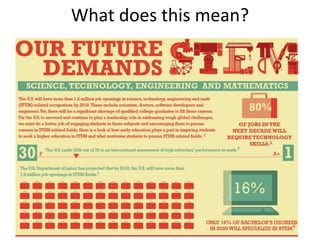
What does this mean?


Source: The Global Achievement Gap, Dr. Tony Wagner
The Global Achievement Gap
7 Critical Skills Students Need for their
                   Future
1.   Critical Thinking and Problem Solving Skills
2.   Collaboration and Leading with Influence
3.   Agility and Adaptability
4.   Initiative and Entrepreneurialism
5.   Effective Oral and Written Communication
6.   Accessing and Analyzing Information
7.   Curiosity and Imagination


     Source: The Global Achievement Gap, Dr. Tony Wagner
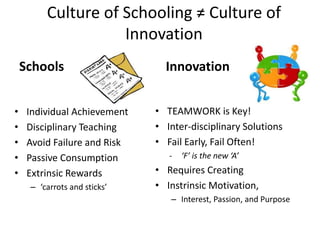
Culture of Schooling ≠ Culture of
                    Innovation
    Schools                     Innovation


•    Individual Achievement   • TEAMWORK is Key!
•    Disciplinary Teaching    • Inter-disciplinary Solutions
•    Avoid Failure and Risk   • Fail Early, Fail Often!
•    Passive Consumption         -   ‘F’ is the new ‘A’

•    Extrinsic Rewards        • Requires Creating
     – ‘carrots and sticks’   • Instrinsic Motivation,
                                 – Interest, Passion, and Purpose
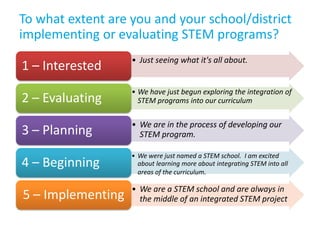
To what extent are you and your school/district
implementing or evaluating STEM programs?
                   • Just seeing what it's all about.
1 – Interested
                   • We have just begun exploring the integration of
2 – Evaluating       STEM programs into our curriculum


                   • We are in the process of developing our
3 – Planning         STEM program.

                   • We were just named a STEM school. I am excited
4 – Beginning        about learning more about integrating STEM into all
                     areas of the curriculum.

                   • We are a STEM school and are always in
5 – Implementing     the middle of an integrated STEM project
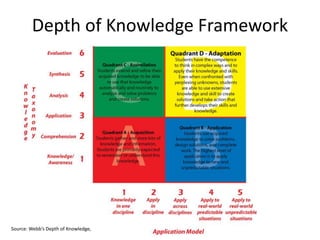
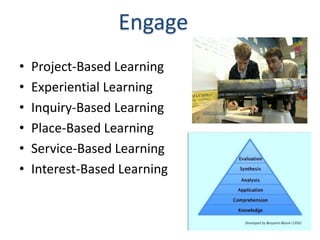
Depth of Knowledge Framework


Source: Webb’s Depth of Knowledge,
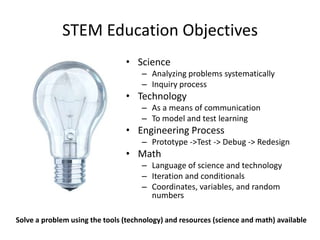
STEM Education Objectives
                                • Science
                                     – Analyzing problems systematically
                                     – Inquiry process
                                • Technology
                                     – As a means of communication
                                     – To model and test learning
                                • Engineering Process
                                     – Prototype ->Test -> Debug -> Redesign
                                • Math
                                     – Language of science and technology
                                     – Iteration and conditionals
                                     – Coordinates, variables, and random
                                       numbers

Solve a problem using the tools (technology) and resources (science and math) available
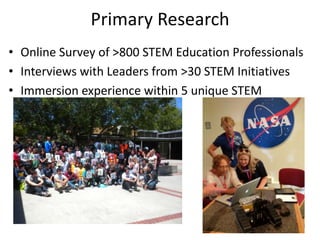
Primary Research
• Online Survey of >800 STEM Education Professionals
• Interviews with Leaders from >30 STEM Initiatives
• Immersion experience within 5 unique STEM
  programs
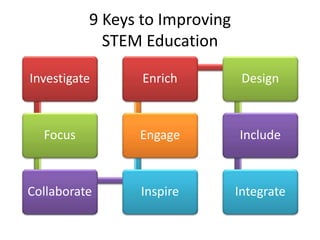
9 Keys to Improving
            STEM Education

Investigate      Enrich          Design


  Focus         Engage          Include


Collaborate     Inspire         Integrate
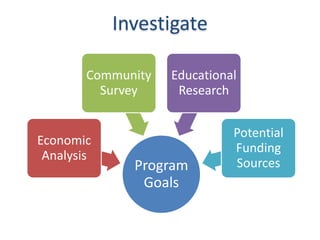
Investigate

        Community   Educational
          Survey     Research


                              Potential
Economic
                              Funding
 Analysis
              Program         Sources
               Goals
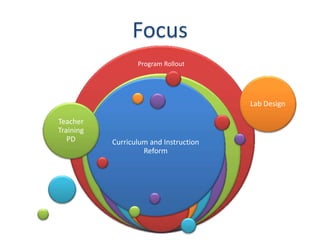
Focus
                  Program Rollout


                  Teacher Training
                       (PD)
                                        Lab Design
                  Interdisciplinary
Teacher                Design
Training
   PD      Curriculum and Instruction
                    Curriculum /
                    Reform
                     Lab Design

                    Goals / Eval
                      Design


                      Advisory
                       Board
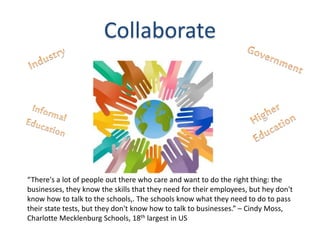
Collaborate


“There's a lot of people out there who care and want to do the right thing: the
businesses, they know the skills that they need for their employees, but hey don't
know how to talk to the schools,. The schools know what they need to do to pass
their state tests, but they don't know how to talk to businesses.” – Cindy Moss,
Charlotte Mecklenburg Schools, 18th largest in US
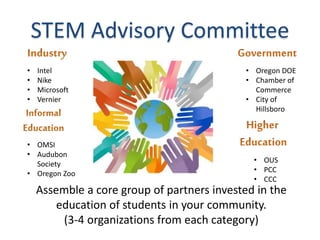
STEM Advisory Committee
•   Intel                                    • Oregon DOE
•   Nike                                     • Chamber of
•   Microsoft                                  Commerce
•   Vernier                                  • City of
                                               Hillsboro


• OMSI
• Audubon
  Society                                     • OUS
• Oregon Zoo                                  • PCC
                                              • CCC
    Assemble a core group of partners invested in the
        education of students in your community.
         (3-4 organizations from each category)
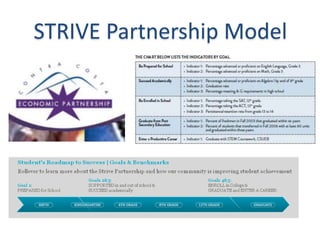
STRIVE Partnership Model
Inspire
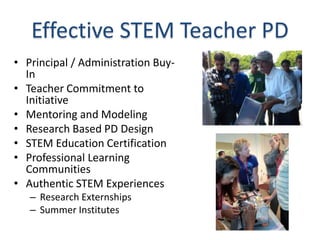
Effective STEM Teacher PD
• Principal / Administration Buy-
  In
• Teacher Commitment to
  Initiative
• Mentoring and Modeling
• Research Based PD Design
• STEM Education Certification
• Professional Learning
  Communities
• Authentic STEM Experiences
   – Research Externships
   – Summer Institutes
Engage
•   Project-Based Learning
•   Experiential Learning
•   Inquiry-Based Learning
•   Place-Based Learning
•   Service-Based Learning
•   Interest-Based Learning
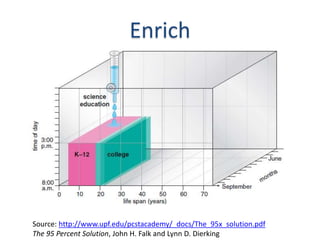
Enrich


Source: http://www.upf.edu/pcstacademy/_docs/The_95x_solution.pdf
The 95 Percent Solution, John H. Falk and Lynn D. Dierking
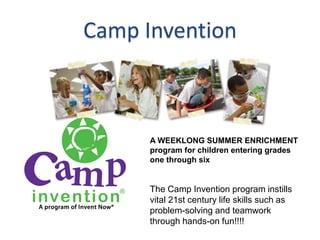
Camp Invention


      A WEEKLONG SUMMER ENRICHMENT
      program for children entering grades
      one through six


      The Camp Invention program instills
      vital 21st century life skills such as
      problem-solving and teamwork
      through hands-on fun!!!!
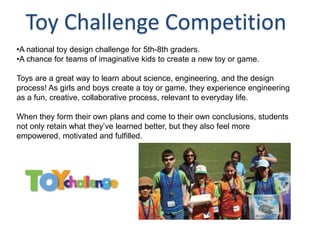
Toy Challenge Competition
•A national toy design challenge for 5th-8th graders.
•A chance for teams of imaginative kids to create a new toy or game.

Toys are a great way to learn about science, engineering, and the design
process! As girls and boys create a toy or game, they experience engineering
as a fun, creative, collaborative process, relevant to everyday life.

When they form their own plans and come to their own conclusions, students
not only retain what they’ve learned better, but they also feel more
empowered, motivated and fulfilled.
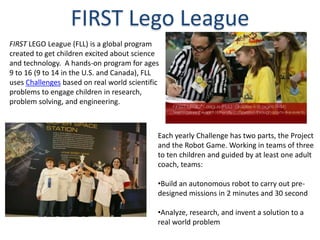
FIRST Lego League
FIRST LEGO League (FLL) is a global program
created to get children excited about science
and technology. A hands-on program for ages
9 to 16 (9 to 14 in the U.S. and Canada), FLL
uses Challenges based on real world scientific
problems to engage children in research,
problem solving, and engineering.


                                             Each yearly Challenge has two parts, the Project
                                             and the Robot Game. Working in teams of three
                                             to ten children and guided by at least one adult
                                             coach, teams:

                                             •Build an autonomous robot to carry out pre-
                                             designed missions in 2 minutes and 30 second

                                             •Analyze, research, and invent a solution to a
                                             real world problem
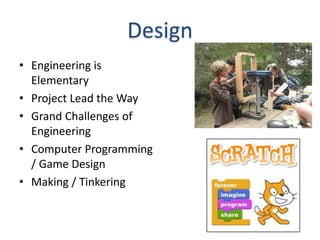
Design
• Engineering is
  Elementary
• Project Lead the Way
• Grand Challenges of
  Engineering
• Computer Programming
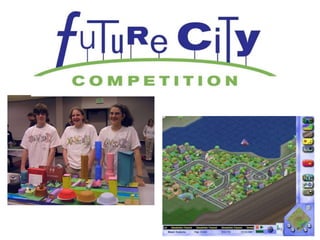
  / Game Design
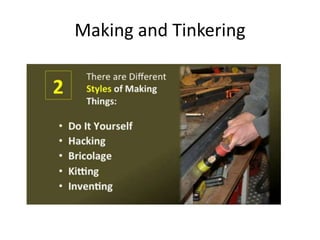
• Making / Tinkering
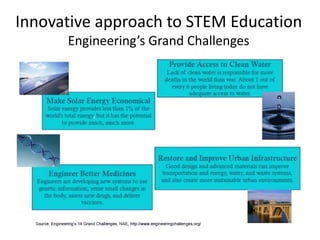
Innovative approach to STEM Education
      Engineering’s Grand Challenges
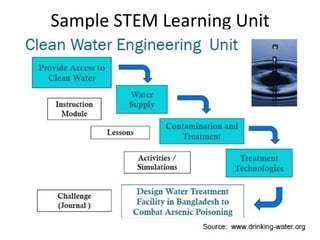
Sample STEM Learning Unit
Making and Tinkering
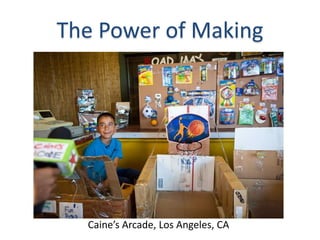
The Power of Making


  Caine’s Arcade, Los Angeles, CA
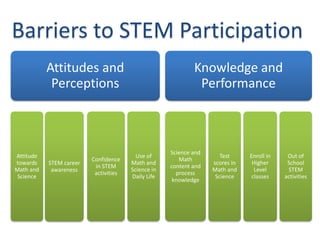
Barriers to STEM Participation
           Attitudes and                                    Knowledge and
            Perceptions                                      Performance


                                                    Science and
Attitude                                 Use of                      Test     Enroll in    Out of
                         Confidence                    Math
towards    STEM career                 Math and                   scores in    Higher      School
                          in STEM                   content and
Math and    awareness                  Science in                 Math and      Level      STEM
                          activities                  process
 Science                               Daily Life                  Science     classes    activities
                                                     knowledge
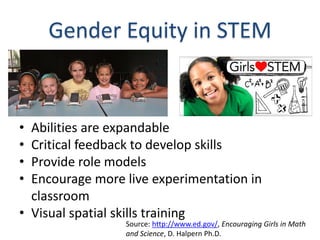
Gender Equity in STEM


• Abilities are expandable
• Critical feedback to develop skills
• Provide role models
• Encourage more live experimentation in
  classroom
• Visual spatial skills training
                 Source: http://www.ed.gov/, Encouraging Girls in Math
                 and Science, D. Halpern Ph.D.
Integration
Book Release Date: Nov/Dec 2013
                • Pre-orders : Early
                  Oct.
                • 25% discount for
                  attendees today
Any Questions?
How to contact me:
           Diana Laboy-Rush
        dlaboyrush@gmail.com
http://educatetoinnovatewithstem.com
 http://facebook.com/PortlandWizKid
       Twitter: @AuthenticSTEM

Presentation on Slideshare: dlaboyrush

The stem innovation equation nsta

  • 1.
    The STEM InnovationEquation 9 keys to Improving STEM Education in the Global Economy NSTA National Conference, April 12, 2013 Diana Laboy-Rush, STEM Education Consultant
  • 2.
  • 3.
    What does thismean? Source: The Global Achievement Gap, Dr. Tony Wagner
  • 4.
  • 5.
    7 Critical SkillsStudents Need for their Future 1. Critical Thinking and Problem Solving Skills 2. Collaboration and Leading with Influence 3. Agility and Adaptability 4. Initiative and Entrepreneurialism 5. Effective Oral and Written Communication 6. Accessing and Analyzing Information 7. Curiosity and Imagination Source: The Global Achievement Gap, Dr. Tony Wagner
  • 6.
    Culture of Schooling≠ Culture of Innovation Schools Innovation • Individual Achievement • TEAMWORK is Key! • Disciplinary Teaching • Inter-disciplinary Solutions • Avoid Failure and Risk • Fail Early, Fail Often! • Passive Consumption - ‘F’ is the new ‘A’ • Extrinsic Rewards • Requires Creating – ‘carrots and sticks’ • Instrinsic Motivation, – Interest, Passion, and Purpose
  • 7.
    To what extentare you and your school/district implementing or evaluating STEM programs? • Just seeing what it's all about. 1 – Interested • We have just begun exploring the integration of 2 – Evaluating STEM programs into our curriculum • We are in the process of developing our 3 – Planning STEM program. • We were just named a STEM school. I am excited 4 – Beginning about learning more about integrating STEM into all areas of the curriculum. • We are a STEM school and are always in 5 – Implementing the middle of an integrated STEM project
  • 8.
    Depth of KnowledgeFramework Source: Webb’s Depth of Knowledge,
  • 9.
    STEM Education Objectives • Science – Analyzing problems systematically – Inquiry process • Technology – As a means of communication – To model and test learning • Engineering Process – Prototype ->Test -> Debug -> Redesign • Math – Language of science and technology – Iteration and conditionals – Coordinates, variables, and random numbers Solve a problem using the tools (technology) and resources (science and math) available
  • 10.
    Primary Research • OnlineSurvey of >800 STEM Education Professionals • Interviews with Leaders from >30 STEM Initiatives • Immersion experience within 5 unique STEM programs
  • 11.
    9 Keys toImproving STEM Education Investigate Enrich Design Focus Engage Include Collaborate Inspire Integrate
  • 12.
    Investigate Community Educational Survey Research Potential Economic Funding Analysis Program Sources Goals
  • 13.
    Focus Program Rollout Teacher Training (PD) Lab Design Interdisciplinary Teacher Design Training PD Curriculum and Instruction Curriculum / Reform Lab Design Goals / Eval Design Advisory Board
  • 14.
    Collaborate “There's a lotof people out there who care and want to do the right thing: the businesses, they know the skills that they need for their employees, but hey don't know how to talk to the schools,. The schools know what they need to do to pass their state tests, but they don't know how to talk to businesses.” – Cindy Moss, Charlotte Mecklenburg Schools, 18th largest in US
  • 15.
    STEM Advisory Committee • Intel • Oregon DOE • Nike • Chamber of • Microsoft Commerce • Vernier • City of Hillsboro • OMSI • Audubon Society • OUS • Oregon Zoo • PCC • CCC Assemble a core group of partners invested in the education of students in your community. (3-4 organizations from each category)
  • 16.
  • 17.
  • 18.
    Effective STEM TeacherPD • Principal / Administration Buy- In • Teacher Commitment to Initiative • Mentoring and Modeling • Research Based PD Design • STEM Education Certification • Professional Learning Communities • Authentic STEM Experiences – Research Externships – Summer Institutes
  • 19.
    Engage • Project-Based Learning • Experiential Learning • Inquiry-Based Learning • Place-Based Learning • Service-Based Learning • Interest-Based Learning
  • 20.
  • 21.
    Camp Invention A WEEKLONG SUMMER ENRICHMENT program for children entering grades one through six The Camp Invention program instills vital 21st century life skills such as problem-solving and teamwork through hands-on fun!!!!
  • 22.
    Toy Challenge Competition •Anational toy design challenge for 5th-8th graders. •A chance for teams of imaginative kids to create a new toy or game. Toys are a great way to learn about science, engineering, and the design process! As girls and boys create a toy or game, they experience engineering as a fun, creative, collaborative process, relevant to everyday life. When they form their own plans and come to their own conclusions, students not only retain what they’ve learned better, but they also feel more empowered, motivated and fulfilled.
  • 23.
    FIRST Lego League FIRSTLEGO League (FLL) is a global program created to get children excited about science and technology. A hands-on program for ages 9 to 16 (9 to 14 in the U.S. and Canada), FLL uses Challenges based on real world scientific problems to engage children in research, problem solving, and engineering. Each yearly Challenge has two parts, the Project and the Robot Game. Working in teams of three to ten children and guided by at least one adult coach, teams: •Build an autonomous robot to carry out pre- designed missions in 2 minutes and 30 second •Analyze, research, and invent a solution to a real world problem
  • 25.
    Design • Engineering is Elementary • Project Lead the Way • Grand Challenges of Engineering • Computer Programming / Game Design • Making / Tinkering
  • 26.
    Innovative approach toSTEM Education Engineering’s Grand Challenges
  • 27.
  • 29.
  • 30.
    The Power ofMaking Caine’s Arcade, Los Angeles, CA
  • 31.
    Barriers to STEMParticipation Attitudes and Knowledge and Perceptions Performance Science and Attitude Use of Test Enroll in Out of Confidence Math towards STEM career Math and scores in Higher School in STEM content and Math and awareness Science in Math and Level STEM activities process Science Daily Life Science classes activities knowledge
  • 32.
    Gender Equity inSTEM • Abilities are expandable • Critical feedback to develop skills • Provide role models • Encourage more live experimentation in classroom • Visual spatial skills training Source: http://www.ed.gov/, Encouraging Girls in Math and Science, D. Halpern Ph.D.
  • 33.
  • 34.
    Book Release Date:Nov/Dec 2013 • Pre-orders : Early Oct. • 25% discount for attendees today
  • 35.
  • 36.
    How to contactme: Diana Laboy-Rush dlaboyrush@gmail.com http://educatetoinnovatewithstem.com http://facebook.com/PortlandWizKid Twitter: @AuthenticSTEM Presentation on Slideshare: dlaboyrush