

STEM Demystified
Agenda
• Understand the importance of STEM education.
• Practice the four Cs of learning: collaboration, communication, critical
thinking, and creativity.
• Collect best practices to create good and inexpensive (many free) STEM
lessons.
• Teach 21st Century skills without technology.
• Learn strategies (e.g., productive struggle) to creatively solve real-world
problems.
• Assess the success of your activities.
STEM activities help students to move beyond simple test
performance and focuses on developing higher-level thinking
skills by connecting classroom learning to the real-world.
The United States is ranked below many industrialized nations in
Science and Mathematics. Consequently, it will become more
difficult to compete globally unless we focus on integrating STEM
activities into all our coursework and workshops. (Pew Research)
STE M Demystified
a
^
Source: http://goo.gl/mSPViJ
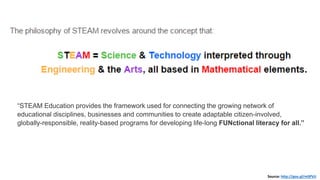
“STEAM Education provides the framework used for connecting the growing network of
educational disciplines, businesses and communities to create adaptable citizen-involved,
globally-responsible, reality-based programs for developing life-long FUNctional literacy for all.”
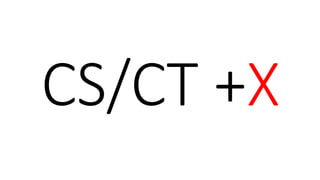
CS/CT +X
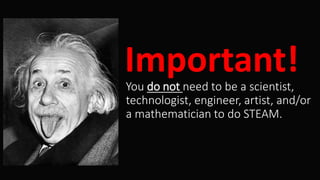
You do not need to be a scientist,
technologist, engineer, artist, and/or
a mathematician to do STEAM.
Important!
Four Cs of Learning:
•Critical Thinking
•Communication
•Collaboration
•Creativity.
Critical Thinking
• Reason Effectively
• Use various types of reasoning (inductive, deductive, etc.) as appropriate to the situation.
• Use Systems Thinking
• Analyze how parts of a whole interact with each other to produce overall outcomes in
complex systems.
• Make Judgments and Decisions
• Effectively analyze and evaluate evidence, arguments, claims, and beliefs.
• Analyze and evaluate major alternative points of view.
• Synthesize and make connections between information and arguments.
• Interpret information and draw conclusions based on the best analysis.
• Reflect critically on learning experiences and processes.
• Solve Problems
• Solve different kinds of unfamiliar problems in both conventional and innovative ways.
• Identify and ask significant questions that clarify various points of view and lead to better
solutions.
Source: https://goo.gl/5ydlz
Communicate Clearly
• Articulate thoughts and ideas effectively using oral, written, and nonverbal
communication skills in a variety of forms and contexts.
• Listen effectively to decipher meaning, including knowledge, values, attitudes,
and intentions.
• Use communication for a range of purposes (e.g. to inform, instruct, motivate,
and persuade).
• Use multiple media and technologies, and know how to assess impact and
their effectiveness a priori.
• Communicate effectively in diverse environments (including multilingual and
multicultural).
Source: https://goo.gl/5ydlz
Collaborate with Others
• Demonstrate ability to work effectively and respectfully with diverse teams.
• Exercise flexibility and willingness to be helpful in making necessary compromises
to accomplish a common goal.
• Assume shared responsibility for collaborative work, and value the individual
contributions made by each team member.
• Check out the GLOBE Program: https://www.globe.gov/.
• Have fun doing the Marshmallow Challenge: www.marshmallowchallenge.com.
Source: https://goo.gl/5ydlz
• Think Creatively
• Use a wide range of idea creation techniques (such as brainstorming).
• Create new and worthwhile ideas (both incremental and radical concepts).
• Elaborate, refine, analyze, and evaluate original ideas to improve and maximize
creative efforts.
• Work Creatively with Others
• Develop, implement, and communicate new ideas to others effectively.
• Be open and responsive to new and diverse perspectives; incorporate group input and
feedback into the work.
• Demonstrate originality and inventiveness in work and understand the real world
limits to adopting new ideas.
• View failure as an opportunity to learn; understand that creativity and innovation are
part of a long-term, cyclical process of small successes and frequent mistakes
• Implement Innovation
• Act on creative ideas to make a tangible and useful contribution to the field in which
the innovation will occur.
Creativity and Innovation
Source: https://goo.gl/5ydlz
https://goo.gl/5ydlz
Learn some great ways to
integrate the 4 C’s into your
library programs/classrooms.
“The future belongs to a very different kind of person with a very
different kind of mind—creators and empathizers, pattern
recognizers and meaning makers. These people…will now reap
society’s richest rewards and share its greatest joys.”
~ Daniel Pink
Best practices for creating good STEM lessons
A good STEM lesson:
• Presents a real-world and interesting open-ended problem.
• Allows for several acceptable solutions for the problem.
• Integrates and applies grade-level content in science and math.
• Expects students to work/communicate in productive teams to solve the
problem.
• Uses the Engineering Design Process approach for solving problems.
Source: https://goo.gl/Y9D75g
Engineering Design Process
EDP gives students a way to think systematically about solving problems.
1. Define problem[s],
2. Conduct research (Information Literacy/Transliteracy),
3. Discuss multiple ideas for solutions,
4. Develop and create a device or prototype, and then
5. Test, evaluate, and redesign.
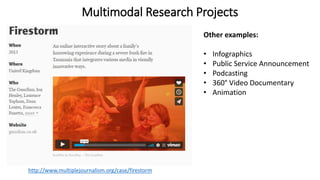
Multimodal Research Projects
http://www.multiplejournalism.org/case/firestorm
Other examples:
• Infographics
• Public Service Announcement
• Podcasting
• 360° Video Documentary
• Animation
A good STEM lesson continued:
• Includes technology that adds value and enhances learning.
• Supports a teaching process that is inquiry-based, hands-on, and student-centered.
• Requires students to design and create a model or prototype of the solution.
• Provides quality time to think critically, creatively, and innovatively and to test their
solutions, evaluate the results, and redesign if needed.
• It is encouraged to fail and make mistakes. It is a positive step toward discovering and
designing solutions.
Source: https://goo.gl/Y9D75g
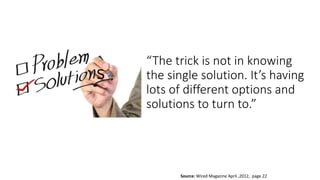
“The trick is not in knowing
the single solution. It’s having
lots of different options and
solutions to turn to.”
Source: Wired Magazine April ,2012, page 22
S
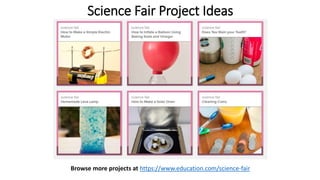
Science Fair Project Ideas
Browse more projects at https://www.education.com/science-fair
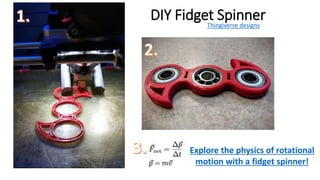
Explore the physics of rotational
motion with a fidget spinner!
DIY Fidget SpinnerThingiverse designs
http://www.ala.org/alsc/curiositycreates
Want a copy of our grant? Please send an email to
mairn.chad@spcollege.edu and I’ll send you a copy.
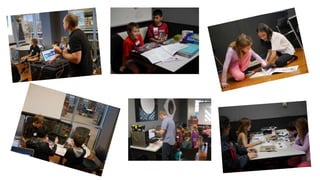
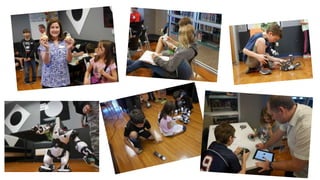
Maker workshops
• Video Game Design (3 sessions, 4 ½ hours)
• 3D Design/Printing (3 sessions, 4 ½ hours)
• Fun With Electronics/Circuitry (3 sessions, 4 ½ hours)
• Introduction to Robotics (3 sessions, 4 ½ hours)
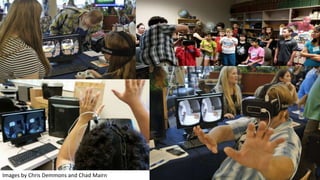
• Virtual Reality (3 sessions, 4 ½ hours)
• Video Editing for Film (3 sessions, 4 ½ hours)
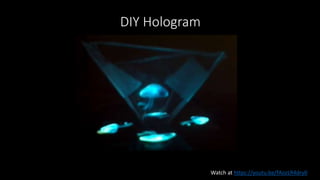
DIY Hologram
Watch at https://youtu.be/fAozLR4dry0
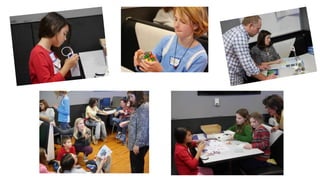
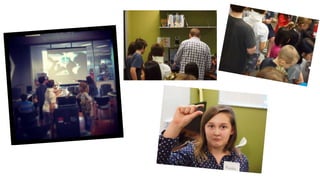
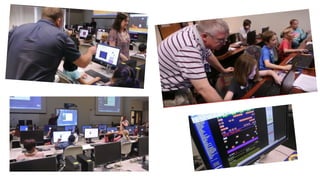
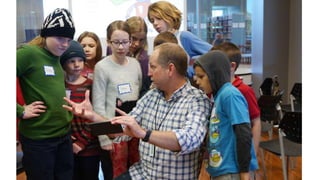
Images by Chris Demmons and Chad Mairn
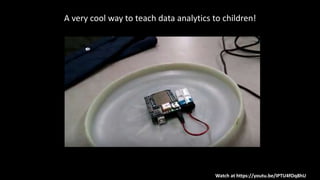
A very cool way to teach data analytics to children!
Watch at https://youtu.be/IPTU4fOq8hU
Teach 21st Century skills without technology
- practical application of knowledge especially in a
particular area (e.g., medical technology).
Technology?
Read more at https://goo.gl/OBWCHW
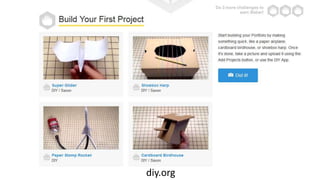
Some of my favorites are:
Understanding Pi with String Art
Learning about ant colonies with Tape Resist Art
Exploring Cameras with Flashlight Painting
DIY Flying Whirly Copter Toy
diy.org
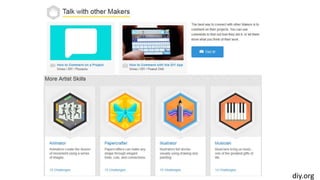
diy.org
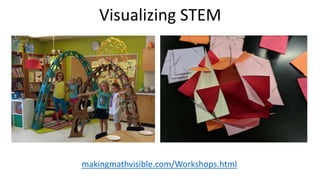
makingmathvisible.com/Workshops.html
Visualizing STEM
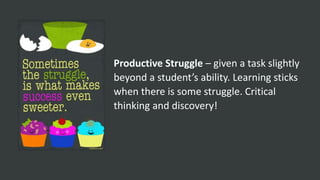
Productive Struggle – given a task slightly
beyond a student’s ability. Learning sticks
when there is some struggle. Critical
thinking and discovery!
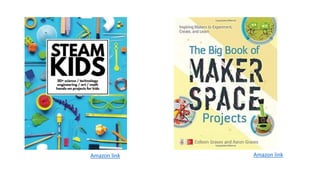
Amazon link Amazon link
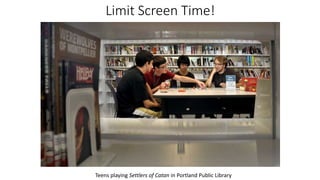
Limit Screen Time!
Teens playing Settlers of Catan in Portland Public Library
Get outside
and explore!
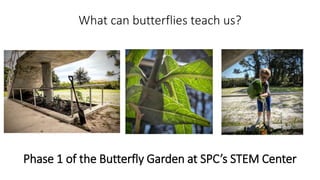
Phase 1 of the Butterfly Garden at SPC’s STEM Center
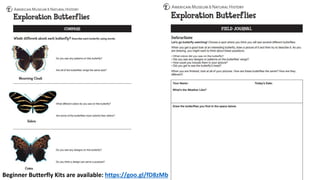
What can butterflies teach us?
Beginner Butterfly Kits are available: https://goo.gl/fD8zMb
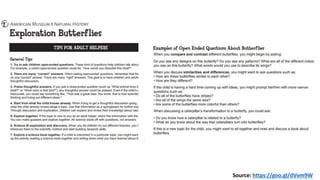
Source: https://goo.gl/dVvm9W
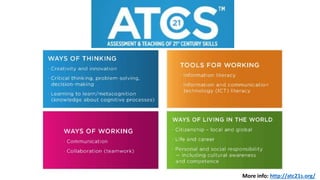
Assess the success of your activities
More info: http://atc21s.org/
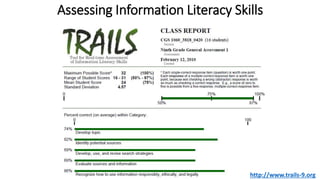
Assessing Information Literacy Skills
http://www.trails-9.org
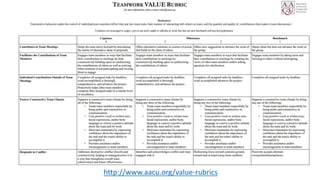
http://www.aacu.org/value-rubrics
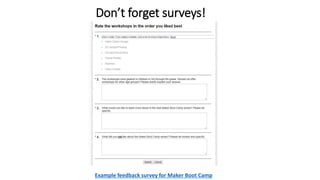
Don’t forget surveys!
Example feedback survey for Maker Boot Camp
Select Resources/ideas:
Student Teaming Tips: STEM by Design – learn necessary skills to collaborate
successfully and be responsible and accountable for their work.
Real-World STEM Problems - STEM teachers pose problems and combine
problem solving with project-based learning across disciplines.
Google Maps | Education - empower students to visualize, share, and
communicate information about the world around them.
Teaching 21st Century Skills Without Technology – can you teach 21st century
skills without technology?
Six Characteristics of a Great STEM Lesson – some great resources here to
help jumpstart thinking about creating STEM lessons.
MIT Blossoms – some great resources to help “deepen and strengthen a curriculum.”
STEM Hands-on Activities (Pinterest) – tons of awesome ideas here!
Teachers Pay Teachers – their goal is to make the “expertise and wisdom of all the teachers
in the world available to anyone, anywhere, at any time.”
eGFI - Engineering, Go For It! – some great lesson plans to create interesting engineering
projects.
Chad Mairn Presentations - a variety of presentations ranging from Open Education
Resources to Basic Video Game Design.
Select Resources/ideas continued:
•Arts Exposure Leads to Increased STEM Patents
Michigan State University
•Testimony on Capitol Hill
View CSPAN coverage of the US House Committee
hearing on Science, Space and Technology.
•Interview with Arne Duncan on STEM
Innovation and Technology in Education conference
•STEAM by US Region
RISD Office of Government Relations
•STE[+a]M Connect
UC San Diego
•The Steam Journal
Claremont Graduate University
•ArtsEdSearch
Arts Education Partnership
•State of Create
Adobe
•Framework for 21st Century Learning
Partnership for 21st Century Skills
•School Transformation Through Arts Integration
Edutopia
•Science Literacy and Assessment Data
American Association for the Advancement of Science
(AAAS)
•Reinvesting in Arts Education
President's Committee on the Arts and Humanities
•Drawing to Learn in Science
Science
•Cultivating Organizational Creativity
IBM Report
•Ready to Innovate
The Conference Board
•Grand Challenges for Engineering
National Academey of Engineering
STEAM resources and connections
Read more at: http://stemtosteam.org/resources
http://www.slideshare.net/chadmairn
@cmairn
Contact me!

STEM Demystified

  • 1.
  • 2.
    Agenda • Understand theimportance of STEM education. • Practice the four Cs of learning: collaboration, communication, critical thinking, and creativity. • Collect best practices to create good and inexpensive (many free) STEM lessons. • Teach 21st Century skills without technology. • Learn strategies (e.g., productive struggle) to creatively solve real-world problems. • Assess the success of your activities.
  • 3.
    STEM activities helpstudents to move beyond simple test performance and focuses on developing higher-level thinking skills by connecting classroom learning to the real-world. The United States is ranked below many industrialized nations in Science and Mathematics. Consequently, it will become more difficult to compete globally unless we focus on integrating STEM activities into all our coursework and workshops. (Pew Research)
  • 4.
  • 5.
    Source: http://goo.gl/mSPViJ “STEAM Educationprovides the framework used for connecting the growing network of educational disciplines, businesses and communities to create adaptable citizen-involved, globally-responsible, reality-based programs for developing life-long FUNctional literacy for all.”
  • 6.
  • 7.
    You do notneed to be a scientist, technologist, engineer, artist, and/or a mathematician to do STEAM. Important!
  • 8.
    Four Cs ofLearning: •Critical Thinking •Communication •Collaboration •Creativity.
  • 9.
    Critical Thinking • ReasonEffectively • Use various types of reasoning (inductive, deductive, etc.) as appropriate to the situation. • Use Systems Thinking • Analyze how parts of a whole interact with each other to produce overall outcomes in complex systems. • Make Judgments and Decisions • Effectively analyze and evaluate evidence, arguments, claims, and beliefs. • Analyze and evaluate major alternative points of view. • Synthesize and make connections between information and arguments. • Interpret information and draw conclusions based on the best analysis. • Reflect critically on learning experiences and processes. • Solve Problems • Solve different kinds of unfamiliar problems in both conventional and innovative ways. • Identify and ask significant questions that clarify various points of view and lead to better solutions. Source: https://goo.gl/5ydlz
  • 10.
    Communicate Clearly • Articulatethoughts and ideas effectively using oral, written, and nonverbal communication skills in a variety of forms and contexts. • Listen effectively to decipher meaning, including knowledge, values, attitudes, and intentions. • Use communication for a range of purposes (e.g. to inform, instruct, motivate, and persuade). • Use multiple media and technologies, and know how to assess impact and their effectiveness a priori. • Communicate effectively in diverse environments (including multilingual and multicultural). Source: https://goo.gl/5ydlz
  • 11.
    Collaborate with Others •Demonstrate ability to work effectively and respectfully with diverse teams. • Exercise flexibility and willingness to be helpful in making necessary compromises to accomplish a common goal. • Assume shared responsibility for collaborative work, and value the individual contributions made by each team member. • Check out the GLOBE Program: https://www.globe.gov/. • Have fun doing the Marshmallow Challenge: www.marshmallowchallenge.com. Source: https://goo.gl/5ydlz
  • 12.
    • Think Creatively •Use a wide range of idea creation techniques (such as brainstorming). • Create new and worthwhile ideas (both incremental and radical concepts). • Elaborate, refine, analyze, and evaluate original ideas to improve and maximize creative efforts. • Work Creatively with Others • Develop, implement, and communicate new ideas to others effectively. • Be open and responsive to new and diverse perspectives; incorporate group input and feedback into the work. • Demonstrate originality and inventiveness in work and understand the real world limits to adopting new ideas. • View failure as an opportunity to learn; understand that creativity and innovation are part of a long-term, cyclical process of small successes and frequent mistakes • Implement Innovation • Act on creative ideas to make a tangible and useful contribution to the field in which the innovation will occur. Creativity and Innovation Source: https://goo.gl/5ydlz
  • 13.
    https://goo.gl/5ydlz Learn some greatways to integrate the 4 C’s into your library programs/classrooms.
  • 14.
    “The future belongsto a very different kind of person with a very different kind of mind—creators and empathizers, pattern recognizers and meaning makers. These people…will now reap society’s richest rewards and share its greatest joys.” ~ Daniel Pink
  • 15.
    Best practices forcreating good STEM lessons
  • 16.
    A good STEMlesson: • Presents a real-world and interesting open-ended problem. • Allows for several acceptable solutions for the problem. • Integrates and applies grade-level content in science and math. • Expects students to work/communicate in productive teams to solve the problem. • Uses the Engineering Design Process approach for solving problems. Source: https://goo.gl/Y9D75g
  • 17.
    Engineering Design Process EDPgives students a way to think systematically about solving problems. 1. Define problem[s], 2. Conduct research (Information Literacy/Transliteracy), 3. Discuss multiple ideas for solutions, 4. Develop and create a device or prototype, and then 5. Test, evaluate, and redesign.
  • 18.
    Multimodal Research Projects http://www.multiplejournalism.org/case/firestorm Otherexamples: • Infographics • Public Service Announcement • Podcasting • 360° Video Documentary • Animation
  • 19.
    A good STEMlesson continued: • Includes technology that adds value and enhances learning. • Supports a teaching process that is inquiry-based, hands-on, and student-centered. • Requires students to design and create a model or prototype of the solution. • Provides quality time to think critically, creatively, and innovatively and to test their solutions, evaluate the results, and redesign if needed. • It is encouraged to fail and make mistakes. It is a positive step toward discovering and designing solutions. Source: https://goo.gl/Y9D75g
  • 20.
    “The trick isnot in knowing the single solution. It’s having lots of different options and solutions to turn to.” Source: Wired Magazine April ,2012, page 22 S
  • 21.
    Science Fair ProjectIdeas Browse more projects at https://www.education.com/science-fair
  • 22.
    Explore the physicsof rotational motion with a fidget spinner! DIY Fidget SpinnerThingiverse designs
  • 23.
    http://www.ala.org/alsc/curiositycreates Want a copyof our grant? Please send an email to mairn.chad@spcollege.edu and I’ll send you a copy.
  • 24.
    Maker workshops • VideoGame Design (3 sessions, 4 ½ hours) • 3D Design/Printing (3 sessions, 4 ½ hours) • Fun With Electronics/Circuitry (3 sessions, 4 ½ hours) • Introduction to Robotics (3 sessions, 4 ½ hours) • Virtual Reality (3 sessions, 4 ½ hours) • Video Editing for Film (3 sessions, 4 ½ hours)
  • 29.
    DIY Hologram Watch athttps://youtu.be/fAozLR4dry0
  • 32.
    Images by ChrisDemmons and Chad Mairn
  • 33.
    A very coolway to teach data analytics to children! Watch at https://youtu.be/IPTU4fOq8hU
  • 34.
    Teach 21st Centuryskills without technology
  • 35.
    - practical applicationof knowledge especially in a particular area (e.g., medical technology).
  • 36.
  • 37.
    Read more athttps://goo.gl/OBWCHW Some of my favorites are: Understanding Pi with String Art Learning about ant colonies with Tape Resist Art Exploring Cameras with Flashlight Painting DIY Flying Whirly Copter Toy
  • 38.
  • 39.
  • 40.
  • 41.
    Productive Struggle –given a task slightly beyond a student’s ability. Learning sticks when there is some struggle. Critical thinking and discovery!
  • 42.
  • 43.
    Limit Screen Time! Teensplaying Settlers of Catan in Portland Public Library
  • 44.
  • 45.
    Phase 1 ofthe Butterfly Garden at SPC’s STEM Center What can butterflies teach us?
  • 46.
    Beginner Butterfly Kitsare available: https://goo.gl/fD8zMb
  • 47.
  • 48.
    Assess the successof your activities
  • 49.
  • 50.
    Assessing Information LiteracySkills http://www.trails-9.org
  • 51.
  • 52.
    Don’t forget surveys! Examplefeedback survey for Maker Boot Camp
  • 53.
    Select Resources/ideas: Student TeamingTips: STEM by Design – learn necessary skills to collaborate successfully and be responsible and accountable for their work. Real-World STEM Problems - STEM teachers pose problems and combine problem solving with project-based learning across disciplines. Google Maps | Education - empower students to visualize, share, and communicate information about the world around them. Teaching 21st Century Skills Without Technology – can you teach 21st century skills without technology? Six Characteristics of a Great STEM Lesson – some great resources here to help jumpstart thinking about creating STEM lessons.
  • 54.
    MIT Blossoms –some great resources to help “deepen and strengthen a curriculum.” STEM Hands-on Activities (Pinterest) – tons of awesome ideas here! Teachers Pay Teachers – their goal is to make the “expertise and wisdom of all the teachers in the world available to anyone, anywhere, at any time.” eGFI - Engineering, Go For It! – some great lesson plans to create interesting engineering projects. Chad Mairn Presentations - a variety of presentations ranging from Open Education Resources to Basic Video Game Design. Select Resources/ideas continued:
  • 55.
    •Arts Exposure Leadsto Increased STEM Patents Michigan State University •Testimony on Capitol Hill View CSPAN coverage of the US House Committee hearing on Science, Space and Technology. •Interview with Arne Duncan on STEM Innovation and Technology in Education conference •STEAM by US Region RISD Office of Government Relations •STE[+a]M Connect UC San Diego •The Steam Journal Claremont Graduate University •ArtsEdSearch Arts Education Partnership •State of Create Adobe •Framework for 21st Century Learning Partnership for 21st Century Skills •School Transformation Through Arts Integration Edutopia •Science Literacy and Assessment Data American Association for the Advancement of Science (AAAS) •Reinvesting in Arts Education President's Committee on the Arts and Humanities •Drawing to Learn in Science Science •Cultivating Organizational Creativity IBM Report •Ready to Innovate The Conference Board •Grand Challenges for Engineering National Academey of Engineering STEAM resources and connections Read more at: http://stemtosteam.org/resources
  • 56.
  • 57.