













LEADING TEACHER CHANGE
  IN A TECHNOLOGY RICH
          SCHOOL
         Neil Stephenson
      Calgary Science School
BIO
BIO

•   PD / Outreach Coordinator
BIO

•   PD / Outreach Coordinator

•   http://www.thinkinginmind.com
BIO

•   PD / Outreach Coordinator

•   http://www.thinkinginmind.com

•   Twitter: @neilstephenson
BIO

•   PD / Outreach Coordinator

•   http://www.thinkinginmind.com

•   Twitter: @neilstephenson

•   email: neil.s@calgaryscienceschool.com
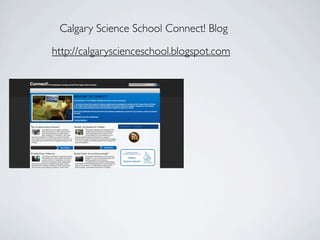
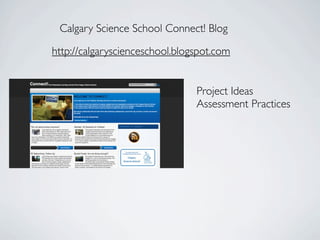
Calgary Science School Connect! Blog

http://calgaryscienceschool.blogspot.com
Calgary Science School Connect! Blog

http://calgaryscienceschool.blogspot.com
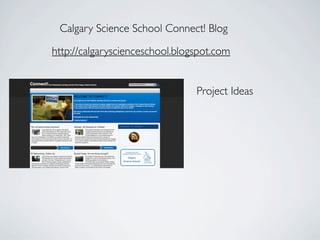
Calgary Science School Connect! Blog

http://calgaryscienceschool.blogspot.com


                                Project Ideas
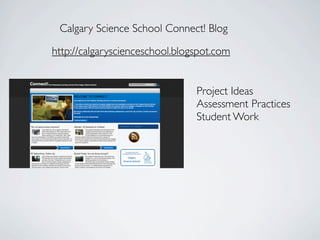
Calgary Science School Connect! Blog

http://calgaryscienceschool.blogspot.com


                                Project Ideas
                                Assessment Practices
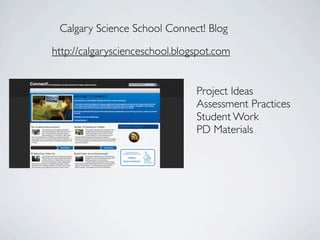
Calgary Science School Connect! Blog

http://calgaryscienceschool.blogspot.com


                                Project Ideas
                                Assessment Practices
                                Student Work
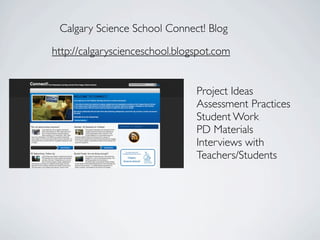
Calgary Science School Connect! Blog

http://calgaryscienceschool.blogspot.com


                                Project Ideas
                                Assessment Practices
                                Student Work
                                PD Materials
Calgary Science School Connect! Blog

http://calgaryscienceschool.blogspot.com


                                Project Ideas
                                Assessment Practices
                                Student Work
                                PD Materials
                                Interviews with
                                Teachers/Students
•   600 students in grade
    4-9
•   600 students in grade
    4-9

•   focus on (1) inquiry
    based learning, (2)
    technology integration
    and (3) outdoor
    education
•   600 students in grade
    4-9

•   focus on (1) inquiry
    based learning, (2)
    technology integration
    and (3) outdoor
    education

•   full 1:1 - 600
    macbooks
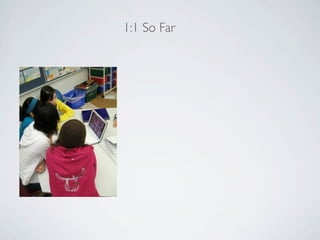
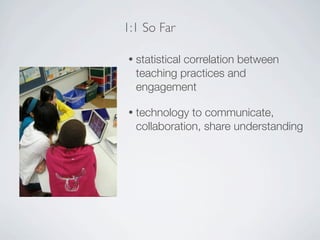
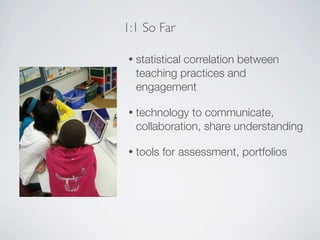
1:1 So Far
1:1 So Far

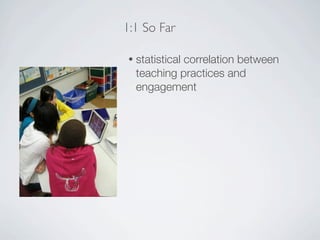
•   statistical correlation between
    teaching practices and
    engagement
1:1 So Far

•   statistical correlation between
    teaching practices and
    engagement

•   technology to communicate,
    collaboration, share understanding
1:1 So Far

•   statistical correlation between
    teaching practices and
    engagement

•   technology to communicate,
    collaboration, share understanding

•   tools for assessment, portfolios
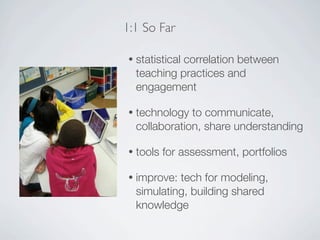
1:1 So Far

•   statistical correlation between
    teaching practices and
    engagement

•   technology to communicate,
    collaboration, share understanding

•   tools for assessment, portfolios

•   improve: tech for modeling,
    simulating, building shared
    knowledge
Sharon Friesen on the Calgary Science School
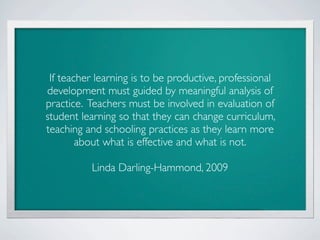
If teacher learning is to be productive, professional
development must guided by meaningful analysis of
practice. Teachers must be involved in evaluation of
student learning so that they can change curriculum,
teaching and schooling practices as they learn more
        about what is effective and what is not.

          Linda Darling-Hammond, 2009
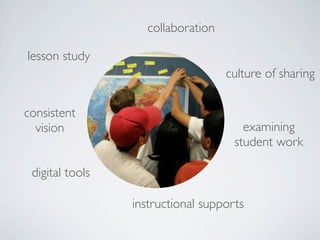
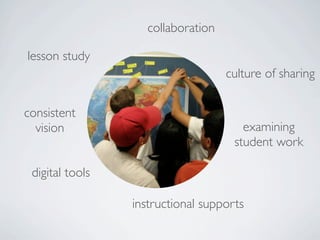
collaboration

lesson study
                                    culture of sharing


consistent
  vision                               examining
                                     student work

 digital tools

                 instructional supports
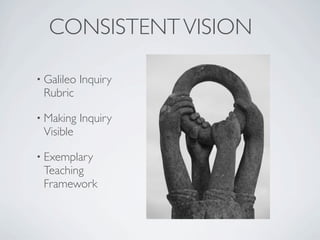
CONSISTENT VISION
CONSISTENT VISION

• Galileo   Inquiry
 Rubric
CONSISTENT VISION

• Galileo   Inquiry
 Rubric

• Making    Inquiry
 Visible
CONSISTENT VISION

• Galileo   Inquiry
 Rubric

• Making    Inquiry
 Visible

• Exemplary
 Teaching
 Framework
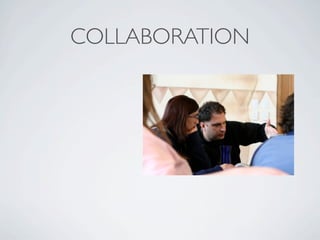
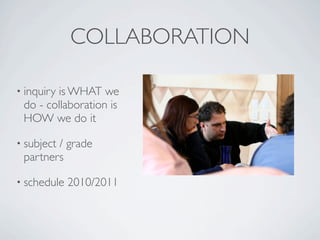
COLLABORATION
COLLABORATION

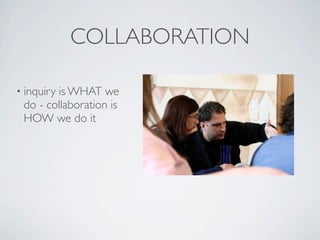
• inquiry
        is WHAT we
 do - collaboration is
 HOW we do it
COLLABORATION

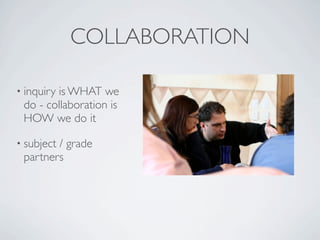
• inquiry
        is WHAT we
 do - collaboration is
 HOW we do it

• subject
        / grade
 partners
COLLABORATION

• inquiry
        is WHAT we
 do - collaboration is
 HOW we do it

• subject
        / grade
 partners

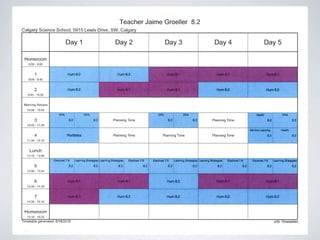
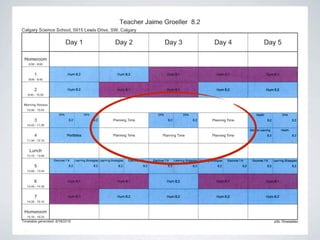
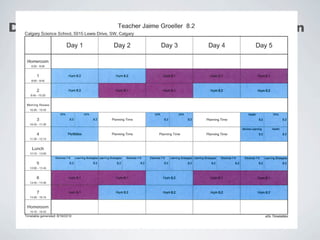
• schedule   2010/2011
COLLABORATION

• inquiry
        is WHAT we
 do - collaboration is
 HOW we do it

• subject
        / grade
 partners

• schedule   2010/2011
COLLABORATION

• inquiry
        is WHAT we
 do - collaboration is
 HOW we do it

• subject
        / grade
 partners

• schedule   2010/2011
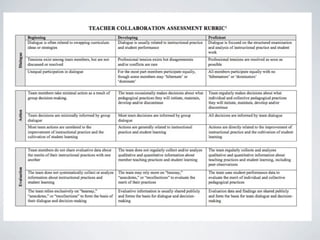
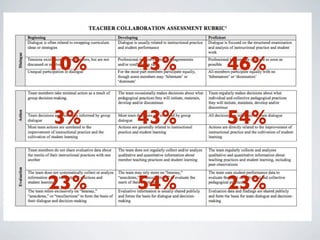
10%   43%   46%

3%    43%   54%


23%   54%   23%
CULTURE OF
 SHARING
CULTURE OF
 SHARING
 •whole staff
CULTURE OF
 SHARING
 •whole staff
 •subject teams
CULTURE OF
 SHARING
 •whole staff
 •subject teams
 •most tech PD
EXAMINING
 STUDENT
  WORK
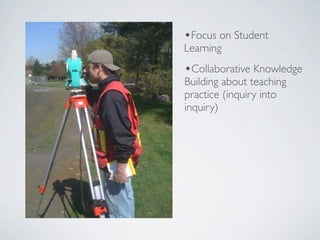
•Focus on Student
Learning
•Focus on Student
Learning
•Collaborative Knowledge
Building about teaching
practice (inquiry into
inquiry)
•Focus on Student
Learning
•Collaborative Knowledge
Building about teaching
practice (inquiry into
inquiry)
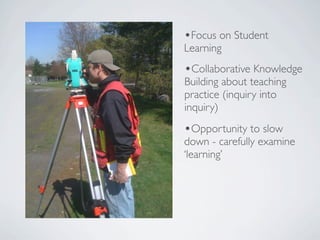
•Opportunity to slow
down - carefully examine
‘learning’
•Focus on Student
Learning
•Collaborative Knowledge
Building about teaching
practice (inquiry into
inquiry)
•Opportunity to slow
down - carefully examine
‘learning’

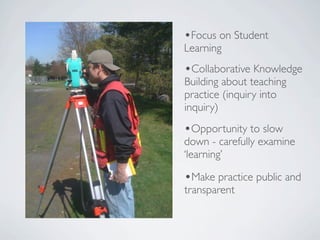
•Make practice public and
transparent
Taken from: Reflective
 Practice for Educators,
Osterman and Kottkamp,
          2004
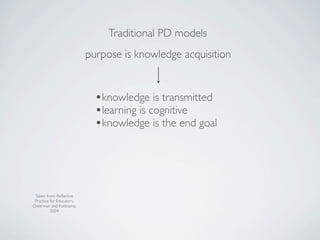
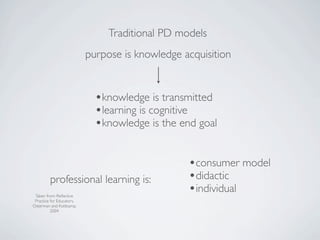
Traditional PD models


 Taken from: Reflective
 Practice for Educators,
Osterman and Kottkamp,
          2004
Traditional PD models
                           purpose is knowledge acquisition


 Taken from: Reflective
 Practice for Educators,
Osterman and Kottkamp,
          2004
Traditional PD models
                           purpose is knowledge acquisition


 Taken from: Reflective
 Practice for Educators,
Osterman and Kottkamp,
          2004
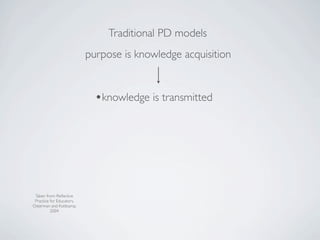
Traditional PD models
                           purpose is knowledge acquisition


                             •knowledge is transmitted


 Taken from: Reflective
 Practice for Educators,
Osterman and Kottkamp,
          2004
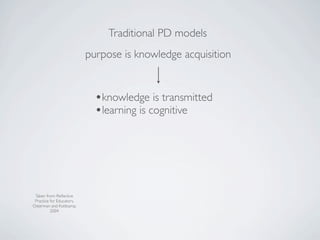
Traditional PD models
                           purpose is knowledge acquisition


                             •knowledge is transmitted
                             •learning is cognitive


 Taken from: Reflective
 Practice for Educators,
Osterman and Kottkamp,
          2004
Traditional PD models
                           purpose is knowledge acquisition


                             •knowledge is transmitted
                             •learning is cognitive
                             •knowledge is the end goal


 Taken from: Reflective
 Practice for Educators,
Osterman and Kottkamp,
          2004
Traditional PD models
                           purpose is knowledge acquisition


                             •knowledge is transmitted
                             •learning is cognitive
                             •knowledge is the end goal


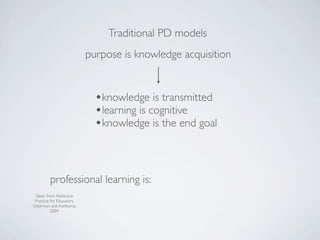
         professional learning is:
 Taken from: Reflective
 Practice for Educators,
Osterman and Kottkamp,
          2004
Traditional PD models
                           purpose is knowledge acquisition


                             •knowledge is transmitted
                             •learning is cognitive
                             •knowledge is the end goal

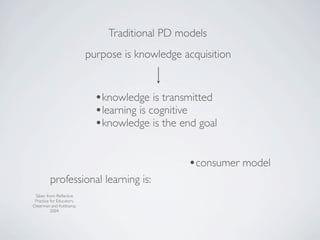
                                                 •consumer model
         professional learning is:
 Taken from: Reflective
 Practice for Educators,
Osterman and Kottkamp,
          2004
Traditional PD models
                           purpose is knowledge acquisition


                             •knowledge is transmitted
                             •learning is cognitive
                             •knowledge is the end goal

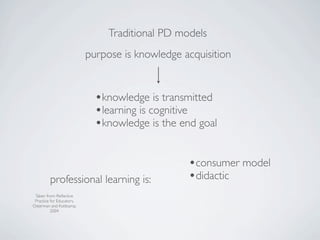
                                                 •consumer model
         professional learning is:               •didactic
 Taken from: Reflective
 Practice for Educators,
Osterman and Kottkamp,
          2004
Traditional PD models
                           purpose is knowledge acquisition


                             •knowledge is transmitted
                             •learning is cognitive
                             •knowledge is the end goal

                                                 •consumer model
         professional learning is:               •didactic
 Taken from: Reflective
                                                 •individual
 Practice for Educators,
Osterman and Kottkamp,
          2004
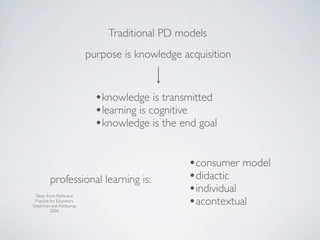
Traditional PD models
                           purpose is knowledge acquisition


                             •knowledge is transmitted
                             •learning is cognitive
                             •knowledge is the end goal

                                                 •consumer model
         professional learning is:               •didactic
                                                 •individual
                                                 •acontextual
 Taken from: Reflective
 Practice for Educators,
Osterman and Kottkamp,
          2004
Taken from: Reflective
 Practice for Educators,
Osterman and Kottkamp,
          2004
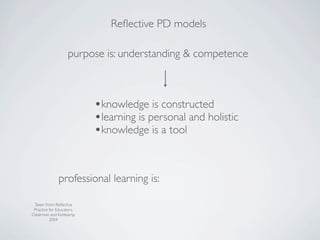
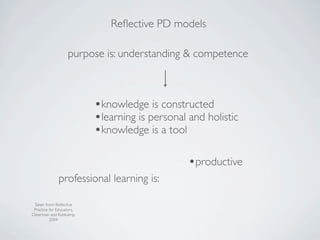
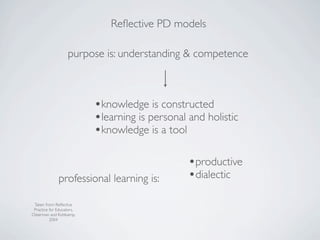
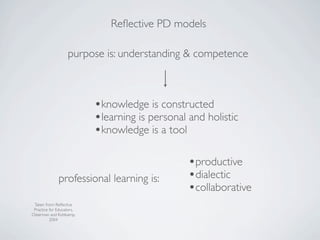
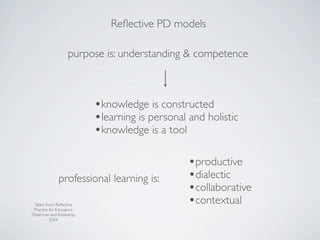
Reflective PD models


 Taken from: Reflective
 Practice for Educators,
Osterman and Kottkamp,
          2004
Reflective PD models

                   purpose is: understanding & competence


 Taken from: Reflective
 Practice for Educators,
Osterman and Kottkamp,
          2004
Reflective PD models

                   purpose is: understanding & competence


 Taken from: Reflective
 Practice for Educators,
Osterman and Kottkamp,
          2004
Reflective PD models

                   purpose is: understanding & competence


                           •knowledge is constructed


 Taken from: Reflective
 Practice for Educators,
Osterman and Kottkamp,
          2004
Reflective PD models

                   purpose is: understanding & competence


                           •knowledge is constructed
                           •learning is personal and holistic


 Taken from: Reflective
 Practice for Educators,
Osterman and Kottkamp,
          2004
Reflective PD models

                   purpose is: understanding & competence


                           •knowledge is constructed
                           •learning is personal and holistic
                           •knowledge is a tool


 Taken from: Reflective
 Practice for Educators,
Osterman and Kottkamp,
          2004
Reflective PD models

                   purpose is: understanding & competence


                           •knowledge is constructed
                           •learning is personal and holistic
                           •knowledge is a tool


              professional learning is:

 Taken from: Reflective
 Practice for Educators,
Osterman and Kottkamp,
          2004
Reflective PD models

                   purpose is: understanding & competence


                           •knowledge is constructed
                           •learning is personal and holistic
                           •knowledge is a tool

                                                 •productive
              professional learning is:

 Taken from: Reflective
 Practice for Educators,
Osterman and Kottkamp,
          2004
Reflective PD models

                   purpose is: understanding & competence


                           •knowledge is constructed
                           •learning is personal and holistic
                           •knowledge is a tool

                                                 •productive
              professional learning is:          •dialectic
 Taken from: Reflective
 Practice for Educators,
Osterman and Kottkamp,
          2004
Reflective PD models

                   purpose is: understanding & competence


                           •knowledge is constructed
                           •learning is personal and holistic
                           •knowledge is a tool

                                                 •productive
              professional learning is:          •dialectic
                                                 •collaborative
 Taken from: Reflective
 Practice for Educators,
Osterman and Kottkamp,
          2004
Reflective PD models

                   purpose is: understanding & competence


                           •knowledge is constructed
                           •learning is personal and holistic
                           •knowledge is a tool

                                                 •productive
              professional learning is:          •dialectic
                                                 •collaborative
 Taken from: Reflective
 Practice for Educators,
                                                 •contextual
Osterman and Kottkamp,
          2004
Examining Student Work Framework

•flexible framework allows for wide variety of
teacher personality/delivery
Examining Student Work Framework

•flexible framework allows for wide variety of
teacher personality/delivery

•honours teacher experiential knowledge
Examining Student Work Framework

•flexible framework allows for wide variety of
teacher personality/delivery

•honours teacher experiential knowledge
•teacher becomes “researcher... engaged in a
continual process of self-education.”
Examining Student Work Framework

•flexible framework allows for wide variety of
teacher personality/delivery

•honours teacher experiential knowledge
•teacher becomes “researcher... engaged in a
continual process of self-education.”

•collaborative search for understanding - versus
“delivering someone else’s mail”
Three parts of “Examining Student Work”:

    •Examination of Task: “What topics are worth
    our students time?”
Three parts of “Examining Student Work”:

    •Examination of Task: “What topics are worth
    our students time?”

    •Examination of Assessment: “How are we
    designing assessment practices so all students
    can succeed?”
Three parts of “Examining Student Work”:

    •Examination of Task: “What topics are worth
    our students time?”

    •Examination of Assessment: “How are we
    designing assessment practices so all students
    can succeed?”

    •Examination of Student Work: “What do we
    count as evidence of deep understanding?”
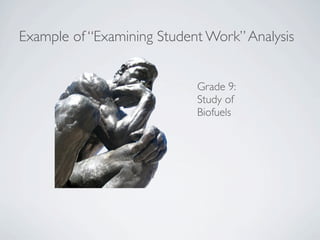
Example of “Examining Student Work” Analysis


                            Grade 9:
                            Study of
                            Biofuels
Example of “Examining Student Work” Analysis


                            Grade 9:
                            Study of
                            Biofuels
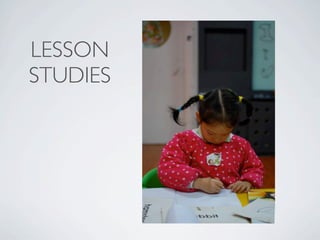
LESSON
STUDIES
LESSON
STUDIES
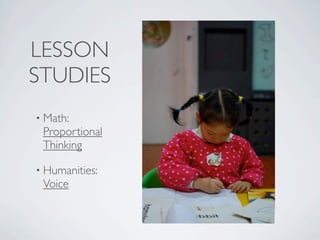
• Math:
 Proportional
 Thinking

• Humanities:
 Voice
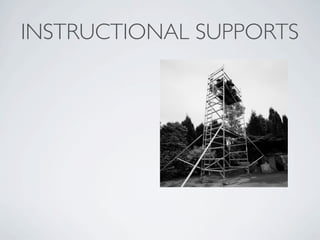
INSTRUCTIONAL SUPPORTS

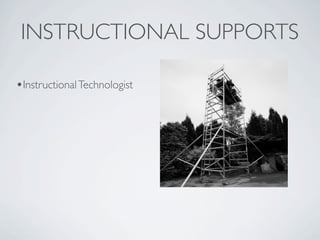
•Instructional Technologist
INSTRUCTIONAL SUPPORTS

•Instructional Technologist
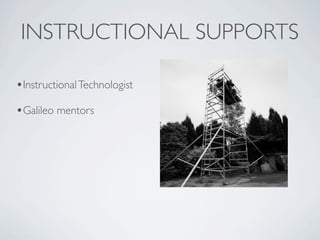
•Galileo mentors
INSTRUCTIONAL SUPPORTS

•Instructional Technologist
•Galileo mentors
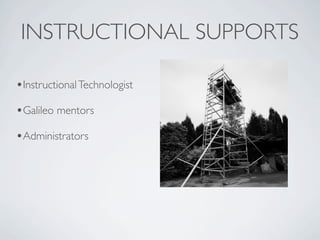
•Administrators
INSTRUCTIONAL SUPPORTS

•Instructional Technologist
•Galileo mentors
•Administrators
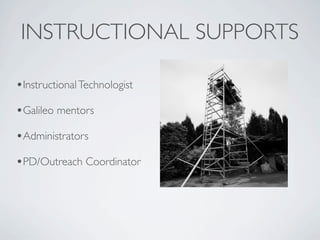
•PD/Outreach Coordinator
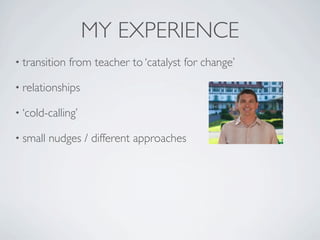
MY EXPERIENCE
MY EXPERIENCE
• transition   from teacher to ‘catalyst for change’
MY EXPERIENCE
• transition   from teacher to ‘catalyst for change’

• relationships
MY EXPERIENCE
• transition   from teacher to ‘catalyst for change’

• relationships

• ‘cold-calling’
MY EXPERIENCE
• transition   from teacher to ‘catalyst for change’

• relationships

• ‘cold-calling’

• small   nudges / different approaches
MY EXPERIENCE
• transition   from teacher to ‘catalyst for change’

• relationships

• ‘cold-calling’

• small   nudges / different approaches

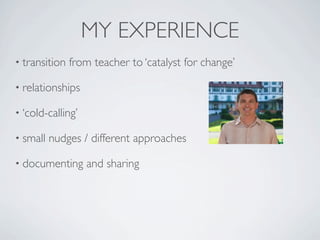
• documenting      and sharing
MY EXPERIENCE
• transition   from teacher to ‘catalyst for change’

• relationships

• ‘cold-calling’

• small   nudges / different approaches

• documenting       and sharing

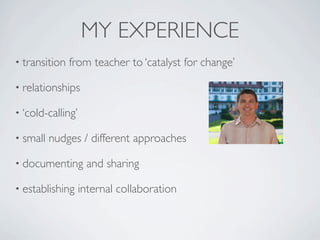
• establishing     internal collaboration
MY EXPERIENCE
• transition   from teacher to ‘catalyst for change’

• relationships

• ‘cold-calling’

• small   nudges / different approaches

• documenting       and sharing

• establishing     internal collaboration

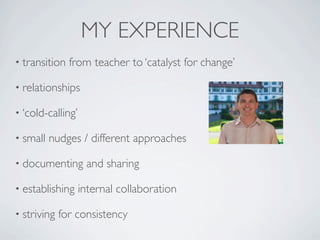
• striving   for consistency
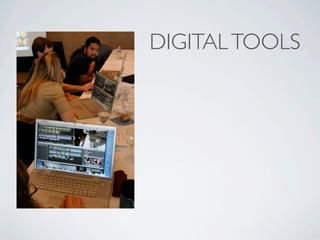
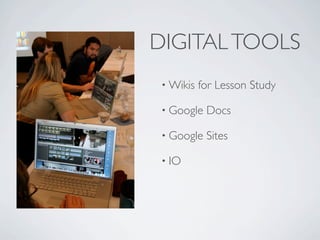
DIGITAL TOOLS
DIGITAL TOOLS
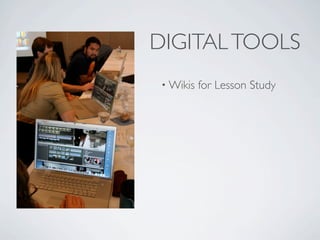
 • Wikis   for Lesson Study
DIGITAL TOOLS
 • Wikis   for Lesson Study

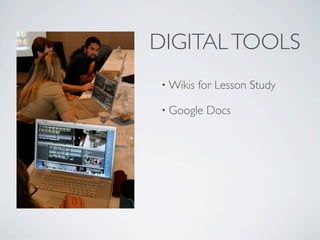
 • Google   Docs
DIGITAL TOOLS
 • Wikis   for Lesson Study

 • Google   Docs

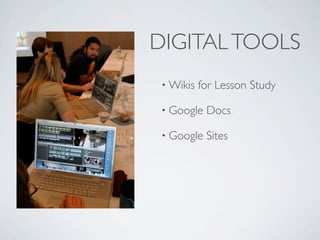
 • Google   Sites
DIGITAL TOOLS
 • Wikis   for Lesson Study

 • Google   Docs

 • Google   Sites

 • IO
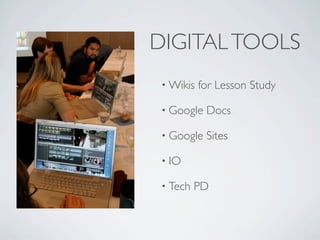
DIGITAL TOOLS
 • Wikis   for Lesson Study

 • Google   Docs

 • Google   Sites

 • IO

 • Tech   PD
Digital Portfolios: Teacher Change in Action

      Teacher Buy-in
Digital Portfolios: Teacher Change in Action

      Teacher Buy-in

      Open Communication between Teachers
      and Administration
Digital Portfolios: Teacher Change in Action

      Teacher Buy-in

      Open Communication between Teachers
      and Administration

      Deep, sustained collaboration among Fine
      Arts / PE teachers
Digital Portfolios: Teacher Change in Action

      Teacher Buy-in

      Open Communication between Teachers
      and Administration

      Deep, sustained collaboration among Fine
      Arts / PE teachers

      Tech PD embedded in teacher change
Digital Portfolios: Teacher Change in Action

      Teacher Buy-in

      Open Communication between Teachers
      and Administration

      Deep, sustained collaboration among Fine
      Arts / PE teachers

      Tech PD embedded in teacher change

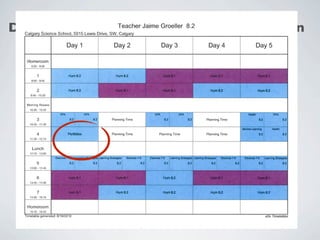
      Modied Schedule
Digital Portfolios: Teacher Change in Action

      Teacher Buy-in

      Open Communication between Teachers
      and Administration

      Deep, sustained collaboration among Fine
      Arts / PE teachers

      Tech PD embedded in teacher change

      Modied Schedule
Digital Portfolios: Teacher Change in Action

      Teacher Buy-in

      Open Communication between Teachers
      and Administration

      Deep, sustained collaboration among Fine
      Arts / PE teachers

      Tech PD embedded in teacher change

      Modied Schedule
Digital Portfolios: Teacher Change in Action

      Teacher Buy-in

      Open Communication between Teachers
      and Administration

      Deep, sustained collaboration among Fine
      Arts / PE teachers

      Tech PD embedded in teacher change

      Modied Schedule
Digital Portfolios: Teacher Change in Action

      Teacher Buy-in

      Open Communication between Teachers
      and Administration

      Deep, sustained collaboration among Fine
      Arts / PE teachers

      Tech PD embedded in teacher change

      Modied Schedule
CSS PORTFOLIO VIDEO
collaboration

lesson study
                                    culture of sharing


consistent
  vision                               examining
                                     student work

 digital tools

                 instructional supports
??
??
•   http://www.thinkinginmind.com
??
•   http://www.thinkinginmind.com

•   http://calgaryscienceschool.blogspot.com
??
•   http://www.thinkinginmind.com

•   http://calgaryscienceschool.blogspot.com

•   Twitter: @neilstephenson
??
•   http://www.thinkinginmind.com

•   http://calgaryscienceschool.blogspot.com

•   Twitter: @neilstephenson

•   email: neil.s@calgaryscienceschool.com

Teacher Change in a Tech Rich School

  • 1.
    LEADING TEACHER CHANGE IN A TECHNOLOGY RICH SCHOOL Neil Stephenson Calgary Science School
  • 2.
  • 3.
    BIO • PD / Outreach Coordinator
  • 4.
    BIO • PD / Outreach Coordinator • http://www.thinkinginmind.com
  • 5.
    BIO • PD / Outreach Coordinator • http://www.thinkinginmind.com • Twitter: @neilstephenson
  • 6.
    BIO • PD / Outreach Coordinator • http://www.thinkinginmind.com • Twitter: @neilstephenson • email: neil.s@calgaryscienceschool.com
  • 8.
  • 9.
    Calgary Science SchoolConnect! Blog http://calgaryscienceschool.blogspot.com
  • 10.
    Calgary Science SchoolConnect! Blog http://calgaryscienceschool.blogspot.com
  • 11.
    Calgary Science SchoolConnect! Blog http://calgaryscienceschool.blogspot.com Project Ideas
  • 12.
    Calgary Science SchoolConnect! Blog http://calgaryscienceschool.blogspot.com Project Ideas Assessment Practices
  • 13.
    Calgary Science SchoolConnect! Blog http://calgaryscienceschool.blogspot.com Project Ideas Assessment Practices Student Work
  • 14.
    Calgary Science SchoolConnect! Blog http://calgaryscienceschool.blogspot.com Project Ideas Assessment Practices Student Work PD Materials
  • 15.
    Calgary Science SchoolConnect! Blog http://calgaryscienceschool.blogspot.com Project Ideas Assessment Practices Student Work PD Materials Interviews with Teachers/Students
  • 17.
    • 600 students in grade 4-9
  • 18.
    • 600 students in grade 4-9 • focus on (1) inquiry based learning, (2) technology integration and (3) outdoor education
  • 19.
    • 600 students in grade 4-9 • focus on (1) inquiry based learning, (2) technology integration and (3) outdoor education • full 1:1 - 600 macbooks
  • 20.
  • 21.
    1:1 So Far • statistical correlation between teaching practices and engagement
  • 22.
    1:1 So Far • statistical correlation between teaching practices and engagement • technology to communicate, collaboration, share understanding
  • 23.
    1:1 So Far • statistical correlation between teaching practices and engagement • technology to communicate, collaboration, share understanding • tools for assessment, portfolios
  • 24.
    1:1 So Far • statistical correlation between teaching practices and engagement • technology to communicate, collaboration, share understanding • tools for assessment, portfolios • improve: tech for modeling, simulating, building shared knowledge
  • 25.
    Sharon Friesen onthe Calgary Science School
  • 26.
    If teacher learningis to be productive, professional development must guided by meaningful analysis of practice. Teachers must be involved in evaluation of student learning so that they can change curriculum, teaching and schooling practices as they learn more about what is effective and what is not. Linda Darling-Hammond, 2009
  • 27.
    collaboration lesson study culture of sharing consistent vision examining student work digital tools instructional supports
  • 28.
  • 29.
  • 30.
    CONSISTENT VISION • Galileo Inquiry Rubric • Making Inquiry Visible
  • 31.
    CONSISTENT VISION • Galileo Inquiry Rubric • Making Inquiry Visible • Exemplary Teaching Framework
  • 32.
  • 33.
    COLLABORATION • inquiry is WHAT we do - collaboration is HOW we do it
  • 34.
    COLLABORATION • inquiry is WHAT we do - collaboration is HOW we do it • subject / grade partners
  • 35.
    COLLABORATION • inquiry is WHAT we do - collaboration is HOW we do it • subject / grade partners • schedule 2010/2011
  • 36.
    COLLABORATION • inquiry is WHAT we do - collaboration is HOW we do it • subject / grade partners • schedule 2010/2011
  • 37.
    COLLABORATION • inquiry is WHAT we do - collaboration is HOW we do it • subject / grade partners • schedule 2010/2011
  • 39.
    10% 43% 46% 3% 43% 54% 23% 54% 23%
  • 40.
  • 41.
    CULTURE OF SHARING •whole staff
  • 42.
    CULTURE OF SHARING •whole staff •subject teams
  • 43.
    CULTURE OF SHARING •whole staff •subject teams •most tech PD
  • 44.
  • 46.
  • 47.
    •Focus on Student Learning •CollaborativeKnowledge Building about teaching practice (inquiry into inquiry)
  • 48.
    •Focus on Student Learning •CollaborativeKnowledge Building about teaching practice (inquiry into inquiry) •Opportunity to slow down - carefully examine ‘learning’
  • 49.
    •Focus on Student Learning •CollaborativeKnowledge Building about teaching practice (inquiry into inquiry) •Opportunity to slow down - carefully examine ‘learning’ •Make practice public and transparent
  • 50.
    Taken from: Reflective Practice for Educators, Osterman and Kottkamp, 2004
  • 51.
    Traditional PD models Taken from: Reflective Practice for Educators, Osterman and Kottkamp, 2004
  • 52.
    Traditional PD models purpose is knowledge acquisition Taken from: Reflective Practice for Educators, Osterman and Kottkamp, 2004
  • 53.
    Traditional PD models purpose is knowledge acquisition Taken from: Reflective Practice for Educators, Osterman and Kottkamp, 2004
  • 54.
    Traditional PD models purpose is knowledge acquisition •knowledge is transmitted Taken from: Reflective Practice for Educators, Osterman and Kottkamp, 2004
  • 55.
    Traditional PD models purpose is knowledge acquisition •knowledge is transmitted •learning is cognitive Taken from: Reflective Practice for Educators, Osterman and Kottkamp, 2004
  • 56.
    Traditional PD models purpose is knowledge acquisition •knowledge is transmitted •learning is cognitive •knowledge is the end goal Taken from: Reflective Practice for Educators, Osterman and Kottkamp, 2004
  • 57.
    Traditional PD models purpose is knowledge acquisition •knowledge is transmitted •learning is cognitive •knowledge is the end goal professional learning is: Taken from: Reflective Practice for Educators, Osterman and Kottkamp, 2004
  • 58.
    Traditional PD models purpose is knowledge acquisition •knowledge is transmitted •learning is cognitive •knowledge is the end goal •consumer model professional learning is: Taken from: Reflective Practice for Educators, Osterman and Kottkamp, 2004
  • 59.
    Traditional PD models purpose is knowledge acquisition •knowledge is transmitted •learning is cognitive •knowledge is the end goal •consumer model professional learning is: •didactic Taken from: Reflective Practice for Educators, Osterman and Kottkamp, 2004
  • 60.
    Traditional PD models purpose is knowledge acquisition •knowledge is transmitted •learning is cognitive •knowledge is the end goal •consumer model professional learning is: •didactic Taken from: Reflective •individual Practice for Educators, Osterman and Kottkamp, 2004
  • 61.
    Traditional PD models purpose is knowledge acquisition •knowledge is transmitted •learning is cognitive •knowledge is the end goal •consumer model professional learning is: •didactic •individual •acontextual Taken from: Reflective Practice for Educators, Osterman and Kottkamp, 2004
  • 62.
    Taken from: Reflective Practice for Educators, Osterman and Kottkamp, 2004
  • 63.
    Reflective PD models Taken from: Reflective Practice for Educators, Osterman and Kottkamp, 2004
  • 64.
    Reflective PD models purpose is: understanding & competence Taken from: Reflective Practice for Educators, Osterman and Kottkamp, 2004
  • 65.
    Reflective PD models purpose is: understanding & competence Taken from: Reflective Practice for Educators, Osterman and Kottkamp, 2004
  • 66.
    Reflective PD models purpose is: understanding & competence •knowledge is constructed Taken from: Reflective Practice for Educators, Osterman and Kottkamp, 2004
  • 67.
    Reflective PD models purpose is: understanding & competence •knowledge is constructed •learning is personal and holistic Taken from: Reflective Practice for Educators, Osterman and Kottkamp, 2004
  • 68.
    Reflective PD models purpose is: understanding & competence •knowledge is constructed •learning is personal and holistic •knowledge is a tool Taken from: Reflective Practice for Educators, Osterman and Kottkamp, 2004
  • 69.
    Reflective PD models purpose is: understanding & competence •knowledge is constructed •learning is personal and holistic •knowledge is a tool professional learning is: Taken from: Reflective Practice for Educators, Osterman and Kottkamp, 2004
  • 70.
    Reflective PD models purpose is: understanding & competence •knowledge is constructed •learning is personal and holistic •knowledge is a tool •productive professional learning is: Taken from: Reflective Practice for Educators, Osterman and Kottkamp, 2004
  • 71.
    Reflective PD models purpose is: understanding & competence •knowledge is constructed •learning is personal and holistic •knowledge is a tool •productive professional learning is: •dialectic Taken from: Reflective Practice for Educators, Osterman and Kottkamp, 2004
  • 72.
    Reflective PD models purpose is: understanding & competence •knowledge is constructed •learning is personal and holistic •knowledge is a tool •productive professional learning is: •dialectic •collaborative Taken from: Reflective Practice for Educators, Osterman and Kottkamp, 2004
  • 73.
    Reflective PD models purpose is: understanding & competence •knowledge is constructed •learning is personal and holistic •knowledge is a tool •productive professional learning is: •dialectic •collaborative Taken from: Reflective Practice for Educators, •contextual Osterman and Kottkamp, 2004
  • 74.
  • 75.
    Examining Student WorkFramework •flexible framework allows for wide variety of teacher personality/delivery
  • 76.
    Examining Student WorkFramework •flexible framework allows for wide variety of teacher personality/delivery •honours teacher experiential knowledge
  • 77.
    Examining Student WorkFramework •flexible framework allows for wide variety of teacher personality/delivery •honours teacher experiential knowledge •teacher becomes “researcher... engaged in a continual process of self-education.”
  • 78.
    Examining Student WorkFramework •flexible framework allows for wide variety of teacher personality/delivery •honours teacher experiential knowledge •teacher becomes “researcher... engaged in a continual process of self-education.” •collaborative search for understanding - versus “delivering someone else’s mail”
  • 80.
    Three parts of“Examining Student Work”:
  • 81.
    Three parts of“Examining Student Work”: •Examination of Task: “What topics are worth our students time?”
  • 82.
    Three parts of“Examining Student Work”: •Examination of Task: “What topics are worth our students time?” •Examination of Assessment: “How are we designing assessment practices so all students can succeed?”
  • 83.
    Three parts of“Examining Student Work”: •Examination of Task: “What topics are worth our students time?” •Examination of Assessment: “How are we designing assessment practices so all students can succeed?” •Examination of Student Work: “What do we count as evidence of deep understanding?”
  • 84.
    Example of “ExaminingStudent Work” Analysis
  • 85.
    Example of “ExaminingStudent Work” Analysis Grade 9: Study of Biofuels
  • 86.
    Example of “ExaminingStudent Work” Analysis Grade 9: Study of Biofuels
  • 87.
  • 88.
    LESSON STUDIES • Math: Proportional Thinking • Humanities: Voice
  • 89.
  • 90.
  • 91.
  • 92.
  • 93.
    INSTRUCTIONAL SUPPORTS •Instructional Technologist •Galileomentors •Administrators •PD/Outreach Coordinator
  • 94.
  • 95.
    MY EXPERIENCE • transition from teacher to ‘catalyst for change’
  • 96.
    MY EXPERIENCE • transition from teacher to ‘catalyst for change’ • relationships
  • 97.
    MY EXPERIENCE • transition from teacher to ‘catalyst for change’ • relationships • ‘cold-calling’
  • 98.
    MY EXPERIENCE • transition from teacher to ‘catalyst for change’ • relationships • ‘cold-calling’ • small nudges / different approaches
  • 99.
    MY EXPERIENCE • transition from teacher to ‘catalyst for change’ • relationships • ‘cold-calling’ • small nudges / different approaches • documenting and sharing
  • 100.
    MY EXPERIENCE • transition from teacher to ‘catalyst for change’ • relationships • ‘cold-calling’ • small nudges / different approaches • documenting and sharing • establishing internal collaboration
  • 101.
    MY EXPERIENCE • transition from teacher to ‘catalyst for change’ • relationships • ‘cold-calling’ • small nudges / different approaches • documenting and sharing • establishing internal collaboration • striving for consistency
  • 102.
  • 103.
    DIGITAL TOOLS •Wikis for Lesson Study
  • 104.
    DIGITAL TOOLS •Wikis for Lesson Study • Google Docs
  • 105.
    DIGITAL TOOLS •Wikis for Lesson Study • Google Docs • Google Sites
  • 106.
    DIGITAL TOOLS •Wikis for Lesson Study • Google Docs • Google Sites • IO
  • 107.
    DIGITAL TOOLS •Wikis for Lesson Study • Google Docs • Google Sites • IO • Tech PD
  • 108.
  • 109.
    Digital Portfolios: TeacherChange in Action Teacher Buy-in
  • 110.
    Digital Portfolios: TeacherChange in Action Teacher Buy-in Open Communication between Teachers and Administration
  • 111.
    Digital Portfolios: TeacherChange in Action Teacher Buy-in Open Communication between Teachers and Administration Deep, sustained collaboration among Fine Arts / PE teachers
  • 112.
    Digital Portfolios: TeacherChange in Action Teacher Buy-in Open Communication between Teachers and Administration Deep, sustained collaboration among Fine Arts / PE teachers Tech PD embedded in teacher change
  • 113.
    Digital Portfolios: TeacherChange in Action Teacher Buy-in Open Communication between Teachers and Administration Deep, sustained collaboration among Fine Arts / PE teachers Tech PD embedded in teacher change Modied Schedule
  • 114.
    Digital Portfolios: TeacherChange in Action Teacher Buy-in Open Communication between Teachers and Administration Deep, sustained collaboration among Fine Arts / PE teachers Tech PD embedded in teacher change Modied Schedule
  • 115.
    Digital Portfolios: TeacherChange in Action Teacher Buy-in Open Communication between Teachers and Administration Deep, sustained collaboration among Fine Arts / PE teachers Tech PD embedded in teacher change Modied Schedule
  • 116.
    Digital Portfolios: TeacherChange in Action Teacher Buy-in Open Communication between Teachers and Administration Deep, sustained collaboration among Fine Arts / PE teachers Tech PD embedded in teacher change Modied Schedule
  • 117.
    Digital Portfolios: TeacherChange in Action Teacher Buy-in Open Communication between Teachers and Administration Deep, sustained collaboration among Fine Arts / PE teachers Tech PD embedded in teacher change Modied Schedule
  • 118.
  • 119.
    collaboration lesson study culture of sharing consistent vision examining student work digital tools instructional supports
  • 120.
  • 121.
    ?? • http://www.thinkinginmind.com
  • 122.
    ?? • http://www.thinkinginmind.com • http://calgaryscienceschool.blogspot.com
  • 123.
    ?? • http://www.thinkinginmind.com • http://calgaryscienceschool.blogspot.com • Twitter: @neilstephenson
  • 124.
    ?? • http://www.thinkinginmind.com • http://calgaryscienceschool.blogspot.com • Twitter: @neilstephenson • email: neil.s@calgaryscienceschool.com