Using Assessment Data for
 Improving Teaching Practice

            ACER Conference
           17 - 18 August 2009


Professor Helen Timperley
Faculty of Education
University of Auckland
Formative assessment for students
     Allows them to answer the
              questions
         Where am I going?
          How am I doing?
          Where to next?

Hattie & Timperley (2007)
Formative assessment for
      TEACHERS

Allows them to answer the
         questions
    Where am I going?
     How am I doing?
     Where to next?
Required Conditions
• Relevant assessment data

• Beliefs, knowledge and skills of
  teachers

• Beliefs, knowledge and skills of
  school leaders
Relevant Assessment Data

• Provides teachers with curriculum relevant
  information about;
  – Where their students are at
  – What their students need to learn next
  – In a timely manner
• Can be of many different kinds
Beliefs, knowledge and skills of
              teachers
• Inquiry habit of mind
  – Data can inform teaching and learning   (not labels
    for students)

• Sufficient knowledge of the meaning of the
  data to make appropriate adjustments to
  practice
• Sufficient pedagogical content knowledge
  to make relevant adjustments to practice
Beliefs, knowledge and skills of
              leaders
• Skilled enough to have conversations
  about the data with teachers;
• Inquiry habit of mind
  – Data can inform teaching and learning
• Know enough to lead the changes
  required for teachers to use data;
• Engage in systematic evidence-informed
  cycles of inquiry
Relationships of Respect and
             Challenge
• Context for learning is social if to have a
  system change rather than patches of
  brilliance
  – Probing meanings, challenging interpretation
    of the evidence and reasoning
  – Respect for the capacity of all to learn and
    improve
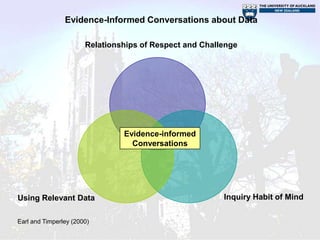
Evidence-Informed Conversations about Data

                       Relationships of Respect and Challenge


                                Evidence-informed
                                  Conversations


Using Relevant Data                                      Inquiry Habit of Mind


Earl and Timperley (2000)
How the Process Can Work:
       Two Sources of Evidence
1. The theory
Professional Learning and Development Best
    Evidence Synthesis iteration (2008)

2. The practice
Literacy Professional Development Project (LPDP)
    in NZ
  –   300 schools
  –   On average 2-3 times expected rate of progress
  –   Bottom 20% 3-4 times expected rate of progress
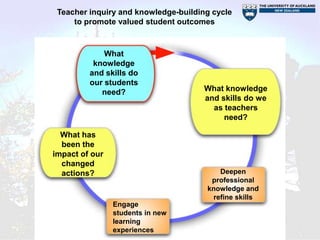
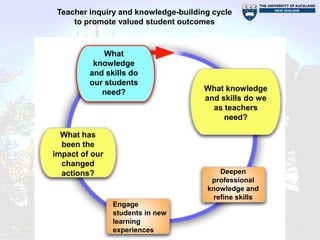
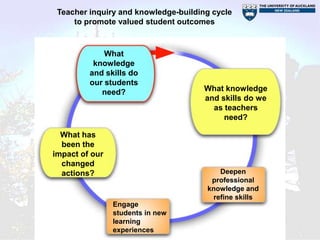
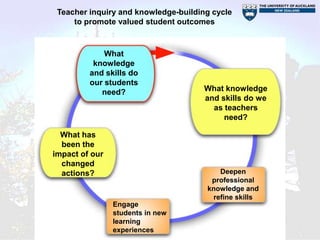
Teacher inquiry and knowledge-building cycle
     to promote valued student outcomes


             What
          knowledge
         and skills do
         our students
            need?                     What knowledge
                                      and skills do we
                                        as teachers
                                           need?

  What has
  been the
impact of our
  changed
  actions?                               Deepen
                                       professional
                                      knowledge and
                                       refine skills
                Engage
                students in new
                learning
                experiences
Teachers Inquiring into Students’
      Knowledge and Skills

• What do the students already know?
• What sources of evidence have we used?
• What do the students need to learn and
  do?
• How do we build on what they know?
Within the LPDP Project
• Students assessed using assessment
  Tools for Teaching and learning (asTTle)

• Facilitated interpretation of how to score it
  and what the results mean with teachers
  and leaders

-at the same time as …
Teacher inquiry and knowledge-building cycle
     to promote valued student outcomes


             What
          knowledge
         and skills do
         our students
            need?                     What knowledge
                                      and skills do we
                                        as teachers
                                           need?

  What has
  been the
impact of our
  changed
  actions?                               Deepen
                                       professional
                                      knowledge and
                                       refine skills
                Engage
                students in new
                learning
                experiences
Teachers Inquiring into Own
       Knowledge and Skills
• How have we contributed to existing
  student outcomes?
• What do we already know that we can use
  to promote improved outcomes for
  students?
• What do we need to learn and do to
  promote these outcomes?
• What sources of evidence / knowledge
  can we utilise?
Within the LPDP Project
• With expert facilitators, the teachers:
• Relate student data to programme
  emphases;
• Respond to a scenario of (mostly
  ineffective) practice and discuss results;
• Interpret a set of hypothetical data and
  discuss different interpretations
Facilitators also observe teaching practice
  and analyse it with teachers
Teacher inquiry and knowledge-building cycle
     to promote valued student outcomes


             What
          knowledge
         and skills do
         our students
            need?                     What knowledge
                                      and skills do we
                                        as teachers
                                           need?

  What has
  been the
impact of our
  changed
  actions?                               Deepen
                                       professional
                                      knowledge and
                                       refine skills
                Engage
                students in new
                learning
                experiences
Deepen Professional Knowledge
        and Refine Skills
Three principles:
• Focus on the teaching / learning links;
  – Explicit that the purpose is to improve learning
• Integrate knowledge and skills
  – Curriculum, assessment, pedagogical
  – Theory and practice (over-assimilation)
  – Multiple opportunities to learn and apply (1 – 2 years)
• Engage teachers’ existing ideas about students,
  assessment, curriculum and how to teach it
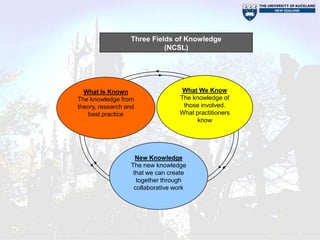
Three Fields of Knowledge
                            (NCSL)


  What Is Known                    What We Know
The knowledge from                The knowledge of
theory, research and               those involved.
    best practice                 What practitioners
                                        know


                    New Knowledge
                  The new knowledge
                   that we can create
                    together through
                   collaborative work
Within the LPDP Project
• Students are the “touchstone” throughout;
• Facilitators work with school literacy
  leaders to develop teachers’ pedagogical
  content knowledge;
• Flexible but specific to develop adaptive
  expertise;
• Teachers’ beliefs (theories of practice)
  engaged
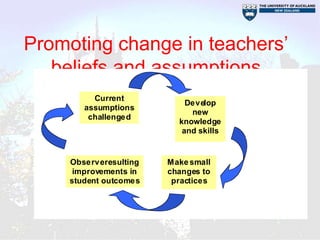
Promoting change in teachers’
   beliefs and assumptions
          Current
                            Develop
        assumptions
                             new
         challenged
                          knowledge
                           and skills


     Observeresulting   Make small
      improvements in   changes to
     student outcomes    practices
Teacher inquiry and knowledge-building cycle
     to promote valued student outcomes


             What
          knowledge
         and skills do
         our students
            need?                     What knowledge
                                      and skills do we
                                        as teachers
                                           need?

  What has
  been the
impact of our
  changed
  actions?                               Deepen
                                       professional
                                      knowledge and
                                       refine skills
                Engage
                students in new
                learning
                experiences
Judging Impact
• How effective is what we have learned and
  done been in promoting our students’
  learning and well-being?
  – Means the use of assessment information on
    a daily, weekly, term by term and annual
    basis
    • Using a range of assessment tools
Assessment Information is NOT a
         single event


• Pervades all aspects of the cycle
  – Identifying what students need to learn
  – Identifying what teachers need to learn
  – Checking impact of changes to practice
Beliefs, knowledge and Skills of
           School Leaders
• Teachers cannot do it alone
• To lead effectively, leaders must know
  their class so they can:
  – Create a vision of new possibilities
  – Lead the learning
  – Organise the learning opportunities
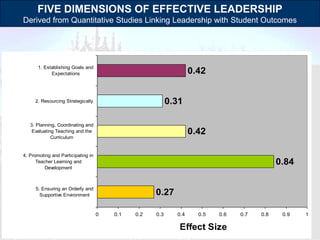
FIVE DIMENSIONS OF EFFECTIVE LEADERSHIP
Derived from Quantitative Studies Linking Leadership with Student Outcomes


      1. Establishing Goals and
            Expectations                                          0.42


     2. Resourcing Strategically                          0.31

   3. Planning, Coordinating and
    Evaluating Teaching and the                                   0.42
             Curriculum


4. Promoting and Participating in
      Teacher Learning and                                                                  0.84
          Development


     5. Ensuring an Orderly and
       Supportive Environment                       0.27

                                    0   0.1   0.2   0.3     0.4     0.5   0.6   0.7   0.8    0.9   1

                                                             Effect Size
If leaders are to lead the learning:
 Must know their class of teachers
• What do the teachers already know?
• What do the leaders need to learn and do
  to make a difference to teacher learning
  and valued student outcomes?
• How are the leaders systematically
  building on what the teachers already
  know and can do?
• How are they checking impact
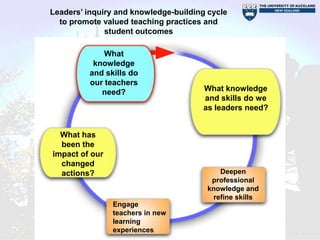
Leaders’ inquiry and knowledge-building cycle
  to promote valued teaching practices and
              student outcomes

              What
           knowledge
          and skills do
          our teachers
             need?                    What knowledge
                                      and skills do we
                                      as leaders need?


  What has
  been the
impact of our
  changed
  actions?                                Deepen
                                        professional
                                       knowledge and
                                        refine skills
                Engage
                teachers in new
                learning
                experiences
Within the LPDP
• Literacy leaders willingly engage and
  recognise their need to learn if they are to
  teach others

• Principals less so
  – Tend to focus on structures and processes to
    promote others’ learning
What about us as system leaders?
• Who is your class and how well do you
  know them as learners?
• What do we need to learn and do to make
  a difference in ways that impact on valued
  student outcomes?
• How are we systematically building on
  what those for whom we have
  responsibility already know and can do?
• How are we checking impact?
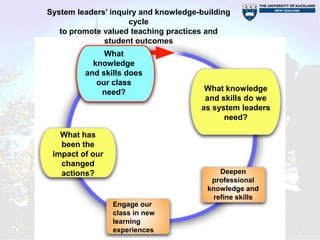
System leaders’ inquiry and knowledge-building
                     cycle
   to promote valued teaching practices and
              student outcomes
              What
           knowledge
         and skills does
            our class
             need?                     What knowledge
                                       and skills do we
                                      as system leaders
                                            need?

   What has
   been the
 impact of our
   changed
   actions?                                Deepen
                                         professional
                                        knowledge and
                                         refine skills
                 Engage our
                 class in new
                 learning
                 experiences
Conclusion
• Teachers can use data to improve
  teaching practice in ways that work for
  students
• Requires
  – Curriculum-relevant assessments
  – All layers of the system to know their learners
  – Development of the beliefs, knowledge and
    skills needed for each to enact their
    responsibility throughout the system
References
Earl, L. & Timperley, H. (2009). Professional
  Learning Conversations: Challenges in Using
  Evidence. Springer.
Timperley, H. & Parr, J. (2009). Chain of Influence
  from Policy to Practice in the New Zealand
  Literacy Strategy. Research Papers in
  Education, 24(2), 135-154,
Timperley, H., Wilson, A., Barrar, H. & Fung, I.
  (2008) Teacher Professional Learnng and
  Development: A Best Evidence Iteration.
  http://educationcounts.edcentre.govt.na/goto/BE
  S

Using assessment data for improving teaching practice acer conference 2009 ppt

  • 1.
    Using Assessment Datafor Improving Teaching Practice ACER Conference 17 - 18 August 2009 Professor Helen Timperley Faculty of Education University of Auckland
  • 2.
    Formative assessment forstudents Allows them to answer the questions Where am I going? How am I doing? Where to next? Hattie & Timperley (2007)
  • 3.
    Formative assessment for TEACHERS Allows them to answer the questions Where am I going? How am I doing? Where to next?
  • 4.
    Required Conditions • Relevantassessment data • Beliefs, knowledge and skills of teachers • Beliefs, knowledge and skills of school leaders
  • 5.
    Relevant Assessment Data •Provides teachers with curriculum relevant information about; – Where their students are at – What their students need to learn next – In a timely manner • Can be of many different kinds
  • 6.
    Beliefs, knowledge andskills of teachers • Inquiry habit of mind – Data can inform teaching and learning (not labels for students) • Sufficient knowledge of the meaning of the data to make appropriate adjustments to practice • Sufficient pedagogical content knowledge to make relevant adjustments to practice
  • 7.
    Beliefs, knowledge andskills of leaders • Skilled enough to have conversations about the data with teachers; • Inquiry habit of mind – Data can inform teaching and learning • Know enough to lead the changes required for teachers to use data; • Engage in systematic evidence-informed cycles of inquiry
  • 8.
    Relationships of Respectand Challenge • Context for learning is social if to have a system change rather than patches of brilliance – Probing meanings, challenging interpretation of the evidence and reasoning – Respect for the capacity of all to learn and improve
  • 9.
    Evidence-Informed Conversations aboutData Relationships of Respect and Challenge Evidence-informed Conversations Using Relevant Data Inquiry Habit of Mind Earl and Timperley (2000)
  • 10.
    How the ProcessCan Work: Two Sources of Evidence 1. The theory Professional Learning and Development Best Evidence Synthesis iteration (2008) 2. The practice Literacy Professional Development Project (LPDP) in NZ – 300 schools – On average 2-3 times expected rate of progress – Bottom 20% 3-4 times expected rate of progress
  • 11.
    Teacher inquiry andknowledge-building cycle to promote valued student outcomes What knowledge and skills do our students need? What knowledge and skills do we as teachers need? What has been the impact of our changed actions? Deepen professional knowledge and refine skills Engage students in new learning experiences
  • 12.
    Teachers Inquiring intoStudents’ Knowledge and Skills • What do the students already know? • What sources of evidence have we used? • What do the students need to learn and do? • How do we build on what they know?
  • 13.
    Within the LPDPProject • Students assessed using assessment Tools for Teaching and learning (asTTle) • Facilitated interpretation of how to score it and what the results mean with teachers and leaders -at the same time as …
  • 14.
    Teacher inquiry andknowledge-building cycle to promote valued student outcomes What knowledge and skills do our students need? What knowledge and skills do we as teachers need? What has been the impact of our changed actions? Deepen professional knowledge and refine skills Engage students in new learning experiences
  • 15.
    Teachers Inquiring intoOwn Knowledge and Skills • How have we contributed to existing student outcomes? • What do we already know that we can use to promote improved outcomes for students? • What do we need to learn and do to promote these outcomes? • What sources of evidence / knowledge can we utilise?
  • 16.
    Within the LPDPProject • With expert facilitators, the teachers: • Relate student data to programme emphases; • Respond to a scenario of (mostly ineffective) practice and discuss results; • Interpret a set of hypothetical data and discuss different interpretations Facilitators also observe teaching practice and analyse it with teachers
  • 17.
    Teacher inquiry andknowledge-building cycle to promote valued student outcomes What knowledge and skills do our students need? What knowledge and skills do we as teachers need? What has been the impact of our changed actions? Deepen professional knowledge and refine skills Engage students in new learning experiences
  • 18.
    Deepen Professional Knowledge and Refine Skills Three principles: • Focus on the teaching / learning links; – Explicit that the purpose is to improve learning • Integrate knowledge and skills – Curriculum, assessment, pedagogical – Theory and practice (over-assimilation) – Multiple opportunities to learn and apply (1 – 2 years) • Engage teachers’ existing ideas about students, assessment, curriculum and how to teach it
  • 19.
    Three Fields ofKnowledge (NCSL) What Is Known What We Know The knowledge from The knowledge of theory, research and those involved. best practice What practitioners know New Knowledge The new knowledge that we can create together through collaborative work
  • 20.
    Within the LPDPProject • Students are the “touchstone” throughout; • Facilitators work with school literacy leaders to develop teachers’ pedagogical content knowledge; • Flexible but specific to develop adaptive expertise; • Teachers’ beliefs (theories of practice) engaged
  • 21.
    Promoting change inteachers’ beliefs and assumptions Current Develop assumptions new challenged knowledge and skills Observeresulting Make small improvements in changes to student outcomes practices
  • 22.
    Teacher inquiry andknowledge-building cycle to promote valued student outcomes What knowledge and skills do our students need? What knowledge and skills do we as teachers need? What has been the impact of our changed actions? Deepen professional knowledge and refine skills Engage students in new learning experiences
  • 23.
    Judging Impact • Howeffective is what we have learned and done been in promoting our students’ learning and well-being? – Means the use of assessment information on a daily, weekly, term by term and annual basis • Using a range of assessment tools
  • 25.
    Assessment Information isNOT a single event • Pervades all aspects of the cycle – Identifying what students need to learn – Identifying what teachers need to learn – Checking impact of changes to practice
  • 26.
    Beliefs, knowledge andSkills of School Leaders • Teachers cannot do it alone • To lead effectively, leaders must know their class so they can: – Create a vision of new possibilities – Lead the learning – Organise the learning opportunities
  • 27.
    FIVE DIMENSIONS OFEFFECTIVE LEADERSHIP Derived from Quantitative Studies Linking Leadership with Student Outcomes 1. Establishing Goals and Expectations 0.42 2. Resourcing Strategically 0.31 3. Planning, Coordinating and Evaluating Teaching and the 0.42 Curriculum 4. Promoting and Participating in Teacher Learning and 0.84 Development 5. Ensuring an Orderly and Supportive Environment 0.27 0 0.1 0.2 0.3 0.4 0.5 0.6 0.7 0.8 0.9 1 Effect Size
  • 28.
    If leaders areto lead the learning: Must know their class of teachers • What do the teachers already know? • What do the leaders need to learn and do to make a difference to teacher learning and valued student outcomes? • How are the leaders systematically building on what the teachers already know and can do? • How are they checking impact
  • 29.
    Leaders’ inquiry andknowledge-building cycle to promote valued teaching practices and student outcomes What knowledge and skills do our teachers need? What knowledge and skills do we as leaders need? What has been the impact of our changed actions? Deepen professional knowledge and refine skills Engage teachers in new learning experiences
  • 30.
    Within the LPDP •Literacy leaders willingly engage and recognise their need to learn if they are to teach others • Principals less so – Tend to focus on structures and processes to promote others’ learning
  • 31.
    What about usas system leaders? • Who is your class and how well do you know them as learners? • What do we need to learn and do to make a difference in ways that impact on valued student outcomes? • How are we systematically building on what those for whom we have responsibility already know and can do? • How are we checking impact?
  • 32.
    System leaders’ inquiryand knowledge-building cycle to promote valued teaching practices and student outcomes What knowledge and skills does our class need? What knowledge and skills do we as system leaders need? What has been the impact of our changed actions? Deepen professional knowledge and refine skills Engage our class in new learning experiences
  • 33.
    Conclusion • Teachers canuse data to improve teaching practice in ways that work for students • Requires – Curriculum-relevant assessments – All layers of the system to know their learners – Development of the beliefs, knowledge and skills needed for each to enact their responsibility throughout the system
  • 34.
    References Earl, L. &Timperley, H. (2009). Professional Learning Conversations: Challenges in Using Evidence. Springer. Timperley, H. & Parr, J. (2009). Chain of Influence from Policy to Practice in the New Zealand Literacy Strategy. Research Papers in Education, 24(2), 135-154, Timperley, H., Wilson, A., Barrar, H. & Fung, I. (2008) Teacher Professional Learnng and Development: A Best Evidence Iteration. http://educationcounts.edcentre.govt.na/goto/BE S