2012


© R. Hollis
Levels Of Accountability Across the System
                                            PLANS ALIGNED WITH
                                            SCHOOL PLANS & INCLUDE:

                                            1. PROFESSIONAL
                                               LEARNING &
                                               DEVELOPMENT PLANS

                                            2.   STANDARDS AND
                                                 EVIDENCE
PRINCIPAL’S PLAN:

1. STRATEGIC DIRECTION
   FOR SCHOOL IMPROVEMENT
                                          SPECIFIC TARGETS IN:
2. PROFESSIONAL LEARNING
                                          1. STUDENT LEARNING
   FOCI
                                          2. STUDENT ENGAGEMENT &
3. STRUCTURE, POLICY &
                                             WELLBEING
PROGRAM DEVELOPMENT &
IMPLEMENTATION
                                          3. STUDENT PATHWAYS &
                                             TRANSITIONS


                            © R. Hollis
Staff Professional Action Plan and Appraisal

At Chaffey Secondary College we have linked our Professional
Learning and Development Model to our Appraisal process.

Why?

   Seamless and ongoing
   The ‘work’ should be the ‘work’
   All on the same page from Leadership to classroom
   Evidence shows us there are identifiable features of
    successful schools and classrooms that require consistent
    application.

                  © R. Hollis
Chaffey Secondary College as a Learning
                 Community
For any learner or learning community (student, teacher,
school), the effectiveness of any formative assessment
process depends on being able to answer 3 questions.

 Where am I going?
 How am I doing?
 Where to next?


              © R. Hollis
The Process
The Professional Action Learning Plan (PALP) and
Appraisal will incorporate two elements:

1. Cycles of Inquiry and knowledge building for teacher
professional practice

2. Review and Reflection – Assessment Standards

1. Timperley, H. (2011) Using Student Assessment for Professional learning: focussing on students’ outcomes to identify teachers’
needs. Paper no. 21.

2. Jensen, B. (2011) Better Teacher Appraisal and Feedback: Improving Performance. Grattan Institute.


                                  © R. Hollis
1. Cycles of Inquiry and knowledge building for
teacher professional practice
This Action focussed model will guide teachers through cycles of development to
improve knowledge, skill and understanding.
                                                      1. What
                                                     knowledge
                                                    and skills do
                                                    our students
                                                       need?

Professional
Learning                  5. What has
                            been the
                                                                               2. What
                                                                              knowledge
and                      impact of our                                      and skill do we
                            changed                                           as teachers
Practice                    actions?                                             need?


                                                                     3. Deepen
                                       4. Engage
                                                                    Professional
                                      students in
                                                                    Knowledge
                                     new learning
                                                                     and refine
                                     experiences.
                                                                        skills.


                       © R. Hollis
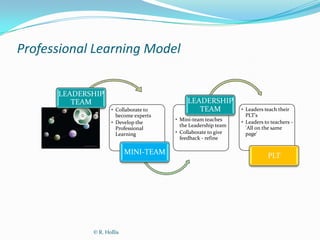
Professional Learning Model


      LEADERSHIP
         TEAM                               LEADERSHIP
                    • Collaborate to           TEAM            • Leaders teach their
                      become experts                             PLT's
                                       • Mini-team teaches     • Leaders to teachers -
                    • Develop the
                                         the Leadership team     'All on the same
                      Professional
                      Learning         • Collaborate to give     page'
                                         feedback - refine

                           MINI-TEAM                                      PLT


             © R. Hollis
2. Review and Reflection – Assessment Standards
  Targeted opportunities for teachers to use data and evidence to identify challenges, needs and
  improvement (teacher and student) using four assessment methods: Student Performance and
  Assessment; Peer Observation and Collaboration; Student Surveys and Feedback; Direct
  Observation of Classroom Teaching and Learning.


                                                     Student Performance
                           Review and Reflection -
                            Assessment Standards
                                                       and Assessments
How we will
gather the
‘base-line’
                                                      Peer Observation
data and data                                         and Collaboration
for reflection,
evaluation                                           Student Surveys and
and evidence.
                                                          Feedback

                                                     Direct Observation -
                                                     Classroom practice

                              © R. Hollis
The Professional Action Learning Plan (PALP) and
                   Appraisal

 Professional Action Learning will occur on an ongoing basis and be
  monitored through the Professional Learning Teams.
 All teaching staff will participate in the full Calendar of Professional
  Learning including the practical elements required in classrooms.
 An Individual Action Plan (SMART goal) will enable staff to pursue
  development in a specific area of their choice appropriate to their need,
  classification and/or role.


                   © R. Hollis
1. What


Professional Action Learning Portfolio
                                                                                        knowledge
                                                                                         and skills
                                                                                           do our
                                                                                         students
                                                                                           need?
                                                     5. What has                                                2. What
                                                       been the                                               knowledge
                                                      impact of                                               and skill do


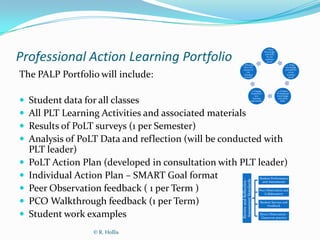
The PALP Portfolio will include:                         our
                                                       changed
                                                       actions?
                                                                                                                 we as
                                                                                                               teachers
                                                                                                                 need?


                                                                           4. Engage                   3. Deepen
                                                                          students in                 Professional
                                                                              new                     Knowledge

   Student data for all classes                                            learning
                                                                         experiences.
                                                                                                       and refine
                                                                                                          skills.


   All PLT Learning Activities and associated materials
   Results of PoLT surveys (1 per Semester)
   Analysis of PoLT Data and reflection (will be conducted with
    PLT leader)
   PoLT Action Plan (developed in consultation with PLT leader)
   Individual Action Plan – SMART Goal format                                    Student Performance


                                                     Review and Reflection -
                                                     Assessment Standards
                                                                                    and Assessments

   Peer Observation feedback ( 1 per Term )                                     Peer Observation and
                                                                                     Collaboration


   PCO Walkthrough feedback (1 per Term)                                         Student Surveys and
                                                                                       Feedback


   Student work examples                                                         Direct Observation -
                                                                                  Classroom practice


                  © R. Hollis
The Professional Learning Team
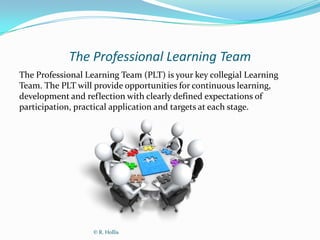
The Professional Learning Team (PLT) is your key collegial Learning
Team. The PLT will provide opportunities for continuous learning,
development and reflection with clearly defined expectations of
participation, practical application and targets at each stage.


                   © R. Hollis
Inside your Portfolio…
Your Portfolio contents:

 A copy of the PowerPoint
 S.M.A.R.T Goal info sheet
 S.M.A.R.T Goal Action Plan template
 Examples of:
      PoLT teacher Questionnaire (PoLT Component Mapping
      PoLT Student Learning Survey
      PoLT Student Perceptions Survey (Middle and Later Years)
   Analysis of PoLT Data Sheet
   PoLT Individual Action Plan Template
   A Summary of the PoLT Principles
   PoLT Unpacked (detailed information about PoLT Principles)
   Ladder of Feedback
   Protocols for Giving and Receiving Feedback


                      © R. Hollis
Timeline
The Professional Learning Calendar has been emailed to you and is also
available at on the Chaffey Secondary School Webiste

The Cycle of Appraisal will be:


Jan 2012 – Dec 2012: During early 2012 all staff will meet with their PLT
leader to discuss Professional Learning and Development Plans (PoLT
Goal and SMART Goal) to be actioned throughout 2012. Progress
meetings will occur during Term 2, 3 and 4.


                   © R. Hollis
Resources and Information

http://www.eduweb.vic.gov.au/edulibrary/public/account/operate/saif2011/aifguidelines3.pdf

http://www.eduweb.vic.gov.au/edulibrary/public/account/operate/saif2011/sspguidelines3.pdf

http://www.eduweb.vic.gov.au/edulibrary/public/account/operate/saif2011/aipguidelines3.pdf

http://www.eduweb.vic.gov.au/edulibrary/public/account/operate/saif2011/Perf_and_Dev_Culture_2011.pdf

http://www.eduweb.vic.gov.au/edulibrary/public/teachlearn/innovation/e5/E5_A1PosterTable4.pdf

http://www.education.vic.gov.au/studentlearning/teachingprinciples/


                               © R. Hollis

Professional action learning plan and portfolio

  • 1.
  • 2.
    Levels Of AccountabilityAcross the System PLANS ALIGNED WITH SCHOOL PLANS & INCLUDE: 1. PROFESSIONAL LEARNING & DEVELOPMENT PLANS 2. STANDARDS AND EVIDENCE PRINCIPAL’S PLAN: 1. STRATEGIC DIRECTION FOR SCHOOL IMPROVEMENT SPECIFIC TARGETS IN: 2. PROFESSIONAL LEARNING 1. STUDENT LEARNING FOCI 2. STUDENT ENGAGEMENT & 3. STRUCTURE, POLICY & WELLBEING PROGRAM DEVELOPMENT & IMPLEMENTATION 3. STUDENT PATHWAYS & TRANSITIONS © R. Hollis
  • 3.
    Staff Professional ActionPlan and Appraisal At Chaffey Secondary College we have linked our Professional Learning and Development Model to our Appraisal process. Why?  Seamless and ongoing  The ‘work’ should be the ‘work’  All on the same page from Leadership to classroom  Evidence shows us there are identifiable features of successful schools and classrooms that require consistent application. © R. Hollis
  • 4.
    Chaffey Secondary Collegeas a Learning Community For any learner or learning community (student, teacher, school), the effectiveness of any formative assessment process depends on being able to answer 3 questions.  Where am I going?  How am I doing?  Where to next? © R. Hollis
  • 5.
    The Process The ProfessionalAction Learning Plan (PALP) and Appraisal will incorporate two elements: 1. Cycles of Inquiry and knowledge building for teacher professional practice 2. Review and Reflection – Assessment Standards 1. Timperley, H. (2011) Using Student Assessment for Professional learning: focussing on students’ outcomes to identify teachers’ needs. Paper no. 21. 2. Jensen, B. (2011) Better Teacher Appraisal and Feedback: Improving Performance. Grattan Institute. © R. Hollis
  • 6.
    1. Cycles ofInquiry and knowledge building for teacher professional practice This Action focussed model will guide teachers through cycles of development to improve knowledge, skill and understanding. 1. What knowledge and skills do our students need? Professional Learning 5. What has been the 2. What knowledge and impact of our and skill do we changed as teachers Practice actions? need? 3. Deepen 4. Engage Professional students in Knowledge new learning and refine experiences. skills. © R. Hollis
  • 7.
    Professional Learning Model LEADERSHIP TEAM LEADERSHIP • Collaborate to TEAM • Leaders teach their become experts PLT's • Mini-team teaches • Leaders to teachers - • Develop the the Leadership team 'All on the same Professional Learning • Collaborate to give page' feedback - refine MINI-TEAM PLT © R. Hollis
  • 8.
    2. Review andReflection – Assessment Standards Targeted opportunities for teachers to use data and evidence to identify challenges, needs and improvement (teacher and student) using four assessment methods: Student Performance and Assessment; Peer Observation and Collaboration; Student Surveys and Feedback; Direct Observation of Classroom Teaching and Learning. Student Performance Review and Reflection - Assessment Standards and Assessments How we will gather the ‘base-line’ Peer Observation data and data and Collaboration for reflection, evaluation Student Surveys and and evidence. Feedback Direct Observation - Classroom practice © R. Hollis
  • 9.
    The Professional ActionLearning Plan (PALP) and Appraisal  Professional Action Learning will occur on an ongoing basis and be monitored through the Professional Learning Teams.  All teaching staff will participate in the full Calendar of Professional Learning including the practical elements required in classrooms.  An Individual Action Plan (SMART goal) will enable staff to pursue development in a specific area of their choice appropriate to their need, classification and/or role. © R. Hollis
  • 10.
    1. What Professional ActionLearning Portfolio knowledge and skills do our students need? 5. What has 2. What been the knowledge impact of and skill do The PALP Portfolio will include: our changed actions? we as teachers need? 4. Engage 3. Deepen students in Professional new Knowledge  Student data for all classes learning experiences. and refine skills.  All PLT Learning Activities and associated materials  Results of PoLT surveys (1 per Semester)  Analysis of PoLT Data and reflection (will be conducted with PLT leader)  PoLT Action Plan (developed in consultation with PLT leader)  Individual Action Plan – SMART Goal format Student Performance Review and Reflection - Assessment Standards and Assessments  Peer Observation feedback ( 1 per Term ) Peer Observation and Collaboration  PCO Walkthrough feedback (1 per Term) Student Surveys and Feedback  Student work examples Direct Observation - Classroom practice © R. Hollis
  • 11.
    The Professional LearningTeam The Professional Learning Team (PLT) is your key collegial Learning Team. The PLT will provide opportunities for continuous learning, development and reflection with clearly defined expectations of participation, practical application and targets at each stage. © R. Hollis
  • 12.
    Inside your Portfolio… YourPortfolio contents:   A copy of the PowerPoint  S.M.A.R.T Goal info sheet  S.M.A.R.T Goal Action Plan template  Examples of:  PoLT teacher Questionnaire (PoLT Component Mapping  PoLT Student Learning Survey  PoLT Student Perceptions Survey (Middle and Later Years)  Analysis of PoLT Data Sheet  PoLT Individual Action Plan Template  A Summary of the PoLT Principles  PoLT Unpacked (detailed information about PoLT Principles)  Ladder of Feedback  Protocols for Giving and Receiving Feedback © R. Hollis
  • 13.
    Timeline The Professional LearningCalendar has been emailed to you and is also available at on the Chaffey Secondary School Webiste The Cycle of Appraisal will be: Jan 2012 – Dec 2012: During early 2012 all staff will meet with their PLT leader to discuss Professional Learning and Development Plans (PoLT Goal and SMART Goal) to be actioned throughout 2012. Progress meetings will occur during Term 2, 3 and 4. © R. Hollis
  • 14.

Editor's Notes

  • #2 Previous work – Heather Birch (SMART GOAL)
  • #3 Further layers exist within the core – Departmental Priorities and Initiatives influence the Strategic direction of the plans. At the school level the AIP has specific targets around 3 main areas:Student LearningStudent Engagement and WellbeingStudent Pathways and TransitionsThis is an important document to be familiar with.PRINCIPAL PERFORMANCE AND DEVELOPMENT PLANSSets the strategic direction and plan for school improvement to reach the targets of the AIP. Identifies and specifies Professional Learning Foci (The Planets) and steers the development of the policies, programs, structures and resources to support the AIP towards success.STAFF PERFORAMNCE AND DEVELOPMENT PLANSIncludes plans for professional learning and development closely aligned with the other plans – some of this is pre-determined by the other plans. (eg. The Planets). The plans must also reflect the standards and evidence that is required of staff at their classification and role.The Annual Implementation Plan
  • #4 Rather than have performance and appraisal measured at arbitrary points in time we are completing the requirements step-by-step over time.The learning and development must be connected to the classroom in real ways rather than artificially derived to meet a performance indicator at an appraisal meeting. The teachers day to day work is the ultimate decider of student success.Leadership is engaged in the process as learners and facilitators. As PLT Leaders they will guide and support you through the process.Whilst there is a ‘Zone of Discretion’ in each teachers classroom and professional decisions are required daily to best meet the needs of individual students and classes, there are common practices we seek to imbed and students should be able to see and access some consistent practices and methods across there classes, not the least of which is the approach to certain writing tasks. (p. 17 – Timperley: Case Study – Where teachers deepened their pedagogical knowledge of writing and were able to give specific feedback related to the learning objectives they were successful in raising their students results. This is what we are attempting to do with the focus on writing we began last year.)
  • #5 We must keep these questions at the forefront of our work together and also provide opportunities for our students to have clear information and assistance to answer these questions for themselves. Our Professional Learning ‘Planets’ will help us to gain the knowledge, skill and understanding to be able to reflect on how we are doing as individuals, in our teams and as a school.
  • #6 The first one (Cycles of Inquiry and knowledge building for teacher professional practice) is primarily the Professional Learning we do, particularly the PLT work around the Planets and the practical application in the classroom. The second one, (Review and Reflection – Assessment standards) is how we DO the work, the methods and tools we use for reflection and evaluation. It is how we monitor our own and our student’s progress and achievement against standards and expectations.
  • #7 The work we have did in our PLT’s last year followed this Action based model. At stage 1 we identified particular needs from our students through data and feedback from student data, walkthroughs, Instructional Rounds etc. At stage 2, 4 Theories of Action: Learning Intentions, Written responses, Success Criteria and Feedback became the basis for the Knowledge and Skill building we believed necessary (this was also influenced by the Regional Plan). In stage 3 we engaged in Professional Learning through our PLT’s and in stage 4 we applied this in practical ways in our classrooms. At stage 5 we received feedback from our colleagues through Peer Observations, engaged in reflection and presented evidence of the effects of the changed practices.
  • #8 Our Professional learning Model from 2011 and now in 2012.The ‘Planets’ will guide us through a full Calendar of Learning. The Leadership team engages in Professional Learning by forming small teams to investigate, research and develop the Professional Development around each of the Planets. This mini-team teaches the Leadership Team and receives feedback. The PD is refined and changed as a result of the feedback. PLT Leaders then deliver the PD to their PLT teams and monitor the professional actions required from the members. We expect that the our experiences of the Learning will be challenging yet supported at every stage.
  • #9 These 4 Assessment Standards will be used by all teachers to provide the data needed for planning, feedback, reflection, evaluation and evidence of our Professional learning and Development and its practical application in the classroom. It is how we go about answering for ourselves and our students the three key questions of where am I going, how am I doing and where to next?
  • #10 The ‘Planets’ of Professional learning will guide us through our requirements for learning for the year. We will support each other in this process through the work we do together in our PLT’s.Learning and Appraisal will run concurrently throughout the year. As staff engage in the PLT Learning and Actions they will be meeting those requirements of their appraisal.There is an opportunity for staff to pursue specific and individual development that is connected to their classification, role or a particular need.
  • #11 The Portfolio will initially be a hard copy file of the elements you see on the screen. As we develop the Portfolio we would like to move it to the Staff Ultranet space. The student data refers to a variety of data available to you and that you should be referring to as you begin every new class with your students: A good starting point is the Data Sheet Toppy created for Course Counselling – it provides a great snapshot of each student. Be mindful of needing collecting and referring to data for specific and special reasons such as Koorie Education and learning Plans, PSD plans, Individual Student Education Plans etc. Data may be ‘base-line’ and also ‘post test or intervention’. It can be used for reflection, evaluation and planning as you move through continuous cycles of inquiry and knowledge building with your students.We will be using the same model of Professional Learning as we did last year – The Leadership team will be expected to engage in Professional Learning and in turn lead the PLT’s through the same learning. Each ‘Planet’ will have associated activities and requirements. These must be included in the Portfolio.PoLT surveys – We used these some time ago in the College and they provide excellent data for teachers to reflect on and use in planning. The surveys have both teacher and student components. They can be completed on the computer. A reflection activity will have each individual analyse the results of their surveys and form a plan of action around the results of the survey. This is not intended to be arduous or difficult. It is designed to have teachers respond to the identified needs of their students. Often there are small things that can be done that have a huge impact. The PLT leader will assist each teacher in this process.The PoLT Action Plan is formed from this process. – Again it need not be a huge amount of work. However, the plan will be evaluated by the teacher for its effectiveness as we get towards the end of the year.The Individual Action Plan can be connected to the PoLT plan or may be something different depending on the teachers need, classification and/or role.Peer Observation – we did these last year and they will continue. Evidence of the pre and post observation planning and feedback should be included in the Portfolio.The PLT leaders and PCO’s will do at least one Walkthrough on your class each term and provide you with feedback.Student Work Examples should feature in your portfolio to demonstrate the effects of the practical application of your learning, knowledge and skills.
  • #12 Keep everything you do in your portfolio as you proceed with your work.
  • #13 You will add to your Portfolio throughout the year. You should bring it to every PLT session and may be useful at your Learning Area meetings.