Chapter II
Professional Development
of Teachers
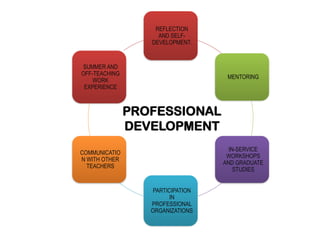
REFLECTION
AND SELF-
DEVELOPMENT.
MENTORING
IN-SERVICE
WORKSHOPS
AND GRADUATE
STUDIES
PARTICIPATION
IN
PROFESSIONAL
ORGANIZATIONS
COMMUNICATIO
N WITH OTHER
TEACHERS
SUMMER AND
OFF-TEACHING
WORK
EXPERIENCE
PROFESSIONAL
DEVELOPMENT
Forms of Professional Development
1. REFLECTION and SELF-DEVELOPMENT.
- The most competent professional is someone
proactive, one who takes charge and initiate his/her
own continuing professional development.
Forms of Professional Development
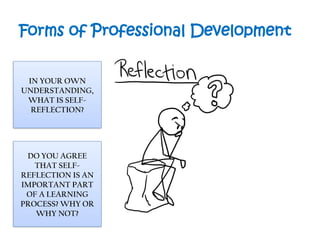
DO YOU AGREE
THAT SELF-
REFLECTION IS AN
IMPORTANT PART
OF A LEARNING
PROCESS? WHY OR
WHY NOT?
IN YOUR OWN
UNDERSTANDING,
WHAT IS SELF-
REFLECTION?
SELF-REFLECTION
• It is a way of assessing yourself, your ways of
working and how you study.
• It is about questioning(in a positive way)
 what you do and why you do it .
What went well and what could be the even
better.
deciding whether there is a better, or more
efficient, way of doing it in the future.
Forms of Professional Development
1. REFLECTION and SELF-DEVELOPMENT.
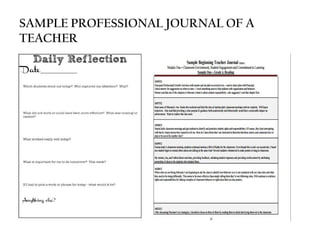
- One useful way of continuing to reflect, self-assess, and
grow personally is by maintaining a professional journal and
a professional career portfolio.
SAMPLE PROFESSIONAL PORTFOLIO OF AN
ELEMENTARY SCHOOL TEACHER
SAMPLE PROFESSIONAL PORTFOLIO OF AN
ELEMENTARY SCHOOL TEACHER
SAMPLE PROFESSIONAL PORTFOLIO OF AN
ELEMENTARY SCHOOL TEACHER
SAMPLE PROFESSIONAL JOURNAL OF A
TEACHER
Forms of Professional Development
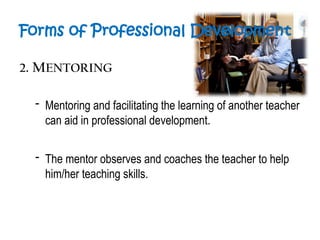
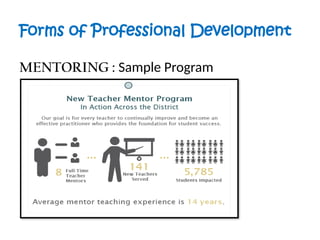
2. MENTORING
- Mentoring and facilitating the learning of another teacher
can aid in professional development.
- The mentor observes and coaches the teacher to help
him/her teaching skills.
Forms of Professional Development
MENTORING : Sample Program
Forms of Professional Development
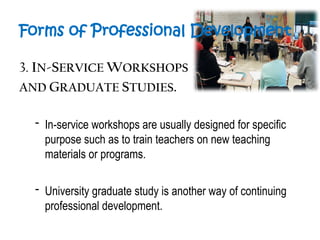
3. IN-SERVICE WORKSHOPS
AND GRADUATE STUDIES.
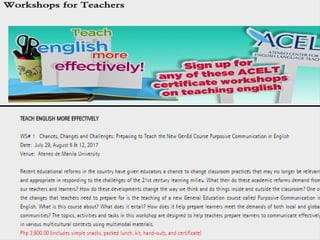
- In-service workshops are usually designed for specific
purpose such as to train teachers on new teaching
materials or programs.
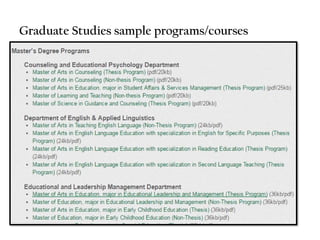
- University graduate study is another way of continuing
professional development.
Graduate Studies sample programs/courses
Forms of Professional Development
4. PARTICIPATION IN PROFESSIONAL
ORGANIZATION
- There are many professional local, national, and
international organizations that teacher can join for
professional advancement.
O
R
G
A
N
I
Z
A
T
I
O
N
S
What are the benefits of teachers in joining/
participating in organizations?
• Help you to interact with fellow teachers
• Gives you access to conferences and professional
development workshops
• Allows you to hone your teaching techniques and learn
about new breakthroughs in the field.
• Give back to the community
• Strength in Numbers
• Stay Inspired and Stay Motivated
• And MORE!!
Forms of Professional Development
5. COMMUNICATION WITH
OTHER TEACHERS.
- Visiting teachers in other schools, attending in-service
workshops , and graduate seminars and programs; and
participating in teacher study groups are valuable
experiences.
Forms of Professional Development
6. SUMMER AND OFF-WORK EXPERIENCE.
- These are government-sponsored programs that are
available to teachers during summer.
Forms of Professional Development
Armstrong (1980) pointed out that a professional
teacher’s preparation does not end with the
awarding of an academic degree. Bear in mind that
a professional development is a continuous
process.
Professional Behaviors of Teachers
According to Danielson’s (1966) study, true
professional teachers practice the following:
1. Reflect on their teaching. They thoughtfully
consider what was taught and how well it was
taught.
2. Maintain accurate records. They keep written
records to document student learning.
3. Communicate with families. They stay in written or
verbal contact with their students’ families to
support student progress.
Professional Behaviors of Teachers
4. Contribute to the school. They support functions
of the school.
5. Grow as professionals. They take courses and
workshops, and consult with others.
6. Show professionalism. They act as advocates for
students and families.
Peer Coaching: A Professional
Development Model
• The teacher as a reflective practitioner has become one of
the most consistent themes of teacher development. For
Dewey(1933) and Schön(1987), reflective thinking is not
just post active in nature, but proactive and interactive as
well. When reflection is done , teachers can appreciate that
the nature of their work engages them in a recursive cycle
of reflective thinking that involves planning, acting, and
reflecting (Lasley II, Matczynski, & Rowley 2002)
Peer Coaching: A Professional
Development Model
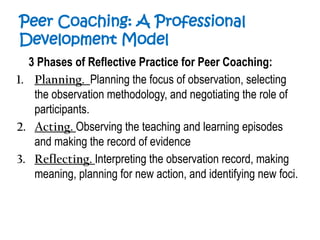
3 Phases of Reflective Practice for Peer Coaching:
1. Planning. Planning the focus of observation, selecting
the observation methodology, and negotiating the role of
participants.
2. Acting. Observing the teaching and learning episodes
and making the record of evidence
3. Reflecting. Interpreting the observation record, making
meaning, planning for new action, and identifying new foci.
MOTIVATION- TEETH
MECHANICS:
BATTLE SHIPS
Activity:
• Arrange all the captains in a circle, the ships' crews must line
up behind their
• captains. The shooter is the last crew member in line.
• The teacher must decide a lexical area of vocabulary, this
vocabulary will be used to defend their ships from the attacks.
Every students (except the shooters) must find their own
words. The lexical area for example, "Four Legged Animals".
Give the students 1-2 minutes to find as many possible words
as they can and memorize them.
• Start the game by calling a ship's name, for example the ship name is
"THE CALIFORNIAN". The captain of THE CALIFORNIAN must reply
with a word from the lexical area given, for example he says "TIGER"
followed by his crews behind him one by one, "COW"; "SHEEP" until
it is the shooter turns and he calls out the name of another ship and
the captain of the ship called must reply and his crews must do the
same thing. No word can be repeated.
• If the captain is late to reply (more than 2 seconds) or his crew can
not say the words or a word repeated or the shooter shoots the
wrong ship (his own ship or the ship that has already been sunk) the
ship is sunk, and the crew members can join the crew of another
ship.
• The teacher will change the lexical area for the next round.
• In the last round there will be two big groups battling to be the winner.
Domain of Knowledge of
Professional Teachers
Domain of Knowledge of
Professional Teachers
• A survey of the experiences of practicing teachers reveals,
among others, that there are several domains of knowledge
on which they could anchor the learning activities they
usually provide in the classroom. In this connection,
Schuman(1987) managed to organize the important
domains of knowledge of teachers into seven categories.
7 Domains of Knowledge of
Professional Teachers
1. Content of Knowledge
• Knowledge of particular subject to be taught.
examples: English, Math, Chemistry
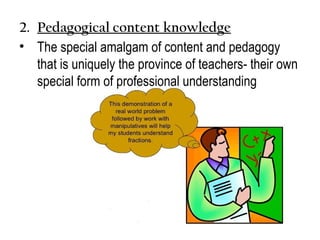
2. Pedagogical content knowledge
• The special amalgam of content and pedagogy
that is uniquely the province of teachers- their own
special form of professional understanding
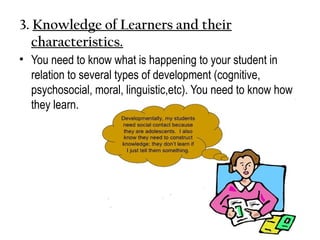
3. Knowledge of Learners and their
characteristics.
• You need to know what is happening to your student in
relation to several types of development (cognitive,
psychosocial, moral, linguistic,etc). You need to know how
they learn.
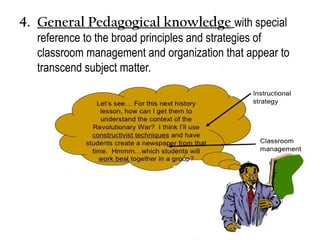
4. General Pedagogical knowledge with special
reference to the broad principles and strategies of
classroom management and organization that appear to
transcend subject matter.
5. Knowledge of educational contexts
• The contexts in which teaching and learning take place,
which make a significant impact on both teacher and pupils.
• For example: cultures, communities of which pupils come,
the size of school, class size, the amount for support for
teachers, the quality of relationships in the school, the
expectations and attitudes of the head teacher and how
group, classroom, and school organization and government
work.
6. Curriculum knowledge
• with a particular grasp of the materials and programs on
which your teaching is based.
7. Knowledge of educational ends, purpose
and values and their philosophical and
historical grounds
• Generally implicit knowledge which underpins and
influences classroom activity
For example: whether education is viewed as being
intrinsically valuable or as an extrinsic, more utilitarian
activity, the purpose of which is to prepare pupils for
employment.
Domain of Knowledge of
Professional Teachers
• Apparently, teachers who are equipped with the
knowledge domains of teachers coupled with the
needed management skills, organization skills in
teaching, study skills, and social skills are on the
road toward effective teaching, which is the product
of professional development.
Professional Teachers are
Clear Teachers
• Clear teachers are the product of professional
development.
• Instructional clarity – refers to the teachers ability
to promote instruction that helps students come to a
clear understanding of the lesson.
• Clarity is something students achieve and NOT
something the teacher does.
Professional Teachers are
Clear Teachers
• Cruickshank, Jenkins, and Metcalf (1999)
enumerated the ten specific behaviors that
characterize clear teachers.
1. The lesson is planned and implemented in an organized
manner.
2. Students are informed of the lesson objectives in
advanced.
3. The lesson is conducted step by step.
Professional Teachers are
Clear Teachers
4. The teacher draws the students attention to new or
important points by writing this points on the board ,
repeating them at appropriate points in the lesson, and
incorporating deliberate pauses, thereby allowing time for
processing and reflection.
5. The teacher presents and work on examples that explain
and support the concept or ideas being taught.
Professional Teachers are
Clear Teachers
6. The teacher explains unfamiliar words before using them in
the lesson and points out similarities and differences
between ideas.
7. The teacher asks the students lots of questions and gives
application exercises to find out if they were able to
understand the lesson.
Professional Teachers are
Clear Teachers
8. The teacher carefully monitors the students’ work to gauge
comprehension
9. The teacher encourages and allows time for the students to
ask questions.
10. When the students do not understand the lesson, the
teacher repeats main point s, present s additional examples
or explanations, or elaborates until the student s achieve
clarity of the lesson.
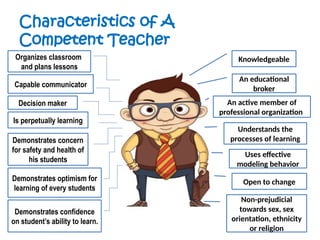
Characteristics of A
Competent Teacher
Knowledgeable
An educational
broker
An active member of
professional organization
Understands the
processes of learning
Uses effective
modeling behavior
Open to change
Non-prejudicial
towards sex, sex
orientation, ethnicity
or religion
Organizes classroom
and plans lessons
Capable communicator
Decision maker
Is perpetually learning
Demonstrates concern
for safety and health of
his students
Demonstrates optimism for
learning of every students
Demonstrates confidence
on student’s ability to learn.
THANK YOU
FOR
LISTENING! 
Insights of Good Teachers
Good teachers engage in a continuing pursuit of
professional development. They are dedicated to
the work assigned to them , competent and clear,
and have the following insights as expounded by
Gunter, Estes, and Schwab(2003).
Insights of Good Teachers
GOOD TEACHERS :
1. Are In charge of their classrooms
2. Create a conducive environment for learning
3. Manage human relations effectively
4. Engage students in the process of learning by their own
5. Teach us up
Insights of Good Teachers
6. Are good learners
7. Develop instructional objectives with the learners]
8. Are able to find out why the a plan is not working
9. Strive to make their teaching interesting
10. Give learners access to information and opportunities for
application
11. Teach for the kinds of knowledge, knowledge content and
knowledge on how to learn.
Guidelines in Developing Teachers’
Competencies (Ellis,1986)
1. Make decisions.
2. Use a learning theory.
3. Use a variety of instructional strategies.
4. Build bridges to other subjects.
5. Build relationship between facts and concepts.
6. Teach for transfer.
7. Emphasize hands-on experience.
Guidelines in Developing Teachers’
Competencies (Ellis,1986)
8. Keep the focus on people.
9. Gather materials.
10. Teach content.
11.Teach concepts.
12. Teach skills.
13.Teach values.
14. Give students freedom.
Guidelines in Developing Teachers’
Competencies (Ellis,1986)
15. Differentiate instruction.
16. Create a sense of place.
17. Promote success.
18. Reward excellence.
Professional Standards for
Teachers
The National Board of Professional Teaching
Standards(1990) presented five propositions of
accomplished teaching as fundamental
requirements for professional teachers to
demonstrate.
Professional Standards for Teachers
1. Teachers are committed to students in their learning.
2. Teachers know the subjects they teach and how teach
them to students.
3. Teachers are responsible for managing and
monitoring student learning.
4. Teachers think systematically about their practice and
learn from experience.
5. Teachers are members of Learning communities.

Professional Development for SPED Teachers.pptx

  • 1.
  • 2.
  • 3.
    Forms of ProfessionalDevelopment 1. REFLECTION and SELF-DEVELOPMENT. - The most competent professional is someone proactive, one who takes charge and initiate his/her own continuing professional development.
  • 4.
    Forms of ProfessionalDevelopment DO YOU AGREE THAT SELF- REFLECTION IS AN IMPORTANT PART OF A LEARNING PROCESS? WHY OR WHY NOT? IN YOUR OWN UNDERSTANDING, WHAT IS SELF- REFLECTION?
  • 5.
    SELF-REFLECTION • It isa way of assessing yourself, your ways of working and how you study. • It is about questioning(in a positive way)  what you do and why you do it . What went well and what could be the even better. deciding whether there is a better, or more efficient, way of doing it in the future.
  • 6.
    Forms of ProfessionalDevelopment 1. REFLECTION and SELF-DEVELOPMENT. - One useful way of continuing to reflect, self-assess, and grow personally is by maintaining a professional journal and a professional career portfolio.
  • 7.
    SAMPLE PROFESSIONAL PORTFOLIOOF AN ELEMENTARY SCHOOL TEACHER
  • 8.
    SAMPLE PROFESSIONAL PORTFOLIOOF AN ELEMENTARY SCHOOL TEACHER
  • 9.
    SAMPLE PROFESSIONAL PORTFOLIOOF AN ELEMENTARY SCHOOL TEACHER
  • 10.
  • 11.
    Forms of ProfessionalDevelopment 2. MENTORING - Mentoring and facilitating the learning of another teacher can aid in professional development. - The mentor observes and coaches the teacher to help him/her teaching skills.
  • 12.
    Forms of ProfessionalDevelopment MENTORING : Sample Program
  • 13.
    Forms of ProfessionalDevelopment 3. IN-SERVICE WORKSHOPS AND GRADUATE STUDIES. - In-service workshops are usually designed for specific purpose such as to train teachers on new teaching materials or programs. - University graduate study is another way of continuing professional development.
  • 15.
    Graduate Studies sampleprograms/courses
  • 16.
    Forms of ProfessionalDevelopment 4. PARTICIPATION IN PROFESSIONAL ORGANIZATION - There are many professional local, national, and international organizations that teacher can join for professional advancement.
  • 17.
  • 18.
    What are thebenefits of teachers in joining/ participating in organizations? • Help you to interact with fellow teachers • Gives you access to conferences and professional development workshops • Allows you to hone your teaching techniques and learn about new breakthroughs in the field. • Give back to the community • Strength in Numbers • Stay Inspired and Stay Motivated • And MORE!!
  • 19.
    Forms of ProfessionalDevelopment 5. COMMUNICATION WITH OTHER TEACHERS. - Visiting teachers in other schools, attending in-service workshops , and graduate seminars and programs; and participating in teacher study groups are valuable experiences.
  • 20.
    Forms of ProfessionalDevelopment 6. SUMMER AND OFF-WORK EXPERIENCE. - These are government-sponsored programs that are available to teachers during summer.
  • 24.
    Forms of ProfessionalDevelopment Armstrong (1980) pointed out that a professional teacher’s preparation does not end with the awarding of an academic degree. Bear in mind that a professional development is a continuous process.
  • 25.
    Professional Behaviors ofTeachers According to Danielson’s (1966) study, true professional teachers practice the following: 1. Reflect on their teaching. They thoughtfully consider what was taught and how well it was taught. 2. Maintain accurate records. They keep written records to document student learning. 3. Communicate with families. They stay in written or verbal contact with their students’ families to support student progress.
  • 26.
    Professional Behaviors ofTeachers 4. Contribute to the school. They support functions of the school. 5. Grow as professionals. They take courses and workshops, and consult with others. 6. Show professionalism. They act as advocates for students and families.
  • 27.
    Peer Coaching: AProfessional Development Model • The teacher as a reflective practitioner has become one of the most consistent themes of teacher development. For Dewey(1933) and Schön(1987), reflective thinking is not just post active in nature, but proactive and interactive as well. When reflection is done , teachers can appreciate that the nature of their work engages them in a recursive cycle of reflective thinking that involves planning, acting, and reflecting (Lasley II, Matczynski, & Rowley 2002)
  • 28.
    Peer Coaching: AProfessional Development Model 3 Phases of Reflective Practice for Peer Coaching: 1. Planning. Planning the focus of observation, selecting the observation methodology, and negotiating the role of participants. 2. Acting. Observing the teaching and learning episodes and making the record of evidence 3. Reflecting. Interpreting the observation record, making meaning, planning for new action, and identifying new foci.
  • 29.
    MOTIVATION- TEETH MECHANICS: BATTLE SHIPS Activity: •Arrange all the captains in a circle, the ships' crews must line up behind their • captains. The shooter is the last crew member in line. • The teacher must decide a lexical area of vocabulary, this vocabulary will be used to defend their ships from the attacks. Every students (except the shooters) must find their own words. The lexical area for example, "Four Legged Animals". Give the students 1-2 minutes to find as many possible words as they can and memorize them.
  • 30.
    • Start thegame by calling a ship's name, for example the ship name is "THE CALIFORNIAN". The captain of THE CALIFORNIAN must reply with a word from the lexical area given, for example he says "TIGER" followed by his crews behind him one by one, "COW"; "SHEEP" until it is the shooter turns and he calls out the name of another ship and the captain of the ship called must reply and his crews must do the same thing. No word can be repeated. • If the captain is late to reply (more than 2 seconds) or his crew can not say the words or a word repeated or the shooter shoots the wrong ship (his own ship or the ship that has already been sunk) the ship is sunk, and the crew members can join the crew of another ship. • The teacher will change the lexical area for the next round. • In the last round there will be two big groups battling to be the winner.
  • 31.
    Domain of Knowledgeof Professional Teachers
  • 32.
    Domain of Knowledgeof Professional Teachers • A survey of the experiences of practicing teachers reveals, among others, that there are several domains of knowledge on which they could anchor the learning activities they usually provide in the classroom. In this connection, Schuman(1987) managed to organize the important domains of knowledge of teachers into seven categories.
  • 33.
    7 Domains ofKnowledge of Professional Teachers 1. Content of Knowledge • Knowledge of particular subject to be taught. examples: English, Math, Chemistry
  • 34.
    2. Pedagogical contentknowledge • The special amalgam of content and pedagogy that is uniquely the province of teachers- their own special form of professional understanding
  • 35.
    3. Knowledge ofLearners and their characteristics. • You need to know what is happening to your student in relation to several types of development (cognitive, psychosocial, moral, linguistic,etc). You need to know how they learn.
  • 36.
    4. General Pedagogicalknowledge with special reference to the broad principles and strategies of classroom management and organization that appear to transcend subject matter.
  • 37.
    5. Knowledge ofeducational contexts • The contexts in which teaching and learning take place, which make a significant impact on both teacher and pupils. • For example: cultures, communities of which pupils come, the size of school, class size, the amount for support for teachers, the quality of relationships in the school, the expectations and attitudes of the head teacher and how group, classroom, and school organization and government work.
  • 38.
    6. Curriculum knowledge •with a particular grasp of the materials and programs on which your teaching is based. 7. Knowledge of educational ends, purpose and values and their philosophical and historical grounds • Generally implicit knowledge which underpins and influences classroom activity For example: whether education is viewed as being intrinsically valuable or as an extrinsic, more utilitarian activity, the purpose of which is to prepare pupils for employment.
  • 39.
    Domain of Knowledgeof Professional Teachers • Apparently, teachers who are equipped with the knowledge domains of teachers coupled with the needed management skills, organization skills in teaching, study skills, and social skills are on the road toward effective teaching, which is the product of professional development.
  • 40.
    Professional Teachers are ClearTeachers • Clear teachers are the product of professional development. • Instructional clarity – refers to the teachers ability to promote instruction that helps students come to a clear understanding of the lesson. • Clarity is something students achieve and NOT something the teacher does.
  • 41.
    Professional Teachers are ClearTeachers • Cruickshank, Jenkins, and Metcalf (1999) enumerated the ten specific behaviors that characterize clear teachers. 1. The lesson is planned and implemented in an organized manner. 2. Students are informed of the lesson objectives in advanced. 3. The lesson is conducted step by step.
  • 42.
    Professional Teachers are ClearTeachers 4. The teacher draws the students attention to new or important points by writing this points on the board , repeating them at appropriate points in the lesson, and incorporating deliberate pauses, thereby allowing time for processing and reflection. 5. The teacher presents and work on examples that explain and support the concept or ideas being taught.
  • 43.
    Professional Teachers are ClearTeachers 6. The teacher explains unfamiliar words before using them in the lesson and points out similarities and differences between ideas. 7. The teacher asks the students lots of questions and gives application exercises to find out if they were able to understand the lesson.
  • 44.
    Professional Teachers are ClearTeachers 8. The teacher carefully monitors the students’ work to gauge comprehension 9. The teacher encourages and allows time for the students to ask questions. 10. When the students do not understand the lesson, the teacher repeats main point s, present s additional examples or explanations, or elaborates until the student s achieve clarity of the lesson.
  • 45.
    Characteristics of A CompetentTeacher Knowledgeable An educational broker An active member of professional organization Understands the processes of learning Uses effective modeling behavior Open to change Non-prejudicial towards sex, sex orientation, ethnicity or religion Organizes classroom and plans lessons Capable communicator Decision maker Is perpetually learning Demonstrates concern for safety and health of his students Demonstrates optimism for learning of every students Demonstrates confidence on student’s ability to learn.
  • 46.
  • 47.
    Insights of GoodTeachers Good teachers engage in a continuing pursuit of professional development. They are dedicated to the work assigned to them , competent and clear, and have the following insights as expounded by Gunter, Estes, and Schwab(2003).
  • 48.
    Insights of GoodTeachers GOOD TEACHERS : 1. Are In charge of their classrooms 2. Create a conducive environment for learning 3. Manage human relations effectively 4. Engage students in the process of learning by their own 5. Teach us up
  • 49.
    Insights of GoodTeachers 6. Are good learners 7. Develop instructional objectives with the learners] 8. Are able to find out why the a plan is not working 9. Strive to make their teaching interesting 10. Give learners access to information and opportunities for application 11. Teach for the kinds of knowledge, knowledge content and knowledge on how to learn.
  • 50.
    Guidelines in DevelopingTeachers’ Competencies (Ellis,1986) 1. Make decisions. 2. Use a learning theory. 3. Use a variety of instructional strategies. 4. Build bridges to other subjects. 5. Build relationship between facts and concepts. 6. Teach for transfer. 7. Emphasize hands-on experience.
  • 51.
    Guidelines in DevelopingTeachers’ Competencies (Ellis,1986) 8. Keep the focus on people. 9. Gather materials. 10. Teach content. 11.Teach concepts. 12. Teach skills. 13.Teach values. 14. Give students freedom.
  • 52.
    Guidelines in DevelopingTeachers’ Competencies (Ellis,1986) 15. Differentiate instruction. 16. Create a sense of place. 17. Promote success. 18. Reward excellence.
  • 53.
    Professional Standards for Teachers TheNational Board of Professional Teaching Standards(1990) presented five propositions of accomplished teaching as fundamental requirements for professional teachers to demonstrate.
  • 54.
    Professional Standards forTeachers 1. Teachers are committed to students in their learning. 2. Teachers know the subjects they teach and how teach them to students. 3. Teachers are responsible for managing and monitoring student learning. 4. Teachers think systematically about their practice and learn from experience. 5. Teachers are members of Learning communities.