Using Teacher Inquiry as Professional Development

                                         Aloha Lavina
                       Bangkok Teachers Network 2012
True or False
Professional development is a workshop given
by an expert who is not a school community
member.

Professional development is based on teacher
deficiency.

Professional development is linked to school
improvement.
True or False
Problem solving with my colleagues is part of my
professional development.

Student learning has nothing to do with teacher
learning.

Professional development is best when it is
done outside of the school.
How do we lead learners?
Match the leadership slogans with the type
of leadership and the relationships that
each style fosters.


Workbook p. 2
“The success of a school depends
    above all on the quality of
          interactions
  between teacher and teacher,
 and teacher and administrator.”

          - R. L. Barth
Sandbox or Beehive?


                       Just happen to be in the same place?
                                        Or
                       Working together for common goals?
Sandbox photo ©www.safesand.com
Beehive photo © oneida.uwex.edu
How do we Focus the Community?
• What type of environment do we want?
• What would we have to do to become a
  beehive?

• Jot down words and phrases on Blue Post its.
• Post your Blue Post its on the Essential
  Agreements Wall.
What will our school be like?
Professional Learning Priorities
• Think of your school action plan.
• Pick a priority and state it as a teacher learning
  priority.
• Write your priority on a blank A4 sheet.
• Leave the topic you wrote on your table.
• Take your Green Post it and Orange Post it and go
  around the tables to see the topics.
• Post the Green Post it on a topic you’d like to
  learn.
• Post the Orange Post it on a topic you could
  facilitate teachers to learn.
Connect – Extend – Challenge
If you are…
• …an Administrator, how will you support
   teacher learning with resources and time?
• …a Teacher Leader or Department Head, how
   will you embed the learning into teaching and
   curriculum?
• …a Classroom Teacher, how will your learning
   impact your students’ learning?
Coaching to Sustain Professional Learning
                                          NON
                               Peer       THREATENING
 Cognitive Coaching Model
 (Costa, 1994)
                            observation   Observation:
                                          Teacher who is
                                          being observed
                                          sets the
                                          observation goal

                                                       REFLECTIVE
                              Inquiry                  PRACTICE
                                                       Post-
                               Group                   conference:
                                                       Did actual
APPLICATION                                            decisions
Pre-                                                   and
conference:      Teacher                               behaviors in
Setting a        Learning                 Reflecting
                                                       the
classroom goal     Goal                   together
                                                       classroom
                                                       match what
                                                       the teacher
                                                       intended?
Reflecting on practice


     Professional curiosity
Finding personal relevance
Making decisions
Documenting insight
Making direct connections with own
            classroom
Affirming beliefs about practice
Inquiring into point of practice
Making interdisciplinary connections
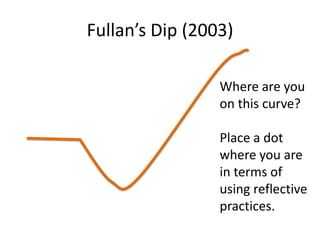
Fullan’s Dip (2003)

                 Where are you
                 on this curve?

                 Place a dot
                 where you are
                 in terms of
                 using reflective
                 practices.
Compass Points
                        North: What do you need to
                                 know?


     West: What
                                                East: What are
                                                you excited
     worries you?
                                                about?


                          South: What is your
                               stance?
©Harvard Project Zero
Tug of War
• Ponder the priority learning for your faculty
  you named earlier.
• What understanding does your faculty have of
  this topic? Write this on a yellow post it.
• What challenges remain? Write this on a
  yellow post it.
• Post the sticky notes on the Tug of War string.
Exit card
I used to think…but now I think…

Using teacher inquiry as professional development

  • 1.
    Using Teacher Inquiryas Professional Development Aloha Lavina Bangkok Teachers Network 2012
  • 2.
    True or False Professionaldevelopment is a workshop given by an expert who is not a school community member. Professional development is based on teacher deficiency. Professional development is linked to school improvement.
  • 3.
    True or False Problemsolving with my colleagues is part of my professional development. Student learning has nothing to do with teacher learning. Professional development is best when it is done outside of the school.
  • 4.
    How do welead learners? Match the leadership slogans with the type of leadership and the relationships that each style fosters. Workbook p. 2
  • 5.
    “The success ofa school depends above all on the quality of interactions between teacher and teacher, and teacher and administrator.” - R. L. Barth
  • 6.
    Sandbox or Beehive? Just happen to be in the same place? Or Working together for common goals? Sandbox photo ©www.safesand.com Beehive photo © oneida.uwex.edu
  • 7.
    How do weFocus the Community? • What type of environment do we want? • What would we have to do to become a beehive? • Jot down words and phrases on Blue Post its. • Post your Blue Post its on the Essential Agreements Wall.
  • 8.
    What will ourschool be like?
  • 9.
    Professional Learning Priorities •Think of your school action plan. • Pick a priority and state it as a teacher learning priority. • Write your priority on a blank A4 sheet. • Leave the topic you wrote on your table. • Take your Green Post it and Orange Post it and go around the tables to see the topics. • Post the Green Post it on a topic you’d like to learn. • Post the Orange Post it on a topic you could facilitate teachers to learn.
  • 10.
    Connect – Extend– Challenge If you are… • …an Administrator, how will you support teacher learning with resources and time? • …a Teacher Leader or Department Head, how will you embed the learning into teaching and curriculum? • …a Classroom Teacher, how will your learning impact your students’ learning?
  • 11.
    Coaching to SustainProfessional Learning NON Peer THREATENING Cognitive Coaching Model (Costa, 1994) observation Observation: Teacher who is being observed sets the observation goal REFLECTIVE Inquiry PRACTICE Post- Group conference: Did actual APPLICATION decisions Pre- and conference: Teacher behaviors in Setting a Learning Reflecting the classroom goal Goal together classroom match what the teacher intended?
  • 12.
    Reflecting on practice Professional curiosity
  • 13.
  • 14.
  • 15.
  • 16.
    Making direct connectionswith own classroom
  • 17.
  • 18.
  • 19.
  • 20.
    Fullan’s Dip (2003) Where are you on this curve? Place a dot where you are in terms of using reflective practices.
  • 21.
    Compass Points North: What do you need to know? West: What East: What are you excited worries you? about? South: What is your stance? ©Harvard Project Zero
  • 22.
    Tug of War •Ponder the priority learning for your faculty you named earlier. • What understanding does your faculty have of this topic? Write this on a yellow post it. • What challenges remain? Write this on a yellow post it. • Post the sticky notes on the Tug of War string.
  • 23.
    Exit card I usedto think…but now I think…

Editor's Notes

  • #3 The assumptions that frame professional development can either limit the learning in the school, or expand it and let it flourish.
  • #4 Professional development has shifted from the transmission model, where an EXPERT delivers content to a group of teachers, to transformational, where the teacher is an active learner and the workshop leader is a FACILITATOR or guide through the learning.3 minutes----- Meeting Notes (11/9/12 18:22) -----Leadership is essential.
  • #5 5 minutesVision is necessary to frame the school’s pathway. But just vision without collaboration still fragments a school. Collegial leadership and coaching type of leadership makes everyone in the school a part of the school improvement effort, and fosters OWNERSHIP of the school’s direction and future.
  • #6 AND WHAT IF we were working together by learning something that would enhance our student’s learning?We would have interactions based on a common goal beneficial to our students, ourselves, and our school. Parallel goals mean synchronicity, coherence in professional development.
  • #7 What type of environment do we want? What evidence would we have that tells us we are ready to be a beehive?
  • #8 5 minutesNorms Workbook page 3
  • #9 What do the documents in your school right now tell you what your school wants to be like? Examples: mission statement, language policy, assessment policy, student learning expectations, learner profile, action plan or strategic plan.5 minutes
  • #10 Add at the end: this is how we sorted the inquiry groups at our school. Our internal PD is based on teacher needs, teacher choice. We have 100 percent commitment to school goals, and we document this through the professional portfolio. This has transformed our school culture. WORKBOOK page 4
  • #11 This is a way to provoke reflective thinking from Project Zero at Harvard. CONNECT: between your role and the learning goal. EXTEND: to those you lead, and CHALLENGE: NAME the challenges you will have to face to get your team to where they need to be. 10 minutes
  • #12 Workbook page 5 (10 minutes)Take a look at this model of coaching. How would a teacher benefit from this model?How would you help a teacher through this model?What consequences might it have for learning?
  • #13 Reflection is a by-product of coaching. Through coaching, teachers begin to consciously link their teaching decisions with student learning outcomes.Reflection needs to be ongoing to facilitate this shared school culture through the beliefs that emerge as teachers learn together. Here are some patterns that may emerge… 10 minutes
  • #21 Research shows that as a change is introduced into an organization, practice dips, or decreases in quality. This is because people are still sorting out through their learning and probably experimenting with application. This is a healthy part of change. It can be managed by providing time and resources, such as coaching, to help people through their ‘dip’ 5 minutes
  • #22 5 minutesA good reflection tool to take the temperature, to see what worries might interfere with teachers moving forward in their inquiry, and provide the necessary support whether it is through time, resources, or coaching.
  • #24 This is also from the Project Zero visible thinking strategies. Collect the post its. 5 minutes