Introduction to Tea


    Tea is a natural beverage brewed from the leaves of an evergreen plant called
    “Camellia Sinensis.”
    The second emperor of China, Shen Nung, discovers tea when tea leaves blow into his
    cup of hot water.
    In 1824 the first tea plant was brought by British from China & planted in the Royal
    Botanical Gardens in Peradeniya.
    The pioneer of Ceylon Tea industry James Taylor planted the first 19 acres of tea in
    “Loolecondra” Estate near to the Kandy.
    In present Sri Lanka has become 3rd biggest tea producer in global market.
    As a result of that tea become one of major foreign exchanger which contributes to
    the economy of Sri Lanka.
    And it provides large number of direct & indirect employee opportunities to over one
    million people.
    Approximately 4% of country land area is covered tea plantation.
    Central province, Uva province, Southern province & Sabaragamuwa province are
    major tea growing regions in Sri Lanka.
    To grow properly tea requires hot, moist climate, temperature ranging from 10 -30
    degrees centigrade, Average annual rainfall 200mm & ground level between 600 –
    200m above sea level.
    Sri Lanka tea manufactures most prefer to produce Black Tea, Green Tea, White Tea
    & Oolong Tea.
    Drinking tea cause to generate so many benefits to human. They are,

                 Reduce the risk of heart diseases, cancers, blood pressures & etc.
                 Give relax & energy to the human.
                 Higher antioxidant capacity than fruits & vegetables.
                 Assist in natural immune
                 Response to infection
                 Reduce eye fatigue


                                          2
Rathnayaka Tea (PVT) Ltd.


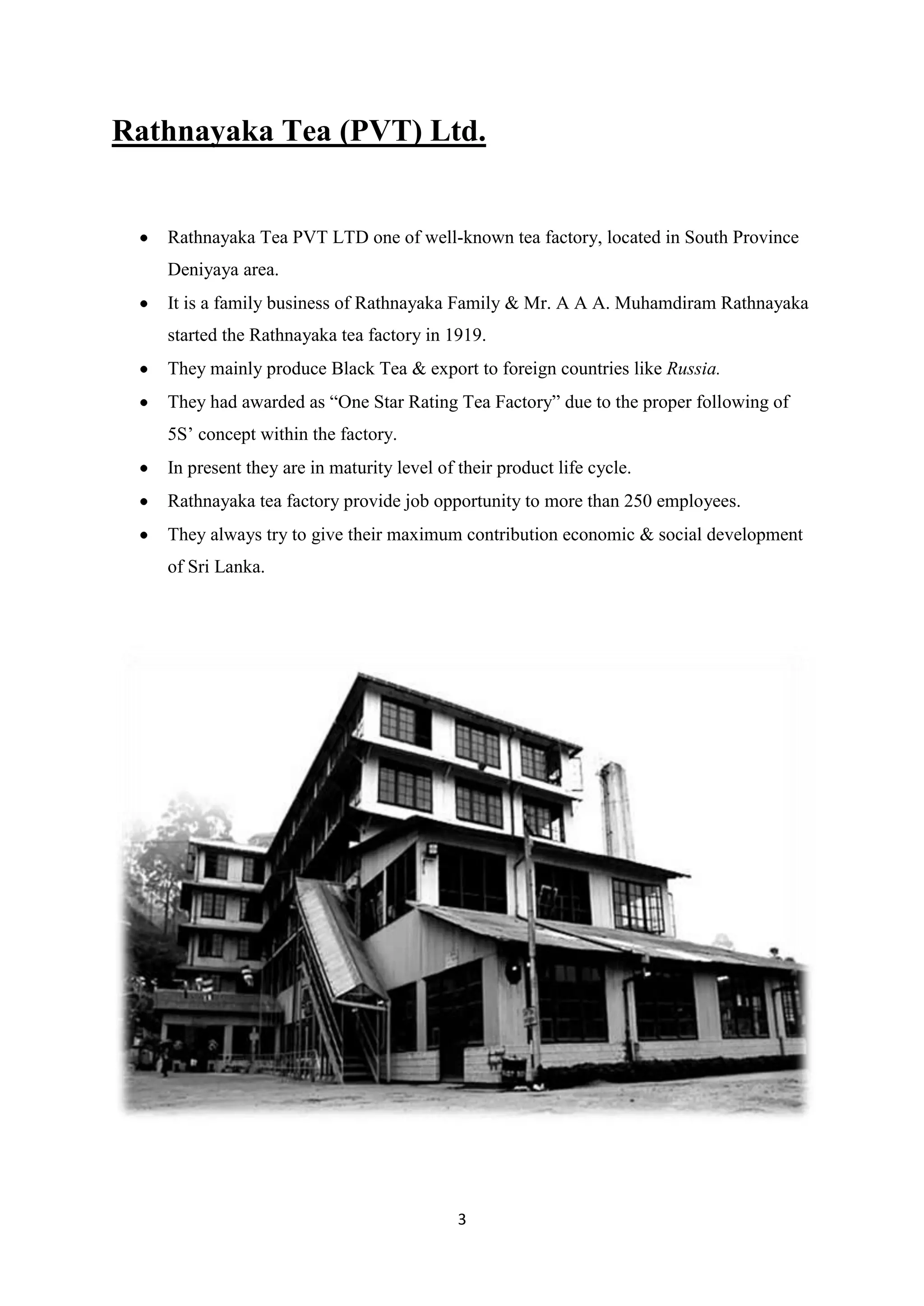
   Rathnayaka Tea PVT LTD one of well-known tea factory, located in South Province
   Deniyaya area.
   It is a family business of Rathnayaka Family & Mr. A A A. Muhamdiram Rathnayaka
   started the Rathnayaka tea factory in 1919.
   They mainly produce Black Tea & export to foreign countries like Russia.
   They had awarded as “One Star Rating Tea Factory” due to the proper following of
   5S‟ concept within the factory.
   In present they are in maturity level of their product life cycle.
   Rathnayaka tea factory provide job opportunity to more than 250 employees.
   They always try to give their maximum contribution economic & social development
   of Sri Lanka.


                                            3
Tea Manufacturing Process


 01. Plucking
                           It is a process of harvesting and collecting tea leaves. Tea plucking
                           is still conducted in the traditional manner: the tea leaves are
                           handpicked and gathered into wide baskets on the backs of the tea
                           pickers. The hand picking ensures that only the best leaves of the tea
                           plant are collected and used for producing the tea. Before the tea
                           plucking we have to maintain foliage & tipping. There are mainly
                           3 types of plucking systems & they are Scale leaf, fish leaf, & single
                           leaf plucking.


 02.Withering
 After the plucking those plucked leaves are delivered to the factory
 for measure the weight & send to the withering process. The
 primary aims of withering are, to reduce the moisture content of
 the leaf and to soften it. The tea leaves are spread out on a large
 tray of wire mesh, and hot air blowers are used to heat the leaf and
 drive the moisture out. Withering duration is dependent on
 temperature and humidity and could range from 18 to 24 hours. At
 this point, the leaf has become limp and turned into a darker shade
 of green.


                                              4
03. Rolling
                            The withered leaves are loaded into rollers where they are twisted by
                            a mechanical action. The process is carefully monitored so that the
                            style of the leaf is maintained and overheating does not take place. In
                            this process the green color of the leaf is replaced by brown coppery
                            colored texture as the process of rolling under pressure twist the leaf,
                            rupture the cells and release the natural juices, promoting oxidation
                            and acceleration of pigmentation. Premium quality green and white
                            teas are generally manually selected and hand rolled.


04. Fermentation
Fermentation is the process during which the Polyphenols in
the tea leaf are oxidized in presence of the enzymes and
subsequently condensed to form Colored compounds
contributing to the quality attributes of tea. Fermentation starts
immediately after cell rupture. In here pay more attention to
humidity & Temperature.

Temperature

Optimum: 24'C – 29‟C
Factors affecting temperature:

         i) Leaf temperatures at the end of green leaf processing,
        ii) Thickness of spread
       iii) Temperature of air in fermenting room.

Humidity

 Optimum: 1‟C – 1.5 „C Hygrometric Difference
 Any larger H.D. requires humidification of the room.
 Normal method: mist chambers or spray units.


                                                5
6

Tea manufacturing process part 1

  • 2.
    Introduction to Tea Tea is a natural beverage brewed from the leaves of an evergreen plant called “Camellia Sinensis.” The second emperor of China, Shen Nung, discovers tea when tea leaves blow into his cup of hot water. In 1824 the first tea plant was brought by British from China & planted in the Royal Botanical Gardens in Peradeniya. The pioneer of Ceylon Tea industry James Taylor planted the first 19 acres of tea in “Loolecondra” Estate near to the Kandy. In present Sri Lanka has become 3rd biggest tea producer in global market. As a result of that tea become one of major foreign exchanger which contributes to the economy of Sri Lanka. And it provides large number of direct & indirect employee opportunities to over one million people. Approximately 4% of country land area is covered tea plantation. Central province, Uva province, Southern province & Sabaragamuwa province are major tea growing regions in Sri Lanka. To grow properly tea requires hot, moist climate, temperature ranging from 10 -30 degrees centigrade, Average annual rainfall 200mm & ground level between 600 – 200m above sea level. Sri Lanka tea manufactures most prefer to produce Black Tea, Green Tea, White Tea & Oolong Tea. Drinking tea cause to generate so many benefits to human. They are,  Reduce the risk of heart diseases, cancers, blood pressures & etc.  Give relax & energy to the human.  Higher antioxidant capacity than fruits & vegetables.  Assist in natural immune  Response to infection  Reduce eye fatigue 2
  • 3.
    Rathnayaka Tea (PVT)Ltd. Rathnayaka Tea PVT LTD one of well-known tea factory, located in South Province Deniyaya area. It is a family business of Rathnayaka Family & Mr. A A A. Muhamdiram Rathnayaka started the Rathnayaka tea factory in 1919. They mainly produce Black Tea & export to foreign countries like Russia. They had awarded as “One Star Rating Tea Factory” due to the proper following of 5S‟ concept within the factory. In present they are in maturity level of their product life cycle. Rathnayaka tea factory provide job opportunity to more than 250 employees. They always try to give their maximum contribution economic & social development of Sri Lanka. 3
  • 4.
    Tea Manufacturing Process 01. Plucking It is a process of harvesting and collecting tea leaves. Tea plucking is still conducted in the traditional manner: the tea leaves are handpicked and gathered into wide baskets on the backs of the tea pickers. The hand picking ensures that only the best leaves of the tea plant are collected and used for producing the tea. Before the tea plucking we have to maintain foliage & tipping. There are mainly 3 types of plucking systems & they are Scale leaf, fish leaf, & single leaf plucking. 02.Withering After the plucking those plucked leaves are delivered to the factory for measure the weight & send to the withering process. The primary aims of withering are, to reduce the moisture content of the leaf and to soften it. The tea leaves are spread out on a large tray of wire mesh, and hot air blowers are used to heat the leaf and drive the moisture out. Withering duration is dependent on temperature and humidity and could range from 18 to 24 hours. At this point, the leaf has become limp and turned into a darker shade of green. 4
  • 5.
    03. Rolling The withered leaves are loaded into rollers where they are twisted by a mechanical action. The process is carefully monitored so that the style of the leaf is maintained and overheating does not take place. In this process the green color of the leaf is replaced by brown coppery colored texture as the process of rolling under pressure twist the leaf, rupture the cells and release the natural juices, promoting oxidation and acceleration of pigmentation. Premium quality green and white teas are generally manually selected and hand rolled. 04. Fermentation Fermentation is the process during which the Polyphenols in the tea leaf are oxidized in presence of the enzymes and subsequently condensed to form Colored compounds contributing to the quality attributes of tea. Fermentation starts immediately after cell rupture. In here pay more attention to humidity & Temperature. Temperature Optimum: 24'C – 29‟C Factors affecting temperature: i) Leaf temperatures at the end of green leaf processing, ii) Thickness of spread iii) Temperature of air in fermenting room. Humidity Optimum: 1‟C – 1.5 „C Hygrometric Difference Any larger H.D. requires humidification of the room. Normal method: mist chambers or spray units. 5
  • 6.