Content
           I Part                       II Part
•   Introduction               •   Drying
•   Rathnayaka Tea (Pvt) Ltd   •   Sorting & Grading
•   Tea Plucking               •   Storage & Packaging
•   Withering                  •   Limitation
•   Rolling                    •   Recommendation
•   Fermentation               •   Conclusion
Introduction
•   History of Tea
•   Growing Conditions
•   Types of Tea
•   Tea Growing Regions
•   Benefits of Tea
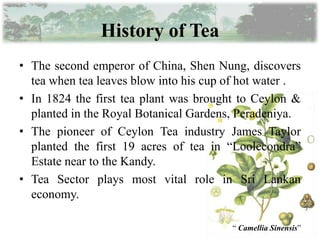
History of Tea
• The second emperor of China, Shen Nung, discovers
  tea when tea leaves blow into his cup of hot water .
• In 1824 the first tea plant was brought to Ceylon &
  planted in the Royal Botanical Gardens, Peradeniya.
• The pioneer of Ceylon Tea industry James Taylor
  planted the first 19 acres of tea in “Loolecondra”
  Estate near to the Kandy.
• Tea Sector plays most vital role in Sri Lankan
  economy.

                                        “ Camellia Sinensis”
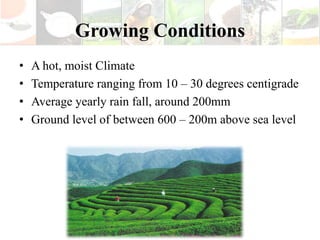
Growing Conditions
•   A hot, moist Climate
•   Temperature ranging from 10 – 30 degrees centigrade
•   Average yearly rain fall, around 200mm
•   Ground level of between 600 – 200m above sea level
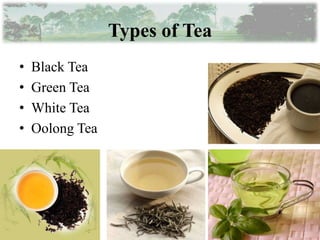
Types of Tea
•   Black Tea
•   Green Tea
•   White Tea
•   Oolong Tea
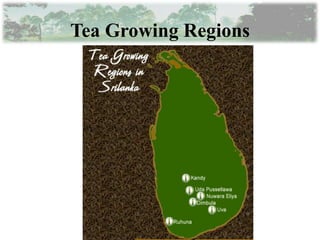
Tea Growing Regions
Health & Benefits of Tea
• Higher antioxidant capacity than fruits & vegetables.
• Help to relax on human
• Assist in natural immune
• Response to infection
• Reduce risk of heart diseases, cancers, cholesterol
  level, higher blood pressure.
• Reduce eye fatigue.
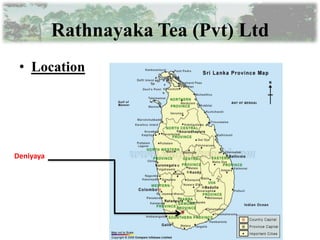
Rathnayaka Tea (Pvt) Ltd
 • Location


Deniyaya
History

• In 1919 • Mr. A.A.W Muhamdiram started the Rathnayaka Tea Factory.

• 1942     • Properly organized the company management .

• 1974     • The Rathnayaka Tea Factory was over taken by the Government.

• 1979     • Rathnayaka family was able to get their company again.

• 1993     • John Keells Group of Company joined with management of
             Rathnayaka Tea factory.

• 2008     • John Keells Group of Company secession from the management
             of Rathnayaka Tea Factory.
Current Situation

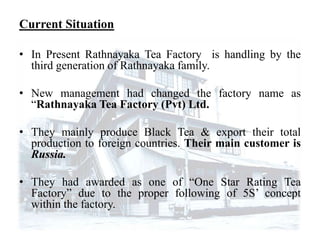
• In Present Rathnayaka Tea Factory is handling by the
  third generation of Rathnayaka family.

• New management had changed the factory name as
  “Rathnayaka Tea Factory (Pvt) Ltd.

• They mainly produce Black Tea & export their total
  production to foreign countries. Their main customer is
  Russia.

• They had awarded as one of “One Star Rating Tea
  Factory” due to the proper following of 5S’ concept
  within the factory.
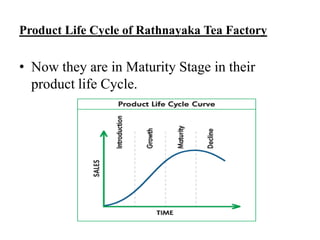
Product Life Cycle of Rathnayaka Tea Factory

• Now they are in Maturity Stage in their
  product life Cycle.
Employees.

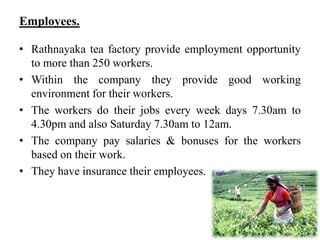
• Rathnayaka tea factory provide employment opportunity
  to more than 250 workers.
• Within the company they provide good working
  environment for their workers.
• The workers do their jobs every week days 7.30am to
  4.30pm and also Saturday 7.30am to 12am.
• The company pay salaries & bonuses for the workers
  based on their work.
• They have insurance their employees.
Tea Processing Cycle
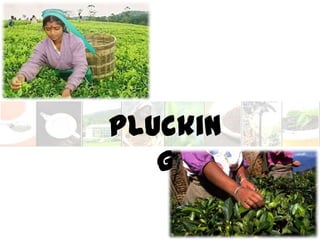
Pluckin
   g
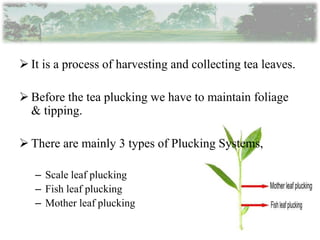
 It is a process of harvesting and collecting tea leaves.

 Before the tea plucking we have to maintain foliage
  & tipping.

 There are mainly 3 types of Plucking Systems,

   – Scale leaf plucking
   – Fish leaf plucking
   – Mother leaf plucking
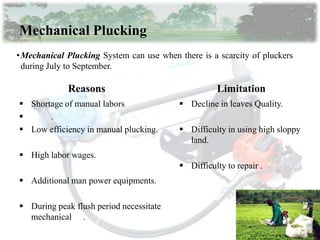
Mechanical Plucking
• Mechanical Plucking System can use when there is a scarcity of pluckers
  during July to September.

             Reasons                                Limitation
 Shortage of manual labors                Decline in leaves Quality.
      .
 Low efficiency in manual plucking.       Difficulty in using high sloppy
                                            land.
 High labor wages.
                                           Difficulty to repair .
 Additional man power equipments.

 During peak flush period necessitate
  mechanical .
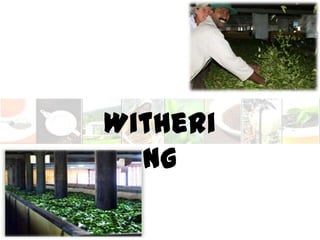
Witheri
  ng
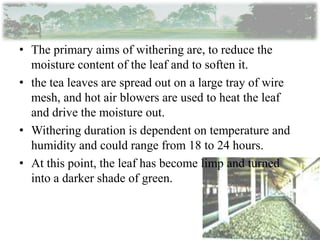
• The primary aims of withering are, to reduce the
  moisture content of the leaf and to soften it.
• the tea leaves are spread out on a large tray of wire
  mesh, and hot air blowers are used to heat the leaf
  and drive the moisture out.
• Withering duration is dependent on temperature and
  humidity and could range from 18 to 24 hours.
• At this point, the leaf has become limp and turned
  into a darker shade of green.
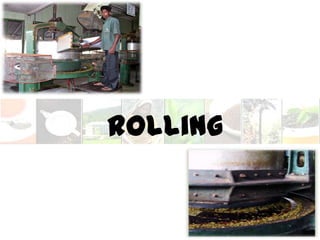
Rolling
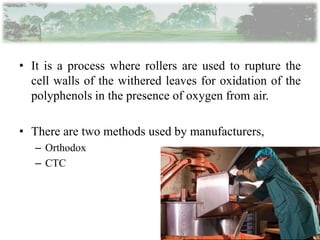
• It is a process where rollers are used to rupture the
  cell walls of the withered leaves for oxidation of the
  polyphenols in the presence of oxygen from air.

• There are two methods used by manufacturers,
   – Orthodox
   – CTC
Fermentat
   ion
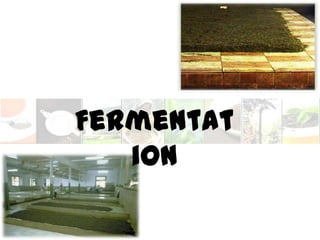
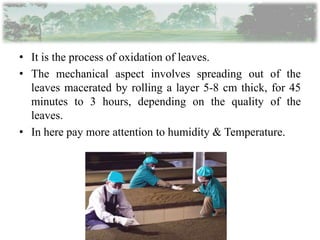
• It is the process of oxidation of leaves.
• The mechanical aspect involves spreading out of the
  leaves macerated by rolling a layer 5-8 cm thick, for 45
  minutes to 3 hours, depending on the quality of the
  leaves.
• In here pay more attention to humidity & Temperature.

Tea manufacturing process part 1

  • 2.
    Content I Part II Part • Introduction • Drying • Rathnayaka Tea (Pvt) Ltd • Sorting & Grading • Tea Plucking • Storage & Packaging • Withering • Limitation • Rolling • Recommendation • Fermentation • Conclusion
  • 3.
    Introduction • History of Tea • Growing Conditions • Types of Tea • Tea Growing Regions • Benefits of Tea
  • 4.
    History of Tea •The second emperor of China, Shen Nung, discovers tea when tea leaves blow into his cup of hot water . • In 1824 the first tea plant was brought to Ceylon & planted in the Royal Botanical Gardens, Peradeniya. • The pioneer of Ceylon Tea industry James Taylor planted the first 19 acres of tea in “Loolecondra” Estate near to the Kandy. • Tea Sector plays most vital role in Sri Lankan economy. “ Camellia Sinensis”
  • 5.
    Growing Conditions • A hot, moist Climate • Temperature ranging from 10 – 30 degrees centigrade • Average yearly rain fall, around 200mm • Ground level of between 600 – 200m above sea level
  • 6.
    Types of Tea • Black Tea • Green Tea • White Tea • Oolong Tea
  • 7.
  • 8.
    Health & Benefitsof Tea • Higher antioxidant capacity than fruits & vegetables. • Help to relax on human • Assist in natural immune • Response to infection • Reduce risk of heart diseases, cancers, cholesterol level, higher blood pressure. • Reduce eye fatigue.
  • 9.
    Rathnayaka Tea (Pvt)Ltd • Location Deniyaya
  • 10.
    History • In 1919• Mr. A.A.W Muhamdiram started the Rathnayaka Tea Factory. • 1942 • Properly organized the company management . • 1974 • The Rathnayaka Tea Factory was over taken by the Government. • 1979 • Rathnayaka family was able to get their company again. • 1993 • John Keells Group of Company joined with management of Rathnayaka Tea factory. • 2008 • John Keells Group of Company secession from the management of Rathnayaka Tea Factory.
  • 11.
    Current Situation • InPresent Rathnayaka Tea Factory is handling by the third generation of Rathnayaka family. • New management had changed the factory name as “Rathnayaka Tea Factory (Pvt) Ltd. • They mainly produce Black Tea & export their total production to foreign countries. Their main customer is Russia. • They had awarded as one of “One Star Rating Tea Factory” due to the proper following of 5S’ concept within the factory.
  • 12.
    Product Life Cycleof Rathnayaka Tea Factory • Now they are in Maturity Stage in their product life Cycle.
  • 13.
    Employees. • Rathnayaka teafactory provide employment opportunity to more than 250 workers. • Within the company they provide good working environment for their workers. • The workers do their jobs every week days 7.30am to 4.30pm and also Saturday 7.30am to 12am. • The company pay salaries & bonuses for the workers based on their work. • They have insurance their employees.
  • 14.
  • 15.
  • 16.
     It isa process of harvesting and collecting tea leaves.  Before the tea plucking we have to maintain foliage & tipping.  There are mainly 3 types of Plucking Systems, – Scale leaf plucking – Fish leaf plucking – Mother leaf plucking
  • 17.
    Mechanical Plucking • MechanicalPlucking System can use when there is a scarcity of pluckers during July to September. Reasons Limitation  Shortage of manual labors  Decline in leaves Quality.  .  Low efficiency in manual plucking.  Difficulty in using high sloppy land.  High labor wages.  Difficulty to repair .  Additional man power equipments.  During peak flush period necessitate mechanical .
  • 18.
  • 19.
    • The primaryaims of withering are, to reduce the moisture content of the leaf and to soften it. • the tea leaves are spread out on a large tray of wire mesh, and hot air blowers are used to heat the leaf and drive the moisture out. • Withering duration is dependent on temperature and humidity and could range from 18 to 24 hours. • At this point, the leaf has become limp and turned into a darker shade of green.
  • 20.
  • 21.
    • It isa process where rollers are used to rupture the cell walls of the withered leaves for oxidation of the polyphenols in the presence of oxygen from air. • There are two methods used by manufacturers, – Orthodox – CTC
  • 22.
  • 23.
    • It isthe process of oxidation of leaves. • The mechanical aspect involves spreading out of the leaves macerated by rolling a layer 5-8 cm thick, for 45 minutes to 3 hours, depending on the quality of the leaves. • In here pay more attention to humidity & Temperature.