(Camellia sinensis)
 Tea is a beverage made by steeping 
processed leaves, buds, or twigs of the tea 
bush (Camellia sinensis) in hot water for a 
few minutes. 
 The processing can include 
 oxidation 
 heating 
 drying 
 the addition of 
 other herbs 
 flowers 
 spices 
 fruits.
 World’s most popular beverage after water 
 Every day, 800 million cups or glasses of tea 
are consumed globally. 
 There are four basic types of true tea: 
 black tea 
 oolong tea 
 green tea 
 white tea.
 The term herbal tea usually refers to 
infusions of fruit or of herbs such as 
 Rosehip 
 Chamomile 
 jiaogulan 
that contain no C. sinensis. 
 Alternative terms for herbal tea 
 tisane 
 herbal infusion
 Tea is a natural source of 
 amino acid theanine 
 methylxanthines such as 
 caffeine 
 theobromine 
 polyphenolic antioxidant catechins. 
 It has almost no carbohydrates, fat, or protein. 
 It has a 
 cooling 
 mildly fragrant 
 slightly bitter 
 astringent 
flavor.
 2004: new high world tea production 
 grew by 2 % 
 reach an estimated 3.2 million tones 
 FAO’s report for the Intergovernmental Group on Tea 
meeting in Bali (20-22 July 2005). 
 The expansion was due the increases in: 
 Turkey 
 China 
 Kenya 
 Malawi 
 Sri Lanka 
 Indonesia.
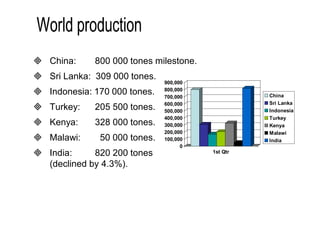
 China: 800 000 tones milestone. 
 Sri Lanka: 309 000 tones. 
 Indonesia: 170 000 tones. 
 Turkey: 205 500 tones. 
 Kenya: 328 000 tones. 
 Malawi: 50 000 tones. 
 India: 820 200 tones 
(declined by 4.3%). 
900,000 
800,000 
700,000 
600,000 
500,000 
400,000 
300,000 
200,000 
100,000 
0 
1st Qtr 
China 
Sri Lanka 
Indonesia 
Turkey 
Kenya 
Malawi 
India
 in 2004 world tea exports 
 increased by 4.4 percent 
 reached 1.47 million tonnes 
 The largest exporters 
 Kenya: almost 293 000 tones (8.9 % increase) 
 Sri Lanka 
 Indonesia: increase 8.9%. 
 China: reached 282 000 tones (> 7 %) 
 dominated by green tea (> 75 %). 
Importers (2004) 
 EC (an increase of 2.4 %) = 215 000 tones 
 US (5.3 %) = 99 000 tones 
 Japan (2 %) = 56 000 tones 
 in response to promotional efforts on the health 
benefits of tea consumption.
 In 2004, according to FAO 
 opened at US$1.56 per kg in January 
 closed at US$1.73 per kg in December 
 A recent study on the market evolution 
between 1993/1995 and 2001/2003: 
 out of 27 agricultural commodities, tea showed 
the second lowest variability in prices: 
 2% decline compared to 
 39% for cocoa 
 38% for coffee.
 Kingdom: Plantae 
 Division: Spermatophyte 
 Subdivision: Angiospermae 
 Class: Dicotyledoneae 
 Order: Guttiferales 
 Family: Theaceae 
 Genus: Camelia 
 Species: Camelia sinensis
 The genus Camellia covers over 260 species. 
 It is an important plant: 
 economically: Camellia sinensis 
 horticulturally: Camellia japonica 
 increasing number of interspecies hybrids (evergreen 
ornamental shrubs and trees). 
 The tea plant is an evergreen shrub or small tree 
that may reach 30 feet if unpruned. 
 It is adapted to sub-tropical areas. 
 tolerate some frost.
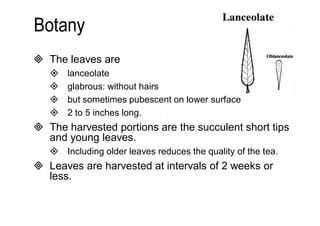
 The leaves are 
 lanceolate 
 glabrous: without hairs 
 but sometimes pubescent on lower surface 
 2 to 5 inches long. 
 The harvested portions are the succulent short tips 
and young leaves. 
 Including older leaves reduces the quality of the tea. 
 Leaves are harvested at intervals of 2 weeks or 
less.
 Tea plant is an evergreen plant and grows in 
 tropical and sub-tropical climates 
 prefers acidic soils 
 heavy rainfall 
 elevations up to 1524 meters. 
 Grown in rows or on terraces 
 4 feet apart and 4-5 feet tall 
 Help irrigation and prevent soil erosion
 Only the top 1-2 in of the mature plant are 
picked. 
 called flushes 
 new flushes are produced every 7 – 10 days 
during the growing season. 
 Vegetative Propagation 
 A variety can be grown vegetatively without 
going through the usual cycle of annual 
growth. 
 Cuttings obtained from mother bush 
 Rooted & grown in nursery for 1- 2 years 
 Can also be grown from seeds
 Planting 
 Planting is a crucial operation 
 determines the development and productive level 
of tea throughout its economic life. 
 Wrong planting of good planting materials 
affects the plant productivity. 
 For long term benefits, techniques of: 
 care 
 planning 
 refinement 
are essential.
 Pruning 
 cultivated plants are pruned for ease of 
plucking 
 helps in maintaining the plant as a low bush in 
a phase of continuous vegetative growth. 
 stimulates and controls growth. 
 helps rejuvenate bushes that have crossed the 
period of maximum productivity. 
 Tea plants will grow into a tree if undisturbed 
 Chinese tea (C. sinensis var sinensis): 3 meters. 
 Assam variety (C. sinensis var. assamica or 
C. assamica): 6 -20 meters.
 Fertilizer 
 To replenish the nutrients removed from 
 the plant as yield 
 the soil by the plant for its growth 
 Nutrient requirements should be 
 related to local soil conditions 
 must be monitored continuously to ensure an 
optimum balance of nutrients.
 Weed control 
 Weeds affect tea by competing with it for 
 moisture 
 nutrients 
 sunlight. 
 The effect of weeds: 
 a reduction in yield. 
 as secondary hosts for some important pests. 
 The timing of weed emergence relative to the 
growth stages of tea is an important parameter 
in weed management
 Pest Management 
 Optimal management of the pests should 
consider 
 ecologically 
 economically. 
 The presence of mites and insects 
 their characteristic mode of feeding 
 diverse habitat and seasonal cycles
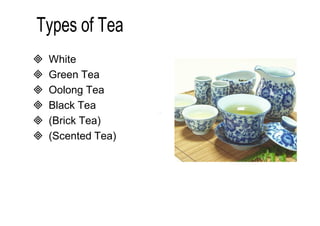
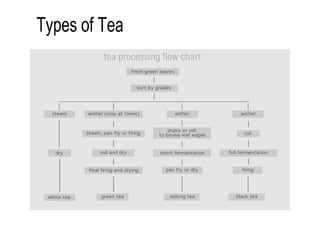
 White 
 Green Tea 
 Oolong Tea 
 Black Tea 
 (Brick Tea) 
 (Scented Tea)
 Processing tea is considered the art of tea. 
 taste, body, and overall character are created. 
 Basic form: 
 the raw green leaves 
 whether or not, and how much oxidation (or 
fermentation) should take place. 
 Tea leaves have enzymes in their veins. 
 When the leaf is broken, bruised, or crushed, the 
enzymes are exposed to the air resulting in oxidation. 
 The amount of oxidation depends upon how much 
of the enzymes are exposed and for how long.
The Processing of White Tea 
 does not go through any oxidation at all. 
 the leaves are immediately fired or steamed after 
letting them wither (air dry) for a period of time. 
 to prevent oxidation, 
 no rolling, breaking, or bruising of any kind. 
 The dried buds have a silver-like appearance 
 the most popular white tea called Silver Needle. 
 White teas are the least processed of any tea 
 taste like fresh leaves or grass. 
 They also have the lowest amount of caffeine and 
most likely have the highest antioxidant properties
The Processing of Green Tea 
 similar to white tea  no oxidation. 
 the leaves are laid out to wither for 8 - 24 hours. 
 most of the water evaporate. 
 the leaves are steamed or pan fried. 
 to neutralize the enzymes  preventing oxidation 
 leaves are rolled up in various ways and tightness. 
 a final drying takes place. 
 no oxidation  has more of a green appearance. 
 it goes off to be sorted, graded, and packaged. 
 closer to tasting like fresh leaves or grass 
 lower in caffeine, higher in antioxidant.
The Processing of Oolong Tea 
 requires only a partial oxidation of the leaves. 
 The leaves are laid out to wither for 8 to 24 hours. 
 This lets most of the water evaporate. 
 The leaves are tossed in baskets 
 to bruise the edges of the leaves. 
 the leaves partially oxidized, only a portion of the 
enzymes are exposed to air. 
 leaves steamed to neutralize the enzymes and 
stop any oxidation. 
 Oolong tea can have varying degrees of oxidation. 
 Some are closer to black teas, some closer to green. 
 a final drying takes place. 
 it goes off to be sorted, graded, and packaged.
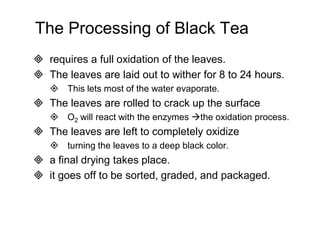
The Processing of Black Tea 
 requires a full oxidation of the leaves. 
 The leaves are laid out to wither for 8 to 24 hours. 
 This lets most of the water evaporate. 
 The leaves are rolled to crack up the surface 
 O2 will react with the enzymes the oxidation process. 
 The leaves are left to completely oxidize 
 turning the leaves to a deep black color. 
 a final drying takes place. 
 it goes off to be sorted, graded, and packaged.
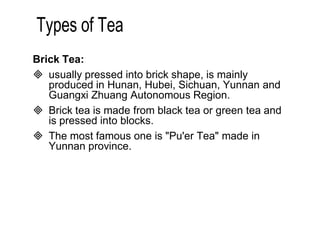
Brick Tea: 
 usually pressed into brick shape, is mainly 
produced in Hunan, Hubei, Sichuan, Yunnan and 
Guangxi Zhuang Autonomous Region. 
 Brick tea is made from black tea or green tea and 
is pressed into blocks. 
 The most famous one is "Pu'er Tea" made in 
Yunnan province.
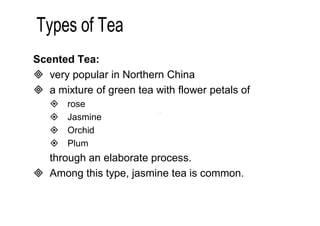
Scented Tea: 
 very popular in Northern China 
 a mixture of green tea with flower petals of 
 rose 
 Jasmine 
 Orchid 
 Plum 
through an elaborate process. 
 Among this type, jasmine tea is common.
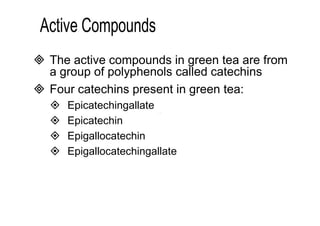
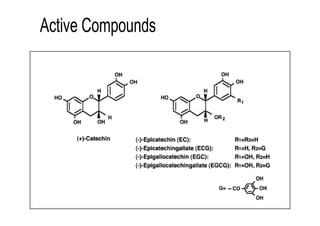
 The active compounds in green tea are from 
a group of polyphenols called catechins 
 Four catechins present in green tea: 
 Epicatechingallate 
 Epicatechin 
 Epigallocatechin 
 Epigallocatechingallate
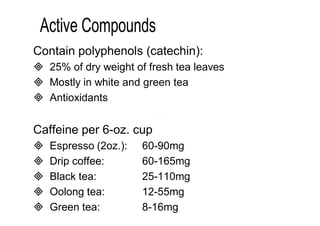
Contain polyphenols (catechin): 
 25% of dry weight of fresh tea leaves 
 Mostly in white and green tea 
 Antioxidants 
Caffeine per 6-oz. cup 
 Espresso (2oz.): 60-90mg 
 Drip coffee: 60-165mg 
 Black tea: 25-110mg 
 Oolong tea: 12-55mg 
 Green tea: 8-16mg
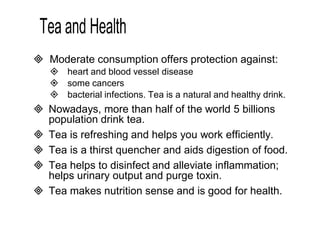
 Moderate consumption offers protection against: 
 heart and blood vessel disease 
 some cancers 
 bacterial infections. Tea is a natural and healthy drink. 
 Nowadays, more than half of the world 5 billions 
population drink tea. 
 Tea is refreshing and helps you work efficiently. 
 Tea is a thirst quencher and aids digestion of food. 
 Tea helps to disinfect and alleviate inflammation; 
helps urinary output and purge toxin. 
 Tea makes nutrition sense and is good for health.
 Improving immune system and preventing cancers 
 Slowing down aging process 
 Preventing loss of bone calcium 
 Alleviating blood lipoid, cholesterol, blood pressure, 
and arteriosclerosis 
 Helping sterilization and reinforcing teeth and 
intestine 
 Reducing urine hyperacidity and gout 
 Eliminate body fat 
 Preventing sunburn and resisting UV
 Tea is also rich in various vitamins 
 for smokers, it helps to discharge nicotine out of the 
system. 
 Antioxidant 
 With HIV the epigallocatechingallate acts as a 
block to the HIV transport protein on the host 
cell 
 Cancer 
 Epigallocatechingallate has been shown to 
inhibit angiogenesis of tumor cell and thus not 
allowing them to become cancerous. 
 This is achieved by stopping the production of 
angiogenic compounds in the tumor cells. 
 Weight loss
 Green tea stops angiogenesis 
 Stops blood flow to tumor 
 Mice given green tea 
 EGCG (Epigallocatechin gallate) slowed 
angiogenesis 
 Green tea induced apoptosis 
 Increases normal cell growth while promoting 
programmed cell death 
 Mice given green tea over a 4 month period 
 tumors suppressed
Disadvantages of Tea-Drinking 
 Too much tannic acid will affect the secretion of 
the gastric juice, irritate the membrane of the 
stomach and cause indigestion or constipation. 
 Strong tea taken just before bedtime will give rise 
to occasional insomnia. 
 Constant drinking of over-strong tea may induce 
heart and blood-pressure disorders 
 in some people, reduce the milk of a breast-feeding 
mother, and put a brown color on the teeth of young 
people. 
 just don't make your tea too strong.

Food tea1 print [compatibility mode]

  • 1.
  • 2.
     Tea isa beverage made by steeping processed leaves, buds, or twigs of the tea bush (Camellia sinensis) in hot water for a few minutes.  The processing can include  oxidation  heating  drying  the addition of  other herbs  flowers  spices  fruits.
  • 3.
     World’s mostpopular beverage after water  Every day, 800 million cups or glasses of tea are consumed globally.  There are four basic types of true tea:  black tea  oolong tea  green tea  white tea.
  • 4.
     The termherbal tea usually refers to infusions of fruit or of herbs such as  Rosehip  Chamomile  jiaogulan that contain no C. sinensis.  Alternative terms for herbal tea  tisane  herbal infusion
  • 5.
     Tea isa natural source of  amino acid theanine  methylxanthines such as  caffeine  theobromine  polyphenolic antioxidant catechins.  It has almost no carbohydrates, fat, or protein.  It has a  cooling  mildly fragrant  slightly bitter  astringent flavor.
  • 6.
     2004: newhigh world tea production  grew by 2 %  reach an estimated 3.2 million tones  FAO’s report for the Intergovernmental Group on Tea meeting in Bali (20-22 July 2005).  The expansion was due the increases in:  Turkey  China  Kenya  Malawi  Sri Lanka  Indonesia.
  • 7.
     China: 800000 tones milestone.  Sri Lanka: 309 000 tones.  Indonesia: 170 000 tones.  Turkey: 205 500 tones.  Kenya: 328 000 tones.  Malawi: 50 000 tones.  India: 820 200 tones (declined by 4.3%). 900,000 800,000 700,000 600,000 500,000 400,000 300,000 200,000 100,000 0 1st Qtr China Sri Lanka Indonesia Turkey Kenya Malawi India
  • 8.
     in 2004world tea exports  increased by 4.4 percent  reached 1.47 million tonnes  The largest exporters  Kenya: almost 293 000 tones (8.9 % increase)  Sri Lanka  Indonesia: increase 8.9%.  China: reached 282 000 tones (> 7 %)  dominated by green tea (> 75 %). Importers (2004)  EC (an increase of 2.4 %) = 215 000 tones  US (5.3 %) = 99 000 tones  Japan (2 %) = 56 000 tones  in response to promotional efforts on the health benefits of tea consumption.
  • 9.
     In 2004,according to FAO  opened at US$1.56 per kg in January  closed at US$1.73 per kg in December  A recent study on the market evolution between 1993/1995 and 2001/2003:  out of 27 agricultural commodities, tea showed the second lowest variability in prices:  2% decline compared to  39% for cocoa  38% for coffee.
  • 10.
     Kingdom: Plantae  Division: Spermatophyte  Subdivision: Angiospermae  Class: Dicotyledoneae  Order: Guttiferales  Family: Theaceae  Genus: Camelia  Species: Camelia sinensis
  • 11.
     The genusCamellia covers over 260 species.  It is an important plant:  economically: Camellia sinensis  horticulturally: Camellia japonica  increasing number of interspecies hybrids (evergreen ornamental shrubs and trees).  The tea plant is an evergreen shrub or small tree that may reach 30 feet if unpruned.  It is adapted to sub-tropical areas.  tolerate some frost.
  • 12.
     The leavesare  lanceolate  glabrous: without hairs  but sometimes pubescent on lower surface  2 to 5 inches long.  The harvested portions are the succulent short tips and young leaves.  Including older leaves reduces the quality of the tea.  Leaves are harvested at intervals of 2 weeks or less.
  • 13.
     Tea plantis an evergreen plant and grows in  tropical and sub-tropical climates  prefers acidic soils  heavy rainfall  elevations up to 1524 meters.  Grown in rows or on terraces  4 feet apart and 4-5 feet tall  Help irrigation and prevent soil erosion
  • 14.
     Only thetop 1-2 in of the mature plant are picked.  called flushes  new flushes are produced every 7 – 10 days during the growing season.  Vegetative Propagation  A variety can be grown vegetatively without going through the usual cycle of annual growth.  Cuttings obtained from mother bush  Rooted & grown in nursery for 1- 2 years  Can also be grown from seeds
  • 15.
     Planting Planting is a crucial operation  determines the development and productive level of tea throughout its economic life.  Wrong planting of good planting materials affects the plant productivity.  For long term benefits, techniques of:  care  planning  refinement are essential.
  • 16.
     Pruning cultivated plants are pruned for ease of plucking  helps in maintaining the plant as a low bush in a phase of continuous vegetative growth.  stimulates and controls growth.  helps rejuvenate bushes that have crossed the period of maximum productivity.  Tea plants will grow into a tree if undisturbed  Chinese tea (C. sinensis var sinensis): 3 meters.  Assam variety (C. sinensis var. assamica or C. assamica): 6 -20 meters.
  • 17.
     Fertilizer To replenish the nutrients removed from  the plant as yield  the soil by the plant for its growth  Nutrient requirements should be  related to local soil conditions  must be monitored continuously to ensure an optimum balance of nutrients.
  • 18.
     Weed control  Weeds affect tea by competing with it for  moisture  nutrients  sunlight.  The effect of weeds:  a reduction in yield.  as secondary hosts for some important pests.  The timing of weed emergence relative to the growth stages of tea is an important parameter in weed management
  • 19.
     Pest Management  Optimal management of the pests should consider  ecologically  economically.  The presence of mites and insects  their characteristic mode of feeding  diverse habitat and seasonal cycles
  • 20.
     White Green Tea  Oolong Tea  Black Tea  (Brick Tea)  (Scented Tea)
  • 21.
     Processing teais considered the art of tea.  taste, body, and overall character are created.  Basic form:  the raw green leaves  whether or not, and how much oxidation (or fermentation) should take place.  Tea leaves have enzymes in their veins.  When the leaf is broken, bruised, or crushed, the enzymes are exposed to the air resulting in oxidation.  The amount of oxidation depends upon how much of the enzymes are exposed and for how long.
  • 22.
    The Processing ofWhite Tea  does not go through any oxidation at all.  the leaves are immediately fired or steamed after letting them wither (air dry) for a period of time.  to prevent oxidation,  no rolling, breaking, or bruising of any kind.  The dried buds have a silver-like appearance  the most popular white tea called Silver Needle.  White teas are the least processed of any tea  taste like fresh leaves or grass.  They also have the lowest amount of caffeine and most likely have the highest antioxidant properties
  • 23.
    The Processing ofGreen Tea  similar to white tea  no oxidation.  the leaves are laid out to wither for 8 - 24 hours.  most of the water evaporate.  the leaves are steamed or pan fried.  to neutralize the enzymes  preventing oxidation  leaves are rolled up in various ways and tightness.  a final drying takes place.  no oxidation  has more of a green appearance.  it goes off to be sorted, graded, and packaged.  closer to tasting like fresh leaves or grass  lower in caffeine, higher in antioxidant.
  • 24.
    The Processing ofOolong Tea  requires only a partial oxidation of the leaves.  The leaves are laid out to wither for 8 to 24 hours.  This lets most of the water evaporate.  The leaves are tossed in baskets  to bruise the edges of the leaves.  the leaves partially oxidized, only a portion of the enzymes are exposed to air.  leaves steamed to neutralize the enzymes and stop any oxidation.  Oolong tea can have varying degrees of oxidation.  Some are closer to black teas, some closer to green.  a final drying takes place.  it goes off to be sorted, graded, and packaged.
  • 25.
    The Processing ofBlack Tea  requires a full oxidation of the leaves.  The leaves are laid out to wither for 8 to 24 hours.  This lets most of the water evaporate.  The leaves are rolled to crack up the surface  O2 will react with the enzymes the oxidation process.  The leaves are left to completely oxidize  turning the leaves to a deep black color.  a final drying takes place.  it goes off to be sorted, graded, and packaged.
  • 27.
    Brick Tea: usually pressed into brick shape, is mainly produced in Hunan, Hubei, Sichuan, Yunnan and Guangxi Zhuang Autonomous Region.  Brick tea is made from black tea or green tea and is pressed into blocks.  The most famous one is "Pu'er Tea" made in Yunnan province.
  • 28.
    Scented Tea: very popular in Northern China  a mixture of green tea with flower petals of  rose  Jasmine  Orchid  Plum through an elaborate process.  Among this type, jasmine tea is common.
  • 29.
     The activecompounds in green tea are from a group of polyphenols called catechins  Four catechins present in green tea:  Epicatechingallate  Epicatechin  Epigallocatechin  Epigallocatechingallate
  • 31.
    Contain polyphenols (catechin):  25% of dry weight of fresh tea leaves  Mostly in white and green tea  Antioxidants Caffeine per 6-oz. cup  Espresso (2oz.): 60-90mg  Drip coffee: 60-165mg  Black tea: 25-110mg  Oolong tea: 12-55mg  Green tea: 8-16mg
  • 32.
     Moderate consumptionoffers protection against:  heart and blood vessel disease  some cancers  bacterial infections. Tea is a natural and healthy drink.  Nowadays, more than half of the world 5 billions population drink tea.  Tea is refreshing and helps you work efficiently.  Tea is a thirst quencher and aids digestion of food.  Tea helps to disinfect and alleviate inflammation; helps urinary output and purge toxin.  Tea makes nutrition sense and is good for health.
  • 33.
     Improving immunesystem and preventing cancers  Slowing down aging process  Preventing loss of bone calcium  Alleviating blood lipoid, cholesterol, blood pressure, and arteriosclerosis  Helping sterilization and reinforcing teeth and intestine  Reducing urine hyperacidity and gout  Eliminate body fat  Preventing sunburn and resisting UV
  • 34.
     Tea isalso rich in various vitamins  for smokers, it helps to discharge nicotine out of the system.  Antioxidant  With HIV the epigallocatechingallate acts as a block to the HIV transport protein on the host cell  Cancer  Epigallocatechingallate has been shown to inhibit angiogenesis of tumor cell and thus not allowing them to become cancerous.  This is achieved by stopping the production of angiogenic compounds in the tumor cells.  Weight loss
  • 35.
     Green teastops angiogenesis  Stops blood flow to tumor  Mice given green tea  EGCG (Epigallocatechin gallate) slowed angiogenesis  Green tea induced apoptosis  Increases normal cell growth while promoting programmed cell death  Mice given green tea over a 4 month period  tumors suppressed
  • 36.
    Disadvantages of Tea-Drinking  Too much tannic acid will affect the secretion of the gastric juice, irritate the membrane of the stomach and cause indigestion or constipation.  Strong tea taken just before bedtime will give rise to occasional insomnia.  Constant drinking of over-strong tea may induce heart and blood-pressure disorders  in some people, reduce the milk of a breast-feeding mother, and put a brown color on the teeth of young people.  just don't make your tea too strong.