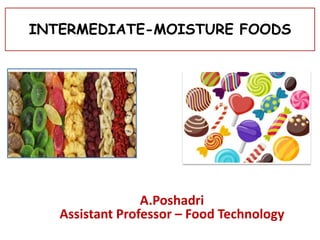
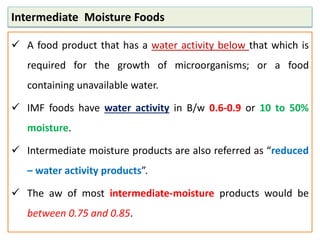
INTERMEDIATE-MOISTURE FOODS
A.Poshadri
Assistant Professor – Food Technology
Intermediate Moisture Foods
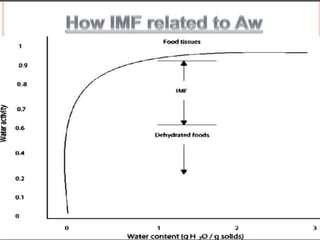
 A food product that has a water activity below that which is
required for the growth of microorganisms; or a food
containing unavailable water.
 IMF foods have water activity in B/w 0.6-0.9 or 10 to 50%
moisture.
 Intermediate moisture products are also referred as “reduced
– water activity products”.
 The aw of most intermediate-moisture products would be
between 0.75 and 0.85.
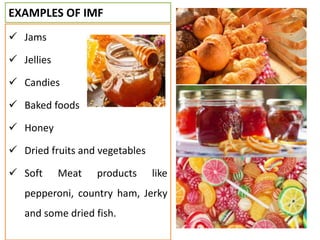
EXAMPLES OF IMF
 Jams
 Jellies
 Candies
 Baked foods
 Honey
 Dried fruits and vegetables
 Soft Meat products like
pepperoni, country ham, Jerky
and some dried fish.
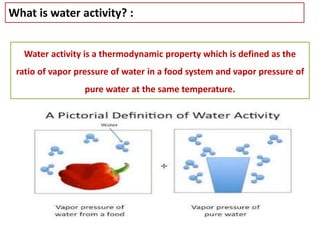
What is water activity? :
Water activity is a thermodynamic property which is defined as the
ratio of vapor pressure of water in a food system and vapor pressure of
pure water at the same temperature.
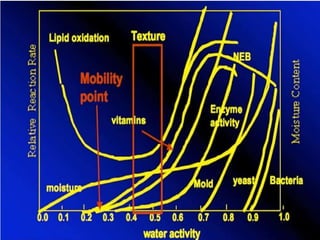
The potential of reduced water activity in food
preservation with the following considerations
1. An aw of 0.85 inhibits the most common food pathogens,
2. Bacterial spore germination is inhibited at relatively high aw values,
3. Non spore formers, which can grow at an aw b below 0.95, are
susceptible to pasteurizing temperatures
4. Suboptimal conditions of growth impose inhibition at higher levels of
water activity
5. Organisms that will grow at low water activities multiply very slowly,
and
6. yeasts and molds can be suppressed by antimycotics.
PURPOSE OF INTERMEDIATE MOISTURE FOOD
 The purpose is to achieve a desirable water activity by the various
ingredients so that food product maintain enough water for
palatability and can be stored safely.
 Addition of preservatives provides the margin of safety against
spoilage organisms
 Staphylococcus aureus is one of the organism of high concern which
can tolerate aw as low as 0.83-0.86 under aerobic conditions.
Advantages
 Low aw thus aw is the primary hurdle to achieve the microbial stability
and safety.
 Easy to prepare and store without refrigeration.
 These are energy efficient and relatively cheap.
 They don’t get easily spoiled even if the package is damaged(because
of low aw)
Disadvantages
 Some IMF foods contain high level of additives that may cause health
concerns and possible legal problems.
 High sugar content is also a concern because of high calorific value.
 Texture and flavour sometimes gets damaged if not properly handled.
Conclusion
Efforts should be made to improve the quality of such foods by lowering
the sugar and salt addition as well as increasing the moisture content
and aw but without sacrificing the microbial stability and safety of
products if stored without refrigeration. This may be achieved by an
intelligent applications of hurdles.

Intermediate moisture foods

  • 1.
  • 2.
    Intermediate Moisture Foods A food product that has a water activity below that which is required for the growth of microorganisms; or a food containing unavailable water.  IMF foods have water activity in B/w 0.6-0.9 or 10 to 50% moisture.  Intermediate moisture products are also referred as “reduced – water activity products”.  The aw of most intermediate-moisture products would be between 0.75 and 0.85.
  • 3.
    EXAMPLES OF IMF Jams  Jellies  Candies  Baked foods  Honey  Dried fruits and vegetables  Soft Meat products like pepperoni, country ham, Jerky and some dried fish.
  • 4.
    What is wateractivity? : Water activity is a thermodynamic property which is defined as the ratio of vapor pressure of water in a food system and vapor pressure of pure water at the same temperature.
  • 7.
    The potential ofreduced water activity in food preservation with the following considerations 1. An aw of 0.85 inhibits the most common food pathogens, 2. Bacterial spore germination is inhibited at relatively high aw values, 3. Non spore formers, which can grow at an aw b below 0.95, are susceptible to pasteurizing temperatures 4. Suboptimal conditions of growth impose inhibition at higher levels of water activity 5. Organisms that will grow at low water activities multiply very slowly, and 6. yeasts and molds can be suppressed by antimycotics.
  • 8.
    PURPOSE OF INTERMEDIATEMOISTURE FOOD  The purpose is to achieve a desirable water activity by the various ingredients so that food product maintain enough water for palatability and can be stored safely.  Addition of preservatives provides the margin of safety against spoilage organisms  Staphylococcus aureus is one of the organism of high concern which can tolerate aw as low as 0.83-0.86 under aerobic conditions.
  • 9.
    Advantages  Low awthus aw is the primary hurdle to achieve the microbial stability and safety.  Easy to prepare and store without refrigeration.  These are energy efficient and relatively cheap.  They don’t get easily spoiled even if the package is damaged(because of low aw)
  • 10.
    Disadvantages  Some IMFfoods contain high level of additives that may cause health concerns and possible legal problems.  High sugar content is also a concern because of high calorific value.  Texture and flavour sometimes gets damaged if not properly handled.
  • 11.
    Conclusion Efforts should bemade to improve the quality of such foods by lowering the sugar and salt addition as well as increasing the moisture content and aw but without sacrificing the microbial stability and safety of products if stored without refrigeration. This may be achieved by an intelligent applications of hurdles.