TEA PROCESSING
Botanical Name: Cornelia thea
Family: Camelliaceae
Origin: Tea is believed to be
indigenous to Assam in India only.
Unit operations involved in black tea processing
Plucking
Withering
Rolling
Fermentation
Drying
Sorting & grading
(Harler, 1963)
PLUCKING:
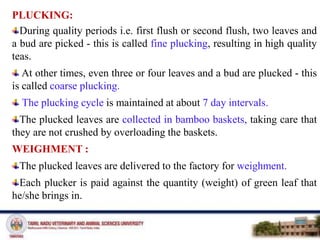
During quality periods i.e. first flush or second flush, two leaves and
a bud are picked - this is called fine plucking, resulting in high quality
teas.
At other times, even three or four leaves and a bud are plucked - this
is called coarse plucking.
The plucking cycle is maintained at about 7 day intervals.
The plucked leaves are collected in bamboo baskets, taking care that
they are not crushed by overloading the baskets.
WEIGHMENT :
The plucked leaves are delivered to the factory for weighment.
Each plucker is paid against the quantity (weight) of green leaf that
he/she brings in.
WITHERING (dry up):
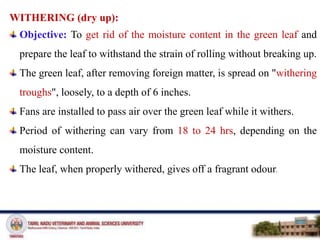
Objective: To get rid of the moisture content in the green leaf and
prepare the leaf to withstand the strain of rolling without breaking up.
The green leaf, after removing foreign matter, is spread on "withering
troughs", loosely, to a depth of 6 inches.
Fans are installed to pass air over the green leaf while it withers.
Period of withering can vary from 18 to 24 hrs, depending on the
moisture content.
The leaf, when properly withered, gives off a fragrant odour.
ROLLING
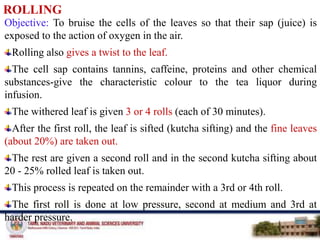
Objective: To bruise the cells of the leaves so that their sap (juice) is
exposed to the action of oxygen in the air.
Rolling also gives a twist to the leaf.
The cell sap contains tannins, caffeine, proteins and other chemical
substances-give the characteristic colour to the tea liquor during
infusion.
The withered leaf is given 3 or 4 rolls (each of 30 minutes).
After the first roll, the leaf is sifted (kutcha sifting) and the fine leaves
(about 20%) are taken out.
The rest are given a second roll and in the second kutcha sifting about
20 - 25% rolled leaf is taken out.
This process is repeated on the remainder with a 3rd or 4th roll.
The first roll is done at low pressure, second at medium and 3rd at
harder pressure.
ROLL-BREAKING
From the roller the tea emerges as twisted lumps which are broken
up by coarse mesh sieves or roll-breakers.
The fine leaf which falls through are taken to the fermenting
rooms, while the coarse leaf is returned for further rolling
FERMENTATION
The rolled leaves are spread on fermenting beds and left to ferment
for a period of 3 to 4 hrs.
The leaves are loosely spread to a thickness of 1 or 1.5. inches.
Good fermentation results in the colour of the leaf to change to
reddish brown giving off the characteristic aroma after the juices in
the rolled leaves react with each other and the air.
DRYING OR FIRING
The fermented leaves are then fired (i.e. heated) in a drier machine.
Objective: To arrest fermentation and slowly dessicate the leaf in such
a way so as to extract the moisture without scorching the tea and at the
same time, preserving its quality and other characters to the optimum
level.
The leaves are passed through the driers and remain within the driers
for a period of approx. 20 mins, at 240 to 250° F.
This results in the leaves moisture content to come down to 20 - 25%
from 60 - 70% before it enters the drier.
A second firing is also given shortly thereafter.
SORTING
Sorting of different grades is done by sorting machines which are
fitted with wire mesh trays that revolve or vibrate.
The tea is passed over wire mesh of varying sizes so that the whole
leaf, broken leaf and dust grades fall at different places.
These sorted teas comprise the different grades.
PACKING
The different grades of tea are then packed into plywood chests /
paper sacks lined with aluminium foil inside.
Each lot is generally packed in a minimum of 5 chests / sacks or
more.
The chests / sacks are sealed and the grade name, garden name, lot
number (called an invoice), chest number, gross and net weight, year
of manufacture etc. are printed on the chests / sacks with stencils.
Lastly, licence number and "CTM-applied for" are also stencilled
onto the tea chests / sacks.
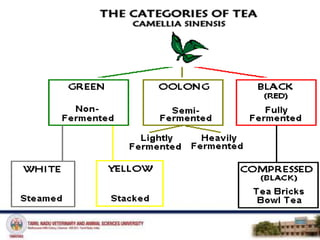
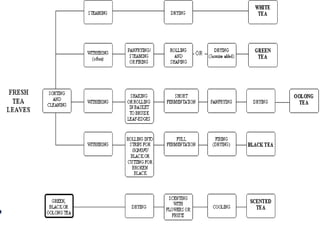
GREEN TEA
Green tea is not given the withering treatment.
Immediately after it is plucked it is put into a large "steamer" and
heated.
This softens the leaves for rolling and keeps the "juices" from
oxidizing.
The leaves are then rolled and dried again and again until they are
crisp.
They remain green.
OOLONG TEA
This tea is a compromise between black and green tea.
The leaves are only partly oxidized.
They turn a greenish brown.
Oolong teas are only partially fermented or oxidized.
Orthodox and CTC methods of tea processing
In the orthodox processing method: only the top two leaves from
each branch are picked, at the precise moment when they are budding
out. They are gathered by hand and are then processed.
The CTC method (Crush, Tear, Curl) is a mechanized process that
strips the plants of their leaves and turns them into tiny pellets.
These teas are appropriate for industrial strength machines because
they infuse faster and can be made with a much lower grade of tea.
Tea

Tea

  • 1.
    TEA PROCESSING Botanical Name:Cornelia thea Family: Camelliaceae Origin: Tea is believed to be indigenous to Assam in India only.
  • 4.
    Unit operations involvedin black tea processing Plucking Withering Rolling Fermentation Drying Sorting & grading (Harler, 1963)
  • 5.
    PLUCKING: During quality periodsi.e. first flush or second flush, two leaves and a bud are picked - this is called fine plucking, resulting in high quality teas. At other times, even three or four leaves and a bud are plucked - this is called coarse plucking. The plucking cycle is maintained at about 7 day intervals. The plucked leaves are collected in bamboo baskets, taking care that they are not crushed by overloading the baskets. WEIGHMENT : The plucked leaves are delivered to the factory for weighment. Each plucker is paid against the quantity (weight) of green leaf that he/she brings in.
  • 6.
    WITHERING (dry up): Objective:To get rid of the moisture content in the green leaf and prepare the leaf to withstand the strain of rolling without breaking up. The green leaf, after removing foreign matter, is spread on "withering troughs", loosely, to a depth of 6 inches. Fans are installed to pass air over the green leaf while it withers. Period of withering can vary from 18 to 24 hrs, depending on the moisture content. The leaf, when properly withered, gives off a fragrant odour.
  • 7.
    ROLLING Objective: To bruisethe cells of the leaves so that their sap (juice) is exposed to the action of oxygen in the air. Rolling also gives a twist to the leaf. The cell sap contains tannins, caffeine, proteins and other chemical substances-give the characteristic colour to the tea liquor during infusion. The withered leaf is given 3 or 4 rolls (each of 30 minutes). After the first roll, the leaf is sifted (kutcha sifting) and the fine leaves (about 20%) are taken out. The rest are given a second roll and in the second kutcha sifting about 20 - 25% rolled leaf is taken out. This process is repeated on the remainder with a 3rd or 4th roll. The first roll is done at low pressure, second at medium and 3rd at harder pressure.
  • 8.
    ROLL-BREAKING From the rollerthe tea emerges as twisted lumps which are broken up by coarse mesh sieves or roll-breakers. The fine leaf which falls through are taken to the fermenting rooms, while the coarse leaf is returned for further rolling
  • 9.
    FERMENTATION The rolled leavesare spread on fermenting beds and left to ferment for a period of 3 to 4 hrs. The leaves are loosely spread to a thickness of 1 or 1.5. inches. Good fermentation results in the colour of the leaf to change to reddish brown giving off the characteristic aroma after the juices in the rolled leaves react with each other and the air.
  • 10.
    DRYING OR FIRING Thefermented leaves are then fired (i.e. heated) in a drier machine. Objective: To arrest fermentation and slowly dessicate the leaf in such a way so as to extract the moisture without scorching the tea and at the same time, preserving its quality and other characters to the optimum level. The leaves are passed through the driers and remain within the driers for a period of approx. 20 mins, at 240 to 250° F. This results in the leaves moisture content to come down to 20 - 25% from 60 - 70% before it enters the drier. A second firing is also given shortly thereafter.
  • 11.
    SORTING Sorting of differentgrades is done by sorting machines which are fitted with wire mesh trays that revolve or vibrate. The tea is passed over wire mesh of varying sizes so that the whole leaf, broken leaf and dust grades fall at different places. These sorted teas comprise the different grades.
  • 12.
    PACKING The different gradesof tea are then packed into plywood chests / paper sacks lined with aluminium foil inside. Each lot is generally packed in a minimum of 5 chests / sacks or more. The chests / sacks are sealed and the grade name, garden name, lot number (called an invoice), chest number, gross and net weight, year of manufacture etc. are printed on the chests / sacks with stencils. Lastly, licence number and "CTM-applied for" are also stencilled onto the tea chests / sacks.
  • 13.
    GREEN TEA Green teais not given the withering treatment. Immediately after it is plucked it is put into a large "steamer" and heated. This softens the leaves for rolling and keeps the "juices" from oxidizing. The leaves are then rolled and dried again and again until they are crisp. They remain green.
  • 14.
    OOLONG TEA This teais a compromise between black and green tea. The leaves are only partly oxidized. They turn a greenish brown. Oolong teas are only partially fermented or oxidized.
  • 15.
    Orthodox and CTCmethods of tea processing In the orthodox processing method: only the top two leaves from each branch are picked, at the precise moment when they are budding out. They are gathered by hand and are then processed. The CTC method (Crush, Tear, Curl) is a mechanized process that strips the plants of their leaves and turns them into tiny pellets. These teas are appropriate for industrial strength machines because they infuse faster and can be made with a much lower grade of tea.