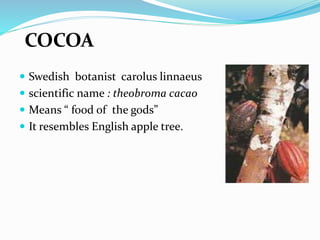
 Swedish botanist carolus linnaeus
 scientific name : theobroma cacao
 Means “ food of the gods”
 It resembles English apple tree.
COCOA
TYPES OF COCOA PODS
1. Forastero
2. Criollo
3. Trinitario
Forastero
 Hard & vigorous , strongest flavour.
 Grown in west Africa , Brazil.
 Smooth yellow pods & pale purple beans
CRIOLLO
 Mild or weak chocolate flavour.
 Grown in Indonesia, central & south America.
 Not hardy & produce softer red pods.
TRINITARIO
 Grown in Caribbean , Cameroon ,New Guinea.
 Variable colours, white bean are rare.
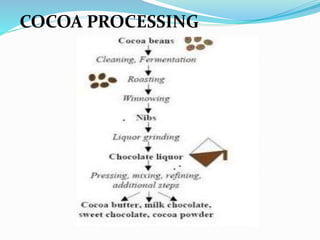
COCOA PROCESSING
PROCESSING OF COCOA BEANS
 Fermentation
cocoa pulp clinging to the beans matures & turns
into liquid which drains away and true chocolate flavour
starts to develop.
3 types;
1. basket fermentation
2. tray fermentation
3. Box fermentation
BASKET FERMENTATION
 Quantity of the beans to be fermented is less
than 40 kg.
 Closely woven bamboo or can basket is used.
 Inside of the basket is provided with a lining of
banana leaves.
 Freshly collected beans are filled and then giving a
light pressing by hand.
 The top of the basket is covered by banana leaves.
 The basket is placed over a raised platform to facilitate
drainage of sweating.
 The beans are mixed thoroughly and again covered
with leaves.
 This process is completed within 6 days.
 After the end of fermentation , drying is carried out.
TRAY FERMENTATION
 Quantity of the beans is 200-500 kg at a time.
 Wooden trays are used.
 The bottom of the trays are made up of reapers.
 After filling , the trays are left individually for 24 hrs
on a raised platform for draining.
 No mixing or turning of the beans is required.
 This process is completed within 5 days.
 Time & labour is saved.
BOX FERMENTATION
 Quantity of the beans is about 40 kg or more.
 Wooden boxes is used.
 Care should be exercised in the making of the
box to ensure that metallic nails are not used.
 The boxes may be individual or row of boxes.
 The boxes are kept in raised platform for drainage.
 The beans are filled in the boxes & covered with
gunny bags.
 The process is completed within 6 days.
DRYING
• When fermentation is complete, wet mass of beans is
dried either traditionally by being spread in the sun on
mats or using special drying equipment.
2 types;
1. Sun drying
2. Artificial drying
SUN DRYING
 Beans are spread on palm leaf plates for drying.
 45 – 60 degree Celsius are deemed to be satisfactory.
 It is superior than artificial drying.
 It takes about 6 days.
ARTIFICIAL DRYING
 Drying is carried on hot air & in vacuum.
 After drying, the beans are taken to dry places.
WINNOWING
• The dried beans are cracked and a stream of air
separates the shell from the nib, the small pieces used
to make chocolate.
ROASTING
 The nibs are roasted in ovens at temperatures between
105-120 degrees Celsius.
 The cocoa nibs darken , brown colour and chocolate
flavour and aroma.
GRINDING
 The roasted nibs are ground in stone mills until the
friction and heat of the milling reduces them to a thick
chocolate- coloured liquid, known as 'mass.'
 It contains 53-58% cocoa butter and solidifies on
cooling.
 This is the basis of all chocolate and cocoa products.
PRESSING
 The cocoa mass is pressed in powerful machines to
extract the cocoa butter, vital to making chocolate.
 Press cake are pulverized into a fine powder to produce
a high-grade cocoa powder & used as beverage or in
cooking.
 The cocoa mass, cocoa butter and cocoa powder are
then quality inspected and shipped to our factories in
Australia and New Zealand, ready to be made into
chocolate.
COCOA PRODUCTS
 Cocoa nibs
• Cocoa butter
 Cocoa mass (or) chocolate - coloured liquid
 Chocolate
REFERENCES
 Urquhart, D.H (196 1) . Cacao, Long mass, Green and
co.ltd, London.
 Thomas, G. (1990). Canopy architecture ,
photosynthesis and yield of irrigated cocoa . M. Phil,
thesis, Mangalore university, India.
cocoa processing

cocoa processing

  • 2.
     Swedish botanistcarolus linnaeus  scientific name : theobroma cacao  Means “ food of the gods”  It resembles English apple tree. COCOA
  • 3.
    TYPES OF COCOAPODS 1. Forastero 2. Criollo 3. Trinitario
  • 4.
    Forastero  Hard &vigorous , strongest flavour.  Grown in west Africa , Brazil.  Smooth yellow pods & pale purple beans
  • 5.
    CRIOLLO  Mild orweak chocolate flavour.  Grown in Indonesia, central & south America.  Not hardy & produce softer red pods.
  • 6.
    TRINITARIO  Grown inCaribbean , Cameroon ,New Guinea.  Variable colours, white bean are rare.
  • 7.
  • 8.
    PROCESSING OF COCOABEANS  Fermentation cocoa pulp clinging to the beans matures & turns into liquid which drains away and true chocolate flavour starts to develop. 3 types; 1. basket fermentation 2. tray fermentation 3. Box fermentation
  • 9.
    BASKET FERMENTATION  Quantityof the beans to be fermented is less than 40 kg.  Closely woven bamboo or can basket is used.
  • 10.
     Inside ofthe basket is provided with a lining of banana leaves.  Freshly collected beans are filled and then giving a light pressing by hand.  The top of the basket is covered by banana leaves.  The basket is placed over a raised platform to facilitate drainage of sweating.  The beans are mixed thoroughly and again covered with leaves.  This process is completed within 6 days.  After the end of fermentation , drying is carried out.
  • 11.
    TRAY FERMENTATION  Quantityof the beans is 200-500 kg at a time.  Wooden trays are used.
  • 12.
     The bottomof the trays are made up of reapers.  After filling , the trays are left individually for 24 hrs on a raised platform for draining.  No mixing or turning of the beans is required.  This process is completed within 5 days.  Time & labour is saved.
  • 13.
    BOX FERMENTATION  Quantityof the beans is about 40 kg or more.  Wooden boxes is used.
  • 14.
     Care shouldbe exercised in the making of the box to ensure that metallic nails are not used.  The boxes may be individual or row of boxes.  The boxes are kept in raised platform for drainage.  The beans are filled in the boxes & covered with gunny bags.  The process is completed within 6 days.
  • 15.
    DRYING • When fermentationis complete, wet mass of beans is dried either traditionally by being spread in the sun on mats or using special drying equipment. 2 types; 1. Sun drying 2. Artificial drying
  • 16.
    SUN DRYING  Beansare spread on palm leaf plates for drying.  45 – 60 degree Celsius are deemed to be satisfactory.  It is superior than artificial drying.  It takes about 6 days.
  • 17.
    ARTIFICIAL DRYING  Dryingis carried on hot air & in vacuum.  After drying, the beans are taken to dry places.
  • 18.
    WINNOWING • The driedbeans are cracked and a stream of air separates the shell from the nib, the small pieces used to make chocolate.
  • 19.
    ROASTING  The nibsare roasted in ovens at temperatures between 105-120 degrees Celsius.  The cocoa nibs darken , brown colour and chocolate flavour and aroma.
  • 20.
    GRINDING  The roastednibs are ground in stone mills until the friction and heat of the milling reduces them to a thick chocolate- coloured liquid, known as 'mass.'  It contains 53-58% cocoa butter and solidifies on cooling.  This is the basis of all chocolate and cocoa products.
  • 22.
    PRESSING  The cocoamass is pressed in powerful machines to extract the cocoa butter, vital to making chocolate.  Press cake are pulverized into a fine powder to produce a high-grade cocoa powder & used as beverage or in cooking.  The cocoa mass, cocoa butter and cocoa powder are then quality inspected and shipped to our factories in Australia and New Zealand, ready to be made into chocolate.
  • 24.
    COCOA PRODUCTS  Cocoanibs • Cocoa butter
  • 25.
     Cocoa mass(or) chocolate - coloured liquid  Chocolate
  • 26.
    REFERENCES  Urquhart, D.H(196 1) . Cacao, Long mass, Green and co.ltd, London.  Thomas, G. (1990). Canopy architecture , photosynthesis and yield of irrigated cocoa . M. Phil, thesis, Mangalore university, India.