The Citric Acid Cycle
(TCA)
Dr. Kanisha Shah Kalaria
Visiting Faculty
Institute of Science
Nirma University
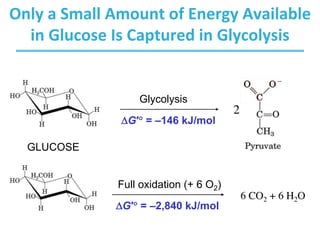
Only a Small Amount of Energy Available
in Glucose Is Captured in Glycolysis
2
DG′° = –146 kJ/mol
Glycolysis
Full oxidation (+ 6 O2)
DG′° = –2,840 kJ/mol
6 CO2 + 6 H2O
GLUCOSE
Cellular Respiration
• Process in which cells consume O2 and produce CO2
• Provides more energy (ATP) from glucose than
glycolysis
• Also captures energy stored in lipids and amino acids
• Evolutionary origin: developed about 2.5 billion years
ago
• Used by animals, plants, and many microorganisms
• Occurs in three major stages:
- acetyl CoA production
- acetyl CoA oxidation
- electron transfer and oxidative phosphorylation
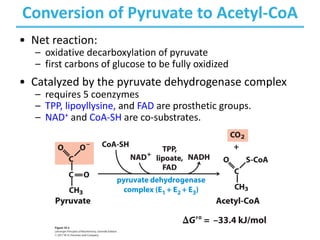
Conversion of Pyruvate to Acetyl-CoA
• Net reaction:
– oxidative decarboxylation of pyruvate
– first carbons of glucose to be fully oxidized
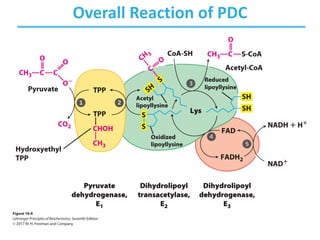
• Catalyzed by the pyruvate dehydrogenase complex
– requires 5 coenzymes
– TPP, lipoyllysine, and FAD are prosthetic groups.
– NAD+ and CoA-SH are co-substrates.
Pyruvate Dehydrogenase Complex
(PDC)
• PDC is a large (up to 10 MDa) multienzyme complex.
- pyruvate dehydrogenase (E1)
- dihydrolipoyl transacetylase (E2)
- dihydrolipoyl dehydrogenase (E3)
•Advantages of multienzyme complexes:
- The short distance between catalytic sites allows channeling
of substrates from one catalytic site to another.
- Channeling minimizes side reactions.
- The regulation of activity of one subunit affects the entire
complex.
Overall Reaction of PDC
The Citric Acid Cycle (CAC)
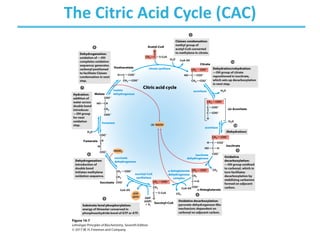
• The citric acid cycle includes a series of oxidation–reduction
reactions that result in the oxidation of an acetyl group to two
molecules of carbon dioxide.
• This oxidation generates high-energy electrons that will be
used to power the synthesis of ATP.
• The function of the citric acid cycle is the harvesting of high
energy electrons from carbon fuels.
Sequence of Events in the
Citric Acid Cycle
• Step 1: C-C bond formation between acetate (2C) and
oxaloacetate (4C) to make citrate (6C)
• Step 2: Isomerization via dehydration/rehydration
• Steps 3–4: Oxidative decarboxylations to give 2 NADH
• Step 5: Substrate-level phosphorylation to give GTP
• Step 6: Dehydrogenation to give FADH2
• Step 7: Hydration
• Step 8: Dehydrogenation to give NADH
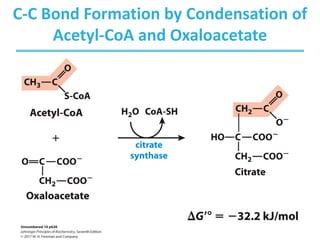
C-C Bond Formation by Condensation of
Acetyl-CoA and Oxaloacetate
Citrate Synthase
• Condensation of acetyl-CoA and oxaloacetate
• The only reaction with C-C bond formation
• Uses acid/base catalysis
– Carbonyl of oxaloacetate is a good electrophile.
– Methyl of acetyl-CoA is not a good nucleophile…
– …unless activated by deprotonation.
• Rate-limiting step of CAC
• Activity largely depends on [oxaloacetate].
• Highly thermodynamically favorable/irreversible
– regulated by substrate availability and product inhibition
Oxidative Decarboxylation by Isocitrate
Dehydrogenase
• Isozymes are specific for NADP+ (cytosolic) or NAD+ (mitochondrial).
• Decarboxylation releases CO2.
• Highly favorable/irreversible and regulated by [ATP]
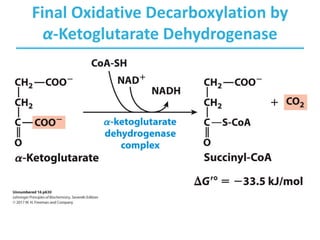
Final Oxidative Decarboxylation by
α-Ketoglutarate Dehydrogenase
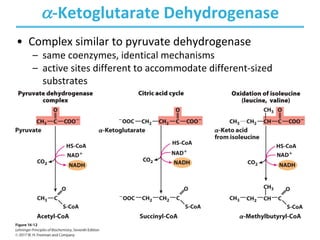
a-Ketoglutarate Dehydrogenase
• Complex similar to pyruvate dehydrogenase
– same coenzymes, identical mechanisms
– active sites different to accommodate different-sized
substrates
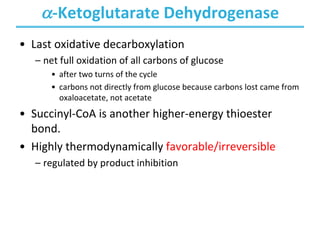
a-Ketoglutarate Dehydrogenase
• Last oxidative decarboxylation
– net full oxidation of all carbons of glucose
• after two turns of the cycle
• carbons not directly from glucose because carbons lost came from
oxaloacetate, not acetate
• Succinyl-CoA is another higher-energy thioester
bond.
• Highly thermodynamically favorable/irreversible
– regulated by product inhibition
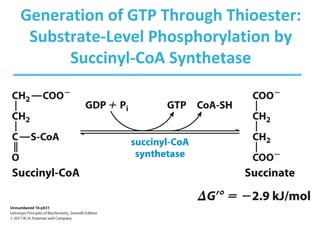
Generation of GTP Through Thioester:
Substrate-Level Phosphorylation by
Succinyl-CoA Synthetase
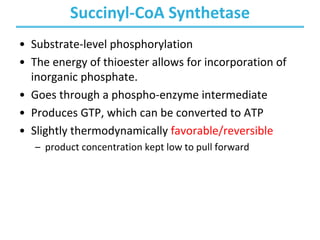
• Substrate-level phosphorylation
• The energy of thioester allows for incorporation of
inorganic phosphate.
• Goes through a phospho-enzyme intermediate
• Produces GTP, which can be converted to ATP
• Slightly thermodynamically favorable/reversible
– product concentration kept low to pull forward
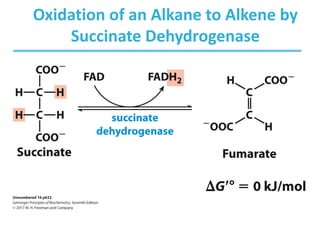
Oxidation of an Alkane to Alkene by
Succinate Dehydrogenase
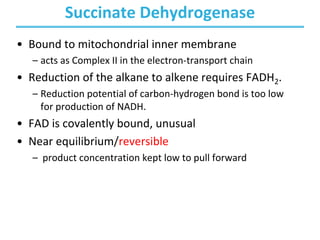
• Bound to mitochondrial inner membrane
– acts as Complex II in the electron-transport chain
• Reduction of the alkane to alkene requires FADH2.
– Reduction potential of carbon-hydrogen bond is too low
for production of NADH.
• FAD is covalently bound, unusual
• Near equilibrium/reversible
– product concentration kept low to pull forward
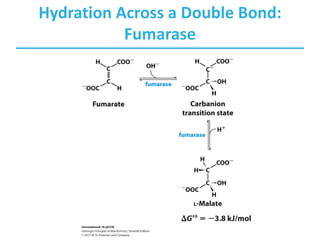
Hydration Across a Double Bond:
Fumarase
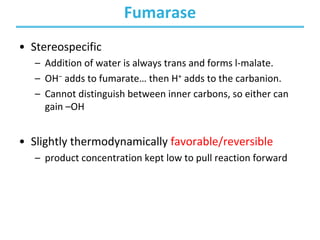
Fumarase
• Stereospecific
– Addition of water is always trans and forms l-malate.
– OH− adds to fumarate… then H+ adds to the carbanion.
– Cannot distinguish between inner carbons, so either can
gain –OH
• Slightly thermodynamically favorable/reversible
– product concentration kept low to pull reaction forward
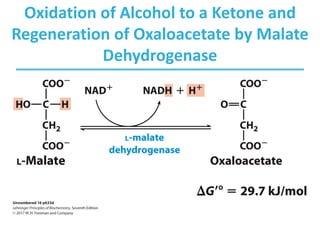
Oxidation of Alcohol to a Ketone and
Regeneration of Oxaloacetate by Malate
Dehydrogenase
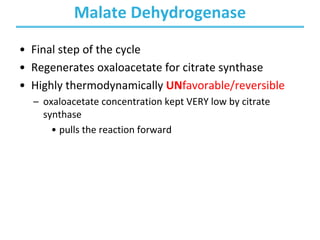
Malate Dehydrogenase
• Final step of the cycle
• Regenerates oxaloacetate for citrate synthase
• Highly thermodynamically UNfavorable/reversible
– oxaloacetate concentration kept VERY low by citrate
synthase
• pulls the reaction forward
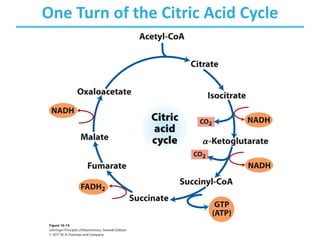
One Turn of the Citric Acid Cycle
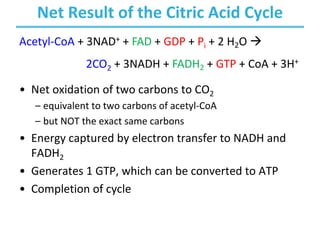
Net Result of the Citric Acid Cycle
• Net oxidation of two carbons to CO2
– equivalent to two carbons of acetyl-CoA
– but NOT the exact same carbons
• Energy captured by electron transfer to NADH and
FADH2
• Generates 1 GTP, which can be converted to ATP
• Completion of cycle
Acetyl-CoA + 3NAD+ + FAD + GDP + Pi + 2 H2O à
2CO2 + 3NADH + FADH2 + GTP + CoA + 3H+
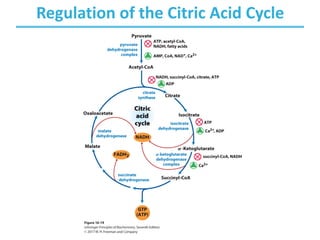
Regulation of the Citric Acid Cycle
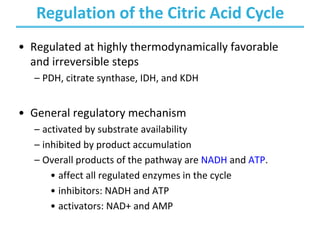
• Regulated at highly thermodynamically favorable
and irreversible steps
– PDH, citrate synthase, IDH, and KDH
• General regulatory mechanism
– activated by substrate availability
– inhibited by product accumulation
– Overall products of the pathway are NADH and ATP.
• affect all regulated enzymes in the cycle
• inhibitors: NADH and ATP
• activators: NAD+ and AMP
Regulation of Pyruvate Dehydrogenase
• Also regulated by reversible phosphorylation of E1
– phosphorylation: inactive
– dephosphorylation: active
• PDH kinase and PDH phosphorylase are part of
mammalian PDH complex.
– Kinase is activated by ATP.
• high ATP à phosphorylated PDH à less acetyl-CoA
• low ATP à kinase is less active and phosphorylase
removes phosphate from PDH à more acetyl-CoA
Regulation of PDH is somewhat similar to regulation of the
glycogen synthase/glycogen phosphorylase complex.
Additional Regulatory Mechanisms
• Citrate synthase is also inhibited by succinyl-CoA.
– α-Ketoglutarate is an important branch point for amino
acid metabolism.
– Succinyl-CoA communicates flow at this branch point to
the start of the cycle.
• Regulation of isocitrate dehydrogenase controls
citrate levels.
– Aconitase is reversible.
– Inhibition of IDH leads to accumulation of isocitrate and
reverses acconitase.
– Accumulated citrate leaves mitochondria and inhibits
phosphofructokinase in glycolysis.

TCA Cycle.pdf

  • 1.
    The Citric AcidCycle (TCA) Dr. Kanisha Shah Kalaria Visiting Faculty Institute of Science Nirma University
  • 2.
    Only a SmallAmount of Energy Available in Glucose Is Captured in Glycolysis 2 DG′° = –146 kJ/mol Glycolysis Full oxidation (+ 6 O2) DG′° = –2,840 kJ/mol 6 CO2 + 6 H2O GLUCOSE
  • 3.
    Cellular Respiration • Processin which cells consume O2 and produce CO2 • Provides more energy (ATP) from glucose than glycolysis • Also captures energy stored in lipids and amino acids • Evolutionary origin: developed about 2.5 billion years ago • Used by animals, plants, and many microorganisms • Occurs in three major stages: - acetyl CoA production - acetyl CoA oxidation - electron transfer and oxidative phosphorylation
  • 4.
    Conversion of Pyruvateto Acetyl-CoA • Net reaction: – oxidative decarboxylation of pyruvate – first carbons of glucose to be fully oxidized • Catalyzed by the pyruvate dehydrogenase complex – requires 5 coenzymes – TPP, lipoyllysine, and FAD are prosthetic groups. – NAD+ and CoA-SH are co-substrates.
  • 5.
    Pyruvate Dehydrogenase Complex (PDC) •PDC is a large (up to 10 MDa) multienzyme complex. - pyruvate dehydrogenase (E1) - dihydrolipoyl transacetylase (E2) - dihydrolipoyl dehydrogenase (E3) •Advantages of multienzyme complexes: - The short distance between catalytic sites allows channeling of substrates from one catalytic site to another. - Channeling minimizes side reactions. - The regulation of activity of one subunit affects the entire complex.
  • 6.
  • 7.
    The Citric AcidCycle (CAC)
  • 8.
    • The citricacid cycle includes a series of oxidation–reduction reactions that result in the oxidation of an acetyl group to two molecules of carbon dioxide. • This oxidation generates high-energy electrons that will be used to power the synthesis of ATP. • The function of the citric acid cycle is the harvesting of high energy electrons from carbon fuels.
  • 9.
    Sequence of Eventsin the Citric Acid Cycle • Step 1: C-C bond formation between acetate (2C) and oxaloacetate (4C) to make citrate (6C) • Step 2: Isomerization via dehydration/rehydration • Steps 3–4: Oxidative decarboxylations to give 2 NADH • Step 5: Substrate-level phosphorylation to give GTP • Step 6: Dehydrogenation to give FADH2 • Step 7: Hydration • Step 8: Dehydrogenation to give NADH
  • 10.
    C-C Bond Formationby Condensation of Acetyl-CoA and Oxaloacetate
  • 11.
    Citrate Synthase • Condensationof acetyl-CoA and oxaloacetate • The only reaction with C-C bond formation • Uses acid/base catalysis – Carbonyl of oxaloacetate is a good electrophile. – Methyl of acetyl-CoA is not a good nucleophile… – …unless activated by deprotonation. • Rate-limiting step of CAC • Activity largely depends on [oxaloacetate]. • Highly thermodynamically favorable/irreversible – regulated by substrate availability and product inhibition
  • 12.
    Oxidative Decarboxylation byIsocitrate Dehydrogenase • Isozymes are specific for NADP+ (cytosolic) or NAD+ (mitochondrial). • Decarboxylation releases CO2. • Highly favorable/irreversible and regulated by [ATP]
  • 13.
    Final Oxidative Decarboxylationby α-Ketoglutarate Dehydrogenase
  • 14.
    a-Ketoglutarate Dehydrogenase • Complexsimilar to pyruvate dehydrogenase – same coenzymes, identical mechanisms – active sites different to accommodate different-sized substrates
  • 15.
    a-Ketoglutarate Dehydrogenase • Lastoxidative decarboxylation – net full oxidation of all carbons of glucose • after two turns of the cycle • carbons not directly from glucose because carbons lost came from oxaloacetate, not acetate • Succinyl-CoA is another higher-energy thioester bond. • Highly thermodynamically favorable/irreversible – regulated by product inhibition
  • 16.
    Generation of GTPThrough Thioester: Substrate-Level Phosphorylation by Succinyl-CoA Synthetase
  • 17.
    Succinyl-CoA Synthetase • Substrate-levelphosphorylation • The energy of thioester allows for incorporation of inorganic phosphate. • Goes through a phospho-enzyme intermediate • Produces GTP, which can be converted to ATP • Slightly thermodynamically favorable/reversible – product concentration kept low to pull forward
  • 18.
    Oxidation of anAlkane to Alkene by Succinate Dehydrogenase
  • 19.
    Succinate Dehydrogenase • Boundto mitochondrial inner membrane – acts as Complex II in the electron-transport chain • Reduction of the alkane to alkene requires FADH2. – Reduction potential of carbon-hydrogen bond is too low for production of NADH. • FAD is covalently bound, unusual • Near equilibrium/reversible – product concentration kept low to pull forward
  • 20.
    Hydration Across aDouble Bond: Fumarase
  • 21.
    Fumarase • Stereospecific – Additionof water is always trans and forms l-malate. – OH− adds to fumarate… then H+ adds to the carbanion. – Cannot distinguish between inner carbons, so either can gain –OH • Slightly thermodynamically favorable/reversible – product concentration kept low to pull reaction forward
  • 22.
    Oxidation of Alcoholto a Ketone and Regeneration of Oxaloacetate by Malate Dehydrogenase
  • 23.
    Malate Dehydrogenase • Finalstep of the cycle • Regenerates oxaloacetate for citrate synthase • Highly thermodynamically UNfavorable/reversible – oxaloacetate concentration kept VERY low by citrate synthase • pulls the reaction forward
  • 24.
    One Turn ofthe Citric Acid Cycle
  • 25.
    Net Result ofthe Citric Acid Cycle • Net oxidation of two carbons to CO2 – equivalent to two carbons of acetyl-CoA – but NOT the exact same carbons • Energy captured by electron transfer to NADH and FADH2 • Generates 1 GTP, which can be converted to ATP • Completion of cycle Acetyl-CoA + 3NAD+ + FAD + GDP + Pi + 2 H2O à 2CO2 + 3NADH + FADH2 + GTP + CoA + 3H+
  • 26.
    Regulation of theCitric Acid Cycle
  • 27.
    Regulation of theCitric Acid Cycle • Regulated at highly thermodynamically favorable and irreversible steps – PDH, citrate synthase, IDH, and KDH • General regulatory mechanism – activated by substrate availability – inhibited by product accumulation – Overall products of the pathway are NADH and ATP. • affect all regulated enzymes in the cycle • inhibitors: NADH and ATP • activators: NAD+ and AMP
  • 28.
    Regulation of PyruvateDehydrogenase • Also regulated by reversible phosphorylation of E1 – phosphorylation: inactive – dephosphorylation: active • PDH kinase and PDH phosphorylase are part of mammalian PDH complex. – Kinase is activated by ATP. • high ATP à phosphorylated PDH à less acetyl-CoA • low ATP à kinase is less active and phosphorylase removes phosphate from PDH à more acetyl-CoA Regulation of PDH is somewhat similar to regulation of the glycogen synthase/glycogen phosphorylase complex.
  • 29.
    Additional Regulatory Mechanisms •Citrate synthase is also inhibited by succinyl-CoA. – α-Ketoglutarate is an important branch point for amino acid metabolism. – Succinyl-CoA communicates flow at this branch point to the start of the cycle. • Regulation of isocitrate dehydrogenase controls citrate levels. – Aconitase is reversible. – Inhibition of IDH leads to accumulation of isocitrate and reverses acconitase. – Accumulated citrate leaves mitochondria and inhibits phosphofructokinase in glycolysis.