Basic Principles and Applications of
Mass spectroscopy
Dr. Heena Dave
Institute of Science
Nirma University
❑ Ionization methods
❑ Mass analyzers
❑ MALDI : Matrix-assisted laser desorption/ionization
❑ ESI : Electrospray Ionisation Mass Spectrometry
❑TOF : Time of Flight (TOF) mass spectrometer
❑Q-TOF : Quadrupole- TOF
❑ MS-MS : Tandom Mass Spectrometry
Mass spectroscopy is an analytical technique that provides qualitative and
quantitative information, including the mass of molecules and atoms in
samples as well as the molecular structure of organic and inorganic
compounds
❑ Emphasis on functional aspects of cell biochemistry, gene expression, & proteins in the cell.
❑ A method for protein identification and characterization.
❑ An essential technique in the analysis of proteins and other biological molecules by
virtue of their versatility, sensitivity, speed, and improving ease of use.
Importance of Mass Spec Technology
❑ High level of sensitivity (Femtomole)
❑ “Exact” molecular weight measurement of molecules up to 150,000 Da. and as large as
500,000 Da.
❑ New peptide sequencing facilities provide protein ID in minutes instead of hours
❑ New instruments and techniques are becoming easier to use
Advantages of Mass Spectroscopy
Principle
• Separates gas phase ionized atoms, moleculaes and fragments of
molecules
• Separation is based on the difference in mass-to-charge ratio (m/z)
– M= unified atomic mass units (u)
– 1 dalton (Da)=1u=1.665402x10⁻²⁷ kg
– Z=charge on the ion (may be positive or negative)
• Analyte molecule undergo electron ionization
M + e- → M0+ + 2e-
• M0+ is the ionized analyte molecule called molecular ion
• Radical cation is formed by the loss of one electron
• Computer algoritms are used to deconvolute m/z values of multiply
charged ions into the equivalent mass of singly charged ion
• Permits easy determination of molecular weight of analyte
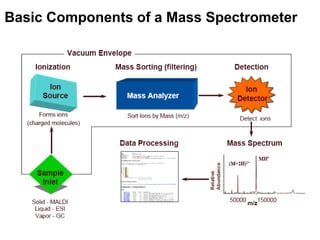
Basic Components of a Mass Spectrometer
What does a Mass Spectrometer do?
1. Generation of gas phase ions
2. Separation on mass to charge ratio
3. Counting
Sample Introduction/Preparation:
• The selection of a sample inlet depends upon sample and sample matrix.
• Most ionization techniques are designed for gas phase molecules so the inlet must transfer
the analyte into the source as a gas phase molecule.
• Gases and samples with high vapor pressure are introduced directly into the source region.
• Liquids and solids are usually heated to increase the vapor pressure for analysis.
• If the analyte is thermally labile or if it does not have sufficient vapor pressure, the sample
must be directly ionized from the condensed phase.
1. Direct vapour inlet:
• The simplest sample introduction method.
• The gas phase analyte is introduced directly into the source region of the mass
spectrometer through a needle valve.
• Pump out lines are usually included to remove air from the sample.
• This inlet works well for gases, liquids with a high vapor pressure.
• Samples with low vapor pressure are heated to increase vapor pressure.
• It only works for some samples.
2. Gas Chromatography:
• Most common technique; Gas chromatography coupled with mass spectrometry is used to
identify and quantitate the individual components. Several different interface designs are used
to connect these two instruments.
• The most significant characteristics of the inlets are the amount of GC carrier gas that enters
the mass spectrometer and the amount of analyte that enters the mass spectrometer.
• Ideally all the analyte and none of the GC carrier gas would enter the source region.
• If a large flow of GC carrier gas enters the mass spectrometer it will increase the pressure in
the source region.
• Maintaining the required source pressure will require larger & more expensive vacuum pumps.
• Most common GC/MS interface uses a capillary GC column.
• Since the carrier gas flow rate is very small for these columns, the end of the capillary is
inserted directly into the source region of the mass spectrometer.
• The entire flow from the GC enters the mass spectrometer.
• Since capillary columns are very common, this inlet is widely used.
• Wide bore capillaries and packed GC columns have higher flow rates. This increases the
pressure in the mass spectrometer.
• Several inlet designs are available to reduce the gas flow into the source.
• Splitting of the GC eluate - only a small portion of the total flow enters the mass spectrometer.
• Effusive separators and membrane inlets are more selective - transport a higher fraction of the
analyte into the source region.
3. Liquid Chromatography:
• Liquid chromatography inlets are used to introduce thermally labile compounds not easily
separated by gas chromatography.
• As these inlets are used for temperature sensitive compounds, the sample is ionized
directly from the condensed phase.
4. Direct Insertion Probe (DIP):
• DIP is used to introduce temperature sensitive, low vapor pressure liquids and solids into the
mass spectrometer.
• The sample is loaded into a short capillary tube at the end of a heated sleeve.
• This sleeve is then inserted through a vacuum lock so the sample is inside the source region.
•The temperature of the capillary tube is increased to vaporize the sample.
• The sample is under vacuum and located close to the source so that lower temperatures are
required for analysis.
5. Direct Ionisation of Sample:
• Some compounds either decompose when heated or have no significant vapor pressure.
These samples may be introduced to the mass spectrometer by direct ionization from the
condensed phase.
• These direct ionization techniques are used for liquid chromatography/mass spectrometry,
glow discharge mass spectrometry, fast atom bombardment and laser desorption.
Ionisation Methods
Ionisation
• For biological applications, ion sources convert neutral molecules to ions by adding or taking
away one or more protons.
• Ions may be singly or multiply charged.
• Ions are easier to control in the mass spectrometer than neutral molecules.
• Ions are easier to detect than neutral molecules.
Ionisation Techniques
• A number of techniques.
• Most ionization techniques excite the neutral analyte molecule which then ejects an electron
to form a radical cation (M+).
• Other ionization techniques involve ion molecule reactions that produce adduct ions (MH+).
• The most important considerations are the physical state of the analyte & ionization energy.
• Ionisation energy is important because it controls the amount of fragmentation observed in
mass spectrum.
• Some ionization techniques are very soft and only produce molecular ions.
• Other techniques are very energetic and cause ions to undergo extensive fragmentation.
• Although this fragmentation complicates the mass spectrum, it provides structural information
for the identification of unknown compounds.
Ionisation Techniques
1. Electron Ionisation (EI)
2. Field Ionisation (FI)
3. Chemical Ionisation
4. Fast Ion/Atom Bombardment (FAB)
5. Matrix Assisted Laser Desorption Ionisation (MALDI)
6. Atmospheric Pressure Ionisation (API) and Electro Spray Ionisation (ESI)
Electron Ionisation (EI)
• The electrons used for ionization are
produced by passing a current through a wire
filament.
• The amount of current controls the number of
electrons emitted by the filament.
• An electric field accelerates these electrons
across the source region to produce a beam of
high energy electrons.
• When an analyte molecule passes through
this electron beam, a valence shell electron
can be removed from the molecule to produce
an ion.
• Ionization does not occur by electron capture.
• Instead, EI produces positive ions by knocking a valence electron off the analyte molecule.
• As the electron passes close to the molecule the negative charge of the electron repels and
distorts the electron cloud surrounding the molecule.
• This distortion transfers kinetic energy from the fast-moving electron to the electron cloud of
the molecule.
• If enough energy is transferred by the process, the molecule will eject a valence electron and
form a radical cation (M+).
• EI causes extensive fragmentation so that molecular ion is not observed for many compounds.
• Still, fragmentation is useful because it provides structural information for interpreting unknown spectra.
• A mass spectrum is produced by ionizing many molecules, spectrum is a distribution of the possible
product ions.
• Intact molecular ions are observed from ions produced with little excess energy. Other molecular ions
have more energy and undergo fragmentation in the source region.
The abundance of the resulting fragments, is determined by the kinetics of the fragmentation pathways
and the ionization energy.
• Changing the ionization energy changes the observed distribution of fragment ions.
Advantages:
1. Established and very well understood
2. Reproducible mass spectra
3. Fragmentation can provide structural information
Disadvantages:
1. The sample has to be in gas phase
Field Ionisation (FI)
• Ions are formed under the influence of a large electric field (108 V/cm)
• Such fields are produced by applying high voltages to emitters consisting of numerous fine
tips (eg: a fine tungsten wire)
• Emitters are mounted 0.5 – 2.0 mm from the cathode which also serves as a slit.
• The gaseous sample from a batch inlet is allowed to diffuse into the high field area.
• Ionisation occurs via extraction of electrons from the analyte by the anode.
Advantages:
1. Very soft ionisation
2. Almost no chemical background
Disadvantages:
1. Preparation of the emitter is tough
2. High fields often require use of
sector MS
Fast Ion/Atom Bombardment
• Fast Atom Bombardment (FAB) and Secondary Ion Mass Spectrometry (SIMS) use high
energy atoms to sputter and ionize the sample in a single step.
• In these techniques, a beam of rare gas neutrals (FAB) or ions (SIMS) is focused on the
liquid or solid sample.
• The impact of this high energy beam causes the analyte molecules to sputter into the gas
phase and ionize in a single step
•These work well for compounds with molecular weights up to a few thousand dalton.
• Since no heating is required, sputtering techniques (especially FAB) are useful for studying
thermally labile compounds that decompose in conventional inlets.
• Sample preparation is different in FAB and SIMS
• SIMS is useful mostly for studying surface chemistry of solids.
•In FAB the analyte is dissolved in a liquid matrix.
• Glycerol or similar low vapor pressure liquids are typically used for the matrix.
• A drop of the sample/matrix mixture is placed at the end of an insertion probe and
introduced to the source region.
• The fast atom beam is focused on this droplet to produce analyte ions.
• Ideally, the analyte is soluble in the liquid matrix and a monolayer of analyte forms on the
surface of the droplet.
• This monolayer concentrates the analyte while the dissolved sample provides a reservoir to
replenish the monolayer as the analyte is depleted.
Advantages:
1. Simple
2. Cold samples can also be detected
3. High ion currents lead to good resolution
Disadvantages:
1. High background
2. Lower m/z dominated by matrix
Chemical Ionisation (CI)
• Chemical Ionization (CI) is a “soft” ionization technique that produces ions with little excess
energy. As a result, less fragmentation is observed in the mass spectrum.
• Since this ↑ the abundance of the molecular ion, the technique is complimentary to EI.
•The source is enclosed in a small cell with openings for the electron beam, the reagent gas
and the sample.
• The reagent gas is added to this cell at approximately 10 Pa (0.1 torr) pressure.
• This is higher than the 10-3 Pa (10-5 torr) pressure typical for a mass spectrometer source.
• At 10-3 Pa the mean free path between collisions is approximately 2 meters and ion-molecule
reactions are unlikely.
• In the CI source, the mean free path between collisions is only 10-4 meters and analyte
molecules undergo many collisions with the reagent gas.
• The reagent gas in the CI source is ionized with an electron beam to produce a cloud of ions.
• The reagent gas ions in this cloud react and produce adduct ions like CH5
+, which are
excellent proton donors.
• When analyte molecules (M) are introduced to a source region with this cloud of ions, the
reagent gas ions donate a proton to the analyte molecule and produce MH+ ions.
• The energetics of the proton transfer is controlled by using different reagent gases. The
most common reagent gases are methane, isobutane and ammonia. Methane is the
strongest proton donor and commonly used. For softer ionization, isobutane and ammonia
are frequently used.
• Fragmentation is minimized in CI by reducing the amount of excess energy produced by the
reaction.
• Because the adduct ions have little excess energy and are relatively stable, CI is very useful
for molecular mass determination.
Behaviour of Reagent Gas:
1. as strong acid (proton transfer):
e.g. AH + CH5
+ → AH2
+ + CH4
 
analyte protonated
2. Hydride ion transfer (H- abstraction):
C2H5
+ + AH → A+ + C2H6

fragmentation less extensive than with E. I.
3. Charge transfer:
CH4
+ + AH → CH4 + AH+
(Also -ve ion CI: slow e captured by AH.)
3. Degree of fragmentation in C.I. (F.I.) smaller.
• M.S. more easily interpreted. E.I. wealth of fragments at
expense of M+.
4. C.I. more sensitive than E.I.
• Ionization concentrated in few ions.
For E.I. ionization efficiency is 0.1%.
• Residence time inc. & pressure of R inc. give more ions in
C.I.
3. Degree of fragmentation in C.I. (F.I.) smaller.
• M.S. more easily interpreted. E.I. wealth of fragments at
expense of M+.
4. C.I. more sensitive than E.I.
• Ionization concentrated in few ions.
For E.I. ionization efficiency is 0.1%.
• Residence time inc. & pressure of R inc. give more ions in
C.I.
3. Degree of fragmentation in C.I. (F.I.) smaller.
M.S. more easily interpreted. E.I. wealth of fragments at expense of M+.
4. C.I. more sensitive than E.I.
For E.I. ionization efficiency is 0.1%.
Ionization concentrated in few ions.
Increase in residence time & pressure of reagent gas give more ions in C.I.
• MALDI is used to analyze extremely large molecules.
• This technique directly ionizes and vaporizes the analyte from the condensed phase.
• used for the analysis of synthetic and natural polymers, proteins, peptides.
• Analysis of compounds with molecular weights up to 200,000 dalton is possible
• Both desorption and ionization are induced by a single laser pulse.
• The sample is prepared by mixing the analyte and a matrix compound chosen to absorb the
laser wavelength. This is placed on a probe tip and dried.
• A vacuum lock is used to insert the probe into the source region of the mass spectrometer.
• A laser beam is then focused on this dried mixture and the energy from a laser pulse is
absorbed by the matrix.
• This energy ejects analyte ions from the surface so that a mass spectrum is acquired for
each laser pulse.
•This technique is more universal (works with more compounds) than other laser ionization
techniques because the matrix absorbs the laser pulse.
• With other laser ionization techniques, the analyte must absorb at the laser wavelength.
• Typical MALDI spectra include the molecular ion, some multiply charged ions, and very few
fragments.
Matrix Assisted Laser Desorption Ionisation
Importance of the Matrix
• Matrix is necessary to dilute and disperse the analyte
• It functions as energy mediator for ionising the analyte itself or other neutral molecules
• It forms an activated state produced by photo ionisation.
•Maldi forms predominantly singly charged ions like [M+H]+ or adducts: sodium [M+Na]+
or potassium [M+K]+
Advantages of MALDI
• Produces singly charged ions
• Less sensitive to contaminants
• Sensitivity at femtomole levels
• High throughput analysis possible
MALDI Plate MALDI – TOF Spectrum
Atmospheric Pressure Ionization
❑ API revolutionized LC/MS opening it to a wide array of applications.
❑ Desolvation and/or ionization of analytes occurs at atmospheric pressures
❑ Gas phase ions are sampled by the high vacuum mass spectrometer.
• Several common modes differing in the method of ion formation:
– Electrospray (ESI)
– Atmospheric Pressure Chemical Ionization (APCI)
– Atmospheric Pressure Photo-Ionization (APPI)
– New dual sources (ESI/APCI) or (APCI/APPI)
Which among these is the best?
• It depends on the exact application.
• Increasing polarity and molecular weight and thermal instability
favors electrospray.
- Most drugs are highly polar and are easily analyzed using electrospray.
- High molecular weight proteins also require electrospray
• Lower polarity and molecular weight favors APCI or APPI.
- Lower background, but compounds must be more thermally stable.
Electrospray is a method of getting the solution phase ions into the gas phase so that
they can be sampled by the mass spectrometer.
Three Fundamental Processes:
1. Production of charged droplets.
2. Droplet size reduction, and fission.
3. Gas phase ion formation
Electrospray Ionisation
All these processes occur between the end of a capillary carrying the LC mobile phase and the
mass spectrometer entrance.
• Ions (of the same polarity) are drawn out toward the counter electrode (curtain plate) pulling
the mobile phase along.
• When the excess charge at the tip of the capillary overcomes surface tension, a droplet is
formed.
Production of Charged Droplet
Droplet size reduction & fission
Droplet size reduction occurs by the continuous repetition of two
processes:
1. Desolvation (evaporation of neutral solvent and volatile buffers)
2. Droplet fission caused by electric repulsion between like
charges.
+ +
+
+
+
+
+
+
+
+
+
+
+
++ ++
+
+
+
+
+
+
+
+
+
+
+
++
++
+
+
+
+
+
+
+
+
+
+
+
++
++
+
+
+
+
+
+
+
+
+
+
+
++
++
+
+
+
+
+
+
+
+
+
+
+
++
+
+
+
+
+
Gas Phase Ion Formation
There are several models of bare ion formation:
• Charge Residue Model
- All the solvent evaporates, leaving a bare gas phase ion.
• Ion Evaporation Model
- As the droplet shrinks the charges (analyte) that reside on the surface get just enough
energy to jump into the gas phase
• Ion Emission Model
- The high voltage cause some ion formation directly from the LC capillary.
ESI process revealing droplet shrinkage and a) uneven Rayleigh fission,
followed by two divergent ion desolvation theories: b) the ion evaporation
theory and c) the charge residue theory
Types of Ions Formed
• Electrospray can operate in either positive or negative mode.
• Positive mode:
– Best suited to basic molecules that form a stable HCl salt.
• [M+H]+ is the primary ion formed
• [M+nH]n+ and [M+Na+]+ can also be formed.
• Negative mode:
– Best suited to acidic molecules that form stable Na salts.
• [M-H]-, [M-nH]n- and [M+I-]-
Ionization Efficiency
• Enhanced by the production of smaller droplets.
– Lower mobile phase flow rate yield smaller droplets.
– Nebulizing gas promotes droplet formation
– Use of volatile mobile phases promotes desolvation and droplet fission
• Enhanced by increasing the concentration of analyte ions at the end of
the capillary tip.
– Matrix modifiers to promote solution ion formation.
– Chromatography to produce narrow highly concentrated bands of analyte.
1. Electrospray is a soft ionization technique generally producing [M+H]+ ions
in positive mode.
2. Most analytes that form an HCl salt will be analyzable by positive mode
electrospray.
3. Volatile buffers and mobile phases will increase generally ionization
efficiency.
4. Good chromatography producing concentrated bands of analyte at the
nebulizer tip will increase ionization efficiency.
5. Poor clean-up can lead to significant ion suppression usually at the
beginning of the LC run.
ESI
Advantages :
• Soft ionization technique, resulting
in little decomposition of labile
analytes.
• Generally produces only molecular
ions.
• Molecular ions are produced from
solution
• Multi charged analytes easily
produced, allowing proteins to be
analyzed.
• Wide range of analytes
• Highly efficient ion production.
• Easy coupling with separation
techniques.
Disadvantages:
• Lower flow rates
– concentration dependent
– nl/min (nanospray)
• Analyte must form solution phase
ion.
– HCl or Na salt good indicator
of suitability
• Ion Suppression
Atmospheric Pressure Chemical Ionisation
(APCI)
APCI: Similar to ESI, but a corona discharge at atmospheric pressure is
used to ionize the analyte. No high voltage at probe tip, but hot (250-400
oC) vaporization chamber. Charge transfer from solvent to MH.
• High flow rates of standard HPLC can be used directly, without diverting the
larger fraction of volume to waste.
• The mobile phase containing eluting analyte is heated to relatively high
temperatures (above 400 degrees Celsius), sprayed with high flow rates of
nitrogen and the entire aerosol cloud is subjected to a Corona Discharge that
creates ions.
• The ionization occurs in the gas phase, (In ESI the ionization occurs in the
liquid phase).
Atmospheric Pressure Chemical
Ionisation (APCI)
Advantage of APCI
• It is possible to use a nonpolar
solvent as a mobile phase
solution, instead of a polar
solvent, because the solvent
and molecules of interest are
converted to a gaseous state
before reaching the corona
discharge pin.
Disadvantage of APCI:
• APCI is a less "soft" ionization
technique than ESI, i.e. it
generates more fragment ions
relative to the parent ion.
• UV light photons are used to ionize sample molecules.
• The technique works well with nonpolar or low-polarity compounds not
efficiently ionized by other ionization sources.
• First the sample (analyte) is mixed with a solvent. Depending on the type
used, the solvent could increase the number of ions that are formed.
•The liquid solution is then vaporized with the help of a nebulizing gas such
as nitrogen, then enters an ionization chamber at atmospheric pressure.
• There, the mixture of solvent and sample molecules is exposed to
ultraviolet light from a krypton lamp. The photons emitted from this lamp
have a specific energy level (10 electron volts, or eV) that is just right for this
process: high enough to ionize the target molecules, but not high enough to
ionize air and other unwanted molecules. So only the analyte molecules
proceed to the mass spectrometer to be measured.
Atmospheric Pressure Photo Ionisation (APPI)
Once they are exposed to the UV light, the analyte molecules
are ionized in two ways:
1. Direct APPI
2. Dopant assisted APPI
Direct APPI
• A minority of the analyte molecules will be ionized directly by the
UV light (photoionization).
• The photons (h) will excite the analyte molecule (M) enough to
cause the loss of an electron (e-), creating a radical cation (M+• )
that will, because of its acquired positive charge, continue to the
mass spectrometer.
M + h → M+• + e-
• Some of the analyte molecules can be indirectly ionized with the help of the
solvent molecules.
• The photons also excite the solvent molecules which are much more in
number than the analyte molecules.
• Since the molecules are at atmospheric pressure, there are billions of
molecular collisions per second.
•For a small fraction of these collisions, the result is a chemical reaction in
which the solvent molecule donates a proton (depicted by an H below) to the
analyte molecule (protonation).
• The process and outcome depends on the particular solvent used, but
generally this solvent-assisted chemical ionization can be represented as:
M + S + h → [M + H]+ + [S - H]- (solvent dependent)
Dopant Assisted APPI
• By this process we get two types of ions:
(M+• and [M + H]+) from one compound.
• These then proceed to the MS to be analyzed.
• This technique has been found to give much enhanced ionization for
some substances, as compared to atmospheric pressure chemical
ionization.

05-BAT-Mass-Spec-Heena-1.pdf

  • 1.
    Basic Principles andApplications of Mass spectroscopy Dr. Heena Dave Institute of Science Nirma University ❑ Ionization methods ❑ Mass analyzers ❑ MALDI : Matrix-assisted laser desorption/ionization ❑ ESI : Electrospray Ionisation Mass Spectrometry ❑TOF : Time of Flight (TOF) mass spectrometer ❑Q-TOF : Quadrupole- TOF ❑ MS-MS : Tandom Mass Spectrometry
  • 2.
    Mass spectroscopy isan analytical technique that provides qualitative and quantitative information, including the mass of molecules and atoms in samples as well as the molecular structure of organic and inorganic compounds
  • 3.
    ❑ Emphasis onfunctional aspects of cell biochemistry, gene expression, & proteins in the cell. ❑ A method for protein identification and characterization. ❑ An essential technique in the analysis of proteins and other biological molecules by virtue of their versatility, sensitivity, speed, and improving ease of use. Importance of Mass Spec Technology ❑ High level of sensitivity (Femtomole) ❑ “Exact” molecular weight measurement of molecules up to 150,000 Da. and as large as 500,000 Da. ❑ New peptide sequencing facilities provide protein ID in minutes instead of hours ❑ New instruments and techniques are becoming easier to use Advantages of Mass Spectroscopy
  • 4.
    Principle • Separates gasphase ionized atoms, moleculaes and fragments of molecules • Separation is based on the difference in mass-to-charge ratio (m/z) – M= unified atomic mass units (u) – 1 dalton (Da)=1u=1.665402x10⁻²⁷ kg – Z=charge on the ion (may be positive or negative) • Analyte molecule undergo electron ionization M + e- → M0+ + 2e- • M0+ is the ionized analyte molecule called molecular ion • Radical cation is formed by the loss of one electron • Computer algoritms are used to deconvolute m/z values of multiply charged ions into the equivalent mass of singly charged ion • Permits easy determination of molecular weight of analyte
  • 5.
    Basic Components ofa Mass Spectrometer
  • 6.
    What does aMass Spectrometer do? 1. Generation of gas phase ions 2. Separation on mass to charge ratio 3. Counting
  • 8.
    Sample Introduction/Preparation: • Theselection of a sample inlet depends upon sample and sample matrix. • Most ionization techniques are designed for gas phase molecules so the inlet must transfer the analyte into the source as a gas phase molecule. • Gases and samples with high vapor pressure are introduced directly into the source region. • Liquids and solids are usually heated to increase the vapor pressure for analysis. • If the analyte is thermally labile or if it does not have sufficient vapor pressure, the sample must be directly ionized from the condensed phase. 1. Direct vapour inlet: • The simplest sample introduction method. • The gas phase analyte is introduced directly into the source region of the mass spectrometer through a needle valve. • Pump out lines are usually included to remove air from the sample. • This inlet works well for gases, liquids with a high vapor pressure. • Samples with low vapor pressure are heated to increase vapor pressure. • It only works for some samples.
  • 9.
    2. Gas Chromatography: •Most common technique; Gas chromatography coupled with mass spectrometry is used to identify and quantitate the individual components. Several different interface designs are used to connect these two instruments. • The most significant characteristics of the inlets are the amount of GC carrier gas that enters the mass spectrometer and the amount of analyte that enters the mass spectrometer. • Ideally all the analyte and none of the GC carrier gas would enter the source region. • If a large flow of GC carrier gas enters the mass spectrometer it will increase the pressure in the source region. • Maintaining the required source pressure will require larger & more expensive vacuum pumps. • Most common GC/MS interface uses a capillary GC column. • Since the carrier gas flow rate is very small for these columns, the end of the capillary is inserted directly into the source region of the mass spectrometer. • The entire flow from the GC enters the mass spectrometer. • Since capillary columns are very common, this inlet is widely used. • Wide bore capillaries and packed GC columns have higher flow rates. This increases the pressure in the mass spectrometer. • Several inlet designs are available to reduce the gas flow into the source. • Splitting of the GC eluate - only a small portion of the total flow enters the mass spectrometer. • Effusive separators and membrane inlets are more selective - transport a higher fraction of the analyte into the source region.
  • 10.
    3. Liquid Chromatography: •Liquid chromatography inlets are used to introduce thermally labile compounds not easily separated by gas chromatography. • As these inlets are used for temperature sensitive compounds, the sample is ionized directly from the condensed phase. 4. Direct Insertion Probe (DIP): • DIP is used to introduce temperature sensitive, low vapor pressure liquids and solids into the mass spectrometer. • The sample is loaded into a short capillary tube at the end of a heated sleeve. • This sleeve is then inserted through a vacuum lock so the sample is inside the source region. •The temperature of the capillary tube is increased to vaporize the sample. • The sample is under vacuum and located close to the source so that lower temperatures are required for analysis. 5. Direct Ionisation of Sample: • Some compounds either decompose when heated or have no significant vapor pressure. These samples may be introduced to the mass spectrometer by direct ionization from the condensed phase. • These direct ionization techniques are used for liquid chromatography/mass spectrometry, glow discharge mass spectrometry, fast atom bombardment and laser desorption.
  • 11.
  • 12.
    Ionisation • For biologicalapplications, ion sources convert neutral molecules to ions by adding or taking away one or more protons. • Ions may be singly or multiply charged. • Ions are easier to control in the mass spectrometer than neutral molecules. • Ions are easier to detect than neutral molecules. Ionisation Techniques • A number of techniques. • Most ionization techniques excite the neutral analyte molecule which then ejects an electron to form a radical cation (M+). • Other ionization techniques involve ion molecule reactions that produce adduct ions (MH+). • The most important considerations are the physical state of the analyte & ionization energy. • Ionisation energy is important because it controls the amount of fragmentation observed in mass spectrum. • Some ionization techniques are very soft and only produce molecular ions. • Other techniques are very energetic and cause ions to undergo extensive fragmentation. • Although this fragmentation complicates the mass spectrum, it provides structural information for the identification of unknown compounds.
  • 13.
    Ionisation Techniques 1. ElectronIonisation (EI) 2. Field Ionisation (FI) 3. Chemical Ionisation 4. Fast Ion/Atom Bombardment (FAB) 5. Matrix Assisted Laser Desorption Ionisation (MALDI) 6. Atmospheric Pressure Ionisation (API) and Electro Spray Ionisation (ESI)
  • 14.
    Electron Ionisation (EI) •The electrons used for ionization are produced by passing a current through a wire filament. • The amount of current controls the number of electrons emitted by the filament. • An electric field accelerates these electrons across the source region to produce a beam of high energy electrons. • When an analyte molecule passes through this electron beam, a valence shell electron can be removed from the molecule to produce an ion. • Ionization does not occur by electron capture. • Instead, EI produces positive ions by knocking a valence electron off the analyte molecule. • As the electron passes close to the molecule the negative charge of the electron repels and distorts the electron cloud surrounding the molecule. • This distortion transfers kinetic energy from the fast-moving electron to the electron cloud of the molecule. • If enough energy is transferred by the process, the molecule will eject a valence electron and form a radical cation (M+).
  • 15.
    • EI causesextensive fragmentation so that molecular ion is not observed for many compounds. • Still, fragmentation is useful because it provides structural information for interpreting unknown spectra. • A mass spectrum is produced by ionizing many molecules, spectrum is a distribution of the possible product ions. • Intact molecular ions are observed from ions produced with little excess energy. Other molecular ions have more energy and undergo fragmentation in the source region. The abundance of the resulting fragments, is determined by the kinetics of the fragmentation pathways and the ionization energy. • Changing the ionization energy changes the observed distribution of fragment ions.
  • 16.
    Advantages: 1. Established andvery well understood 2. Reproducible mass spectra 3. Fragmentation can provide structural information Disadvantages: 1. The sample has to be in gas phase
  • 17.
    Field Ionisation (FI) •Ions are formed under the influence of a large electric field (108 V/cm) • Such fields are produced by applying high voltages to emitters consisting of numerous fine tips (eg: a fine tungsten wire) • Emitters are mounted 0.5 – 2.0 mm from the cathode which also serves as a slit. • The gaseous sample from a batch inlet is allowed to diffuse into the high field area. • Ionisation occurs via extraction of electrons from the analyte by the anode. Advantages: 1. Very soft ionisation 2. Almost no chemical background Disadvantages: 1. Preparation of the emitter is tough 2. High fields often require use of sector MS
  • 18.
    Fast Ion/Atom Bombardment •Fast Atom Bombardment (FAB) and Secondary Ion Mass Spectrometry (SIMS) use high energy atoms to sputter and ionize the sample in a single step. • In these techniques, a beam of rare gas neutrals (FAB) or ions (SIMS) is focused on the liquid or solid sample. • The impact of this high energy beam causes the analyte molecules to sputter into the gas phase and ionize in a single step •These work well for compounds with molecular weights up to a few thousand dalton. • Since no heating is required, sputtering techniques (especially FAB) are useful for studying thermally labile compounds that decompose in conventional inlets. • Sample preparation is different in FAB and SIMS • SIMS is useful mostly for studying surface chemistry of solids. •In FAB the analyte is dissolved in a liquid matrix. • Glycerol or similar low vapor pressure liquids are typically used for the matrix. • A drop of the sample/matrix mixture is placed at the end of an insertion probe and introduced to the source region. • The fast atom beam is focused on this droplet to produce analyte ions. • Ideally, the analyte is soluble in the liquid matrix and a monolayer of analyte forms on the surface of the droplet. • This monolayer concentrates the analyte while the dissolved sample provides a reservoir to replenish the monolayer as the analyte is depleted.
  • 19.
    Advantages: 1. Simple 2. Coldsamples can also be detected 3. High ion currents lead to good resolution Disadvantages: 1. High background 2. Lower m/z dominated by matrix
  • 20.
    Chemical Ionisation (CI) •Chemical Ionization (CI) is a “soft” ionization technique that produces ions with little excess energy. As a result, less fragmentation is observed in the mass spectrum. • Since this ↑ the abundance of the molecular ion, the technique is complimentary to EI. •The source is enclosed in a small cell with openings for the electron beam, the reagent gas and the sample. • The reagent gas is added to this cell at approximately 10 Pa (0.1 torr) pressure. • This is higher than the 10-3 Pa (10-5 torr) pressure typical for a mass spectrometer source. • At 10-3 Pa the mean free path between collisions is approximately 2 meters and ion-molecule reactions are unlikely. • In the CI source, the mean free path between collisions is only 10-4 meters and analyte molecules undergo many collisions with the reagent gas. • The reagent gas in the CI source is ionized with an electron beam to produce a cloud of ions. • The reagent gas ions in this cloud react and produce adduct ions like CH5 +, which are excellent proton donors.
  • 21.
    • When analytemolecules (M) are introduced to a source region with this cloud of ions, the reagent gas ions donate a proton to the analyte molecule and produce MH+ ions. • The energetics of the proton transfer is controlled by using different reagent gases. The most common reagent gases are methane, isobutane and ammonia. Methane is the strongest proton donor and commonly used. For softer ionization, isobutane and ammonia are frequently used. • Fragmentation is minimized in CI by reducing the amount of excess energy produced by the reaction. • Because the adduct ions have little excess energy and are relatively stable, CI is very useful for molecular mass determination.
  • 22.
    Behaviour of ReagentGas: 1. as strong acid (proton transfer): e.g. AH + CH5 + → AH2 + + CH4   analyte protonated 2. Hydride ion transfer (H- abstraction): C2H5 + + AH → A+ + C2H6  fragmentation less extensive than with E. I. 3. Charge transfer: CH4 + + AH → CH4 + AH+ (Also -ve ion CI: slow e captured by AH.)
  • 25.
    3. Degree offragmentation in C.I. (F.I.) smaller. • M.S. more easily interpreted. E.I. wealth of fragments at expense of M+. 4. C.I. more sensitive than E.I. • Ionization concentrated in few ions. For E.I. ionization efficiency is 0.1%. • Residence time inc. & pressure of R inc. give more ions in C.I. 3. Degree of fragmentation in C.I. (F.I.) smaller. • M.S. more easily interpreted. E.I. wealth of fragments at expense of M+. 4. C.I. more sensitive than E.I. • Ionization concentrated in few ions. For E.I. ionization efficiency is 0.1%. • Residence time inc. & pressure of R inc. give more ions in C.I. 3. Degree of fragmentation in C.I. (F.I.) smaller. M.S. more easily interpreted. E.I. wealth of fragments at expense of M+. 4. C.I. more sensitive than E.I. For E.I. ionization efficiency is 0.1%. Ionization concentrated in few ions. Increase in residence time & pressure of reagent gas give more ions in C.I.
  • 26.
    • MALDI isused to analyze extremely large molecules. • This technique directly ionizes and vaporizes the analyte from the condensed phase. • used for the analysis of synthetic and natural polymers, proteins, peptides. • Analysis of compounds with molecular weights up to 200,000 dalton is possible • Both desorption and ionization are induced by a single laser pulse. • The sample is prepared by mixing the analyte and a matrix compound chosen to absorb the laser wavelength. This is placed on a probe tip and dried. • A vacuum lock is used to insert the probe into the source region of the mass spectrometer. • A laser beam is then focused on this dried mixture and the energy from a laser pulse is absorbed by the matrix. • This energy ejects analyte ions from the surface so that a mass spectrum is acquired for each laser pulse. •This technique is more universal (works with more compounds) than other laser ionization techniques because the matrix absorbs the laser pulse. • With other laser ionization techniques, the analyte must absorb at the laser wavelength. • Typical MALDI spectra include the molecular ion, some multiply charged ions, and very few fragments. Matrix Assisted Laser Desorption Ionisation
  • 28.
    Importance of theMatrix • Matrix is necessary to dilute and disperse the analyte • It functions as energy mediator for ionising the analyte itself or other neutral molecules • It forms an activated state produced by photo ionisation. •Maldi forms predominantly singly charged ions like [M+H]+ or adducts: sodium [M+Na]+ or potassium [M+K]+
  • 29.
    Advantages of MALDI •Produces singly charged ions • Less sensitive to contaminants • Sensitivity at femtomole levels • High throughput analysis possible MALDI Plate MALDI – TOF Spectrum
  • 30.
    Atmospheric Pressure Ionization ❑API revolutionized LC/MS opening it to a wide array of applications. ❑ Desolvation and/or ionization of analytes occurs at atmospheric pressures ❑ Gas phase ions are sampled by the high vacuum mass spectrometer. • Several common modes differing in the method of ion formation: – Electrospray (ESI) – Atmospheric Pressure Chemical Ionization (APCI) – Atmospheric Pressure Photo-Ionization (APPI) – New dual sources (ESI/APCI) or (APCI/APPI)
  • 31.
    Which among theseis the best? • It depends on the exact application. • Increasing polarity and molecular weight and thermal instability favors electrospray. - Most drugs are highly polar and are easily analyzed using electrospray. - High molecular weight proteins also require electrospray • Lower polarity and molecular weight favors APCI or APPI. - Lower background, but compounds must be more thermally stable.
  • 32.
    Electrospray is amethod of getting the solution phase ions into the gas phase so that they can be sampled by the mass spectrometer. Three Fundamental Processes: 1. Production of charged droplets. 2. Droplet size reduction, and fission. 3. Gas phase ion formation Electrospray Ionisation All these processes occur between the end of a capillary carrying the LC mobile phase and the mass spectrometer entrance.
  • 33.
    • Ions (ofthe same polarity) are drawn out toward the counter electrode (curtain plate) pulling the mobile phase along. • When the excess charge at the tip of the capillary overcomes surface tension, a droplet is formed. Production of Charged Droplet
  • 34.
    Droplet size reduction& fission Droplet size reduction occurs by the continuous repetition of two processes: 1. Desolvation (evaporation of neutral solvent and volatile buffers) 2. Droplet fission caused by electric repulsion between like charges. + + + + + + + + + + + + + ++ ++ + + + + + + + + + + + ++ ++ + + + + + + + + + + + ++ ++ + + + + + + + + + + + ++ ++ + + + + + + + + + + + ++ + + + + +
  • 35.
    Gas Phase IonFormation There are several models of bare ion formation: • Charge Residue Model - All the solvent evaporates, leaving a bare gas phase ion. • Ion Evaporation Model - As the droplet shrinks the charges (analyte) that reside on the surface get just enough energy to jump into the gas phase • Ion Emission Model - The high voltage cause some ion formation directly from the LC capillary.
  • 39.
    ESI process revealingdroplet shrinkage and a) uneven Rayleigh fission, followed by two divergent ion desolvation theories: b) the ion evaporation theory and c) the charge residue theory
  • 40.
    Types of IonsFormed • Electrospray can operate in either positive or negative mode. • Positive mode: – Best suited to basic molecules that form a stable HCl salt. • [M+H]+ is the primary ion formed • [M+nH]n+ and [M+Na+]+ can also be formed. • Negative mode: – Best suited to acidic molecules that form stable Na salts. • [M-H]-, [M-nH]n- and [M+I-]-
  • 41.
    Ionization Efficiency • Enhancedby the production of smaller droplets. – Lower mobile phase flow rate yield smaller droplets. – Nebulizing gas promotes droplet formation – Use of volatile mobile phases promotes desolvation and droplet fission • Enhanced by increasing the concentration of analyte ions at the end of the capillary tip. – Matrix modifiers to promote solution ion formation. – Chromatography to produce narrow highly concentrated bands of analyte.
  • 42.
    1. Electrospray isa soft ionization technique generally producing [M+H]+ ions in positive mode. 2. Most analytes that form an HCl salt will be analyzable by positive mode electrospray. 3. Volatile buffers and mobile phases will increase generally ionization efficiency. 4. Good chromatography producing concentrated bands of analyte at the nebulizer tip will increase ionization efficiency. 5. Poor clean-up can lead to significant ion suppression usually at the beginning of the LC run.
  • 43.
    ESI Advantages : • Softionization technique, resulting in little decomposition of labile analytes. • Generally produces only molecular ions. • Molecular ions are produced from solution • Multi charged analytes easily produced, allowing proteins to be analyzed. • Wide range of analytes • Highly efficient ion production. • Easy coupling with separation techniques. Disadvantages: • Lower flow rates – concentration dependent – nl/min (nanospray) • Analyte must form solution phase ion. – HCl or Na salt good indicator of suitability • Ion Suppression
  • 45.
    Atmospheric Pressure ChemicalIonisation (APCI) APCI: Similar to ESI, but a corona discharge at atmospheric pressure is used to ionize the analyte. No high voltage at probe tip, but hot (250-400 oC) vaporization chamber. Charge transfer from solvent to MH.
  • 46.
    • High flowrates of standard HPLC can be used directly, without diverting the larger fraction of volume to waste. • The mobile phase containing eluting analyte is heated to relatively high temperatures (above 400 degrees Celsius), sprayed with high flow rates of nitrogen and the entire aerosol cloud is subjected to a Corona Discharge that creates ions. • The ionization occurs in the gas phase, (In ESI the ionization occurs in the liquid phase).
  • 47.
    Atmospheric Pressure Chemical Ionisation(APCI) Advantage of APCI • It is possible to use a nonpolar solvent as a mobile phase solution, instead of a polar solvent, because the solvent and molecules of interest are converted to a gaseous state before reaching the corona discharge pin. Disadvantage of APCI: • APCI is a less "soft" ionization technique than ESI, i.e. it generates more fragment ions relative to the parent ion.
  • 48.
    • UV lightphotons are used to ionize sample molecules. • The technique works well with nonpolar or low-polarity compounds not efficiently ionized by other ionization sources. • First the sample (analyte) is mixed with a solvent. Depending on the type used, the solvent could increase the number of ions that are formed. •The liquid solution is then vaporized with the help of a nebulizing gas such as nitrogen, then enters an ionization chamber at atmospheric pressure. • There, the mixture of solvent and sample molecules is exposed to ultraviolet light from a krypton lamp. The photons emitted from this lamp have a specific energy level (10 electron volts, or eV) that is just right for this process: high enough to ionize the target molecules, but not high enough to ionize air and other unwanted molecules. So only the analyte molecules proceed to the mass spectrometer to be measured. Atmospheric Pressure Photo Ionisation (APPI)
  • 49.
    Once they areexposed to the UV light, the analyte molecules are ionized in two ways: 1. Direct APPI 2. Dopant assisted APPI Direct APPI • A minority of the analyte molecules will be ionized directly by the UV light (photoionization). • The photons (h) will excite the analyte molecule (M) enough to cause the loss of an electron (e-), creating a radical cation (M+• ) that will, because of its acquired positive charge, continue to the mass spectrometer. M + h → M+• + e-
  • 50.
    • Some ofthe analyte molecules can be indirectly ionized with the help of the solvent molecules. • The photons also excite the solvent molecules which are much more in number than the analyte molecules. • Since the molecules are at atmospheric pressure, there are billions of molecular collisions per second. •For a small fraction of these collisions, the result is a chemical reaction in which the solvent molecule donates a proton (depicted by an H below) to the analyte molecule (protonation). • The process and outcome depends on the particular solvent used, but generally this solvent-assisted chemical ionization can be represented as: M + S + h → [M + H]+ + [S - H]- (solvent dependent) Dopant Assisted APPI
  • 51.
    • By thisprocess we get two types of ions: (M+• and [M + H]+) from one compound. • These then proceed to the MS to be analyzed. • This technique has been found to give much enhanced ionization for some substances, as compared to atmospheric pressure chemical ionization.