INTRODUCTION
Web Technologies are the Techniques
  using which we can access various
 resources on the Web.
Web technologies related to the interface
 between web servers and their clients.
 This information includes markup
 languages, programming interfaces and
 languages, and standards for document
 identification and display.
 It facilitates communication, secure
 information sharing and collaboration on the
 World Wide Web .
 The basic Web technologies
 that are used to implement the Web
 portion of Web Services :
          Core Web Technologies
          Tunneling
          Firewalls
Some Historical Details

Start of standard groups :
 TCP, IP, TCP/IP, TELNET,FTP
 SMTP
 Archie
 Gopher
Core Web Technologies :
 Core Web Technologies  enable linking
 and sharing documents
CHARACTERISTICS

Web Server
 Eg – HTTPd (HTTP Daemon)
Web Browser
 Eg – NCSA Mosaic
Netscape Communication Suite :
 Netscape Messenger
 Netscape Composer
 Netscape Conference
Firewalls
WEBSITES AND MARK UP
          LANGUAGES
Websites :
World Wide Web is a Grand global
 collection of Websites and Internet
 interconnects all the Sites.
Hypertext Document.
  – HTML – HyperText Markup Language
  – CSS – Cascading Style Sheets
  – JavaScript
XML is a software and hardware
 independent tool for carrying
How the Web Works

Your computer must have
 communications hardware
 with installed drivers (software)
 – Modem card, ex: 56k Modem
 – Network or NIC card, ex: Linksys
                       *
 – Wireless Network card
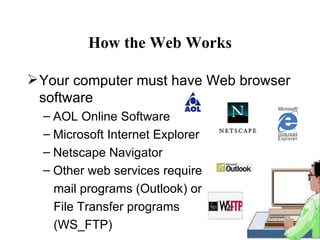
How the Web Works

 Your computer must have Web browser
  software
  – AOL Online Software
  – Microsoft Internet Explorer
  – Netscape Navigator
  – Other web services require
   mail programs (Outlook) or
   File Transfer programs
   (WS_FTP)
How the Web Works

Your computer must be logged into the
 Web
 – Dialup has dialed, connected & user
   has logged in
                   OR
 – DSL/Satellite/Cable modem is on and
   connected
WHAT LED TO WEB
     TECHNOLOGIES SUCCESS
Simple Architecture –
 HTTP,URL,HTML
Networked – value grows with data,
 Services, users .
Simple for Users – Text , Graphics and
 Links
Powerful – for people and Machines
EMERGING TECHNOLOGIES

The main revolutionary Web
 Technologies :
 Web 2.0
 Web 3.0
Today's Latest web technologies :
 AJAX
 Ruby
 Ruby on Rails
ADVANTAGES

    Web Technology have led to :
   Web development
   Evolution of web-based communities :
    social-networking sites,
    video-sharing sites,
    wikis, blogs.
   Business Revolution
CHALLENGES ENCOUNTERED
   USING WEB TECHNOLOGIES
Limited Interactivity
Lack of Skills
Security Risks
Browser Compatibility
Lack of Web Development Tools
Standardization
SUMMARY

Most Web pages remote or local are a
 combination of those Web technologies :
  – Raw content, placed inside…
  – HTML tags, formatted with…
  – CSS rules, interactivity produced by…
  – JavaScript scripts
Newer technologies like DHTML,
 XHTML, and XML are based on these
  – A little knowledge now can prepare

Web Tech

  • 1.
    INTRODUCTION Web Technologies arethe Techniques using which we can access various resources on the Web. Web technologies related to the interface between web servers and their clients. This information includes markup languages, programming interfaces and languages, and standards for document identification and display.
  • 2.
     It facilitatescommunication, secure information sharing and collaboration on the World Wide Web .  The basic Web technologies that are used to implement the Web portion of Web Services : Core Web Technologies Tunneling Firewalls
  • 3.
    Some Historical Details Startof standard groups : TCP, IP, TCP/IP, TELNET,FTP SMTP Archie Gopher Core Web Technologies : Core Web Technologies  enable linking and sharing documents
  • 4.
    CHARACTERISTICS Web Server Eg– HTTPd (HTTP Daemon) Web Browser Eg – NCSA Mosaic Netscape Communication Suite : Netscape Messenger Netscape Composer Netscape Conference Firewalls
  • 5.
    WEBSITES AND MARKUP LANGUAGES Websites : World Wide Web is a Grand global collection of Websites and Internet interconnects all the Sites. Hypertext Document. – HTML – HyperText Markup Language – CSS – Cascading Style Sheets – JavaScript XML is a software and hardware independent tool for carrying
  • 6.
    How the WebWorks Your computer must have communications hardware with installed drivers (software) – Modem card, ex: 56k Modem – Network or NIC card, ex: Linksys * – Wireless Network card
  • 7.
    How the WebWorks  Your computer must have Web browser software – AOL Online Software – Microsoft Internet Explorer – Netscape Navigator – Other web services require mail programs (Outlook) or File Transfer programs (WS_FTP)
  • 8.
    How the WebWorks Your computer must be logged into the Web – Dialup has dialed, connected & user has logged in OR – DSL/Satellite/Cable modem is on and connected
  • 9.
    WHAT LED TOWEB TECHNOLOGIES SUCCESS Simple Architecture – HTTP,URL,HTML Networked – value grows with data, Services, users . Simple for Users – Text , Graphics and Links Powerful – for people and Machines
  • 10.
    EMERGING TECHNOLOGIES The mainrevolutionary Web Technologies : Web 2.0 Web 3.0 Today's Latest web technologies : AJAX Ruby Ruby on Rails
  • 11.
    ADVANTAGES Web Technology have led to :  Web development  Evolution of web-based communities : social-networking sites, video-sharing sites, wikis, blogs.  Business Revolution
  • 12.
    CHALLENGES ENCOUNTERED USING WEB TECHNOLOGIES Limited Interactivity Lack of Skills Security Risks Browser Compatibility Lack of Web Development Tools Standardization
  • 13.
    SUMMARY Most Web pagesremote or local are a combination of those Web technologies : – Raw content, placed inside… – HTML tags, formatted with… – CSS rules, interactivity produced by… – JavaScript scripts Newer technologies like DHTML, XHTML, and XML are based on these – A little knowledge now can prepare