TAXONOMY OF
EDUCATIONAL OBJECTIVES
Cognitive Domain
Nirmala Roberts
India
Taxonomy
• Greek “taxis=arrangement” and “nomos=science”
= Science of arrangements
⌗A scheme of classification used to categorize things
according to how they are related to one another
⌗Psychologists & Educators use it to define and arrange
levels of behaviour according to their type and complexity
= Taxonomy of Educational Objectives
Taxonomy of Educational Objectives
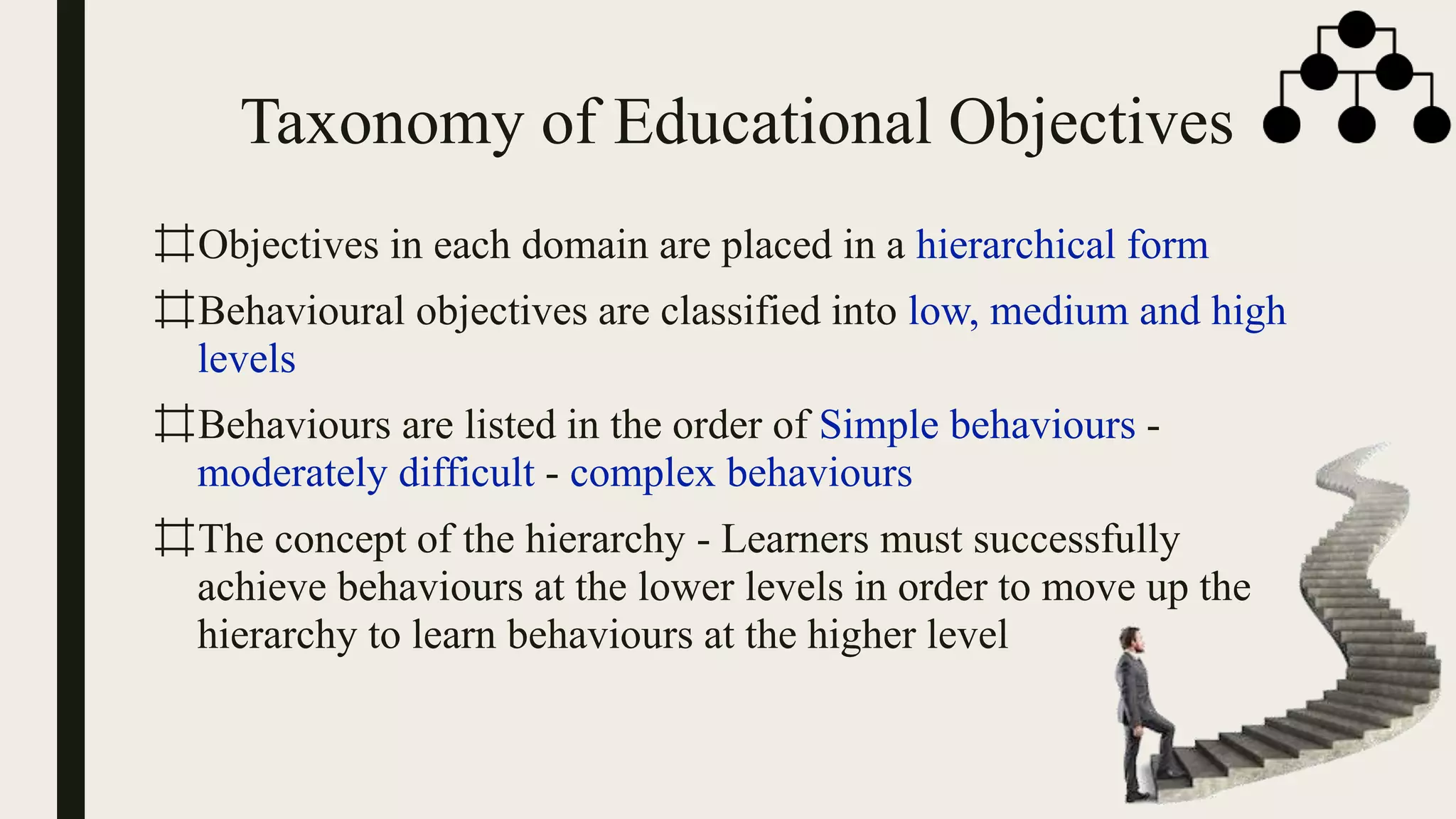
⌗Objectives in each domain are placed in a hierarchical form
⌗Behavioural objectives are classified into low, medium and high
levels
⌗Behaviours are listed in the order of Simple behaviours -
moderately difficult - complex behaviours
⌗The concept of the hierarchy - Learners must successfully
achieve behaviours at the lower levels in order to move up the
hierarchy to learn behaviours at the higher level
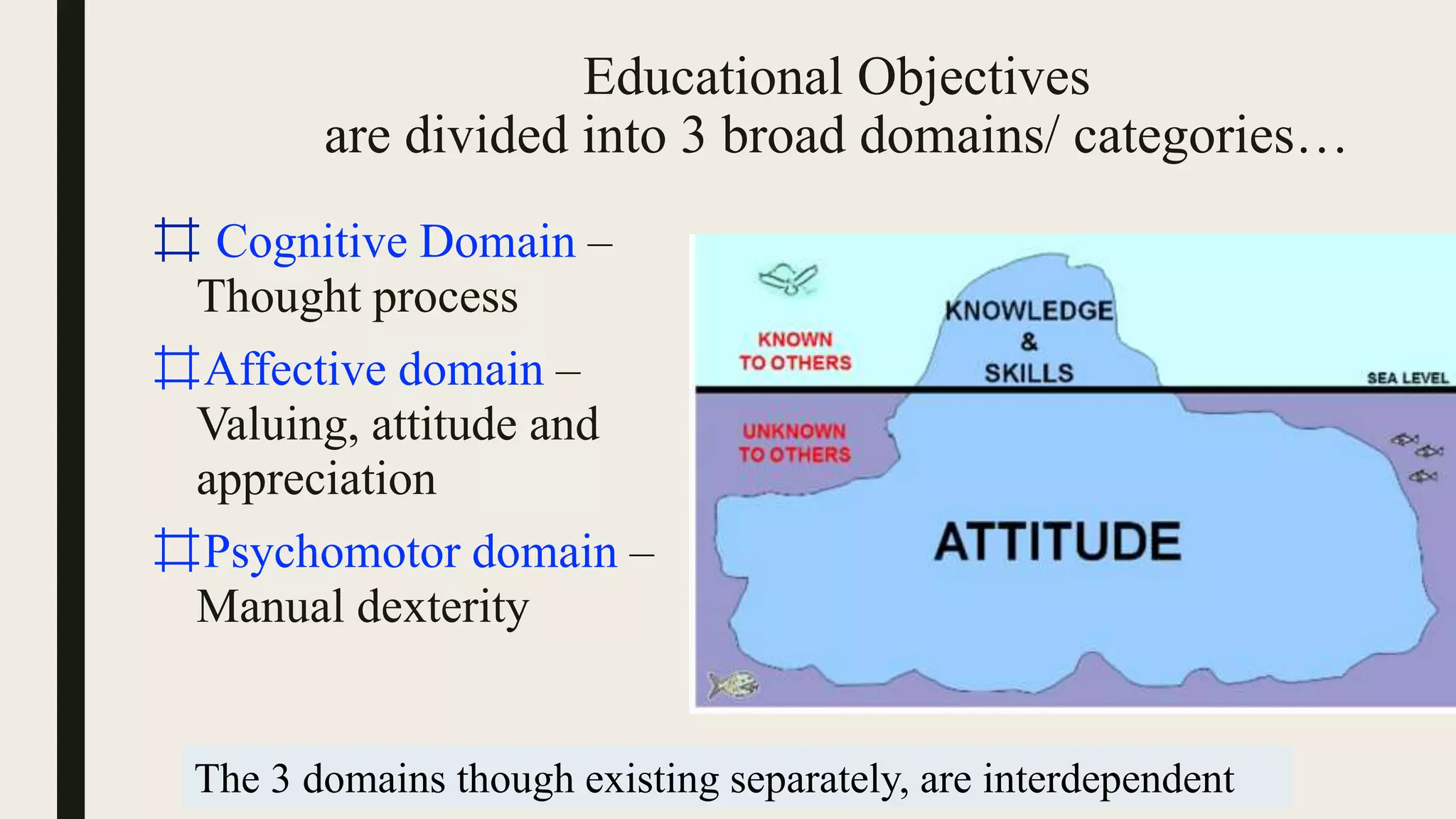
Educational Objectives
are divided into 3 broad domains/ categories…
⌗ Cognitive Domain –
Thought process
⌗Affective domain –
Valuing, attitude and
appreciation
⌗Psychomotor domain –
Manual dexterity
The 3 domains though existing separately, are interdependent
1. THE COGNITIVE DOMAIN
(THE ‘THINKING’ DOMAIN)
Learning in the Cognitive Domain..
⌗Involves knowledge and development of intellectual abilities,
mental capacities, understanding and thinking process
⌗Objectives here are divided into 6 levels by complexity of
behaviour –
☆ Ranging from simple to complex…
☆ …On a continuum
⌗The learner successfully achieves the lower level and moves up
to the next
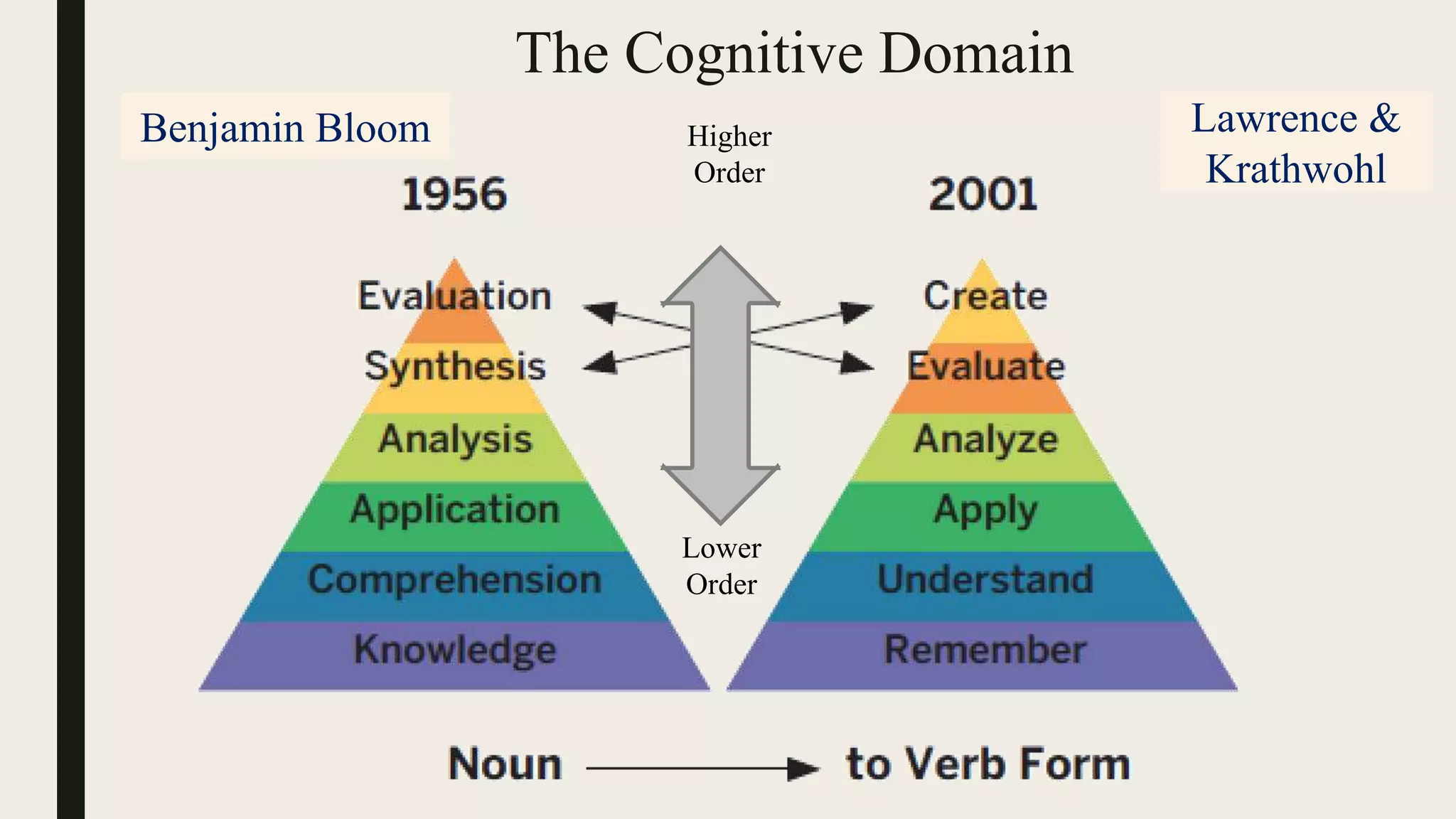
The Cognitive Domain
Higher
Order
Lower
Order
Benjamin Bloom Lawrence &
Krathwohl
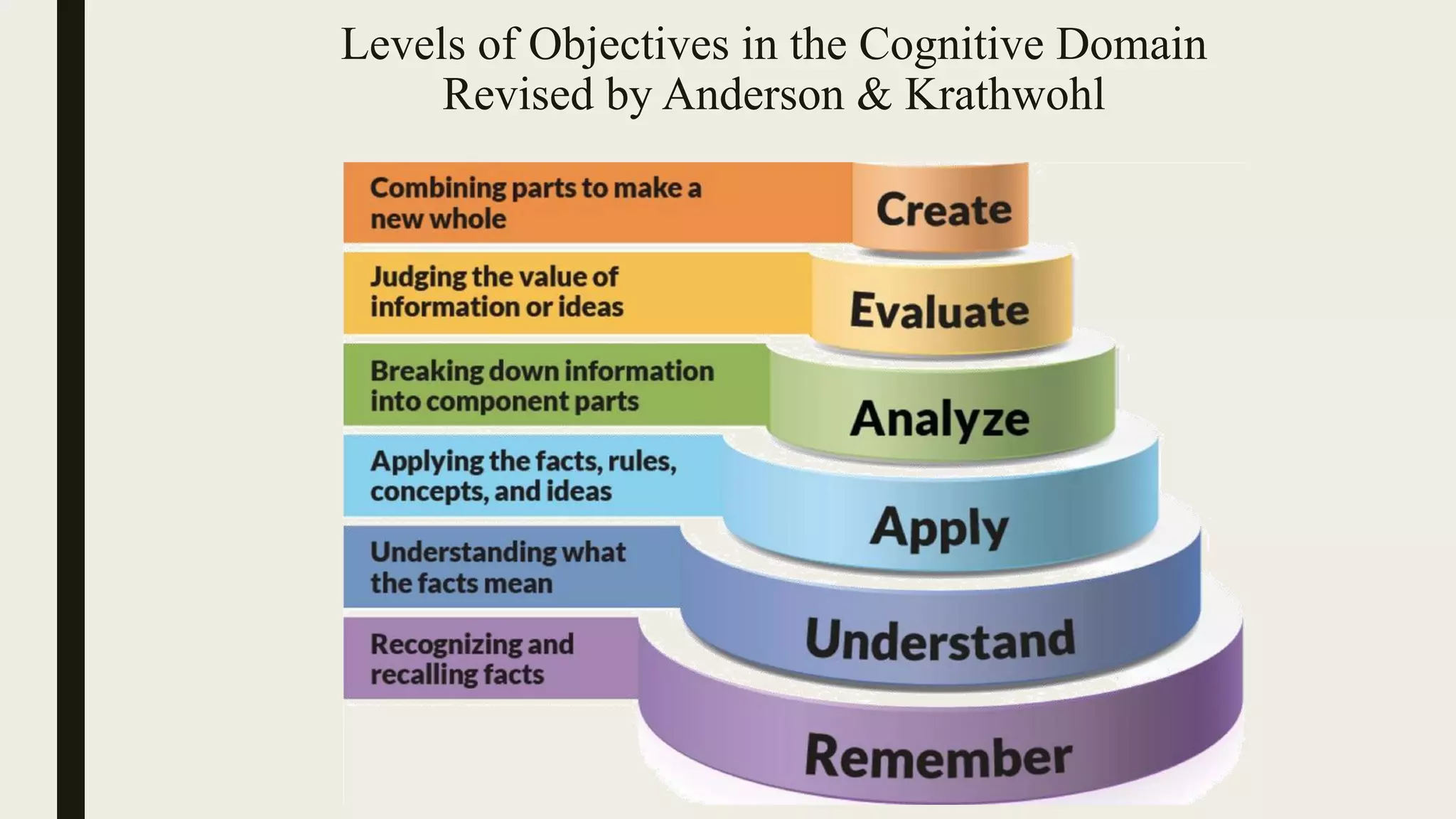
Levels of Objectives in the Cognitive Domain
Revised by Anderson & Krathwohl
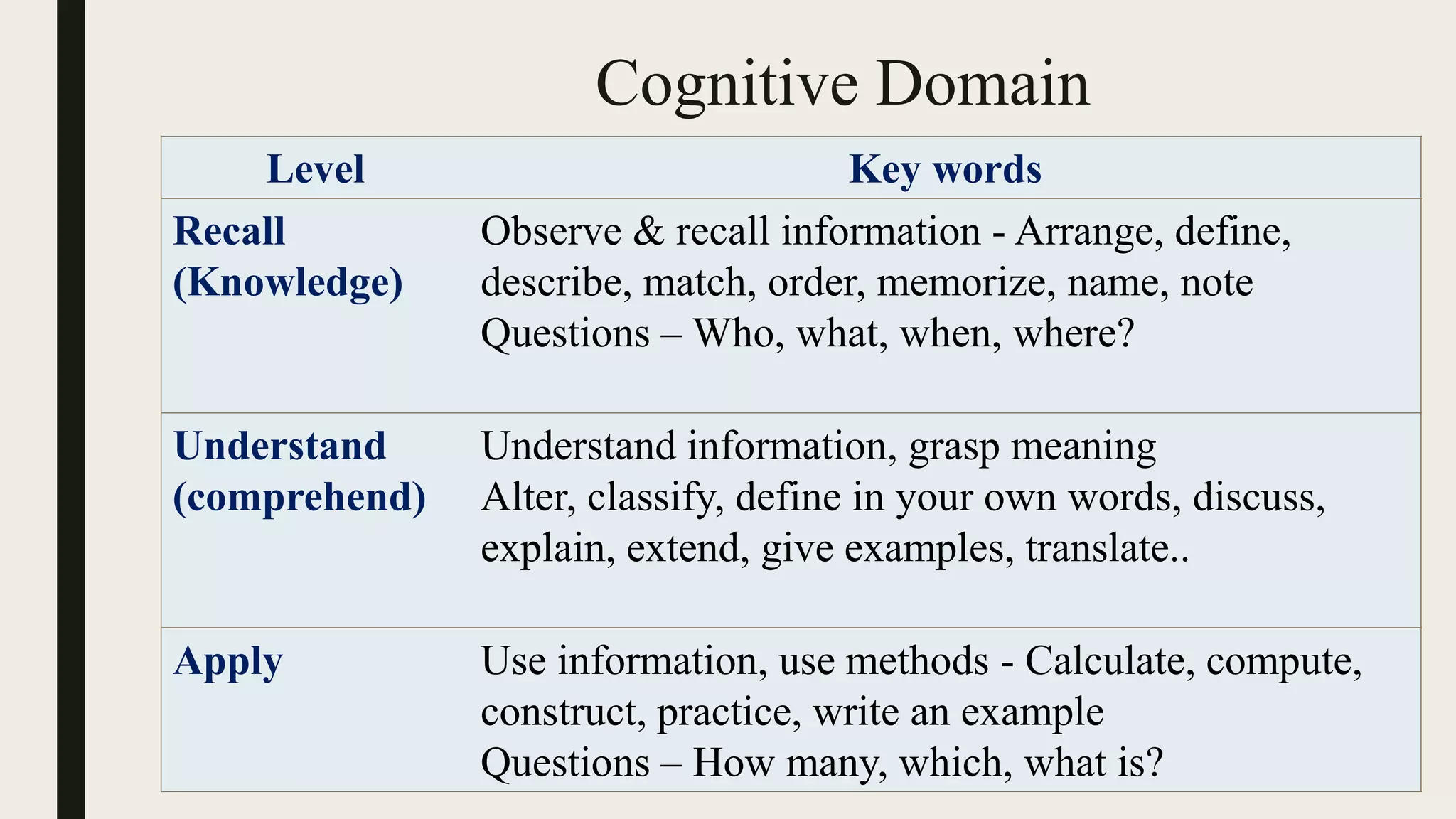
Cognitive Domain
Level Key words
Recall
(Knowledge)
Observe & recall information - Arrange, define,
describe, match, order, memorize, name, note
Questions – Who, what, when, where?
Understand
(comprehend)
Understand information, grasp meaning
Alter, classify, define in your own words, discuss,
explain, extend, give examples, translate..
Apply Use information, use methods - Calculate, compute,
construct, practice, write an example
Questions – How many, which, what is?
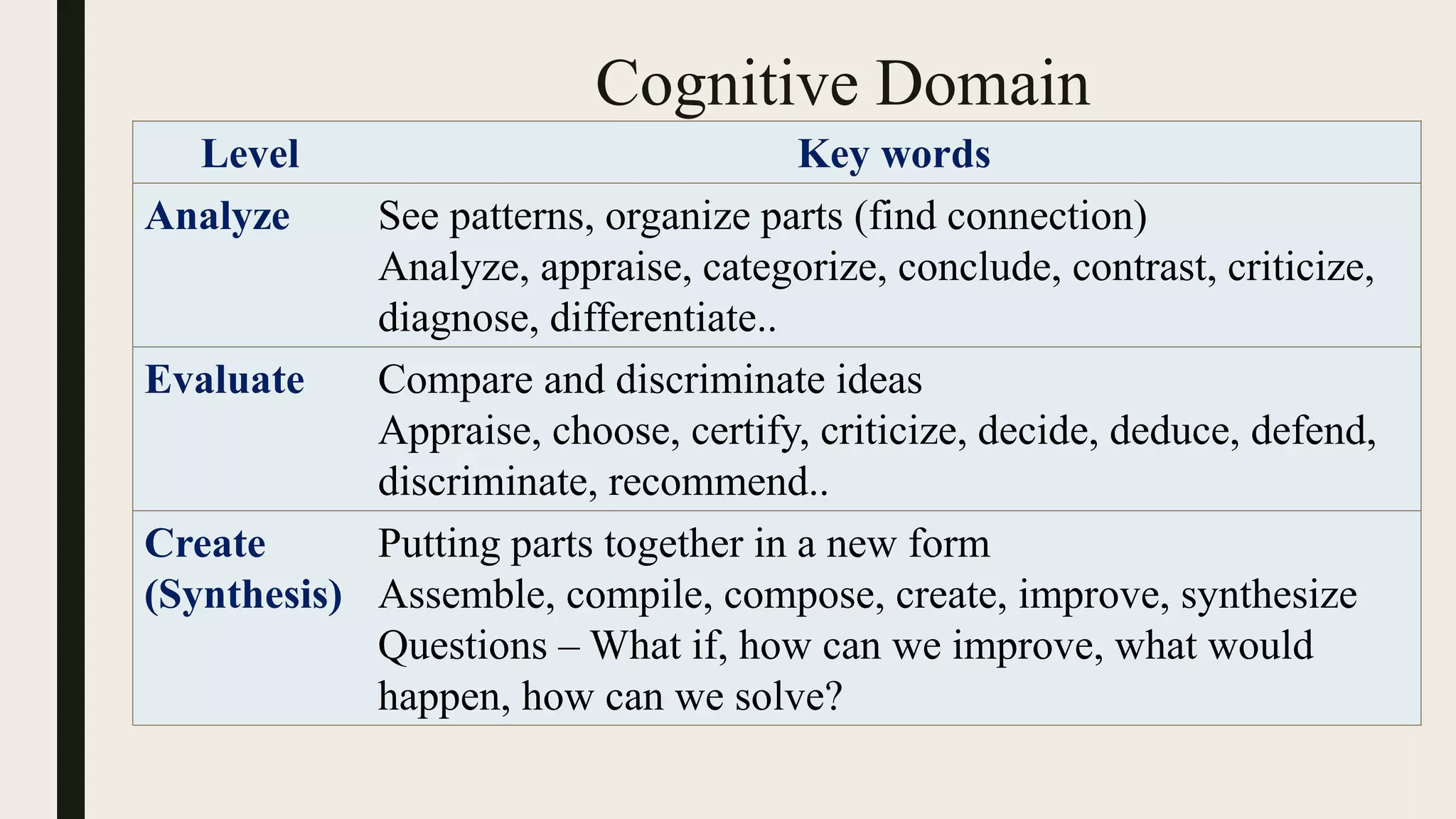
Cognitive Domain
Level Key words
Analyze See patterns, organize parts (find connection)
Analyze, appraise, categorize, conclude, contrast, criticize,
diagnose, differentiate..
Evaluate Compare and discriminate ideas
Appraise, choose, certify, criticize, decide, deduce, defend,
discriminate, recommend..
Create
(Synthesis)
Putting parts together in a new form
Assemble, compile, compose, create, improve, synthesize
Questions – What if, how can we improve, what would
happen, how can we solve?
18
References
⌗ Basavanthappa B T, Nursing Education, 2nd Ed, Jaypee Bro’s Med pub., N Delhi, 2009,
Pp – 433 – 435
⌗ Bastable S. B, Nurse as Educator, 1st Ed, Jones & Barlett India Pvt ltd., New Delhi,
2020, Pp – 383- 393
⌗ Sharma M C, Textbook of Nursing Education, 1st Ed, Jaypee Bro’s Med pub., N Delhi,
2013, Pp – 41 – 43
Practice session
⌗Write educational objectives in the cognitive domain for a lesson
on “Congestive Heart Failure” – in the 6 levels –
At the end of the class, the students are able to
☆ Remember –
☆ Understand –
☆ Apply –
☆ Analyze –
☆ Evaluate –
☆ Create –
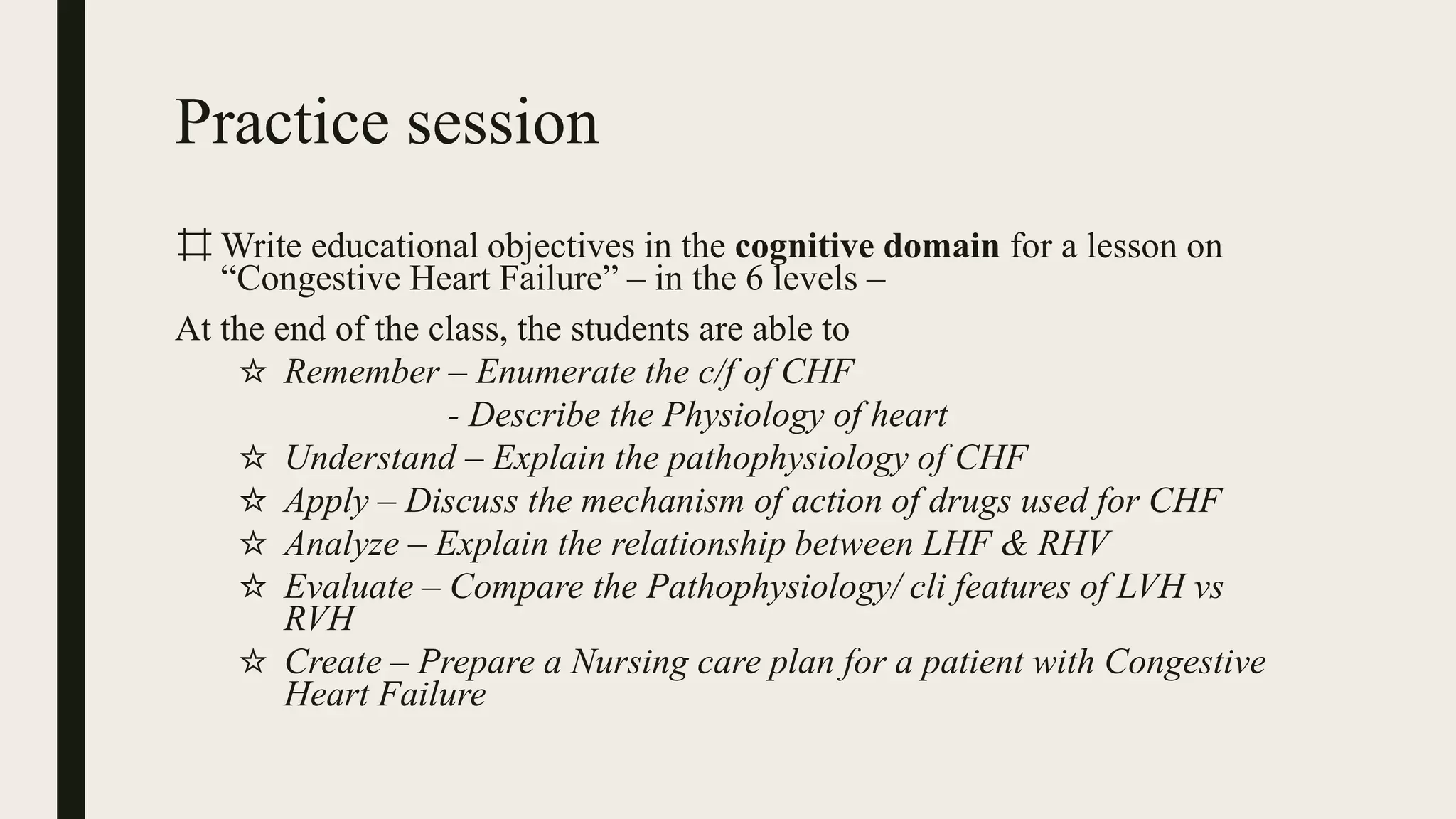
Practice session
⌗ Write educational objectives in the cognitive domain for a lesson on
“Congestive Heart Failure” – in the 6 levels –
At the end of the class, the students are able to
☆ Remember – Enumerate the c/f of CHF
- Describe the Physiology of heart
☆ Understand – Explain the pathophysiology of CHF
☆ Apply – Discuss the mechanism of action of drugs used for CHF
☆ Analyze – Explain the relationship between LHF & RHV
☆ Evaluate – Compare the Pathophysiology/ cli features of LVH vs
RVH
☆ Create – Prepare a Nursing care plan for a patient with Congestive
Heart Failure
Assignment
⌗Write educational objectives in the 6 levels of the cognitive
domain, for a class on “Newborn care” –
1. Remember –
2. Understand –
3. Apply –
4. Analyze –
5. Evaluate –
6. Create –

Taxonomy of Educational Objectives - The Cognitive Domain

  • 1.
  • 2.
    Taxonomy • Greek “taxis=arrangement”and “nomos=science” = Science of arrangements ⌗A scheme of classification used to categorize things according to how they are related to one another ⌗Psychologists & Educators use it to define and arrange levels of behaviour according to their type and complexity = Taxonomy of Educational Objectives
  • 3.
    Taxonomy of EducationalObjectives ⌗Objectives in each domain are placed in a hierarchical form ⌗Behavioural objectives are classified into low, medium and high levels ⌗Behaviours are listed in the order of Simple behaviours - moderately difficult - complex behaviours ⌗The concept of the hierarchy - Learners must successfully achieve behaviours at the lower levels in order to move up the hierarchy to learn behaviours at the higher level
  • 4.
    Educational Objectives are dividedinto 3 broad domains/ categories… ⌗ Cognitive Domain – Thought process ⌗Affective domain – Valuing, attitude and appreciation ⌗Psychomotor domain – Manual dexterity The 3 domains though existing separately, are interdependent
  • 5.
    1. THE COGNITIVEDOMAIN (THE ‘THINKING’ DOMAIN)
  • 6.
    Learning in theCognitive Domain.. ⌗Involves knowledge and development of intellectual abilities, mental capacities, understanding and thinking process ⌗Objectives here are divided into 6 levels by complexity of behaviour – ☆ Ranging from simple to complex… ☆ …On a continuum ⌗The learner successfully achieves the lower level and moves up to the next
  • 7.
  • 8.
    Levels of Objectivesin the Cognitive Domain Revised by Anderson & Krathwohl
  • 9.
    Cognitive Domain Level Keywords Recall (Knowledge) Observe & recall information - Arrange, define, describe, match, order, memorize, name, note Questions – Who, what, when, where? Understand (comprehend) Understand information, grasp meaning Alter, classify, define in your own words, discuss, explain, extend, give examples, translate.. Apply Use information, use methods - Calculate, compute, construct, practice, write an example Questions – How many, which, what is?
  • 10.
    Cognitive Domain Level Keywords Analyze See patterns, organize parts (find connection) Analyze, appraise, categorize, conclude, contrast, criticize, diagnose, differentiate.. Evaluate Compare and discriminate ideas Appraise, choose, certify, criticize, decide, deduce, defend, discriminate, recommend.. Create (Synthesis) Putting parts together in a new form Assemble, compile, compose, create, improve, synthesize Questions – What if, how can we improve, what would happen, how can we solve?
  • 11.
  • 12.
    References ⌗ Basavanthappa BT, Nursing Education, 2nd Ed, Jaypee Bro’s Med pub., N Delhi, 2009, Pp – 433 – 435 ⌗ Bastable S. B, Nurse as Educator, 1st Ed, Jones & Barlett India Pvt ltd., New Delhi, 2020, Pp – 383- 393 ⌗ Sharma M C, Textbook of Nursing Education, 1st Ed, Jaypee Bro’s Med pub., N Delhi, 2013, Pp – 41 – 43
  • 14.
    Practice session ⌗Write educationalobjectives in the cognitive domain for a lesson on “Congestive Heart Failure” – in the 6 levels – At the end of the class, the students are able to ☆ Remember – ☆ Understand – ☆ Apply – ☆ Analyze – ☆ Evaluate – ☆ Create –
  • 15.
    Practice session ⌗ Writeeducational objectives in the cognitive domain for a lesson on “Congestive Heart Failure” – in the 6 levels – At the end of the class, the students are able to ☆ Remember – Enumerate the c/f of CHF - Describe the Physiology of heart ☆ Understand – Explain the pathophysiology of CHF ☆ Apply – Discuss the mechanism of action of drugs used for CHF ☆ Analyze – Explain the relationship between LHF & RHV ☆ Evaluate – Compare the Pathophysiology/ cli features of LVH vs RVH ☆ Create – Prepare a Nursing care plan for a patient with Congestive Heart Failure
  • 16.
    Assignment ⌗Write educational objectivesin the 6 levels of the cognitive domain, for a class on “Newborn care” – 1. Remember – 2. Understand – 3. Apply – 4. Analyze – 5. Evaluate – 6. Create –