
Writing
Objectives and
Learning
Outcomes
Dr Madhavi Dharankar
Associate Professor
Dept of Educational Technology
SNDT Women’s University
Mumbai
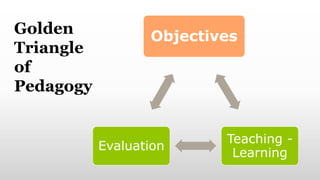
Objectives
Teaching -
Learning
Evaluation
Golden
Triangle
of
Pedagogy
Objectives
Teaching -
Learning
Evaluation
Golden
Triangle
of
Pedagogy
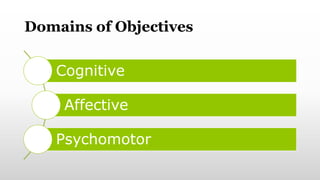
Domains of Objectives
Cognitive
Affective
Psychomotor
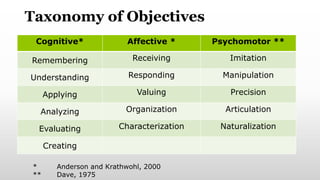
Taxonomy of Objectives
Cognitive* Affective * Psychomotor **
Remembering Receiving Imitation
Understanding Responding Manipulation
Applying Valuing Precision
Analyzing Organization Articulation
Evaluating Characterization Naturalization
Creating
* Anderson and Krathwohl, 2000
** Dave, 1975
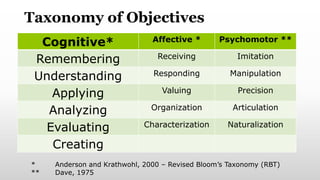
Taxonomy of Objectives
Cognitive* Affective * Psychomotor **
Remembering Receiving Imitation
Understanding Responding Manipulation
Applying Valuing Precision
Analyzing Organization Articulation
Evaluating Characterization Naturalization
Creating
* Anderson and Krathwohl, 2000 – Revised Bloom’s Taxonomy (RBT)
** Dave, 1975
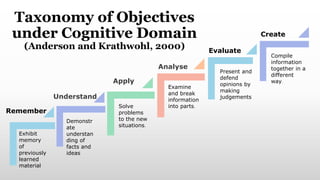
Exhibit
memory
of
previously
learned
material
Remember
Demonstr
ate
understan
ding of
facts and
ideas
Solve
problems
to the new
situations.
Apply
Examine
and break
information
into parts.
Analyse
Understand
Taxonomy of Objectives
under Cognitive Domain
(Anderson and Krathwohl, 2000) Evaluate
Create
Present and
defend
opinions by
making
judgements
Compile
information
together in a
different
way.
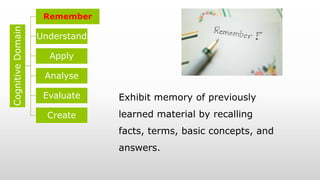
Exhibit memory of previously
learned material by recalling
facts, terms, basic concepts, and
answers.
Cognitive
Domain Remember
Understand
Apply
Analyse
Evaluate
Create
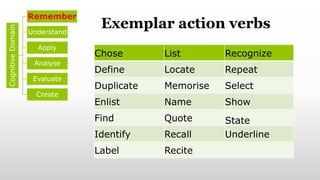
Exemplar action verbs
Cognitive
Domain
Remember
Understand
Apply
Analyse
Evaluate
Create
Chose List Recognize
Define Locate Repeat
Duplicate Memorise Select
Enlist Name Show
Find Quote State
Identify Recall Underline
Label Recite
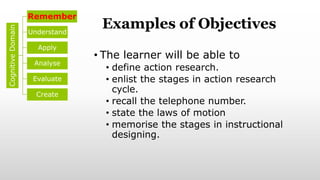
Examples of Objectives
• The learner will be able to
• define action research.
• enlist the stages in action research
cycle.
• recall the telephone number.
• state the laws of motion
• memorise the stages in instructional
designing.
Cognitive
Domain
Remember
Understand
Apply
Analyse
Evaluate
Create
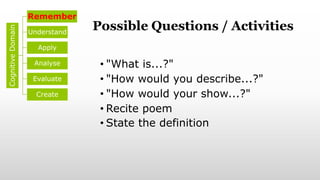
Possible Questions / Activities
• "What is...?"
• "How would you describe...?"
• "How would your show...?"
• Recite poem
• State the definition
Cognitive
Domain
Remember
Understand
Apply
Analyse
Evaluate
Create
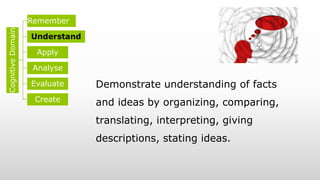
Demonstrate understanding of facts
and ideas by organizing, comparing,
translating, interpreting, giving
descriptions, stating ideas.
Cognitive
Domain
Remember
Understand
Apply
Analyse
Evaluate
Create
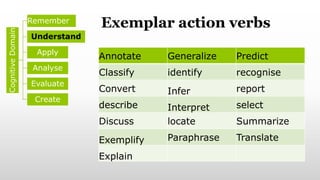
Exemplar action verbs
Cognitive
Domain
Remember
Understand
Apply
Analyse
Evaluate
Create
Annotate Generalize Predict
Classify identify recognise
Convert Infer report
describe Interpret select
Discuss locate Summarize
Exemplify Paraphrase Translate
Explain
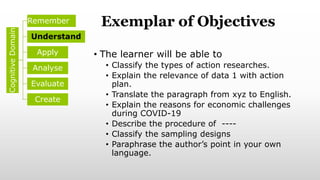
• The learner will be able to
• Classify the types of action researches.
• Explain the relevance of data 1 with action
plan.
• Translate the paragraph from xyz to English.
• Explain the reasons for economic challenges
during COVID-19
• Describe the procedure of ----
• Classify the sampling designs
• Paraphrase the author’s point in your own
language.
Exemplar of Objectives
Cognitive
Domain
Remember
Understand
Apply
Analyse
Evaluate
Create
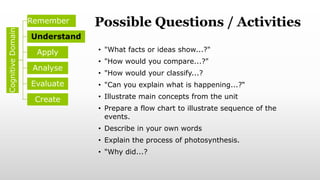
Possible Questions / Activities
• "What facts or ideas show...?"
• "How would you compare...?"
• "How would your classify...?
• "Can you explain what is happening...?“
• Illustrate main concepts from the unit
• Prepare a flow chart to illustrate sequence of the
events.
• Describe in your own words
• Explain the process of photosynthesis.
• "Why did...?
Cognitive
Domain
Remember
Understand
Apply
Analyse
Evaluate
Create
Solve problems to the new situations by
applying acquired knowledge, facts,
techniques and rules in a different
ways.
Cognitive
Domain Remember
Understand
Apply
Analyse
Evaluate
Create
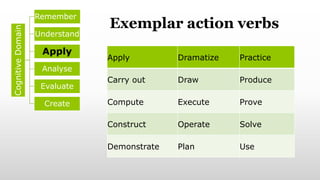
Exemplar action verbs
Apply Dramatize Practice
Carry out Draw Produce
Compute Execute Prove
Construct Operate Solve
Demonstrate Plan Use
Cognitive
Domain Remember
Understand
Apply
Analyse
Evaluate
Create
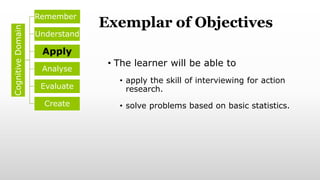
Exemplar of Objectives
• The learner will be able to
• apply the skill of interviewing for action
research.
• solve problems based on basic statistics.
Cognitive
Domain Remember
Understand
Apply
Analyse
Evaluate
Create
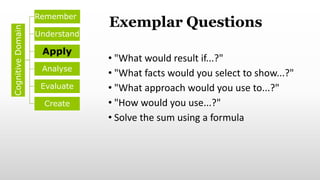
Exemplar Questions
• "What would result if...?"
• "What facts would you select to show...?"
• "What approach would you use to...?"
• "How would you use...?"
• Solve the sum using a formula
Cognitive
Domain Remember
Understand
Apply
Analyse
Evaluate
Create
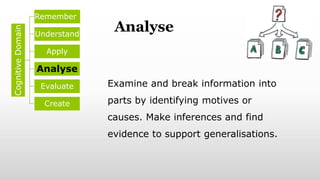
Analyse
Examine and break information into
parts by identifying motives or
causes. Make inferences and find
evidence to support generalisations.
Cognitive
Domain Remember
Understand
Apply
Analyse
Evaluate
Create
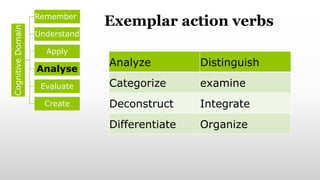
Analyze Distinguish
Categorize examine
Deconstruct Integrate
Differentiate Organize
Exemplar action verbs
Cognitive
Domain Remember
Understand
Apply
Analyse
Evaluate
Create
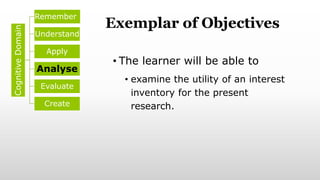
• The learner will be able to
• examine the utility of an interest
inventory for the present
research.
Exemplar of Objectives
Cognitive
Domain Remember
Understand
Apply
Analyse
Evaluate
Create
Exemplar Questions
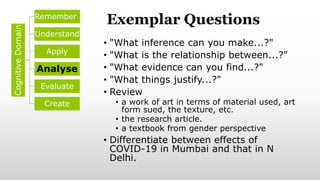
• "What inference can you make...?"
• "What is the relationship between...?"
• "What evidence can you find...?"
• "What things justify...?"
• Review
• a work of art in terms of material used, art
form sued, the texture, etc.
• the research article.
• a textbook from gender perspective
• Differentiate between effects of
COVID-19 in Mumbai and that in N
Delhi.
Cognitive
Domain Remember
Understand
Apply
Analyse
Evaluate
Create
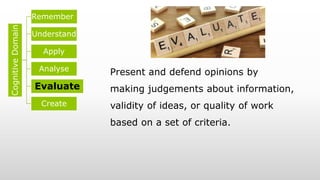
Present and defend opinions by
making judgements about information,
validity of ideas, or quality of work
based on a set of criteria.
Cognitive
Domain Remember
Understand
Apply
Analyse
Evaluate
Create
Exemplar action verbs
Cognitive
Domain Remember
Understand
Apply
Analyse
Evaluate
Create
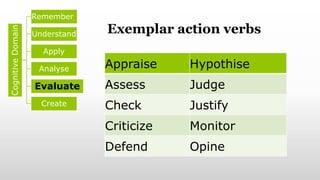
Appraise Hypothise
Assess Judge
Check Justify
Criticize Monitor
Defend Opine
Exemplar of Objectives
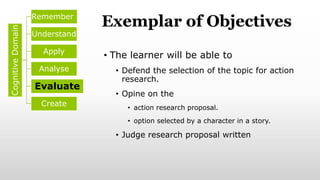
• The learner will be able to
• Defend the selection of the topic for action
research.
• Opine on the
• action research proposal.
• option selected by a character in a story.
• Judge research proposal written
Cognitive
Domain Remember
Understand
Apply
Analyse
Evaluate
Create
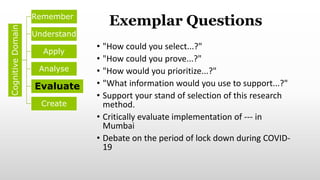
• "How could you select...?"
• "How could you prove...?"
• "How would you prioritize...?"
• "What information would you use to support...?"
• Support your stand of selection of this research
method.
• Critically evaluate implementation of --- in
Mumbai
• Debate on the period of lock down during COVID-
19
Exemplar Questions
Cognitive
Domain Remember
Understand
Apply
Analyse
Evaluate
Create
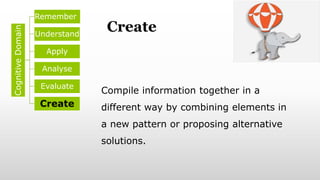
Create
Compile information together in a
different way by combining elements in
a new pattern or proposing alternative
solutions.
Cognitive
Domain Remember
Understand
Apply
Analyse
Evaluate
Create
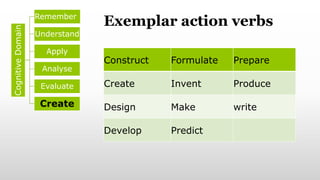
Exemplar action verbs
Construct Formulate Prepare
Create Invent Produce
Design Make write
Develop Predict
Cognitive
Domain Remember
Understand
Apply
Analyse
Evaluate
Create
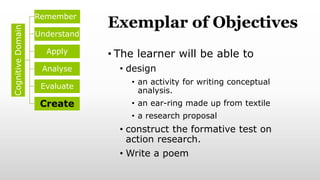
• The learner will be able to
• design
• an activity for writing conceptual
analysis.
• an ear-ring made up from textile
• a research proposal
• construct the formative test on
action research.
• Write a poem
Cognitive
Domain Remember
Understand
Apply
Analyse
Evaluate
Create
Exemplar of Objectives
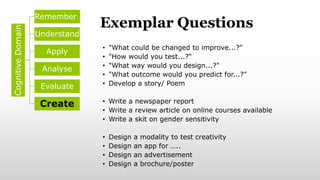
• "What could be changed to improve...?"
• "How would you test...?"
• "What way would you design...?"
• "What outcome would you predict for...?"
• Develop a story/ Poem
• Write a newspaper report
• Write a review article on online courses available
• Write a skit on gender sensitivity
• Design a modality to test creativity
• Design an app for …..
• Design an advertisement
• Design a brochure/poster
Cognitive
Domain Remember
Understand
Apply
Analyse
Evaluate
Create
Exemplar Questions
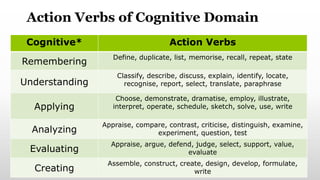
Action Verbs of Cognitive Domain
Cognitive* Action Verbs
Remembering
Define, duplicate, list, memorise, recall, repeat, state
Understanding
Classify, describe, discuss, explain, identify, locate,
recognise, report, select, translate, paraphrase
Applying
Choose, demonstrate, dramatise, employ, illustrate,
interpret, operate, schedule, sketch, solve, use, write
Analyzing
Appraise, compare, contrast, criticise, distinguish, examine,
experiment, question, test
Evaluating
Appraise, argue, defend, judge, select, support, value,
evaluate
Creating
Assemble, construct, create, design, develop, formulate,
write
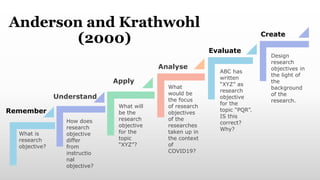
What is
research
objective?
Remember
How does
research
objective
differ
from
instructio
nal
objective?
What will
be the
research
objective
for the
topic
“XYZ”?
Apply
What
would be
the focus
of research
objectives
of the
researches
taken up in
the context
of
COVID19?
Analyse
Understand
Anderson and Krathwohl
(2000)
Evaluate
Create
ABC has
written
“XYZ” as
research
objective
for the
topic “PQR”.
IS this
correct?
Why?
Design
research
objectives in
the light of
the
background
of the
research.
Activity
Consider any one unit / subunit
from your syllabus. Try writing
instructional objectives of all six
levels for the same topic.
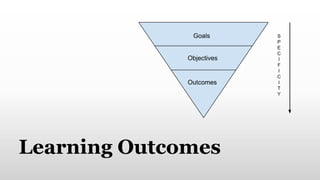
Learning Outcomes
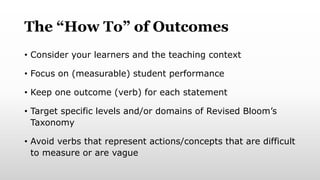
The “How To” of Outcomes
• Consider your learners and the teaching context
• Focus on (measurable) student performance
• Keep one outcome (verb) for each statement
• Target specific levels and/or domains of Revised Bloom’s
Taxonomy
• Avoid verbs that represent actions/concepts that are difficult
to measure or are vague
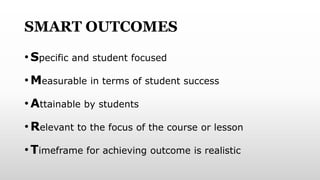
SMART OUTCOMES
• Specific and student focused
• Measurable in terms of student success
• Attainable by students
• Relevant to the focus of the course or lesson
• Timeframe for achieving outcome is realistic
mdharankar@det.sndt.ac.in
http://eduexperiments.blogspot.in/
https://www.facebook.com/madhavi.dharankar

Objectives n learning outcoms - MD 20240404.pptx

  • 1.
    Writing Objectives and Learning Outcomes Dr MadhaviDharankar Associate Professor Dept of Educational Technology SNDT Women’s University Mumbai
  • 2.
  • 3.
  • 4.
  • 5.
    Taxonomy of Objectives Cognitive*Affective * Psychomotor ** Remembering Receiving Imitation Understanding Responding Manipulation Applying Valuing Precision Analyzing Organization Articulation Evaluating Characterization Naturalization Creating * Anderson and Krathwohl, 2000 ** Dave, 1975
  • 6.
    Taxonomy of Objectives Cognitive*Affective * Psychomotor ** Remembering Receiving Imitation Understanding Responding Manipulation Applying Valuing Precision Analyzing Organization Articulation Evaluating Characterization Naturalization Creating * Anderson and Krathwohl, 2000 – Revised Bloom’s Taxonomy (RBT) ** Dave, 1975
  • 7.
    Exhibit memory of previously learned material Remember Demonstr ate understan ding of facts and ideas Solve problems tothe new situations. Apply Examine and break information into parts. Analyse Understand Taxonomy of Objectives under Cognitive Domain (Anderson and Krathwohl, 2000) Evaluate Create Present and defend opinions by making judgements Compile information together in a different way.
  • 8.
    Exhibit memory ofpreviously learned material by recalling facts, terms, basic concepts, and answers. Cognitive Domain Remember Understand Apply Analyse Evaluate Create
  • 9.
    Exemplar action verbs Cognitive Domain Remember Understand Apply Analyse Evaluate Create ChoseList Recognize Define Locate Repeat Duplicate Memorise Select Enlist Name Show Find Quote State Identify Recall Underline Label Recite
  • 10.
    Examples of Objectives •The learner will be able to • define action research. • enlist the stages in action research cycle. • recall the telephone number. • state the laws of motion • memorise the stages in instructional designing. Cognitive Domain Remember Understand Apply Analyse Evaluate Create
  • 11.
    Possible Questions /Activities • "What is...?" • "How would you describe...?" • "How would your show...?" • Recite poem • State the definition Cognitive Domain Remember Understand Apply Analyse Evaluate Create
  • 12.
    Demonstrate understanding offacts and ideas by organizing, comparing, translating, interpreting, giving descriptions, stating ideas. Cognitive Domain Remember Understand Apply Analyse Evaluate Create
  • 13.
    Exemplar action verbs Cognitive Domain Remember Understand Apply Analyse Evaluate Create AnnotateGeneralize Predict Classify identify recognise Convert Infer report describe Interpret select Discuss locate Summarize Exemplify Paraphrase Translate Explain
  • 14.
    • The learnerwill be able to • Classify the types of action researches. • Explain the relevance of data 1 with action plan. • Translate the paragraph from xyz to English. • Explain the reasons for economic challenges during COVID-19 • Describe the procedure of ---- • Classify the sampling designs • Paraphrase the author’s point in your own language. Exemplar of Objectives Cognitive Domain Remember Understand Apply Analyse Evaluate Create
  • 15.
    Possible Questions /Activities • "What facts or ideas show...?" • "How would you compare...?" • "How would your classify...? • "Can you explain what is happening...?“ • Illustrate main concepts from the unit • Prepare a flow chart to illustrate sequence of the events. • Describe in your own words • Explain the process of photosynthesis. • "Why did...? Cognitive Domain Remember Understand Apply Analyse Evaluate Create
  • 16.
    Solve problems tothe new situations by applying acquired knowledge, facts, techniques and rules in a different ways. Cognitive Domain Remember Understand Apply Analyse Evaluate Create
  • 17.
    Exemplar action verbs ApplyDramatize Practice Carry out Draw Produce Compute Execute Prove Construct Operate Solve Demonstrate Plan Use Cognitive Domain Remember Understand Apply Analyse Evaluate Create
  • 18.
    Exemplar of Objectives •The learner will be able to • apply the skill of interviewing for action research. • solve problems based on basic statistics. Cognitive Domain Remember Understand Apply Analyse Evaluate Create
  • 19.
    Exemplar Questions • "Whatwould result if...?" • "What facts would you select to show...?" • "What approach would you use to...?" • "How would you use...?" • Solve the sum using a formula Cognitive Domain Remember Understand Apply Analyse Evaluate Create
  • 20.
    Analyse Examine and breakinformation into parts by identifying motives or causes. Make inferences and find evidence to support generalisations. Cognitive Domain Remember Understand Apply Analyse Evaluate Create
  • 21.
    Analyze Distinguish Categorize examine DeconstructIntegrate Differentiate Organize Exemplar action verbs Cognitive Domain Remember Understand Apply Analyse Evaluate Create
  • 22.
    • The learnerwill be able to • examine the utility of an interest inventory for the present research. Exemplar of Objectives Cognitive Domain Remember Understand Apply Analyse Evaluate Create
  • 23.
    Exemplar Questions • "Whatinference can you make...?" • "What is the relationship between...?" • "What evidence can you find...?" • "What things justify...?" • Review • a work of art in terms of material used, art form sued, the texture, etc. • the research article. • a textbook from gender perspective • Differentiate between effects of COVID-19 in Mumbai and that in N Delhi. Cognitive Domain Remember Understand Apply Analyse Evaluate Create
  • 24.
    Present and defendopinions by making judgements about information, validity of ideas, or quality of work based on a set of criteria. Cognitive Domain Remember Understand Apply Analyse Evaluate Create
  • 25.
    Exemplar action verbs Cognitive DomainRemember Understand Apply Analyse Evaluate Create Appraise Hypothise Assess Judge Check Justify Criticize Monitor Defend Opine
  • 26.
    Exemplar of Objectives •The learner will be able to • Defend the selection of the topic for action research. • Opine on the • action research proposal. • option selected by a character in a story. • Judge research proposal written Cognitive Domain Remember Understand Apply Analyse Evaluate Create
  • 27.
    • "How couldyou select...?" • "How could you prove...?" • "How would you prioritize...?" • "What information would you use to support...?" • Support your stand of selection of this research method. • Critically evaluate implementation of --- in Mumbai • Debate on the period of lock down during COVID- 19 Exemplar Questions Cognitive Domain Remember Understand Apply Analyse Evaluate Create
  • 28.
    Create Compile information togetherin a different way by combining elements in a new pattern or proposing alternative solutions. Cognitive Domain Remember Understand Apply Analyse Evaluate Create
  • 29.
    Exemplar action verbs ConstructFormulate Prepare Create Invent Produce Design Make write Develop Predict Cognitive Domain Remember Understand Apply Analyse Evaluate Create
  • 30.
    • The learnerwill be able to • design • an activity for writing conceptual analysis. • an ear-ring made up from textile • a research proposal • construct the formative test on action research. • Write a poem Cognitive Domain Remember Understand Apply Analyse Evaluate Create Exemplar of Objectives
  • 31.
    • "What couldbe changed to improve...?" • "How would you test...?" • "What way would you design...?" • "What outcome would you predict for...?" • Develop a story/ Poem • Write a newspaper report • Write a review article on online courses available • Write a skit on gender sensitivity • Design a modality to test creativity • Design an app for ….. • Design an advertisement • Design a brochure/poster Cognitive Domain Remember Understand Apply Analyse Evaluate Create Exemplar Questions
  • 32.
    Action Verbs ofCognitive Domain Cognitive* Action Verbs Remembering Define, duplicate, list, memorise, recall, repeat, state Understanding Classify, describe, discuss, explain, identify, locate, recognise, report, select, translate, paraphrase Applying Choose, demonstrate, dramatise, employ, illustrate, interpret, operate, schedule, sketch, solve, use, write Analyzing Appraise, compare, contrast, criticise, distinguish, examine, experiment, question, test Evaluating Appraise, argue, defend, judge, select, support, value, evaluate Creating Assemble, construct, create, design, develop, formulate, write
  • 33.
    What is research objective? Remember How does research objective differ from instructio nal objective? Whatwill be the research objective for the topic “XYZ”? Apply What would be the focus of research objectives of the researches taken up in the context of COVID19? Analyse Understand Anderson and Krathwohl (2000) Evaluate Create ABC has written “XYZ” as research objective for the topic “PQR”. IS this correct? Why? Design research objectives in the light of the background of the research.
  • 35.
    Activity Consider any oneunit / subunit from your syllabus. Try writing instructional objectives of all six levels for the same topic.
  • 36.
  • 37.
    The “How To”of Outcomes • Consider your learners and the teaching context • Focus on (measurable) student performance • Keep one outcome (verb) for each statement • Target specific levels and/or domains of Revised Bloom’s Taxonomy • Avoid verbs that represent actions/concepts that are difficult to measure or are vague
  • 38.
    SMART OUTCOMES • Specificand student focused • Measurable in terms of student success • Attainable by students • Relevant to the focus of the course or lesson • Timeframe for achieving outcome is realistic
  • 39.