EDUCATION MANAGEMENT
AND ADMINISTRATION
Developed by Education Management students:
Neelakshi Dutta
Barnali Das
Manami Medhi
Bhanima Kalita
Niaz Md. Dilwar Rahman
Under the guidance of :
Anjali Sharma
Associate Professor
 INTRODUCTION
 MEANING OF MANAGEMENT
 FEATURES
 OBJECTIVES
 FUNCTIONS
 NEED AND IMPORTANCE
 SCOPE
 EDUCATION MANAGEMENT AND LEADERSHIP
 EDUCATION MANAGEMENT AND ADMINISTRATION
 CONCLUSION
CONTENT
03-11-2017Anjali Sharma,Tezpur University,Assam 2
Let’s start with etymology
 It originated from the Italian word
“Maneggiare’’ which means to handle.
 Latin word “Manus” means hand.
 French word “Mesnagement”
 English word “Management”
Etymology of management
03-11-2017Anjali Sharma,Tezpur University,Assam 3
 According to Henri Fayol, "to manage is to forecast and
to plan, to organise, to command, to co-ordinate and to
control."
 According to Fredmund, “management is transforming
resources into utility.”
 Peter Drucker defined management as dynamic and
life giving element in any organization, without it
resources never become product.
Definitions
03-11-2017Anjali Sharma,Tezpur University,Assam 4
 According to Harold Koontz, “Management is an
art of getting things done through and with the
people in formally organized groups. It is an art
of creating an environment in which people can
perform and individuals can co-operate towards
attainment of group goals. ”
 According to F.W. Taylor, “Management is an art
of knowing what to do, when to do and see that
it is done in the best and cheapest way.”
Cont.…..
03-11-2017Anjali Sharma,Tezpur University,Assam 5
Education is the provision of a series of learning experience to
students in order to impart knowledge, values, attitudes and
skills with the ultimate aim of making them productive
members of society. Through it the latent talent of the child can
be developed.
Education stands for.
Educational Management
03-11-2017Anjali Sharma,Tezpur University,Assam 7
It is a field of study and practice concerned with the
operation of educational organisations. It operates in the
educational organizations. It is theory and practice of the
organisation and administration of existing educational
establishment and systems.
The origin of the development of educational
management as a study began to the United States in early
part of 20th century. As a department it came into existence
in 1976 in University of Ibadan Nigeria.
Sir Graham Balfour writes "the purpose of educational
management is to enable the right pupils to receive the right
education from the right teachers, at a cost within the means
of the state, which will enable pupils to profit by their
learning."
It is an applied branch:- Application of theories, laws and
principles from other disciplines
Its product is living:-The outcome is always living i.e.is
in the form of student.
There is specificity in objectives:- The objectives of the
organisation/institution is very much specific and well-
known.
There is centrality of target:- Different schools and
colleges but they all aim at the same target/goal.
Specific Features
03-11-2017Anjali Sharma,Tezpur University,Assam 9
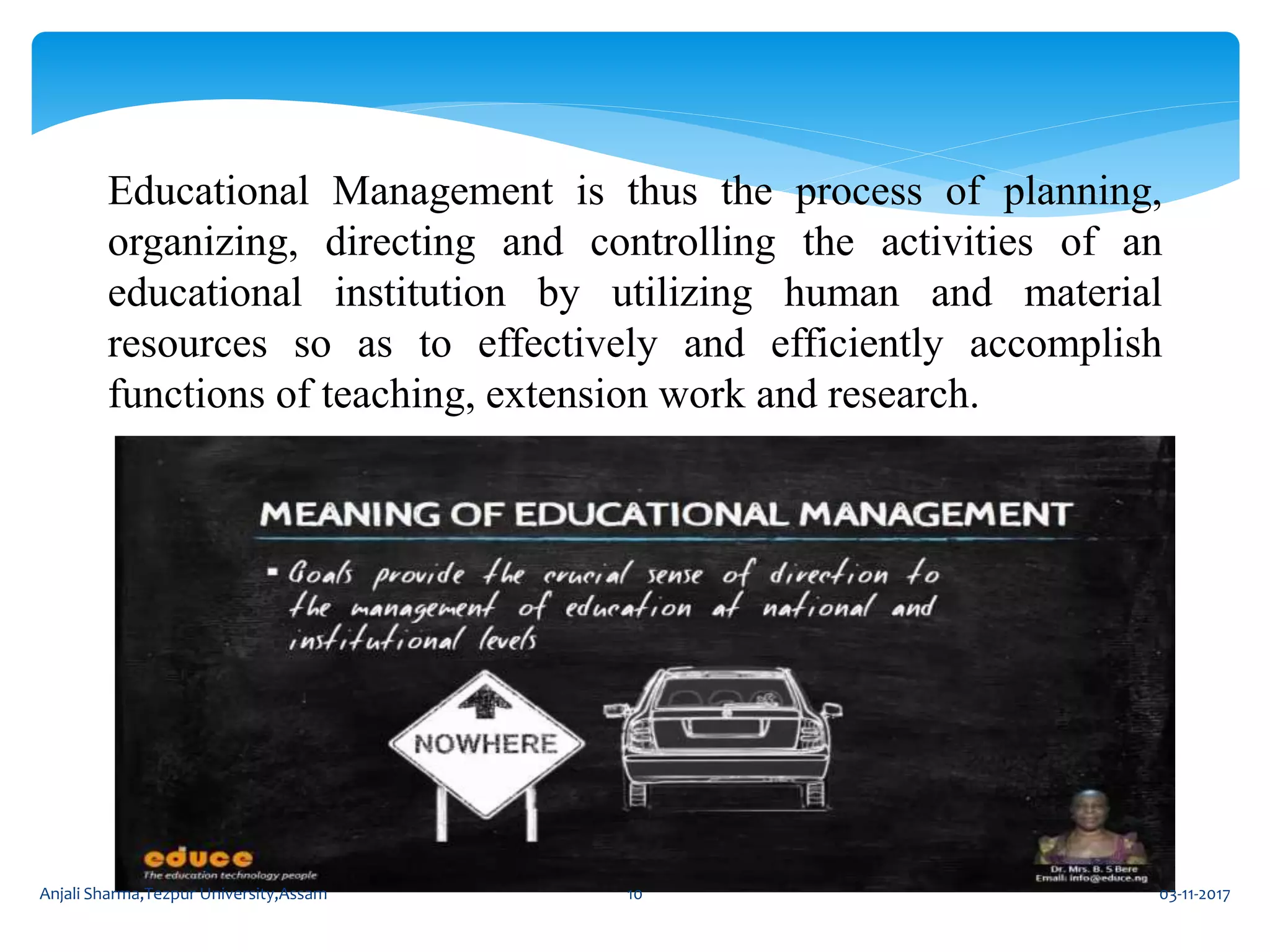
Educational Management is thus the process of planning,
organizing, directing and controlling the activities of an
educational institution by utilizing human and material
resources so as to effectively and efficiently accomplish
functions of teaching, extension work and research.
03-11-2017Anjali Sharma,Tezpur University,Assam 10
Educational management helps in the achievement institution’s
objectives i.e. It ensures school and college effectiveness.
It improves planning, organizing and implementing and institution’s
activities and process.
It helps in appropriate utilization of its human resources i.e.
teaching staff, non –teaching staff and students.
It enhances efficiency of the institution i.e. it helps in attaining the
goals with minimum cost and time.
OBJECTIVES
03-11-2017Anjali Sharma,Tezpur University,Assam 11
It facilitates optimum utilization of infrastructural facilities
(playground, building, equipments, library etc).
It enhances job satisfaction among staff members and
satisfaction with the institution among students.
It helps staff and students to manage, their interpersonal
conflicts, stress and time effectively.
It improves interpersonal communication among members of the
school /college.
It enables the principal to understand his role and carry out his
function more effectively
03-11-2017Anjali Sharma,Tezpur University,Assam 12
Philosophy underlined
Functions of educational management are those functions
which are performed by managers. Managers are generally
involved in the functions of : Planning, Organising, Directing,
Motivating, Evaluating and Decision-making. These are also
the functions of the organization as that beyond an individual
manager and affect the entire institution. These functions of
educational management are largely based on the 14
principles of management, which have been given by Henry
Fayol in 1916. They are:
03-11-2017Anjali Sharma,Tezpur University,Assam 13
Division of work.
Authority.
Discipline.
Unity of command.
Unity of direction.
Subordination of individual interests.
Remuneration.
Centralization.
Scalar chain.
Material and social order.
Equity.
Stability.
Initiative.
Espirit de corps.
03-11-2017Anjali Sharma,Tezpur University,Assam 14
1)Educational Management is necessary to develop the inter relationship
among different human resources and physical resources and with the
organization.
2)Educational management is essential for proper planning of any educational
institution. It gives the practical shape of the planning.
3)It is necessary in this sense that it stresses on the decentralization of
facilities and delegation of powers.
4)It is necessary for the proper evaluation and future course of action.
5)It demands on the educational institution that makes its curriculum more
relevant to the life and needs of the changing society in effective and
efficient manner.
NEED AND IMPORTANCE
03-11-2017Anjali Sharma,Tezpur University,Assam 15
 Goal development: It refers to the act of continuous
examination,evaluating, and making necessary changes in the
goals of education. Keeping in view the continuous change in
the needs and expectations of the society.
 Programme, planning and actualization: It is an area of
educational management. Planning involves assessment of
various alternatives and selecting the best possible action.
Providing support to actualize or implement the planned course
of action to realize the developed goals is the responsibility of
Educational management.
 Organization: It is an another area of Educational Management.
It can lead to effective distribution and coordination of
functions for realization of educational goals.
SCOPE
03-11-2017Anjali Sharma,Tezpur University,Assam 16
Educational Management also includes the day to day
activities in the educational institutions.
1)Planning of Educational goals, principles, approaches
and procedures at macro and micro level of education.
2)Communication ,decision making, problem solving
and team building at the institutional level.
3)Providing support in the form of development and
management of human resources including managers,
principles, supervisors, teachers, office staffs etc.
03-11-2017Anjali Sharma,Tezpur University,Assam 17
4)Provision of management of material resources for
such as board, marker, furniture, laboratory, library
etc.
5)Concluding regular meetings of the staff to discuss
issues and to build consensus and manage conflicts.
6)Development of the conducive climate.
7)Organization and management of services like
training, guidance, counseling, health and physical
education etc.
8)Maintenance of records, students evaluation,
managing finance and budgeting etc.
03-11-2017Anjali Sharma,Tezpur University,Assam 18
Educational management is a set of processes that keep an
organization functioning. Leadership is very different. It is about
aligning people to the vision, that means buy-in and
communication, motivation and inspiration.
March argues, “Management and Leadership are distinct
concepts, there is a natural overlap between the skills, they
require.”
Both educational management and leadership have some
dissimilarities.
 Educational management is directing planning and budgeting,
which is keeping an eye on the bottom line.
EDUCATION MANAGEMENT AND
LEADERSHIP
03-11-2017Anjali Sharma,Tezpur University,Assam 19
Whereas, leadership is directing,
creating, vision and strategy,
which is keeping an eye on the horizon.
•Educational management is based
on position of power.
But, leadership is based on personal
power.
•Educational management is focusing on objects producing,
selling goods and services.
While, leadership is focusing on people inspiring and
motivating followers.
•Educational management is linked with directing and
controlling.
But, leadership is linked with helping others to grow. 03-11-2017Anjali Sharma,Tezpur University,Assam 20
Educational Management is the application of
theories and principles of management in the field of
education.
Administration is the part of management
and educational management and administration are at times used
interchangeably. Administration is a group of people who manage the way
a company, school or other organizational functions.
Both educational management and administration have differences.
 Educational management of an institution is concerned with the
objectives, targets and goals laid down by the board of directors or the
board of governors.
EDUCATION MANAGEMENT AND
ADMINISTRATION
03-11-2017Anjali Sharma,Tezpur University,Assam 21
While, administration is an agency which lays down the aims, policies
and guidelines of institutions.
•Educational management is concerned with the achievement of
results.
On the other hand, administration is concerned with rules and
regulations.
•Educational management is progressive, imaginative and innovative
because of its emphasis on results.
Whereas, administration because of its emphasis on rules is
generally rigid and traditional.
•Educational management, results are
easily measurable.
But, administration results are not
easily measurable.
03-11-2017Anjali Sharma,Tezpur University,Assam 22
The difference between Administration and
Management
FirstView: Main functions of administration:
Policy Making
Formulation of Vision /Mission
Preparing Organisational Plans and strategies
Developing Culture and Climate
Conceptual Skills: Top Level Personnel.
Whereas, main functions of Management:
Executive Body
Implementing Body
Directs and control the subordinates
Technical and Human Skills: Middle Level Personnel
SecondView:
Management includes administration. According to Brech,
"Management is a social process entailing responsibility
for the effective and economical
planning and regulation of the operation of an enterprise in
fulfilment of a given purpose of task."
Administration is that part of management which is
concerned with the installation and carrying out of
the procedures by which the programme is laid down and
communicated and the progress of activities
is regulated and checked against plans. Thus, first and
second viewpoints are exactly opposite to one another.
03-11-2017Anjali Sharma,Tezpur University,Assam 24
ThirdView
There is no distinction between management and
administration. Other authors like Fayol, Newman
Williams, do not make any distinction between
these two terms. This viewpoint is gaining
popularity
these days. It is very difficult to demarcate between
managerial and administrative functions because
the same set of persons perform both of these
functions. We do not have two sets of people to
discharge administrative and operative
management functions. Therefore, there is no
difference.
03-11-2017Anjali Sharma,Tezpur University,Assam 25
Thus, in order to avoid the controversy, we can classify
management into-
(a)Administrative management
(b)Operative management.
Administrative management is primarily concerned with
laying down policies and determining goals whereas
operative management is concerned with implementation of
the policies for the achievement of goals. But both these
functions are performed by the same set of people.
According to Spriegal and Lansbugh, at the higher levels the
managerial authority is concerned with administration and
less with management and at lower levels, the managerial
authority is more concerned with management a nil less with
administration.
03-11-2017Anjali Sharma,Tezpur University,Assam 26
CONCLUSION
We can conclude by saying that education
management in this modern world is very
necessary for a smooth running and growth of a
healthy educational institutions. It should be
noted that an efficient education administration is
an essence for the efficiency and effectiveness.
Thus for success of education management there
must be adequate freedom and flexibility,
discipline and the necessary decorum should be
maintained in the educational institutions.
03-11-2017Anjali Sharma,Tezpur University,Assam 28

Edu. Management and Administration

  • 1.
    EDUCATION MANAGEMENT AND ADMINISTRATION Developedby Education Management students: Neelakshi Dutta Barnali Das Manami Medhi Bhanima Kalita Niaz Md. Dilwar Rahman Under the guidance of : Anjali Sharma Associate Professor
  • 2.
     INTRODUCTION  MEANINGOF MANAGEMENT  FEATURES  OBJECTIVES  FUNCTIONS  NEED AND IMPORTANCE  SCOPE  EDUCATION MANAGEMENT AND LEADERSHIP  EDUCATION MANAGEMENT AND ADMINISTRATION  CONCLUSION CONTENT 03-11-2017Anjali Sharma,Tezpur University,Assam 2
  • 3.
    Let’s start withetymology  It originated from the Italian word “Maneggiare’’ which means to handle.  Latin word “Manus” means hand.  French word “Mesnagement”  English word “Management” Etymology of management 03-11-2017Anjali Sharma,Tezpur University,Assam 3
  • 4.
     According toHenri Fayol, "to manage is to forecast and to plan, to organise, to command, to co-ordinate and to control."  According to Fredmund, “management is transforming resources into utility.”  Peter Drucker defined management as dynamic and life giving element in any organization, without it resources never become product. Definitions 03-11-2017Anjali Sharma,Tezpur University,Assam 4
  • 5.
     According toHarold Koontz, “Management is an art of getting things done through and with the people in formally organized groups. It is an art of creating an environment in which people can perform and individuals can co-operate towards attainment of group goals. ”  According to F.W. Taylor, “Management is an art of knowing what to do, when to do and see that it is done in the best and cheapest way.” Cont.….. 03-11-2017Anjali Sharma,Tezpur University,Assam 5
  • 6.
    Education is theprovision of a series of learning experience to students in order to impart knowledge, values, attitudes and skills with the ultimate aim of making them productive members of society. Through it the latent talent of the child can be developed. Education stands for.
  • 7.
  • 8.
    It is afield of study and practice concerned with the operation of educational organisations. It operates in the educational organizations. It is theory and practice of the organisation and administration of existing educational establishment and systems. The origin of the development of educational management as a study began to the United States in early part of 20th century. As a department it came into existence in 1976 in University of Ibadan Nigeria. Sir Graham Balfour writes "the purpose of educational management is to enable the right pupils to receive the right education from the right teachers, at a cost within the means of the state, which will enable pupils to profit by their learning."
  • 9.
    It is anapplied branch:- Application of theories, laws and principles from other disciplines Its product is living:-The outcome is always living i.e.is in the form of student. There is specificity in objectives:- The objectives of the organisation/institution is very much specific and well- known. There is centrality of target:- Different schools and colleges but they all aim at the same target/goal. Specific Features 03-11-2017Anjali Sharma,Tezpur University,Assam 9
  • 10.
    Educational Management isthus the process of planning, organizing, directing and controlling the activities of an educational institution by utilizing human and material resources so as to effectively and efficiently accomplish functions of teaching, extension work and research. 03-11-2017Anjali Sharma,Tezpur University,Assam 10
  • 11.
    Educational management helpsin the achievement institution’s objectives i.e. It ensures school and college effectiveness. It improves planning, organizing and implementing and institution’s activities and process. It helps in appropriate utilization of its human resources i.e. teaching staff, non –teaching staff and students. It enhances efficiency of the institution i.e. it helps in attaining the goals with minimum cost and time. OBJECTIVES 03-11-2017Anjali Sharma,Tezpur University,Assam 11
  • 12.
    It facilitates optimumutilization of infrastructural facilities (playground, building, equipments, library etc). It enhances job satisfaction among staff members and satisfaction with the institution among students. It helps staff and students to manage, their interpersonal conflicts, stress and time effectively. It improves interpersonal communication among members of the school /college. It enables the principal to understand his role and carry out his function more effectively 03-11-2017Anjali Sharma,Tezpur University,Assam 12
  • 13.
    Philosophy underlined Functions ofeducational management are those functions which are performed by managers. Managers are generally involved in the functions of : Planning, Organising, Directing, Motivating, Evaluating and Decision-making. These are also the functions of the organization as that beyond an individual manager and affect the entire institution. These functions of educational management are largely based on the 14 principles of management, which have been given by Henry Fayol in 1916. They are: 03-11-2017Anjali Sharma,Tezpur University,Assam 13
  • 14.
    Division of work. Authority. Discipline. Unityof command. Unity of direction. Subordination of individual interests. Remuneration. Centralization. Scalar chain. Material and social order. Equity. Stability. Initiative. Espirit de corps. 03-11-2017Anjali Sharma,Tezpur University,Assam 14
  • 15.
    1)Educational Management isnecessary to develop the inter relationship among different human resources and physical resources and with the organization. 2)Educational management is essential for proper planning of any educational institution. It gives the practical shape of the planning. 3)It is necessary in this sense that it stresses on the decentralization of facilities and delegation of powers. 4)It is necessary for the proper evaluation and future course of action. 5)It demands on the educational institution that makes its curriculum more relevant to the life and needs of the changing society in effective and efficient manner. NEED AND IMPORTANCE 03-11-2017Anjali Sharma,Tezpur University,Assam 15
  • 16.
     Goal development:It refers to the act of continuous examination,evaluating, and making necessary changes in the goals of education. Keeping in view the continuous change in the needs and expectations of the society.  Programme, planning and actualization: It is an area of educational management. Planning involves assessment of various alternatives and selecting the best possible action. Providing support to actualize or implement the planned course of action to realize the developed goals is the responsibility of Educational management.  Organization: It is an another area of Educational Management. It can lead to effective distribution and coordination of functions for realization of educational goals. SCOPE 03-11-2017Anjali Sharma,Tezpur University,Assam 16
  • 17.
    Educational Management alsoincludes the day to day activities in the educational institutions. 1)Planning of Educational goals, principles, approaches and procedures at macro and micro level of education. 2)Communication ,decision making, problem solving and team building at the institutional level. 3)Providing support in the form of development and management of human resources including managers, principles, supervisors, teachers, office staffs etc. 03-11-2017Anjali Sharma,Tezpur University,Assam 17
  • 18.
    4)Provision of managementof material resources for such as board, marker, furniture, laboratory, library etc. 5)Concluding regular meetings of the staff to discuss issues and to build consensus and manage conflicts. 6)Development of the conducive climate. 7)Organization and management of services like training, guidance, counseling, health and physical education etc. 8)Maintenance of records, students evaluation, managing finance and budgeting etc. 03-11-2017Anjali Sharma,Tezpur University,Assam 18
  • 19.
    Educational management isa set of processes that keep an organization functioning. Leadership is very different. It is about aligning people to the vision, that means buy-in and communication, motivation and inspiration. March argues, “Management and Leadership are distinct concepts, there is a natural overlap between the skills, they require.” Both educational management and leadership have some dissimilarities.  Educational management is directing planning and budgeting, which is keeping an eye on the bottom line. EDUCATION MANAGEMENT AND LEADERSHIP 03-11-2017Anjali Sharma,Tezpur University,Assam 19
  • 20.
    Whereas, leadership isdirecting, creating, vision and strategy, which is keeping an eye on the horizon. •Educational management is based on position of power. But, leadership is based on personal power. •Educational management is focusing on objects producing, selling goods and services. While, leadership is focusing on people inspiring and motivating followers. •Educational management is linked with directing and controlling. But, leadership is linked with helping others to grow. 03-11-2017Anjali Sharma,Tezpur University,Assam 20
  • 21.
    Educational Management isthe application of theories and principles of management in the field of education. Administration is the part of management and educational management and administration are at times used interchangeably. Administration is a group of people who manage the way a company, school or other organizational functions. Both educational management and administration have differences.  Educational management of an institution is concerned with the objectives, targets and goals laid down by the board of directors or the board of governors. EDUCATION MANAGEMENT AND ADMINISTRATION 03-11-2017Anjali Sharma,Tezpur University,Assam 21
  • 22.
    While, administration isan agency which lays down the aims, policies and guidelines of institutions. •Educational management is concerned with the achievement of results. On the other hand, administration is concerned with rules and regulations. •Educational management is progressive, imaginative and innovative because of its emphasis on results. Whereas, administration because of its emphasis on rules is generally rigid and traditional. •Educational management, results are easily measurable. But, administration results are not easily measurable. 03-11-2017Anjali Sharma,Tezpur University,Assam 22
  • 23.
    The difference betweenAdministration and Management FirstView: Main functions of administration: Policy Making Formulation of Vision /Mission Preparing Organisational Plans and strategies Developing Culture and Climate Conceptual Skills: Top Level Personnel. Whereas, main functions of Management: Executive Body Implementing Body Directs and control the subordinates Technical and Human Skills: Middle Level Personnel
  • 24.
    SecondView: Management includes administration.According to Brech, "Management is a social process entailing responsibility for the effective and economical planning and regulation of the operation of an enterprise in fulfilment of a given purpose of task." Administration is that part of management which is concerned with the installation and carrying out of the procedures by which the programme is laid down and communicated and the progress of activities is regulated and checked against plans. Thus, first and second viewpoints are exactly opposite to one another. 03-11-2017Anjali Sharma,Tezpur University,Assam 24
  • 25.
    ThirdView There is nodistinction between management and administration. Other authors like Fayol, Newman Williams, do not make any distinction between these two terms. This viewpoint is gaining popularity these days. It is very difficult to demarcate between managerial and administrative functions because the same set of persons perform both of these functions. We do not have two sets of people to discharge administrative and operative management functions. Therefore, there is no difference. 03-11-2017Anjali Sharma,Tezpur University,Assam 25
  • 26.
    Thus, in orderto avoid the controversy, we can classify management into- (a)Administrative management (b)Operative management. Administrative management is primarily concerned with laying down policies and determining goals whereas operative management is concerned with implementation of the policies for the achievement of goals. But both these functions are performed by the same set of people. According to Spriegal and Lansbugh, at the higher levels the managerial authority is concerned with administration and less with management and at lower levels, the managerial authority is more concerned with management a nil less with administration. 03-11-2017Anjali Sharma,Tezpur University,Assam 26
  • 27.
    CONCLUSION We can concludeby saying that education management in this modern world is very necessary for a smooth running and growth of a healthy educational institutions. It should be noted that an efficient education administration is an essence for the efficiency and effectiveness. Thus for success of education management there must be adequate freedom and flexibility, discipline and the necessary decorum should be maintained in the educational institutions.
  • 28.