SEMINAR
ON
OBJECTIVE TESTS SCORING,
ESSAY TEST SCORING
PRESENTED BY:
SANCHAYEETA DEY
1ST YEAR M.SC NURSING
CPMS COLLEGE OF NURSING
OBJECTIVE TESTS SCORING:
Answer to true-false, multiple choices, and other
objective item types can be marked directly on the
test copy. But scoring is facilitated if the answers
are indicated by position marking a separate answer
sheet. For example, the examinee may be directed
to indicate his choice of the first, second, third,
fourth or fifth alternative to a multiple – choice test
item by blackening the first, second, third , fourth
or fifth position following the item number on his
answer sheet.
OBJECTIVE TEST SCORING
METHODS:
MANUAL SCORING:
In this method of scoring the answer to test item
are scored by direct comparison of the examinees
answer with the marking key.
If the answers are recorded on the test paper for
instance a scoring key can be made by marking
the correct answer on a blank copy of the test.
Scoring is then done by simply comparing the
columns of answer on the master copy with the
columns of answer on each examinee’s test
paper.
 Alternatively, the correct answers are recorded
on scripts of paper and this script key on which
the columns of answers are recorded are used
as master for scoring the examinees test papers.
STENCIL SCORING:
Here separate sheet of answer sheets are used by
examinees for recording their answers, it’s most
convenient to prepare and use a scoring stencil.
A scoring stencil is prepared by pending holes on
a blank answer sheet where the correct answers
are supposed to appear.
Scoring is then done by laying the stencil over
each answer sheet and the number of answer
checks appearing through the holes is counted.
Answers so marked can be scored with the aid of a
stencil key on which the correct answer positions
have been punched. At the end of this scoring
procedure, each test paper is scanned to eliminate
possible errors due to examinees supplying more
than one correct answer.
 An examinee’s score is simply the number of
correct answers; the scorer simply counts the
number of marks appearing through the holes on
the stencil key.
MACHINE SCORING:
If the number of examinees is large, a specially
prepared answer sheets are used to answer the
questions.
The answers are normally shaded at the appropriate
places assigned to the various items.
The answer can be scored, usually much more
quickly and accurately, by electrical scoring
machines..
Some of these machines, which count correct
answers by cumulating the current flowing
through correctly placed pencil marks, require the
examinee to use special graphite pencils; others,
which use photoelectric cells to scan the answer
sheet, require only marks black enough to
contrast sharply with the lightly printed guide
lines.
High – speed photoelectric test scoring machines
are connected to electronic data processing and
print – out equipment
MEASURES TO PREVENT GUESSING IN
OBJECTIVE TYPE QUESTIONS
Objective test are often criticized because they
encouraging guessing. Marking scheme which
can take account of this assumptions include:
1. Raising the pass mark
2. Deduction for guessing/ negative marking
RAISING THE PASS MARK
In a test of 100 questions with 5 options per
question random guessing should allow a score, on
average of 20. Hence the range of marks to be
considered is from 20 to 100. The mid-point of
this range (or pass mark) is 60, rather than 50.
These methods assume that random guessing takes
place and that a score of 60 represents a
satisfactory attainment of course objectives.
Both these assumptions may or may not be valid.
DEDUCTION FOR GUESSING/ NEGATIVE
MARKING
 A score of 1/(n-1) is deducted for each incorrect answer,
were ‘n’ is the no. of option per item.
 There is no penalty for an omitted answer. Assumptions are
made when this method is applied.
 Firstly, it is assumed that incorrect answers are made on
the basis of random guessing and that omissions are made
only on the basis of insufficient information.
 Secondly, it is assumed that all options are equally
attractive.
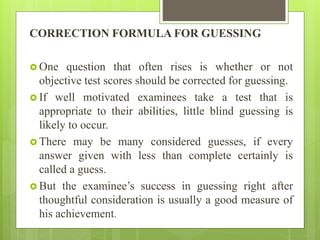
CORRECTION FORMULA FOR GUESSING
 One question that often rises is whether or not
objective test scores should be corrected for guessing.
 If well motivated examinees take a test that is
appropriate to their abilities, little blind guessing is
likely to occur.
 There may be many considered guesses, if every
answer given with less than complete certainly is
called a guess.
 But the examinee’s success in guessing right after
thoughtful consideration is usually a good measure of
his achievement.
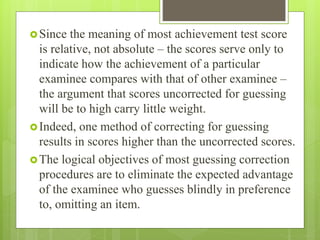
Since the meaning of most achievement test score
is relative, not absolute – the scores serve only to
indicate how the achievement of a particular
examinee compares with that of other examinee –
the argument that scores uncorrected for guessing
will be to high carry little weight.
Indeed, one method of correcting for guessing
results in scores higher than the uncorrected scores.
The logical objectives of most guessing correction
procedures are to eliminate the expected advantage
of the examinee who guesses blindly in preference
to, omitting an item.
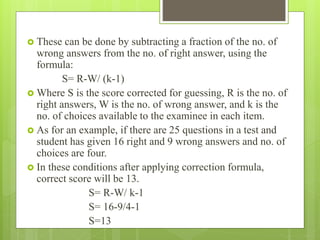
 These can be done by subtracting a fraction of the no. of
wrong answers from the no. of right answer, using the
formula:
S= R-W/ (k-1)
 Where S is the score corrected for guessing, R is the no. of
right answers, W is the no. of wrong answer, and k is the
no. of choices available to the examinee in each item.
 As for an example, if there are 25 questions in a test and
student has given 16 right and 9 wrong answers and no. of
choices are four.
 In these conditions after applying correction formula,
correct score will be 13.
S= R-W/ k-1
S= 16-9/4-1
S=13
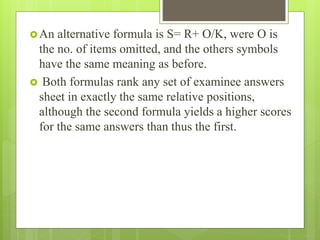
An alternative formula is S= R+ O/K, were O is
the no. of items omitted, and the others symbols
have the same meaning as before.
 Both formulas rank any set of examinee answers
sheet in exactly the same relative positions,
although the second formula yields a higher scores
for the same answers than thus the first.
SCORING ESSAY TYPES
QUESTIONS
 Essay questions are supply or constructed response type
question and can be the best way to measure the student’s
higher order thinking skills, such as applying, organizing,
synthesizing, integrating, evaluating or projecting while at
the same time, providing a measure of writing skills.
 The students has to formulates and write a response, which
may be detailed and lengthy.
 The accuracy and quality of the response are judged by the
teacher.
METHODS FOR SCORING ESSAY TYPE
QUESTIONS
The point or analytic methods
The global/ Holistic rating methods
THE POINT OR ANALYTIC METHODS
 In this method each answer is compared with
already prepared ideal marking scheme (scoring
key) and marks are assigned according to the
adequacy of the answer.
In analytical scoring, essential parts of an ideal
responder identified and the assigned scores are
based upon the no. of parts included in the
response.
 Each part is evaluated individually.
These scoring method requires that the instructor
develop and ideal response and create a scoring
key or guide.
 The scoring key provides an absolutes standard for
determining the total points awarded for a response.
 Student responses are compared to the scoring standard and
not to the response of their classmates.
 The method is generally used satisfactorily to score,
restricted response questions.
 This is made possible by the limited no. of characteristics
elicited by a single answer, which thus defines the degree of
quality preciously enough to assign point value to them.
 It is also possible to identify the particular weakness or
strength of each examinee with analytical scoring.
 Nevertheless, it is desirable to rate each expect of the item
separately.
This has the advantage of providing greater
objectivity.
When used conscientiously, the analytic method
provides a means for maintaining uniformity in
scoring between scores and between scripts, thus
improving the reliability of the scoring.
THE GLOBAL/ HOLISTIC RATING
METHODS
 In holistic scoring the reader forms an impression of the
overall quality of a response and then transform that
impression into a score represents the quality of a response
in a relation into a relative standard such as other student in
the class (rank order) or an absolute standard like a set a
sample papers with pre determine scores.
 In these methods, the examiner first sorts the response into
categories of varying quality based on his general or global
impression on reading the response.
 The standard of quality helps to establish a relative scales,
which forms the basis for ranking response from those with
the poorest quality response to those that have the highest
quality response.
 Usually between the 5 and 10 categories are used with the
rating methods with each of the piles representing the
degree of quality and determines the credit to be assigned.
 For example, where 5 categories are used, and the
responses are awarded 5 letter grades: A, B, C, D and E.
 The responses are sorted into the 5 categories.
Holistic scoring tends to be simpler and quicker
than analytical scoring, and in some situations,
yields more reliable scores.
A disadvantage to holistic scoring is that it doesn’t
provide a clear jurisdiction of the assigned scores,
nor does it give any indications of how a student’s
score may have fallen short of the standard.
ADVANTAGES OF ESSAY- TYPE
QUESTIONS:
Essays require both more effort and deeper
understanding on the part of the student, and then
do other type of questions.
For example, students typically can’t produce an
adequate answer to an easy question simply by
recognizing or recalling the correct information, as
they often can with multiple choice or short answer
questions.
Easy questions can better assess the complexity of
students through processes, as well as ability to
think critically and solve problem in a particular
domain of knowledge then can multiple- choice or
fill in the blanks items.
As a require students to express their thoughts in
grammatical, well-crafted sentence and paragraph- a
skill that all educated persons should be expected to
master.
DISADVANTAGES OF ESSAY- TYPE
QUESTION
Essay type questions take much longer than other
types of assessment items for students to write and
for teacher to grade.
Scoring of essay exams can be influenced by
extraneous factors.
Scores of essay type questions are unreliable.
Essay exam performance conflates course subject
matter knowledge with writing skills.
objective test scoring and essay scoring

objective test scoring and essay scoring

  • 1.
    SEMINAR ON OBJECTIVE TESTS SCORING, ESSAYTEST SCORING PRESENTED BY: SANCHAYEETA DEY 1ST YEAR M.SC NURSING CPMS COLLEGE OF NURSING
  • 4.
    OBJECTIVE TESTS SCORING: Answerto true-false, multiple choices, and other objective item types can be marked directly on the test copy. But scoring is facilitated if the answers are indicated by position marking a separate answer sheet. For example, the examinee may be directed to indicate his choice of the first, second, third, fourth or fifth alternative to a multiple – choice test item by blackening the first, second, third , fourth or fifth position following the item number on his answer sheet.
  • 5.
    OBJECTIVE TEST SCORING METHODS: MANUALSCORING: In this method of scoring the answer to test item are scored by direct comparison of the examinees answer with the marking key. If the answers are recorded on the test paper for instance a scoring key can be made by marking the correct answer on a blank copy of the test.
  • 6.
    Scoring is thendone by simply comparing the columns of answer on the master copy with the columns of answer on each examinee’s test paper.  Alternatively, the correct answers are recorded on scripts of paper and this script key on which the columns of answers are recorded are used as master for scoring the examinees test papers.
  • 7.
    STENCIL SCORING: Here separatesheet of answer sheets are used by examinees for recording their answers, it’s most convenient to prepare and use a scoring stencil. A scoring stencil is prepared by pending holes on a blank answer sheet where the correct answers are supposed to appear. Scoring is then done by laying the stencil over each answer sheet and the number of answer checks appearing through the holes is counted.
  • 8.
    Answers so markedcan be scored with the aid of a stencil key on which the correct answer positions have been punched. At the end of this scoring procedure, each test paper is scanned to eliminate possible errors due to examinees supplying more than one correct answer.  An examinee’s score is simply the number of correct answers; the scorer simply counts the number of marks appearing through the holes on the stencil key.
  • 9.
    MACHINE SCORING: If thenumber of examinees is large, a specially prepared answer sheets are used to answer the questions. The answers are normally shaded at the appropriate places assigned to the various items. The answer can be scored, usually much more quickly and accurately, by electrical scoring machines..
  • 10.
    Some of thesemachines, which count correct answers by cumulating the current flowing through correctly placed pencil marks, require the examinee to use special graphite pencils; others, which use photoelectric cells to scan the answer sheet, require only marks black enough to contrast sharply with the lightly printed guide lines. High – speed photoelectric test scoring machines are connected to electronic data processing and print – out equipment
  • 11.
    MEASURES TO PREVENTGUESSING IN OBJECTIVE TYPE QUESTIONS Objective test are often criticized because they encouraging guessing. Marking scheme which can take account of this assumptions include: 1. Raising the pass mark 2. Deduction for guessing/ negative marking
  • 12.
    RAISING THE PASSMARK In a test of 100 questions with 5 options per question random guessing should allow a score, on average of 20. Hence the range of marks to be considered is from 20 to 100. The mid-point of this range (or pass mark) is 60, rather than 50. These methods assume that random guessing takes place and that a score of 60 represents a satisfactory attainment of course objectives. Both these assumptions may or may not be valid.
  • 13.
    DEDUCTION FOR GUESSING/NEGATIVE MARKING  A score of 1/(n-1) is deducted for each incorrect answer, were ‘n’ is the no. of option per item.  There is no penalty for an omitted answer. Assumptions are made when this method is applied.  Firstly, it is assumed that incorrect answers are made on the basis of random guessing and that omissions are made only on the basis of insufficient information.  Secondly, it is assumed that all options are equally attractive.
  • 14.
    CORRECTION FORMULA FORGUESSING  One question that often rises is whether or not objective test scores should be corrected for guessing.  If well motivated examinees take a test that is appropriate to their abilities, little blind guessing is likely to occur.  There may be many considered guesses, if every answer given with less than complete certainly is called a guess.  But the examinee’s success in guessing right after thoughtful consideration is usually a good measure of his achievement.
  • 15.
    Since the meaningof most achievement test score is relative, not absolute – the scores serve only to indicate how the achievement of a particular examinee compares with that of other examinee – the argument that scores uncorrected for guessing will be to high carry little weight. Indeed, one method of correcting for guessing results in scores higher than the uncorrected scores. The logical objectives of most guessing correction procedures are to eliminate the expected advantage of the examinee who guesses blindly in preference to, omitting an item.
  • 16.
     These canbe done by subtracting a fraction of the no. of wrong answers from the no. of right answer, using the formula: S= R-W/ (k-1)  Where S is the score corrected for guessing, R is the no. of right answers, W is the no. of wrong answer, and k is the no. of choices available to the examinee in each item.  As for an example, if there are 25 questions in a test and student has given 16 right and 9 wrong answers and no. of choices are four.  In these conditions after applying correction formula, correct score will be 13. S= R-W/ k-1 S= 16-9/4-1 S=13
  • 17.
    An alternative formulais S= R+ O/K, were O is the no. of items omitted, and the others symbols have the same meaning as before.  Both formulas rank any set of examinee answers sheet in exactly the same relative positions, although the second formula yields a higher scores for the same answers than thus the first.
  • 18.
    SCORING ESSAY TYPES QUESTIONS Essay questions are supply or constructed response type question and can be the best way to measure the student’s higher order thinking skills, such as applying, organizing, synthesizing, integrating, evaluating or projecting while at the same time, providing a measure of writing skills.  The students has to formulates and write a response, which may be detailed and lengthy.  The accuracy and quality of the response are judged by the teacher.
  • 19.
    METHODS FOR SCORINGESSAY TYPE QUESTIONS The point or analytic methods The global/ Holistic rating methods
  • 20.
    THE POINT ORANALYTIC METHODS  In this method each answer is compared with already prepared ideal marking scheme (scoring key) and marks are assigned according to the adequacy of the answer. In analytical scoring, essential parts of an ideal responder identified and the assigned scores are based upon the no. of parts included in the response.  Each part is evaluated individually. These scoring method requires that the instructor develop and ideal response and create a scoring key or guide.
  • 21.
     The scoringkey provides an absolutes standard for determining the total points awarded for a response.  Student responses are compared to the scoring standard and not to the response of their classmates.  The method is generally used satisfactorily to score, restricted response questions.  This is made possible by the limited no. of characteristics elicited by a single answer, which thus defines the degree of quality preciously enough to assign point value to them.  It is also possible to identify the particular weakness or strength of each examinee with analytical scoring.  Nevertheless, it is desirable to rate each expect of the item separately.
  • 22.
    This has theadvantage of providing greater objectivity. When used conscientiously, the analytic method provides a means for maintaining uniformity in scoring between scores and between scripts, thus improving the reliability of the scoring.
  • 23.
    THE GLOBAL/ HOLISTICRATING METHODS  In holistic scoring the reader forms an impression of the overall quality of a response and then transform that impression into a score represents the quality of a response in a relation into a relative standard such as other student in the class (rank order) or an absolute standard like a set a sample papers with pre determine scores.  In these methods, the examiner first sorts the response into categories of varying quality based on his general or global impression on reading the response.
  • 24.
     The standardof quality helps to establish a relative scales, which forms the basis for ranking response from those with the poorest quality response to those that have the highest quality response.  Usually between the 5 and 10 categories are used with the rating methods with each of the piles representing the degree of quality and determines the credit to be assigned.  For example, where 5 categories are used, and the responses are awarded 5 letter grades: A, B, C, D and E.  The responses are sorted into the 5 categories.
  • 25.
    Holistic scoring tendsto be simpler and quicker than analytical scoring, and in some situations, yields more reliable scores. A disadvantage to holistic scoring is that it doesn’t provide a clear jurisdiction of the assigned scores, nor does it give any indications of how a student’s score may have fallen short of the standard.
  • 26.
    ADVANTAGES OF ESSAY-TYPE QUESTIONS: Essays require both more effort and deeper understanding on the part of the student, and then do other type of questions. For example, students typically can’t produce an adequate answer to an easy question simply by recognizing or recalling the correct information, as they often can with multiple choice or short answer questions.
  • 27.
    Easy questions canbetter assess the complexity of students through processes, as well as ability to think critically and solve problem in a particular domain of knowledge then can multiple- choice or fill in the blanks items. As a require students to express their thoughts in grammatical, well-crafted sentence and paragraph- a skill that all educated persons should be expected to master.
  • 28.
    DISADVANTAGES OF ESSAY-TYPE QUESTION Essay type questions take much longer than other types of assessment items for students to write and for teacher to grade. Scoring of essay exams can be influenced by extraneous factors. Scores of essay type questions are unreliable. Essay exam performance conflates course subject matter knowledge with writing skills.