Blooms Taxonomy-
KSA Domains
By
Dr.S. BASKAR, BOYSCAST Fellow
Dean (R & D), Professor, EEE
Email: sbeee@tce.edu
Thiagarajar College of Engineering, Madurai
Tamilnadu
Session Outcomes
• Afterthe successful completion of the programme,
Participants will be able to:
1. Appreciate the role of Blooms Taxonomy in
improving the quality of T&L
2. Explain the coverage of three domains of learning
in Engineering Education
3. Explain the classification of Cognitive domain of
learning in BT and RBT
4. Explain the classification of affective domain of
learning
5. Explain the classification of psychomotor domain of
learning
5.
Blooms’ Taxonomy
• GlobalLanguage of Education
• Three Domains of Educational Activities:
• Cognitive Domain (Knowledge and Reasoning)
• knowledge, comprehension, and critical thinking
• Knowing
• Psychomotor Domain (Skills)
• Ability to physically manipulate a tool or instrument
• Doing
• Affective Domain ( Values and Attitudes)
• The way people react emotionally
• Feeling
Brief History ofBlooms
• Following the 1948 Convention of the American
Psychological Association, B.S. Bloom took a lead in
formulating a classification of "the goals of the
educational process".
• Three "domains" of educational activities were
identified. Cognitive Domain, Affective Domain and
Psychomotor Domain.
• Bloom and his co-workers established a hierarchy of
educational objectives, which is generally referred to
as Bloom's Taxonomy
Mar 20, 2025
8.
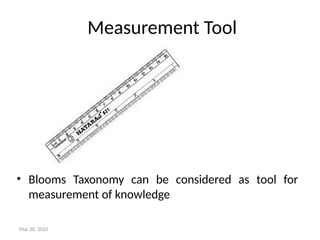
Measurement Tool
• BloomsTaxonomy can be considered as tool for
measurement of knowledge
Mar 20, 2025
9.
Depth of Knowledge
•NCERT syllabi
– Board exam
– NTSE
– JEE Main
– JEE Advanced
– NEET
Mar 20, 2025
10.
Different Levels ofQuestions
• Define Ohm’s Law
• When a voltage drop across a pn junction diode is
increased from 0.70 V to 0.71V, the change in the
diode current is 10 mA. What is the dynamic
resistance of diode?
• An electrician puts a fuse of rating 5 A in that part of
domestic electrical circuit in which an electrical
heater of rating 1.5 kW, 220 V is operating. What is
likely to happen in this case and why ? What change,
if any needs to be made ?
Mar 20, 2025
11.
11
Bloom’s Taxonomy ofEducational Objectives
• Educational Language among educators –means of
communication to maintain consistency
• Bloom’s Taxonomy is frequently used by teachers in writing course
outcomes as it provides a ready made structure and list of verbs.
• Bloom always advocated that when teaching and assessing
students one should bear in mind that learning is a process and
that the teacher should try to get the thought processes of the
students to move up into the higher order stages of synthesis and
evaluation.
Mar 20, 2025
12.
12
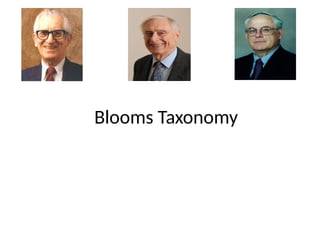
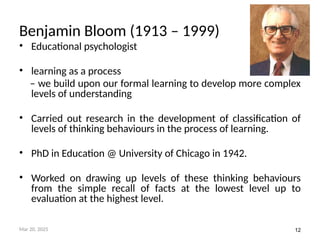
Benjamin Bloom (1913– 1999)
• Educational psychologist
• learning as a process
– we build upon our formal learning to develop more complex
levels of understanding
• Carried out research in the development of classification of
levels of thinking behaviours in the process of learning.
• PhD in Education @ University of Chicago in 1942.
• Worked on drawing up levels of these thinking behaviours
from the simple recall of facts at the lowest level up to
evaluation at the highest level.
Mar 20, 2025
13.
13
Bloom’s Quote
“The purposeof education is to
change the thoughts, feelings, and
actions of students.”
Mar 20, 2025
14.
14
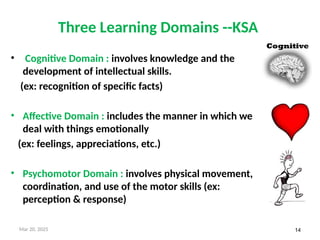
Three Learning Domains--KSA
• Cognitive Domain : involves knowledge and the
development of intellectual skills.
(ex: recognition of specific facts)
• Affective Domain : includes the manner in which we
deal with things emotionally
(ex: feelings, appreciations, etc.)
• Psychomotor Domain : involves physical movement,
coordination, and use of the motor skills (ex:
perception & response)
Mar 20, 2025
15.
15
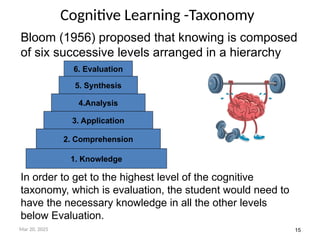
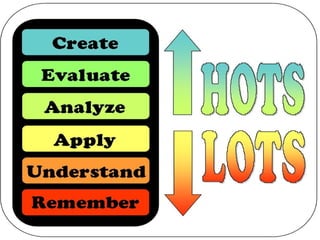
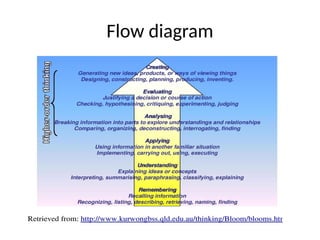
Cognitive Learning -Taxonomy
Mar20, 2025
1. Knowledge
2. Comprehension
3. Application
4.Analysis
5. Synthesis
6. Evaluation
Bloom (1956) proposed that knowing is composed
of six successive levels arranged in a hierarchy
In order to get to the highest level of the cognitive
taxonomy, which is evaluation, the student would need to
have the necessary knowledge in all the other levels
below Evaluation.
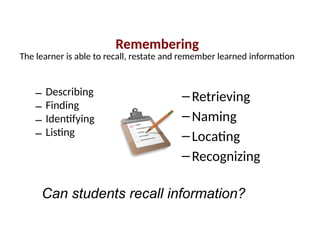
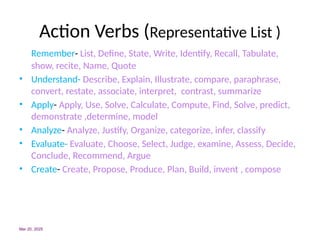
Remembering
The learner isable to recall, restate and remember learned information
– Describing
– Finding
– Identifying
– Listing
–Retrieving
–Naming
–Locating
–Recognizing
Can students recall information?
22.
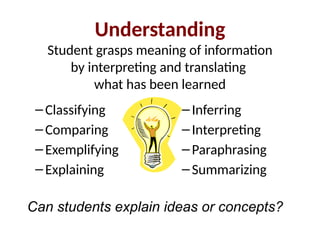
Understanding
Student grasps meaningof information
by interpreting and translating
what has been learned
–Classifying
–Comparing
–Exemplifying
–Explaining
–Inferring
–Interpreting
–Paraphrasing
–Summarizing
Can students explain ideas or concepts?
23.
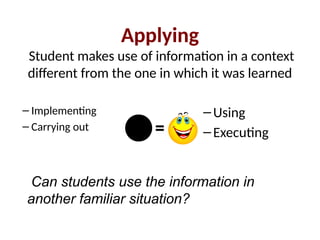
Applying
Student makes useof information in a context
different from the one in which it was learned
– Implementing
– Carrying out
–Using
–Executing
Can students use the information in
another familiar situation?
c =
24.
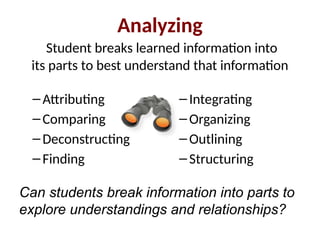
Analyzing
Student breaks learnedinformation into
its parts to best understand that information
–Attributing
–Comparing
–Deconstructing
–Finding
–Integrating
–Organizing
–Outlining
–Structuring
Can students break information into parts to
explore understandings and relationships?
25.
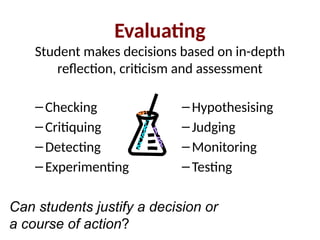
Evaluating
Student makes decisionsbased on in-depth
reflection, criticism and assessment
–Checking
–Critiquing
–Detecting
–Experimenting
–Hypothesising
–Judging
–Monitoring
–Testing
Can students justify a decision or
a course of action?
26.
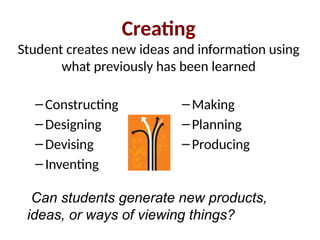
Creating
Student creates newideas and information using
what previously has been learned
–Constructing
–Designing
–Devising
–Inventing
–Making
–Planning
–Producing
Can students generate new products,
ideas, or ways of viewing things?
27.
Mar 20, 2025
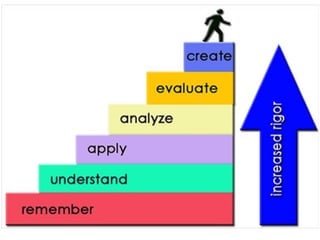
Wemust remember a concept before we can
understand it.
We must understand a concept before we can
apply it.
We must be able to apply a concept before we
analyze it.
We must have analyzed a concept before we can
evaluate it.
We must have remembered, understood,
applied, analyzed, and evaluated a concept
before we can create.
Blooms Knowledge Levels
28.
Mar 20, 2025
•Provides a universally effective strategy for
creating all type of content to impart learning.
• Helps teachers make decisions about the
classification of content and map content to
tasks that students need to perform.
• Guides teachers to develop higher levels of
thinking process for critical thinking or creative
thinking.
Educational Implications of Blooms Taxonomy
30
AFFECTIVE DOMAIN
Mar 20,2025
Emotion and Cognition are inextricably linked and
perhaps never entirely separate, distinctive nor
pure.
~William James
The separation of the head from the heart has
contributed to a fractured education system that
produces minds that do not know how to feel and
hearts that do not know how to think.
~Parker Palmer
32.
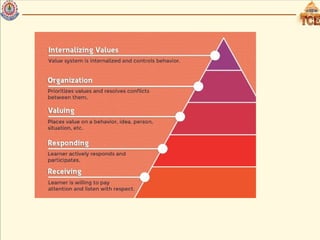
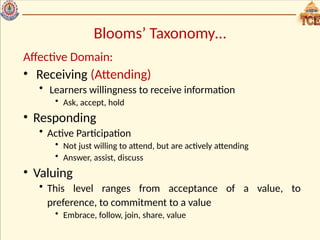
Blooms’ Taxonomy…
Affective Domain:
•Receiving (Attending)
• Learners willingness to receive information
• Ask, accept, hold
• Responding
• Active Participation
• Not just willing to attend, but are actively attending
• Answer, assist, discuss
• Valuing
• This level ranges from acceptance of a value, to
preference, to commitment to a value
• Embrace, follow, join, share, value
33.
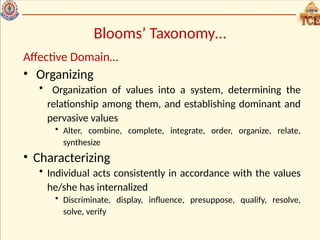
Blooms’ Taxonomy…
Affective Domain…
•Organizing
• Organization of values into a system, determining the
relationship among them, and establishing dominant and
pervasive values
• Alter, combine, complete, integrate, order, organize, relate,
synthesize
• Characterizing
• Individual acts consistently in accordance with the values
he/she has internalized
• Discriminate, display, influence, presuppose, qualify, resolve,
solve, verify
34.
Affective Domain: ActionVerbs
Mar 20, 2025
Receiving Responding Valuing Organizing Characterizing
Students become
aware of an
attitude,
behavior, or value.
Students exhibit a reaction
or change as a
result of
exposure to an attitude,
behavior, or value.
Students recognize
value and
display this
through involvement
or commitment.
Students determine a
new value or
behavior as
important or a priority.
Students integrate consistent
behavior as a naturalized
value in spite of
discomfort or cost. The value is
recognized as a part of the
person’s character.
Accept
Attend
Describe
Explain
Locate
Observe
Realize
Receive
Recognize
Behave
Comply
Cooperate
Discuss
Examine
Follow
Model
Present
Respond
Show
Accept
Adapt
Balance
Choose
Differentiate
Defend I
Influence
Prefer
Recognize
Seek
Value
Adapt
Adjust
Alter
Change
Customize
Develop
Improve
Manipulate
Modify
Practice
Revise
Authenticate
Characterize
Defend
Display
Embody
Habituate
Internalize
Produce
Represent
Validate
Verify
35.
35
Examples of
Course Outcomesin Affective Domain
• Accept the need for professional ethical standards.
• Appreciate the need for confidentiality in the professional
client relationship.
• Display a willingness to communicate well with clients .
• Relate to participants in an ethical and humane manner.
• Resolve conflicting issues between personal beliefs and
ethical considerations.
• Embrace a responsibility for the welfare of children taken into
care.
• Participate in class discussions with colleagues and with
teachers.
Mar 20, 2025
37.
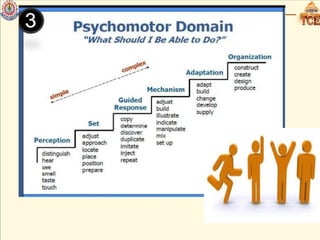
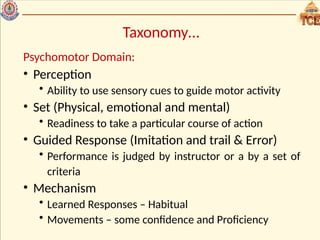
Taxonomy…
Psychomotor Domain:
• Perception
•Ability to use sensory cues to guide motor activity
• Set (Physical, emotional and mental)
• Readiness to take a particular course of action
• Guided Response (Imitation and trail & Error)
• Performance is judged by instructor or a by a set of
criteria
• Mechanism
• Learned Responses – Habitual
• Movements – some confidence and Proficiency
38.
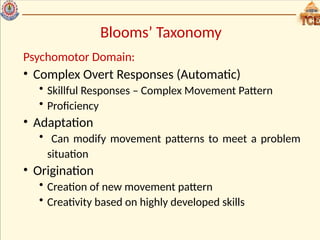
Blooms’ Taxonomy
Psychomotor Domain:
•Complex Overt Responses (Automatic)
• Skillful Responses – Complex Movement Pattern
• Proficiency
• Adaptation
• Can modify movement patterns to meet a problem
situation
• Origination
• Creation of new movement pattern
• Creativity based on highly developed skills
39.
39
Laboratory skills
• Operatethe range of instrumentation specified in the module
safely and efficiently in the electronics laboratory.
• Perform load test of an electrical machine accurately and safely
in the laboratory.
• Construct simple hardware interfacing diagram for a
microprocessor based system.
Presentation skills
• Deliver an effective presentation.
• Demonstrate a range of graphic and CAD communication
techniques.
Mar 20, 2025
40.
Mar 20, 2025
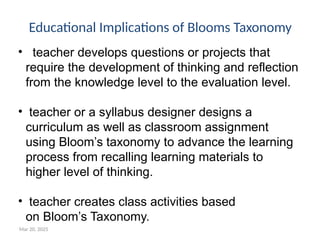
•teacher develops questions or projects that
require the development of thinking and reflection
from the knowledge level to the evaluation level.
• teacher or a syllabus designer designs a
curriculum as well as classroom assignment
using Bloom’s taxonomy to advance the learning
process from recalling learning materials to
higher level of thinking.
• teacher creates class activities based
on Bloom’s Taxonomy.
Educational Implications of Blooms Taxonomy
41.
Mar 20, 2025
Articulationof Course
Outcomes(COs)
By,
Dr.S.BASKAR, BOYSCAST Fellow
Dean (R&D), Professor, EEE Department
Thiagarajar College of Engineering, MADURAI
42.
42
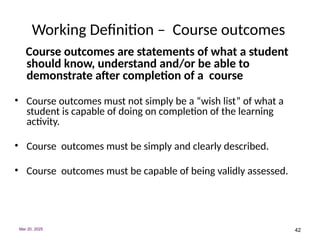
Working Definition –Course outcomes
Course outcomes are statements of what a student
should know, understand and/or be able to
demonstrate after completion of a course
• Course outcomes must not simply be a “wish list” of what a
student is capable of doing on completion of the learning
activity.
• Course outcomes must be simply and clearly described.
• Course outcomes must be capable of being validly assessed.
Mar 20, 2025
43.
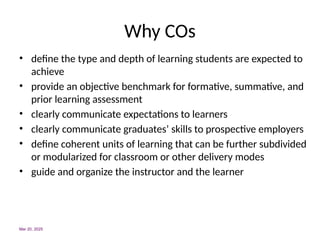
Why COs
• definethe type and depth of learning students are expected to
achieve
• provide an objective benchmark for formative, summative, and
prior learning assessment
• clearly communicate expectations to learners
• clearly communicate graduates’ skills to prospective employers
• define coherent units of learning that can be further subdivided
or modularized for classroom or other delivery modes
• guide and organize the instructor and the learner
Mar 20, 2025
44.
44
Course Outcomes
• Importantto ensure that there is alignment between teaching
methods, learning outcomes and assessment criteria.
• Clear expectations on the part of students of what is required of
them are a vitally important part of students’ effective learning
(Ramsden, 2003)
• This correlation between teaching, learning outcomes and
assessment helps to make the overall learning experience more
transparent and meaningful for students.
• For the good teacher, learning outcomes do not involve a
“paradigm shift”.
• There is a dynamic equilibrium between teaching strategies and
Learning Outcomes
Mar 20, 2025
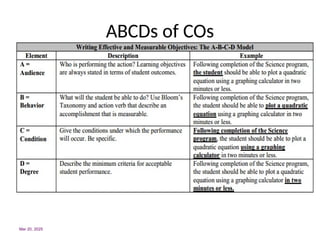
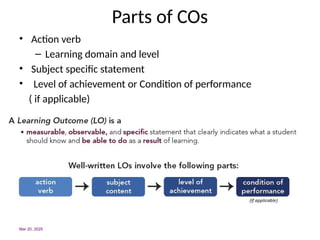
Parts of COs
•Action verb
– Learning domain and level
• Subject specific statement
• Level of achievement or Condition of performance
( if applicable)
Mar 20, 2025
47.
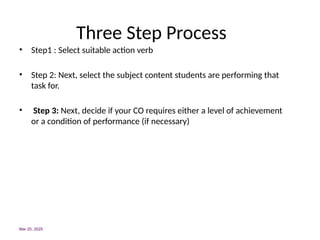
Three Step Process
•Step1 : Select suitable action verb
• Step 2: Next, select the subject content students are performing that
task for.
• Step 3: Next, decide if your CO requires either a level of achievement
or a condition of performance (if necessary)
Mar 20, 2025
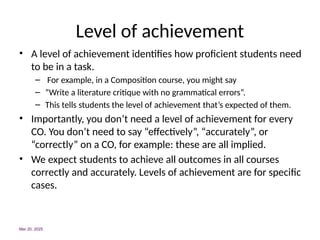
Level of achievement
•A level of achievement identifies how proficient students need
to be in a task.
– For example, in a Composition course, you might say
– “Write a literature critique with no grammatical errors”.
– This tells students the level of achievement that’s expected of them.
• Importantly, you don’t need a level of achievement for every
CO. You don’t need to say “effectively”, “accurately”, or
“correctly” on a CO, for example: these are all implied.
• We expect students to achieve all outcomes in all courses
correctly and accurately. Levels of achievement are for specific
cases.
Mar 20, 2025
50.
Condition
• A conditionof performance identifies if students are only
performing this outcome in a specific context.
• Again, you don’t need a condition of performance for every
CO. Only include a condition of performance if that
information clarifies the specific outcome students will
achieve in the course.
Mar 20, 2025
Conditions on numberof verbs
• COs should have only one verb, and only one
area of significant subject content.
• If CO includes multiple verbs, select the one
that articulates the highest level of learning
students will demonstrate in the course.
• If CO includes multiple topics, select the one
that articulates the key outcome
Mar 20, 2025
53.
53
Writing Learning Outcomes–Challenges
• It is vital that course outcomes are clearly written so that they are
understood by students, colleagues and external examiners.
• When writing course outcomes it may be helpful to you if you focus on
what you expect students to be able to demonstrate upon completion
of the module or programme.
• It is standard practice to list the course outcomes using a phrase like
“On successful completion of this module, students should be able to:”
[list of learning outcomes]
Avoid complicated sentences. If necessary use one than one sentence to
ensure clarity.
General recommendation: 5 – 8 learning outcomes per module.
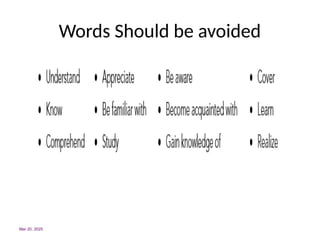
• Avoid certain words……….
Mar 20, 2025
54.
54
Checklist for writing
courseoutcomes
Have I begun each outcome with an active verb?
Have I avoided terms like know, understand, learn, be
familiar with, be exposed to, be acquainted with, be
aware of and appreciate?
Have I included learning outcomes across the range of
levels of Bloom’s Taxonomy?
Are my outcomes observable and measurable?
Do all the outcomes fit within the aims and content of
the course ?
Mar 20, 2025
55.
55
Course Outcomes –ElectricalCircuits
On successful completion of this course, students should be able to :
• Analyze circuit systems using direct application of Kirchoffs Current and
Voltage Laws along with Ohms Law.
• Interpret analytical circuit results to properly assign power, current, and
voltage values to circuit graphical representations.
• Apply node-voltage analysis techniques to analyze circuit behavior.
• Apply mesh-current analysis techniques to analyze circuit behavior.
• Explain the characteristics of capacitor, inductor, and transformer circuit
elements.
• Compute initial conditions for current and voltage in first order R-L and R-C
capacitor and inductor circuits.
• Compute time response of current and voltage in first order R-L and R-C
capacitor and inductor circuits.
• Compute initial conditions for current and voltage in second order RLC
circuits.
• Compute time response of current and voltage in second order RLC circuits.
•
Mar 20, 2025
56.
56
Course Outcomes –Computer Architecture
On successful completion of this course, students should be able to :
• Compare the performance of computer systems using MIPS and MFLOPS
ratings.
• Identify the components of an instruction set, such as opcode, operands, and
format.
• Translate fractional numbers into IEEE scientific format.
• Translate numbers in IEEE scientific format into their fractional form.
• Implement 32-bit multiplication using iterative methods.
• Construct a simple 32-bit data path composed of two function units and a
register file.
• Use pipelining to improve the performance of a simple 32-bit instruction set.
• Compare the design of direct-mapped and associative caches.
• Explain the function of the translation lookaside buffer in a memory
management unit.
Mar 20, 2025
57.
Blooms Taxonomy VsContent delivery
• Lecture
• Lecture with discussion
• Demonstrations
• Group discussion
• Debate
• Technical Quiz
• Seminar
• Mini-project
• Asynchronous discussions
Mar 20, 2025
58.
Blooms Taxonomy VsAssessment
• Internal Test
• End semester exams
• Lab exam
• Case study
• Quiz
• Seminar
• Mini project /Project
• Assignment
• Group Assignment
Mar 20, 2025
59.
59
Laboratory skills
• Operatethe range of instrumentation specified in the module
safely and efficiently in the electronics laboratory.
• Perform load test of an electrical machine accurately and safely
in the laboratory.
• Construct simple hardware interfacing diagram for a
microprocessor based system.
Presentation skills
• Deliver an effective presentation.
• Demonstrate a range of graphic and CAD communication
techniques.
Mar 20, 2025
60.
60
Examples of
Course Outcomesin Affective Domain
• Accept the need for professional ethical standards.
• Appreciate the need for confidentiality in the professional
client relationship.
• Display a willingness to communicate well with clients .
• Relate to participants in an ethical and humane manner.
• Resolve conflicting issues between personal beliefs and
ethical considerations.
• Embrace a responsibility for the welfare of children taken into
care.
• Participate in class discussions with colleagues and with
teachers.
Mar 20, 2025
61.
Mar 20, 2025
References
BloomBenjamin S. and David R. Krathwohl. Taxonomy of
Educational Objectives: The Classification of Educational Goals,
by a committee of college and university examiners.
Handbook I: Cognitive Domain. New York, Longmans, Green,
1956.
Bloom, B.S., Masia, B.B. and Krathwohl, D. R. (1964). Taxonomy
of Educational Objectives Volume II : The Affective Domain. New
York: McKay.
Bloom, B.S. (1975) Taxonomy of Educational Objectives, Book 1
Cognitive Domain. Longman Publishing.
Krathwohl, David, R. (2002) A Revision of Bloom’s Taxonomy: An
Overview. Theory into Practice, 41 (4).
62.
Receiving (A1)
Lowestlevel
Student passively pays attention. Without this level no
learning can occur. Awareness, willingness to hear, selected
attention
• Examples:
– Listen to others with respect.
– Listen for and remember the name of newly introduced
people.
• Keywords: asks, chooses, describes, follows, gives,
holds, identifies, locates, names, points to, selects,
sits, erects, replies, uses
Mar 20, 2025
63.
Responding (A2)
• Activeparticipation on the part of the learners.
• Attends and reacts to a particular phenomenon.
• Learning outcomes may emphasize compliance in responding,
willingness to respond, or satisfaction in responding
(motivation).
• Examples:
Participates in class discussions.
Gives a presentation.
Questions new ideals, concepts, models, etc. in order to fully understand them.
Know the safety rules and practices them.
• Keywords: answers, assists, aids, complies, conforms, discusses,
greets, helps, labels, performs, practices, presents, reads,
recites, reports, selects, tells, writes.
Mar 20, 2025
64.
Valuing (A3)
• Theworth or value a person attaches to a particular object,
phenomenon, or behavior.
• This ranges from simple acceptance to the more complex state
of commitment.
• Valuing is based on the internalization of a set of specified
values, while clues to these values are expressed in the learner’s
overt behavior and are often identifiable.
• Examples :
– Demonstrates belief in the democratic process.
– Is sensitive towards individual and cultural differences (value diversity). Shows the ability to
solve problems.
– Proposes a plan to social improvement and follows through with commitment.
– Informs management on matters that one feels strongly about.
• Keywords: completes, demonstrates, differentiates, explains, follows, forms,
initiates, invites, joins, justifies, proposes, reads, reports, selects, shares,
studies, works.
Mar 20, 2025
65.
Organizing (A4)
• Organizesvalues into priorities by contrasting different values,
resolving conflicts between them, and creating an unique value
system.
• The emphasis is on comparing, relating, and synthesizing values
• Examples:
– Recognizes the need for balance between freedom and responsible behavior. Accepts
responsibility for one’s behavior.
– Explains the role of systematic planning in solving
– problems. Accepts professional
– ethical standards. Creates a life
– plan in harmony with abilities, interests, and beliefs. Prioritizes time
– effectively to meet the needs of the organization, family, and self.
• Keywords: adheres, alters, arranges, combines, compares, completes,
defends, explains, formulates, generalizes, identifies, integrates, modifies,
orders, organizes, prepares, relates, synthesizes.
Mar 20, 2025
66.
Characterizing (A5)
• Hasa value system that controls their behavior.
• The behavior is pervasive, consistent, predictable, and most
importantly, characteristic of the learner.
• Examples:
– Shows self-reliance when working
– independently. Cooperates in group activities (displays teamwork).
– Uses an objective approach in problem solving. Displays a
– professional commitment to ethical practice on a daily basis.
– Revises judgments and changes behavior in light of new evidence.
– Values people for what they are, not how they look.
• Keywords: acts, discriminates, displays, influences, listens, modifies,
performs, practices, proposes, qualifies, questions, revises, serves, solves,
verifies.
Mar 20, 2025
#11 Taxonomy = Classification, Categorisation, arrangement.
His book is used throughout the world in the preparation of evaluation materials.
#13 Taxonomy = Classification, Categorisation, arrangement.
His book is used throughout the world in the preparation of evaluation materials.
#14 Taxonomy = Classification, Categorisation, arrangement.
His book is used throughout the world in the preparation of evaluation materials.
#15 Our thinking can be divided into six increasingly complex levels.
Each level depends on the student’s ability to perform at the level or levels that are below it.
For a student to apply knowledge, he or she would need to have the necessary information and understand it.
Very interested in helping students to move up into the higher mental processes.
The taxonomy was not simply a classification scheme – it was an effort to arrange the various thinking processes in a hierarchy.
#16 Our thinking can be divided into six increasingly complex levels.
Each level depends on the student’s ability to perform at the level or levels that are below it.
For a student to apply knowledge, he or she would need to have the necessary information and understand it.
Very interested in helping students to move up into the higher mental processes.
The taxonomy was not simply a classification scheme – it was an effort to arrange the various thinking processes in a hierarchy.
#21 Make a story map showing the main events of the story.
Make a time line of your typical day.
Make a concept map of the topic.
Write a list of keywords you know about….
What characters were in the story?
Make a chart showing…
Make an acrostic poem about…
Recite a poem you have learned.
#22 Write in your own words…
Cut out, or draw pictures to illustrate a particular event in the story.
Report to the class…
Illustrate what you think the main idea may have been.
Make a cartoon strip showing the sequence of events in the story.
Write and perform a play based on the story.
Write a brief outline to explain this story to someone else
Explain why the character solved the problem in this particular way
Write a summary report of the event.
Prepare a flow chart to illustrate the sequence of events.
Make a coloring book.
Paraphrase this chapter in the book.
Retell in your own words.
Outline the main points.
#23 Construct a model to demonstrate how it looks or works
Practice a play and perform it for the class
Make a diorama to illustrate an event
Write a diary entry
Make a scrapbook about the area of study.
Prepare invitations for a character’s birthday party
Make a topographic map
Take and display a collection of photographs on a particular topic.
Make up a puzzle or a game about the topic.
Write an explanation about this topic for others.
Dress a doll in national costume.
Make a clay model…
Paint a mural using the same materials.
Continue the story…
#24 Use a Venn Diagram to show how two topics are the same and different
Design a questionnaire to gather information.
Survey classmates to find out what they think about a particular topic. Analyse the results.
Make a flow chart to show the critical stages.
Classify the actions of the characters in the book
Create a sociogram from the narrative
Construct a graph to illustrate selected information.
Make a family tree showing relationships.
Devise a roleplay about the study area.
Write a biography of a person studied.
Prepare a report about the area of study.
Conduct an investigation to produce information to support a view.
Review a work of art in terms of form, color and texture.
Draw a graph
Complete a Decision Making Matrix to help you decide which breakfast cereal to purchase
#25 Write a letter to the editor
Prepare and conduct a debate
Prepare a list of criteria to judge…
Write a persuasive speech arguing for/against…
Make a booklet about five rules you see as important. Convince others.
Form a panel to discuss viewpoints on….
Write a letter to. ..advising on changes needed.
Write a half-yearly report.
Prepare a case to present your view about...
Complete a PMI on…
Evaluate the character’s actions in the story
#26 Use the . . . strategy to invent a new type of sports shoe.
Invent a machine to do a specific task.
Design a robot to do your homework.
Create a new product. Give it a name and plan a marketing campaign.
Write about your feelings in relation to...
Write a TV show play, puppet show, role play, song or pantomime about..
Design a new monetary system
Develop a menu for a new restaurant using a variety of healthy foods
Design a CD, book or magazine cover for...
Sell an idea
Devise a way to...
Make up a new language and use it in an example
Write a jingle to advertise a new product.
(Adapted from Dalton, 1986)
#30 This could be used in the area of keeping attendance records to judge the commitment of students in attending lectures.
#42 Synthesised this definition from various other definitions.
In this talk we will restrict ourselves to discussing Learning Outcomes of modules.
STAFF HANDBOOK
GUIDANCE ON WRITING AND USING LEARNING OUTCOMES.
#55 I hope that I have given you food for thought.
#56 I hope that I have given you food for thought.






![53
Writing Learning Outcomes –Challenges
• It is vital that course outcomes are clearly written so that they are
understood by students, colleagues and external examiners.
• When writing course outcomes it may be helpful to you if you focus on
what you expect students to be able to demonstrate upon completion
of the module or programme.
• It is standard practice to list the course outcomes using a phrase like
“On successful completion of this module, students should be able to:”
[list of learning outcomes]
Avoid complicated sentences. If necessary use one than one sentence to
ensure clarity.
General recommendation: 5 – 8 learning outcomes per module.
• Avoid certain words……….
Mar 20, 2025](https://image.slidesharecdn.com/bloomstaxonomy-250320081825-63a050a7/85/Blooms_taxonomy-criterion-NBA-opera-ppt-53-320.jpg)




![sir ben [Autosaved].pptx](https://cdn.slidesharecdn.com/ss_thumbnails/sirbenautosaved-220815044758-c86eced4-thumbnail.jpg?width=640&height=640&fit=bounds)


