TAXES: The main source of
government revenue
 Seligman defines
 “tax as a compulsory contribution from a
person to the state to defray the expenses
incurred in the common interest of all,
without reference to special benefit
conferred.”
 METHODS OF TAXATION
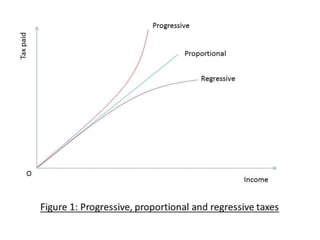
 1. Proportional & Progressive Tax: A
proportional tax is one in which, whatever
the size of income, same rate or
percentage of tax is charged.

 On the contrary, progressive tax refers to
the tax system in which the rate of tax
increases with the increase in income. It
is based on the principle „higher the
income, higher the
 tax‟.
 2. Regressive & Degressive Tax: A tax is
said to be regressive when its burden
falls more heavily on low-income earners
/ poor than the high-income earners /
rich. It is opposite of progressive tax.

 A tax is called degressive when the higher
income does not make a due sacrifice, or
when the burden imposed on them is
relatively less. This tax may be
progressive up to a certain limit beyond
which a uniform rate is charged.
 CLASSIFICATION OF TAXES:
 Specific Tax, Advolarem Tax & VAT: A
specific tax is according to the weight of
the commodity. An advolarem tax is
according to the value of a commodity.
Value Added Tax(VAT) is levied on
businessmen on all the processes carried
out by them.
 Direct & Indirect Tax: Direct tax is one
which is paid by the person on whom it is
charged. The examples of direct taxes are
income tax, wealth tax, etc.

 On the contrary, the indirect tax is paid by
one person and its burden is fallen on
other, generally the consumer. The
examples of indirect taxes are sales tax,
central excise duty, custom duty,
recreational tax, etc.
 Agricultural Income :Agriculture income is
exempt under the Indian Income Tax Act.
This means that income earned from
agricultural operations is not taxed. The
reason for exemption of agriculture
income from Central Taxation is that the
Constitution gives exclusive power to
make laws with respect to taxes on
agricultural income to the State
Legislature. However while computing
tax on non-agricultural income
agricultural income is also taken into
consideration.
 As per Income Tax Act income earned from any of the
under given four sources meant
 Agricultural Income;
 (i) Any rent received from land which is used for
agricultural purpose:
 (ii) Any income derived from such land by agricultural
operations including processing of agricultural
produce, raised or received as rent in kind so as to
render it fit for the market, or sale of such produce.
 (iii)Income attributable to a farm house

 (iv) Income earned from carrying nursery operations is
also considered as agricultural income and hence
exempt from income tax.

The Economics of Taxation
 In addition to creating revenue for the
government, taxes also impact the economy in
the following ways:
 Resource allocation - if taxes are too high, supply will
decrease and /or prices will increase causing a shift in the
allocation of land, labor and capital.
 Behavior adjustment - sin taxes, such as those placed on
cigarettes attempt to change a person’s behavior
 Productivity and Growth - if taxes are too high, there is less
incentive for people or businesses to continue to grow.
Why earn more if most of it is taken away in higher taxes?
Incidence of a Tax
 Who bears the final burden of this tax?
 If there is a relatively inelastic demand
curve the burden can be shifted to the
consumer.
 It there is a relatively elastic demand
curve, the producer will absorb the tax.
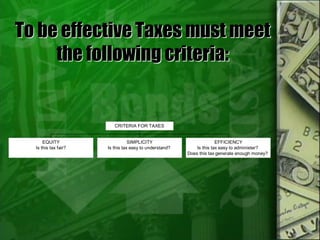
To be effective Taxes must meet
the following criteria:
EQUITY
Is this tax fair?
SIMPLICITY
Is this tax easy to understand?
EFFICIENCY
Is this tax easy to administer?
Does this tax generate enough money?
CRITERIA FOR TAXES
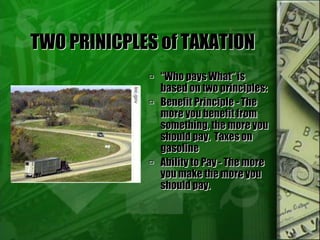
TWO PRINICPLES of TAXATION
 “Who pays What” is
based on two principles:
 Benefit Principle - The
more you benefit from
something, the more you
should pay. Taxes on
gasoline
 Ability to Pay - The more
you make the more you
should pay.
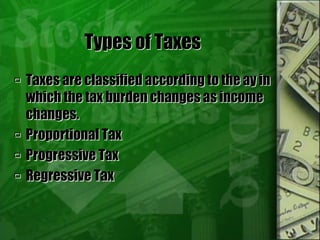
Types of Taxes
 Taxes are classified according to the ay in
which the tax burden changes as income
changes.
 Proportional Tax
 Progressive Tax
 Regressive Tax
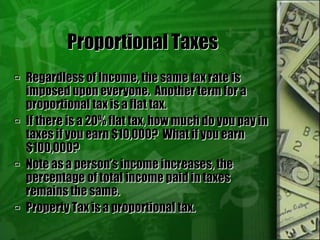
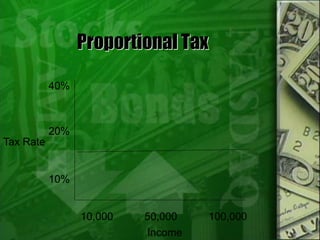
Proportional Taxes
 Regardless of Income, the same tax rate is
imposed upon everyone. Another term for a
proportional tax is a flat tax.
 If there is a 20% flat tax, how much do you pay in
taxes if you earn $10,000? What if you earn
$100,000?
 Note as a person’s income increases, the
percentage of total income paid in taxes
remains the same.
 Property Tax is a proportional tax.
Proportional Tax
Income
10,000 50,000 100,000
Tax Rate
40%
20%
10%
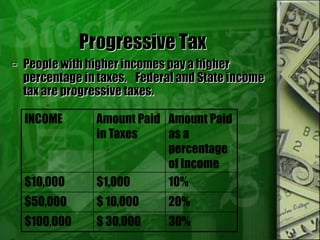
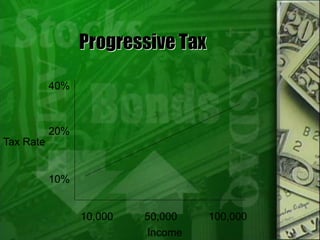
Progressive Tax
 People with higher incomes pay a higher
percentage in taxes. Federal and State income
tax are progressive taxes.
INCOME Amount Paid
in Taxes
Amount Paid
as a
percentage
of Income
$10,000 $1,000 10%
$50,000 $ 10,000 20%
$100,000 $ 30,000 30%
Progressive Tax
Income
10,000 50,000 100,000
Tax Rate
40%
20%
10%
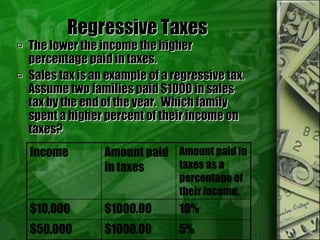
Regressive Taxes
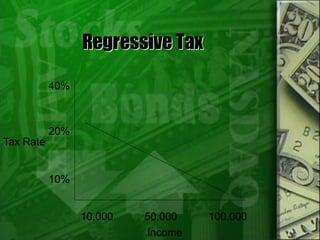
 The lower the income the higher
percentage paid in taxes.
 Sales tax is an example of a regressive tax.
Assume two families paid $1000 in sales
tax by the end of the year. Which family
spent a higher percent of their income on
taxes?
Income Amount paid
in taxes
Amount paid in
taxes as a
percentage of
their income.
$10,000 $1000.00 10%
$50,000 $1000.00 5%
Regressive Tax
Income
10,000 50,000 100,000
Tax Rate
40%
20%
10%
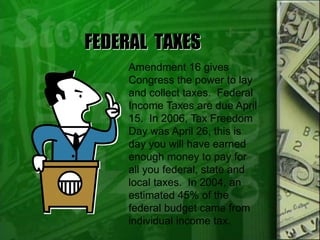
FEDERAL TAXES
Amendment 16 gives
Congress the power to lay
and collect taxes. Federal
Income Taxes are due April
15. In 2006, Tax Freedom
Day was April 26, this is
day you will have earned
enough money to pay for
all you federal, state and
local taxes. In 2004, an
estimated 45% of the
federal budget came from
individual income tax.
Income Tax
 Individual income taxes are paid over time
through a payroll withholding system (just look
at your paycheck). By April 15, you must file a tax
return. Any difference in the amount paid
compared to the amount owed is settled at this
time.
 From an economist’s point of view, is it better to
owe money to the IRS or receive a refund
check? WHY?
More Federal Taxes
 FICA - Federal Insurance Contributions Act
 Social Security and Medicare
 Corporate Income Tax - As a separate legal entity,
corporations are taxed.
 Excise Tax - tax on the manufacture or sale of
selected items
 Estate Tax - tax (18-50%) on the transfer of
property upon a death. As of 2006, estates worth
less than 2 million dollars are exempt.
 Gift Tax - Tax on money donations, paid by the
person donating.
 Customs Duties: Tax on imported goods. Exported
goods may not be taxed.
State Taxes and Local Taxes
 Intergovernmental
Revenues - transfer
of money from the
federal government
 Sales Tax
 Employee Retirement
Contributions
 Individual Income
Tax
 Intergovernmental
Revenues -from state
level
 Property Tax
 Public Utility or State
owned liquor stores
 Sales Tax - this varies
from city to city!

Taxes

  • 1.
    TAXES: The mainsource of government revenue
  • 2.
     Seligman defines “tax as a compulsory contribution from a person to the state to defray the expenses incurred in the common interest of all, without reference to special benefit conferred.”
  • 3.
     METHODS OFTAXATION  1. Proportional & Progressive Tax: A proportional tax is one in which, whatever the size of income, same rate or percentage of tax is charged.   On the contrary, progressive tax refers to the tax system in which the rate of tax increases with the increase in income. It is based on the principle „higher the income, higher the  tax‟.
  • 4.
     2. Regressive& Degressive Tax: A tax is said to be regressive when its burden falls more heavily on low-income earners / poor than the high-income earners / rich. It is opposite of progressive tax.   A tax is called degressive when the higher income does not make a due sacrifice, or when the burden imposed on them is relatively less. This tax may be progressive up to a certain limit beyond which a uniform rate is charged.
  • 6.
     CLASSIFICATION OFTAXES:  Specific Tax, Advolarem Tax & VAT: A specific tax is according to the weight of the commodity. An advolarem tax is according to the value of a commodity. Value Added Tax(VAT) is levied on businessmen on all the processes carried out by them.
  • 7.
     Direct &Indirect Tax: Direct tax is one which is paid by the person on whom it is charged. The examples of direct taxes are income tax, wealth tax, etc.   On the contrary, the indirect tax is paid by one person and its burden is fallen on other, generally the consumer. The examples of indirect taxes are sales tax, central excise duty, custom duty, recreational tax, etc.
  • 8.
     Agricultural Income:Agriculture income is exempt under the Indian Income Tax Act. This means that income earned from agricultural operations is not taxed. The reason for exemption of agriculture income from Central Taxation is that the Constitution gives exclusive power to make laws with respect to taxes on agricultural income to the State Legislature. However while computing tax on non-agricultural income agricultural income is also taken into consideration.
  • 9.
     As perIncome Tax Act income earned from any of the under given four sources meant  Agricultural Income;  (i) Any rent received from land which is used for agricultural purpose:  (ii) Any income derived from such land by agricultural operations including processing of agricultural produce, raised or received as rent in kind so as to render it fit for the market, or sale of such produce.  (iii)Income attributable to a farm house   (iv) Income earned from carrying nursery operations is also considered as agricultural income and hence exempt from income tax. 
  • 10.
    The Economics ofTaxation  In addition to creating revenue for the government, taxes also impact the economy in the following ways:  Resource allocation - if taxes are too high, supply will decrease and /or prices will increase causing a shift in the allocation of land, labor and capital.  Behavior adjustment - sin taxes, such as those placed on cigarettes attempt to change a person’s behavior  Productivity and Growth - if taxes are too high, there is less incentive for people or businesses to continue to grow. Why earn more if most of it is taken away in higher taxes?
  • 11.
    Incidence of aTax  Who bears the final burden of this tax?  If there is a relatively inelastic demand curve the burden can be shifted to the consumer.  It there is a relatively elastic demand curve, the producer will absorb the tax.
  • 12.
    To be effectiveTaxes must meet the following criteria: EQUITY Is this tax fair? SIMPLICITY Is this tax easy to understand? EFFICIENCY Is this tax easy to administer? Does this tax generate enough money? CRITERIA FOR TAXES
  • 13.
    TWO PRINICPLES ofTAXATION  “Who pays What” is based on two principles:  Benefit Principle - The more you benefit from something, the more you should pay. Taxes on gasoline  Ability to Pay - The more you make the more you should pay.
  • 14.
    Types of Taxes Taxes are classified according to the ay in which the tax burden changes as income changes.  Proportional Tax  Progressive Tax  Regressive Tax
  • 15.
    Proportional Taxes  Regardlessof Income, the same tax rate is imposed upon everyone. Another term for a proportional tax is a flat tax.  If there is a 20% flat tax, how much do you pay in taxes if you earn $10,000? What if you earn $100,000?  Note as a person’s income increases, the percentage of total income paid in taxes remains the same.  Property Tax is a proportional tax.
  • 16.
    Proportional Tax Income 10,000 50,000100,000 Tax Rate 40% 20% 10%
  • 17.
    Progressive Tax  Peoplewith higher incomes pay a higher percentage in taxes. Federal and State income tax are progressive taxes. INCOME Amount Paid in Taxes Amount Paid as a percentage of Income $10,000 $1,000 10% $50,000 $ 10,000 20% $100,000 $ 30,000 30%
  • 18.
    Progressive Tax Income 10,000 50,000100,000 Tax Rate 40% 20% 10%
  • 19.
    Regressive Taxes  Thelower the income the higher percentage paid in taxes.  Sales tax is an example of a regressive tax. Assume two families paid $1000 in sales tax by the end of the year. Which family spent a higher percent of their income on taxes? Income Amount paid in taxes Amount paid in taxes as a percentage of their income. $10,000 $1000.00 10% $50,000 $1000.00 5%
  • 20.
    Regressive Tax Income 10,000 50,000100,000 Tax Rate 40% 20% 10%
  • 21.
    FEDERAL TAXES Amendment 16gives Congress the power to lay and collect taxes. Federal Income Taxes are due April 15. In 2006, Tax Freedom Day was April 26, this is day you will have earned enough money to pay for all you federal, state and local taxes. In 2004, an estimated 45% of the federal budget came from individual income tax.
  • 22.
    Income Tax  Individualincome taxes are paid over time through a payroll withholding system (just look at your paycheck). By April 15, you must file a tax return. Any difference in the amount paid compared to the amount owed is settled at this time.  From an economist’s point of view, is it better to owe money to the IRS or receive a refund check? WHY?
  • 23.
    More Federal Taxes FICA - Federal Insurance Contributions Act  Social Security and Medicare  Corporate Income Tax - As a separate legal entity, corporations are taxed.  Excise Tax - tax on the manufacture or sale of selected items  Estate Tax - tax (18-50%) on the transfer of property upon a death. As of 2006, estates worth less than 2 million dollars are exempt.  Gift Tax - Tax on money donations, paid by the person donating.  Customs Duties: Tax on imported goods. Exported goods may not be taxed.
  • 24.
    State Taxes andLocal Taxes  Intergovernmental Revenues - transfer of money from the federal government  Sales Tax  Employee Retirement Contributions  Individual Income Tax  Intergovernmental Revenues -from state level  Property Tax  Public Utility or State owned liquor stores  Sales Tax - this varies from city to city!