Dr. Sukhvir Kaur
Assistant Professor in Economics
 The term investment means purchasing of
different kinds of shares and stocks and investing
capital in such activities as are likely to yield.
 Investment is the expenditure incurred for real
capital formation. It includes 3 kinds of items: 1.
new machines and new capital equipments, 2.
construction of new buildings and 3. increase in
stocks.
 According to Keynes, “investment includes the
increment of capital equipment”.
Investment
Income
Y
I
O
I
X
Investment
Income X
Y
O
I I
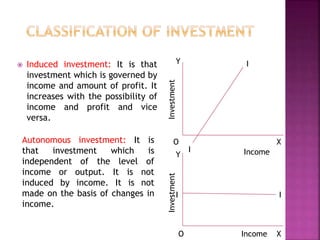
Autonomous investment: It is
that investment which is
independent of the level of
income or output. It is not
induced by income. It is not
made on the basis of changes in
income.
 Induced investment: It is that
investment which is governed by
income and amount of profit. It
increases with the possibility of
income and profit and vice
versa.
 On the basis of ownership of investment, it is
divided into two parts, i.e., private investment
and public investment.
 Private investment: it refers to that investment
which is made by private individuals with the
sole objective of earning profit. According to
Keynes, it depends upon two factors: i) MEC and
ii) Rate of interest. If MEC is greater than rate of
interest, more private investment will be made.
 Public investment: It is that investment which is
made by the govt. of a country. Main objective is
welfare of the people, defence of the country and
eco. Dev. It is not induced by profit motive.
 On the basis of changes in the existing stock of capital
goods as a result of change in investment, it can be
divided into two parts, i.e., gross investment and net
investment.
 Gross investment: The total expenditure incurred on
capital goods at any given time in an economy is called
gross investment. It includes two kinds of investment: i)
Net Investment and Replacement Investment.
 Gross Investment = Net Investment + Replacement Investment.
 Net investment: Net investment is that investment that
enlarges economy’s stock of real capital assets thereby
adding to productive capacity.
 Net Investment = Gross Investment - Replacement Investment.
 From the point of view of objective of
investment, it is divided into two parts, i.e., Ex-
ante investment and Ex-post investment.
 Ex-ante or Planned investment: When the
entrepreneurs make investment according to a
definite plan in order to achieve a given
objective, it is called ex-ante investment.
 Ex-post investment: It is that investment which
is involuntarily incurred by an investor.
 Propensity to invest is the ratio between
aggregate investment and aggregate income.
 PI = I / Y
 Average Propensity to Invest: It is the ratio total
income and total investment.
 API = I /Y
 Marginal Propensity to Invest: It is the ratio of
change in investment and change in income.
 MPI = Change in Investment / Change in Income
Marginal Efficiency of Capital
Rate of Interest
Marginal efficiency of capital refers to the expected
profitability by the use of one more unit of capital.
It depends upon two factors:
1. Prospective Yield: Prospective Yield of a capital
good like, machine, means that net income
which is available during the full life-time of
that machine.
2. Supply Price: Supply refers to the cost of a
machine, but it is not the cost of existing
machine but that of a brand new machine.
 Technological advance and innovation
 Discovery of natural resources
 Govt. policy
 Foreign trade
 Political environment
 Expectations
 Rate of population growth
 Territorial expansion
 Price level
 Market structure
 Availability of finance
 Conditions in the labour market
 Present stock of capital goods
 Aggregate demand
 Reduction in the rate of Interest
 Reduction in Taxes
 Increase in Government Expenditure
 Price support Policy
 Pump Priming
 Policy of Wage Cut
 Promotion of research
Taxation
Loans
Deficit financing
Determination of income
and employment
Volatile factors
Economic dev.

Investment function

  • 1.
    Dr. Sukhvir Kaur AssistantProfessor in Economics
  • 2.
     The terminvestment means purchasing of different kinds of shares and stocks and investing capital in such activities as are likely to yield.  Investment is the expenditure incurred for real capital formation. It includes 3 kinds of items: 1. new machines and new capital equipments, 2. construction of new buildings and 3. increase in stocks.  According to Keynes, “investment includes the increment of capital equipment”.
  • 3.
    Investment Income Y I O I X Investment Income X Y O I I Autonomousinvestment: It is that investment which is independent of the level of income or output. It is not induced by income. It is not made on the basis of changes in income.  Induced investment: It is that investment which is governed by income and amount of profit. It increases with the possibility of income and profit and vice versa.
  • 4.
     On thebasis of ownership of investment, it is divided into two parts, i.e., private investment and public investment.  Private investment: it refers to that investment which is made by private individuals with the sole objective of earning profit. According to Keynes, it depends upon two factors: i) MEC and ii) Rate of interest. If MEC is greater than rate of interest, more private investment will be made.  Public investment: It is that investment which is made by the govt. of a country. Main objective is welfare of the people, defence of the country and eco. Dev. It is not induced by profit motive.
  • 5.
     On thebasis of changes in the existing stock of capital goods as a result of change in investment, it can be divided into two parts, i.e., gross investment and net investment.  Gross investment: The total expenditure incurred on capital goods at any given time in an economy is called gross investment. It includes two kinds of investment: i) Net Investment and Replacement Investment.  Gross Investment = Net Investment + Replacement Investment.  Net investment: Net investment is that investment that enlarges economy’s stock of real capital assets thereby adding to productive capacity.  Net Investment = Gross Investment - Replacement Investment.
  • 6.
     From thepoint of view of objective of investment, it is divided into two parts, i.e., Ex- ante investment and Ex-post investment.  Ex-ante or Planned investment: When the entrepreneurs make investment according to a definite plan in order to achieve a given objective, it is called ex-ante investment.  Ex-post investment: It is that investment which is involuntarily incurred by an investor.
  • 7.
     Propensity toinvest is the ratio between aggregate investment and aggregate income.  PI = I / Y  Average Propensity to Invest: It is the ratio total income and total investment.  API = I /Y  Marginal Propensity to Invest: It is the ratio of change in investment and change in income.  MPI = Change in Investment / Change in Income
  • 8.
    Marginal Efficiency ofCapital Rate of Interest
  • 9.
    Marginal efficiency ofcapital refers to the expected profitability by the use of one more unit of capital. It depends upon two factors: 1. Prospective Yield: Prospective Yield of a capital good like, machine, means that net income which is available during the full life-time of that machine. 2. Supply Price: Supply refers to the cost of a machine, but it is not the cost of existing machine but that of a brand new machine.
  • 12.
     Technological advanceand innovation  Discovery of natural resources  Govt. policy  Foreign trade  Political environment  Expectations  Rate of population growth  Territorial expansion  Price level  Market structure  Availability of finance  Conditions in the labour market  Present stock of capital goods  Aggregate demand
  • 13.
     Reduction inthe rate of Interest  Reduction in Taxes  Increase in Government Expenditure  Price support Policy  Pump Priming  Policy of Wage Cut  Promotion of research
  • 14.
  • 15.
    Determination of income andemployment Volatile factors Economic dev.