TAXATION 
Presented By: 
Gaurav Yadav 
Rishabh Sharma 
Sandeep Singh
CONTENTS 
 Taxation 
 Public Finance 
 Public Revenue 
 Objectives of taxation 
 Classification of taxation 
 Canons of taxation 
 Individual Income tax rates in India 
 Exemptions and Deductions from tax 
 Conclusion 
 References
Taxation 
The most important source of revenue of the government 
is taxes. The act of levying taxes is called taxation. A tax 
is a compulsory charge or fees imposed by government 
on individuals or corporations. The persons who are 
taxed have to pay the taxes irrespective of any 
corresponding return from the goods or services by the 
government. The taxes may be imposed on the income 
and wealth of persons or corporations and the rate of 
taxes may vary.
What is Public Finance? 
Public finance is the branch of knowledge which is concerned with 
the income and expenditure of public authorities and with the 
adjustment of one to another.’ It deals with the study of revenue and 
expenditure of the government at the centre, state and local bodies. 
The public authorities have to perform various functions such as 
maintenance of law an order, provision of defense, production for 
bringing in economic development. The performance of these 
functions require large amount of funds which is raised through 
taxes, fees, fines, commercial revenues and loans.
Public Revenue 
This is one of the branches of public finance. It deals 
with the various sources from which the state might 
derive its income. These sources include incomes from 
taxes, commercial revenues in the form of prices of 
goods and services supplied by public enterprises, 
administrative revenues in the form of fees, fines etc and 
gifts and grants.
Difference between Public revenue and 
Public receipts 
Public revenue includes that income which is not 
subject to repayment by the government. Public receipts 
include all the income of the government including 
public borrowing and issue of new currency. In this way 
public revenue is a part of public receipts. 
Public Receipts = Public revenue + Public borrowing + 
issue of new currency
Objectives of Taxes 
 Raising Revenue 
 Regulation of Consumption and Production 
 Encouraging Domestic Industries 
 Stimulating Investment 
 Reducing Income Inequalities 
 Promoting Economic Growth 
 Development of Backward Regions 
 Ensuring Price Stability
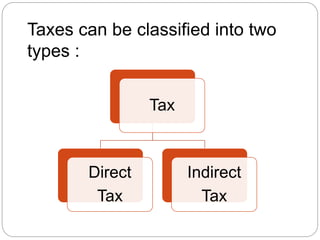
Taxes can be classified into two 
types : 
Tax 
Direct 
Tax 
Indirect 
Tax
 Direct Taxes 
A direct tax is that tax whose burden is borne by the same 
person on whom it is levied. The ultimate burden of taxation 
falls on the person on whom the tax is levied. It is based on the 
income and property of a person. 
The examples of Direct taxes are : 
• Corporation Tax 
• Income Tax 
• Wealth Tax 
• Gift Tax 
• Property Tax
 Indirect Taxes 
An indirect tax is that tax which is initially paid by 
one individual, but the burden of which is passed 
over to some other individual who ultimately bears 
it. It is levied on the expenditure of a person. 
Examples of Indirect Taxes are: 
 Excise Duty 
 Sales Tax 
 Custom Duties 
 Value Added Tax(VAT)
On the basis of degree of progression of tax, it 
may be classified into: 
 Proportional tax 
 Progressive tax 
 Regressive tax 
 Degressive tax
 Proportional Taxation 
A tax is called proportional when the rate of taxation remains 
constant as the income of the tax payer increases. In this system all 
incomes are taxed at a single uniform rate, irrespective of whether 
tax payer’s income is high or low. The tax liability increases in 
absolute terms, but the proportion of income taxed remains the 
same. 
 Progressive Taxation 
When the rate of taxation increases as the tax payer’s income 
increases, it is called a progressive tax. In this system, the rate of tax 
goes on increasing with every increase in income.
 Regressive Taxation 
A regressive tax is one in which the rate of taxation decreases as 
the tax payer’s income increases. Lower income is taxed at a 
higher rate, whereas higher income is taxed at a lower rate. 
However absolute tax liability may increase. 
 Degressive Taxation 
A tax is called degressive when the rate of progression in taxation 
does not increase in the same proportion as the increase in 
income. In this case, the rate of tax increases upto a certain limit, 
after that a uniform rate is charged. Thus degressive tax is a 
combination of progressive and proportional taxation. This type of 
taxation is often used in case of income tax. This is the case of 
income tax in India as well.
Canons of Taxation 
A good tax system should adhere to certain principles 
which become its characteristics. A good tax system is 
therefore based on some principles. Adam Smith has 
formulated four important principles of taxation. A 
few more have been suggested by various other 
economists. These principles which a good tax system 
should follow are called canons of taxation.
Adam Smith’s four canons of taxation 
 Canon of Equality 
 Canon of Certainty 
 Canon of Convenience 
 Canon of Economy
Canon of Equality 
This states that persons should be taxed according to their ability to 
pay taxes. That is why this principle is also known as the canon of 
ability. Equality does not mean equal amount of tax, but equality in 
tax burden. Canon of equality implies a progressive tax system. 
 Canon of Certainty 
According to this canon, the tax which each individual is required 
to pay should be certain and not arbitrary. The time of payment, the 
manner of payment and the amount to be paid should be clear to 
every tax payer. The application of this principle is beneficial both 
to the government as well as to the tax payer.
 Canon of Convenience 
According to this canon, the mode and timings of tax payment 
should be convenient to the tax payer. It means that the taxes 
should be imposed in such a manner and at the time which is most 
convenient for the tax payer. For example, government of India 
collects the income tax at the time when they receive their salaries. 
So this principle is also known as ‘the pay as you earn method’. 
 Canon of Economy 
Every tax has a cost of collection. The canon of economy implies 
that the cost of tax collection should be minimum.
Income exempt from Tax 
 Dividends paid by companies and mutual funds 
 Insurance proceeds from an Insurance company 
 Maturity proceeds of a Public provident fund (PPF 
account)
Deductions from taxable income 
 Section 88 of the Income Tax Act 1961(rebate on certain 
investments) 
 Section 80C deductions 
 Section 80D(Medical insurance premiums) 
 Interest on Housing loans
Conclusion 
To conclude, we can say that the instrument of taxation is of 
great significance on 
• increasing the level of economic activity - Regressive taxation 
• reducing income inequalities - progressive taxation 
• promoting economic growth – Funds could be reinvested 
Social-Welfare Objective - Tax payment helps reduce the gap 
between the haves and have-nots. As it helps in mobilizing the 
surplus income from the haves and reinvesting them for public 
welfare, it helps these surplus funds to reach the have-nots.
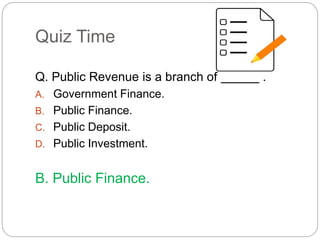
Quiz Time 
Q. Public Revenue is a branch of . 
A. Government Finance. 
B. Public Finance. 
C. Public Deposit. 
D. Public Investment. 
B. Public Finance.
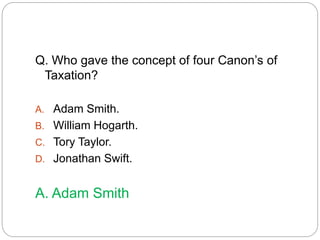
Q. Who gave the concept of four Canon’s of 
Taxation? 
A. Adam Smith. 
B. William Hogarth. 
C. Tory Taylor. 
D. Jonathan Swift. 
A. Adam Smith
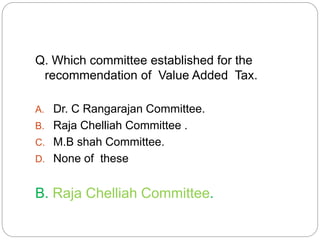
Q. Which committee established for the 
recommendation of Value Added Tax. 
A. Dr. C Rangarajan Committee. 
B. Raja Chelliah Committee . 
C. M.B shah Committee. 
D. None of these 
B. Raja Chelliah Committee.
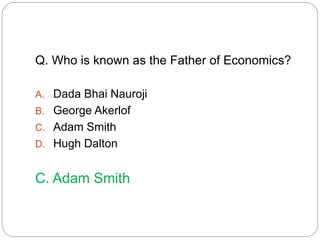
Q. Who is known as the Father of Economics? 
A. Dada Bhai Nauroji 
B. George Akerlof 
C. Adam Smith 
D. Hugh Dalton 
C. Adam Smith
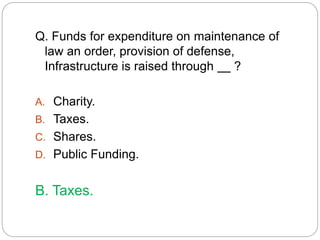
Q. Funds for expenditure on maintenance of 
law an order, provision of defense, 
Infrastructure is raised through ? 
A. Charity. 
B. Taxes. 
C. Shares. 
D. Public Funding. 
B. Taxes.
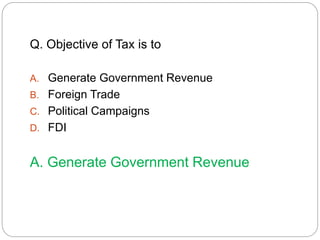
Q. Objective of Tax is to 
A. Generate Government Revenue 
B. Foreign Trade 
C. Political Campaigns 
D. FDI 
A. Generate Government Revenue
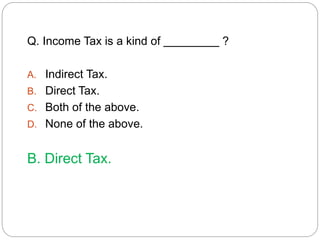
Q. Income Tax is a kind of ? 
A. Indirect Tax. 
B. Direct Tax. 
C. Both of the above. 
D. None of the above. 
B. Direct Tax.
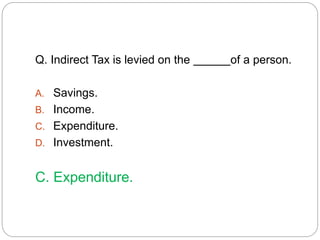
Q. Indirect Tax is levied on the of a person. 
A. Savings. 
B. Income. 
C. Expenditure. 
D. Investment. 
C. Expenditure.
Q. Tax helps to reduce the gap between the 
and . 
A. Haves and Have-not. 
B. Politicians and Public. 
C. Government and Citizens. 
D. None of the above. 
A. Haves and Haves-not
Q. Which of the following is exempted from Tax ? 
A. Salary. 
B. Insurance proceeds from an Insurance 
company. 
C. Proceeds from Fixed Deposits. 
D. None of the above. 
B. Insurance proceeds from an Insurance 
company.
References 
 http://finance.indiamart.com/taxation/income_tax/rates.html 
 http://en.wikipedia.org/wiki/Income_tax_in_India
Taxation

Taxation

  • 1.
    TAXATION Presented By: Gaurav Yadav Rishabh Sharma Sandeep Singh
  • 2.
    CONTENTS  Taxation  Public Finance  Public Revenue  Objectives of taxation  Classification of taxation  Canons of taxation  Individual Income tax rates in India  Exemptions and Deductions from tax  Conclusion  References
  • 3.
    Taxation The mostimportant source of revenue of the government is taxes. The act of levying taxes is called taxation. A tax is a compulsory charge or fees imposed by government on individuals or corporations. The persons who are taxed have to pay the taxes irrespective of any corresponding return from the goods or services by the government. The taxes may be imposed on the income and wealth of persons or corporations and the rate of taxes may vary.
  • 4.
    What is PublicFinance? Public finance is the branch of knowledge which is concerned with the income and expenditure of public authorities and with the adjustment of one to another.’ It deals with the study of revenue and expenditure of the government at the centre, state and local bodies. The public authorities have to perform various functions such as maintenance of law an order, provision of defense, production for bringing in economic development. The performance of these functions require large amount of funds which is raised through taxes, fees, fines, commercial revenues and loans.
  • 5.
    Public Revenue Thisis one of the branches of public finance. It deals with the various sources from which the state might derive its income. These sources include incomes from taxes, commercial revenues in the form of prices of goods and services supplied by public enterprises, administrative revenues in the form of fees, fines etc and gifts and grants.
  • 6.
    Difference between Publicrevenue and Public receipts Public revenue includes that income which is not subject to repayment by the government. Public receipts include all the income of the government including public borrowing and issue of new currency. In this way public revenue is a part of public receipts. Public Receipts = Public revenue + Public borrowing + issue of new currency
  • 7.
    Objectives of Taxes  Raising Revenue  Regulation of Consumption and Production  Encouraging Domestic Industries  Stimulating Investment  Reducing Income Inequalities  Promoting Economic Growth  Development of Backward Regions  Ensuring Price Stability
  • 8.
    Taxes can beclassified into two types : Tax Direct Tax Indirect Tax
  • 9.
     Direct Taxes A direct tax is that tax whose burden is borne by the same person on whom it is levied. The ultimate burden of taxation falls on the person on whom the tax is levied. It is based on the income and property of a person. The examples of Direct taxes are : • Corporation Tax • Income Tax • Wealth Tax • Gift Tax • Property Tax
  • 10.
     Indirect Taxes An indirect tax is that tax which is initially paid by one individual, but the burden of which is passed over to some other individual who ultimately bears it. It is levied on the expenditure of a person. Examples of Indirect Taxes are:  Excise Duty  Sales Tax  Custom Duties  Value Added Tax(VAT)
  • 11.
    On the basisof degree of progression of tax, it may be classified into:  Proportional tax  Progressive tax  Regressive tax  Degressive tax
  • 12.
     Proportional Taxation A tax is called proportional when the rate of taxation remains constant as the income of the tax payer increases. In this system all incomes are taxed at a single uniform rate, irrespective of whether tax payer’s income is high or low. The tax liability increases in absolute terms, but the proportion of income taxed remains the same.  Progressive Taxation When the rate of taxation increases as the tax payer’s income increases, it is called a progressive tax. In this system, the rate of tax goes on increasing with every increase in income.
  • 13.
     Regressive Taxation A regressive tax is one in which the rate of taxation decreases as the tax payer’s income increases. Lower income is taxed at a higher rate, whereas higher income is taxed at a lower rate. However absolute tax liability may increase.  Degressive Taxation A tax is called degressive when the rate of progression in taxation does not increase in the same proportion as the increase in income. In this case, the rate of tax increases upto a certain limit, after that a uniform rate is charged. Thus degressive tax is a combination of progressive and proportional taxation. This type of taxation is often used in case of income tax. This is the case of income tax in India as well.
  • 14.
    Canons of Taxation A good tax system should adhere to certain principles which become its characteristics. A good tax system is therefore based on some principles. Adam Smith has formulated four important principles of taxation. A few more have been suggested by various other economists. These principles which a good tax system should follow are called canons of taxation.
  • 15.
    Adam Smith’s fourcanons of taxation  Canon of Equality  Canon of Certainty  Canon of Convenience  Canon of Economy
  • 16.
    Canon of Equality This states that persons should be taxed according to their ability to pay taxes. That is why this principle is also known as the canon of ability. Equality does not mean equal amount of tax, but equality in tax burden. Canon of equality implies a progressive tax system.  Canon of Certainty According to this canon, the tax which each individual is required to pay should be certain and not arbitrary. The time of payment, the manner of payment and the amount to be paid should be clear to every tax payer. The application of this principle is beneficial both to the government as well as to the tax payer.
  • 17.
     Canon ofConvenience According to this canon, the mode and timings of tax payment should be convenient to the tax payer. It means that the taxes should be imposed in such a manner and at the time which is most convenient for the tax payer. For example, government of India collects the income tax at the time when they receive their salaries. So this principle is also known as ‘the pay as you earn method’.  Canon of Economy Every tax has a cost of collection. The canon of economy implies that the cost of tax collection should be minimum.
  • 18.
    Income exempt fromTax  Dividends paid by companies and mutual funds  Insurance proceeds from an Insurance company  Maturity proceeds of a Public provident fund (PPF account)
  • 19.
    Deductions from taxableincome  Section 88 of the Income Tax Act 1961(rebate on certain investments)  Section 80C deductions  Section 80D(Medical insurance premiums)  Interest on Housing loans
  • 20.
    Conclusion To conclude,we can say that the instrument of taxation is of great significance on • increasing the level of economic activity - Regressive taxation • reducing income inequalities - progressive taxation • promoting economic growth – Funds could be reinvested Social-Welfare Objective - Tax payment helps reduce the gap between the haves and have-nots. As it helps in mobilizing the surplus income from the haves and reinvesting them for public welfare, it helps these surplus funds to reach the have-nots.
  • 21.
    Quiz Time Q.Public Revenue is a branch of . A. Government Finance. B. Public Finance. C. Public Deposit. D. Public Investment. B. Public Finance.
  • 22.
    Q. Who gavethe concept of four Canon’s of Taxation? A. Adam Smith. B. William Hogarth. C. Tory Taylor. D. Jonathan Swift. A. Adam Smith
  • 23.
    Q. Which committeeestablished for the recommendation of Value Added Tax. A. Dr. C Rangarajan Committee. B. Raja Chelliah Committee . C. M.B shah Committee. D. None of these B. Raja Chelliah Committee.
  • 24.
    Q. Who isknown as the Father of Economics? A. Dada Bhai Nauroji B. George Akerlof C. Adam Smith D. Hugh Dalton C. Adam Smith
  • 25.
    Q. Funds forexpenditure on maintenance of law an order, provision of defense, Infrastructure is raised through ? A. Charity. B. Taxes. C. Shares. D. Public Funding. B. Taxes.
  • 26.
    Q. Objective ofTax is to A. Generate Government Revenue B. Foreign Trade C. Political Campaigns D. FDI A. Generate Government Revenue
  • 27.
    Q. Income Taxis a kind of ? A. Indirect Tax. B. Direct Tax. C. Both of the above. D. None of the above. B. Direct Tax.
  • 28.
    Q. Indirect Taxis levied on the of a person. A. Savings. B. Income. C. Expenditure. D. Investment. C. Expenditure.
  • 29.
    Q. Tax helpsto reduce the gap between the and . A. Haves and Have-not. B. Politicians and Public. C. Government and Citizens. D. None of the above. A. Haves and Haves-not
  • 30.
    Q. Which ofthe following is exempted from Tax ? A. Salary. B. Insurance proceeds from an Insurance company. C. Proceeds from Fixed Deposits. D. None of the above. B. Insurance proceeds from an Insurance company.
  • 31.
    References  http://finance.indiamart.com/taxation/income_tax/rates.html  http://en.wikipedia.org/wiki/Income_tax_in_India