Sr. Sindhu P.J (Sr.Sharin CTC)
 The Classical theory of economic
development is the sum total of all
other theories of classical economists.
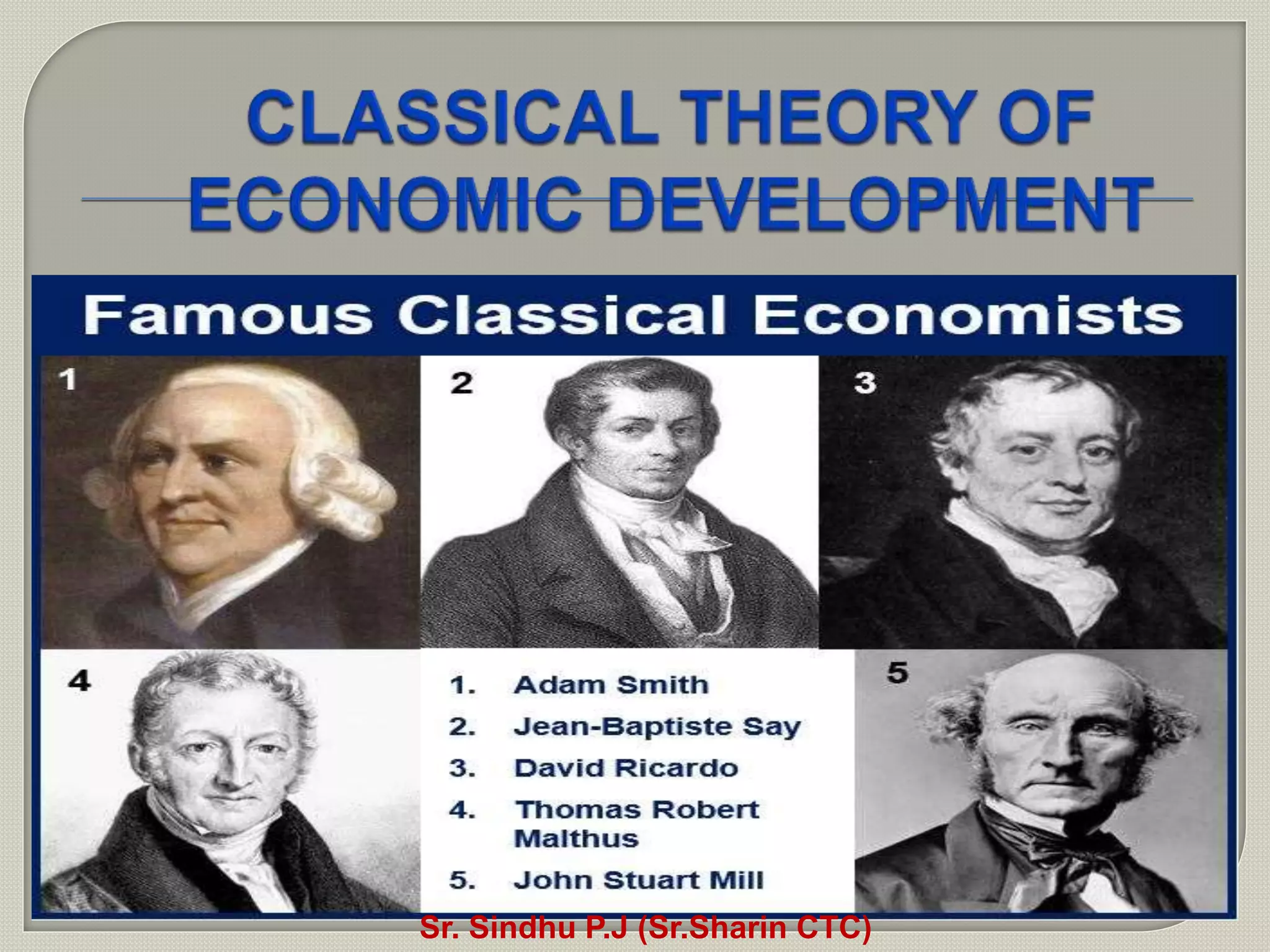
The views of Adam smith, Malthus and
Mill on Economic development form
the crux of the classical theory of
development.
 Though they differ on a number of
development issues, the essence of the
classical approach to development is
the same.
The classical economists had
explained growth process in terms
of rate of technological progress
and population growth.
In their opinion, technological
progress remains in lead for some
time but finally it disappears when
the falling rate of profit prevents
further accumulation of capital.
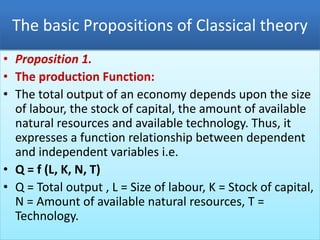
The basic Propositions of Classical theory
• Proposition 1.
• The production Function:
• The total output of an economy depends upon the size
of labour, the stock of capital, the amount of available
natural resources and available technology. Thus, it
expresses a function relationship between dependent
and independent variables i.e.
• Q = f (L, K, N, T)
• Q = Total output , L = Size of labour, K = Stock of capital,
N = Amount of available natural resources, T =
Technology.
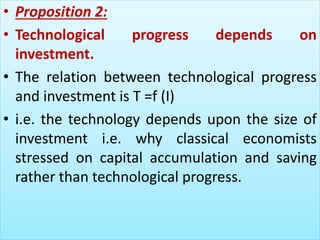
• Proposition 2:
• Technological progress depends on
investment.
• The relation between technological progress
and investment is T =f (I)
• i.e. the technology depends upon the size of
investment i.e. why classical economists
stressed on capital accumulation and saving
rather than technological progress.
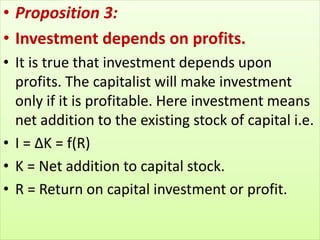
• Proposition 3:
• Investment depends on profits.
• It is true that investment depends upon
profits. The capitalist will make investment
only if it is profitable. Here investment means
net addition to the existing stock of capital i.e.
• I = ∆K = f(R)
• K = Net addition to capital stock.
• R = Return on capital investment or profit.
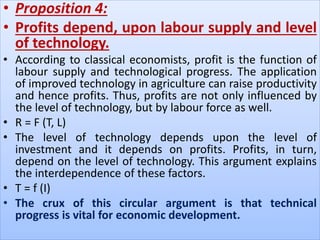
• Proposition 4:
• Profits depend, upon labour supply and level
of technology.
• According to classical economists, profit is the function of
labour supply and technological progress. The application
of improved technology in agriculture can raise productivity
and hence profits. Thus, profits are not only influenced by
the level of technology, but by labour force as well.
• R = F (T, L)
• The level of technology depends upon the level of
investment and it depends on profits. Profits, in turn,
depend on the level of technology. This argument explains
the interdependence of these factors.
• T = f (I)
• The crux of this circular argument is that technical
progress is vital for economic development.
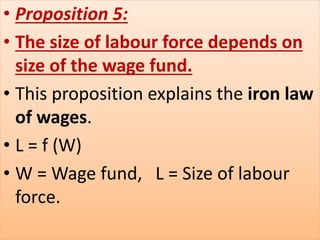
• Proposition 5:
• The size of labour force depends on
size of the wage fund.
• This proposition explains the iron law
of wages.
• L = f (W)
• W = Wage fund, L = Size of labour
force.
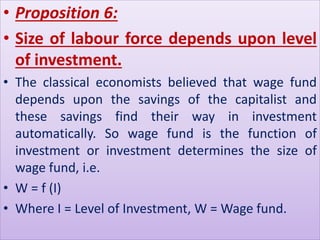
• Proposition 6:
• Size of labour force depends upon level
of investment.
• The classical economists believed that wage fund
depends upon the savings of the capitalist and
these savings find their way in investment
automatically. So wage fund is the function of
investment or investment determines the size of
wage fund, i.e.
• W = f (I)
• Where I = Level of Investment, W = Wage fund.
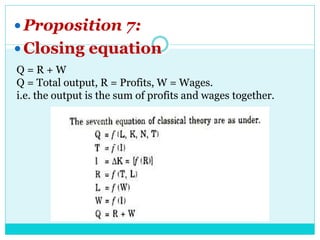
 Proposition 7:
 Closing equation
Q = R + W
Q = Total output, R = Profits, W = Wages.
i.e. the output is the sum of profits and wages together.
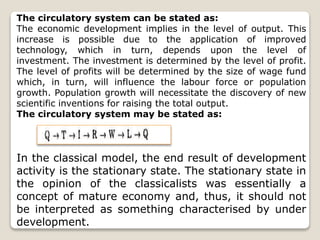
The circulatory system can be stated as:
The economic development implies in the level of output. This
increase is possible due to the application of improved
technology, which in turn, depends upon the level of
investment. The investment is determined by the level of profit.
The level of profits will be determined by the size of wage fund
which, in turn, will influence the labour force or population
growth. Population growth will necessitate the discovery of new
scientific inventions for raising the total output.
The circulatory system may be stated as:
In the classical model, the end result of development
activity is the stationary state. The stationary state in
the opinion of the classicalists was essentially a
concept of mature economy and, thus, it should not
be interpreted as something characterised by under
development.
Thank You

The classical theory of Economic Development

  • 1.
    Sr. Sindhu P.J(Sr.Sharin CTC)
  • 2.
     The Classicaltheory of economic development is the sum total of all other theories of classical economists. The views of Adam smith, Malthus and Mill on Economic development form the crux of the classical theory of development.  Though they differ on a number of development issues, the essence of the classical approach to development is the same.
  • 3.
    The classical economistshad explained growth process in terms of rate of technological progress and population growth. In their opinion, technological progress remains in lead for some time but finally it disappears when the falling rate of profit prevents further accumulation of capital.
  • 4.
    The basic Propositionsof Classical theory • Proposition 1. • The production Function: • The total output of an economy depends upon the size of labour, the stock of capital, the amount of available natural resources and available technology. Thus, it expresses a function relationship between dependent and independent variables i.e. • Q = f (L, K, N, T) • Q = Total output , L = Size of labour, K = Stock of capital, N = Amount of available natural resources, T = Technology.
  • 5.
    • Proposition 2: •Technological progress depends on investment. • The relation between technological progress and investment is T =f (I) • i.e. the technology depends upon the size of investment i.e. why classical economists stressed on capital accumulation and saving rather than technological progress.
  • 6.
    • Proposition 3: •Investment depends on profits. • It is true that investment depends upon profits. The capitalist will make investment only if it is profitable. Here investment means net addition to the existing stock of capital i.e. • I = ∆K = f(R) • K = Net addition to capital stock. • R = Return on capital investment or profit.
  • 7.
    • Proposition 4: •Profits depend, upon labour supply and level of technology. • According to classical economists, profit is the function of labour supply and technological progress. The application of improved technology in agriculture can raise productivity and hence profits. Thus, profits are not only influenced by the level of technology, but by labour force as well. • R = F (T, L) • The level of technology depends upon the level of investment and it depends on profits. Profits, in turn, depend on the level of technology. This argument explains the interdependence of these factors. • T = f (I) • The crux of this circular argument is that technical progress is vital for economic development.
  • 8.
    • Proposition 5: •The size of labour force depends on size of the wage fund. • This proposition explains the iron law of wages. • L = f (W) • W = Wage fund, L = Size of labour force.
  • 9.
    • Proposition 6: •Size of labour force depends upon level of investment. • The classical economists believed that wage fund depends upon the savings of the capitalist and these savings find their way in investment automatically. So wage fund is the function of investment or investment determines the size of wage fund, i.e. • W = f (I) • Where I = Level of Investment, W = Wage fund.
  • 10.
     Proposition 7: Closing equation Q = R + W Q = Total output, R = Profits, W = Wages. i.e. the output is the sum of profits and wages together.
  • 11.
    The circulatory systemcan be stated as: The economic development implies in the level of output. This increase is possible due to the application of improved technology, which in turn, depends upon the level of investment. The investment is determined by the level of profit. The level of profits will be determined by the size of wage fund which, in turn, will influence the labour force or population growth. Population growth will necessitate the discovery of new scientific inventions for raising the total output. The circulatory system may be stated as: In the classical model, the end result of development activity is the stationary state. The stationary state in the opinion of the classicalists was essentially a concept of mature economy and, thus, it should not be interpreted as something characterised by under development.
  • 12.