2021
Introduction
To
GST
(Indirect Tax)
Classroom Deliberations
CA Dr Prithvi Ranjan Parhi
11:01 AM © CA Dr Prithvi Ranjan Parhi 1
11:01 AM © CA Dr Prithvi Ranjan Parhi 2
11:01 AM © CA Dr Prithvi Ranjan Parhi 3
11:01 AM © CA Dr Prithvi Ranjan Parhi 4
11:01 AM © CA Dr Prithvi Ranjan Parhi 5
11:01 AM © CA Dr Prithvi Ranjan Parhi 6
11:01 AM © CA Dr Prithvi Ranjan Parhi 7
11:01 AM © CA Dr Prithvi Ranjan Parhi 8



11:01 AM © CA Dr Prithvi Ranjan Parhi 9
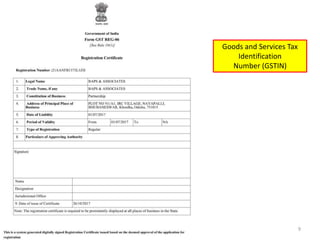
Goods and Services Tax
Identification
Number (GSTIN)
11:01 AM © CA Dr Prithvi Ranjan Parhi 10
11:01 AM © CA Dr Prithvi Ranjan Parhi 11
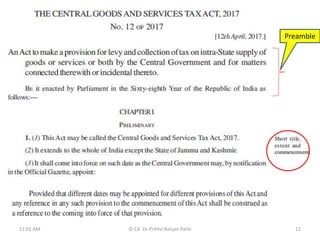
Preamble
11:01 AM © CA Dr Prithvi Ranjan Parhi 12
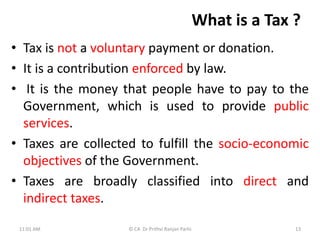
What is a Tax ?
• Tax is not a voluntary payment or donation.
• It is a contribution enforced by law.
• It is the money that people have to pay to the
Government, which is used to provide public
services.
• Taxes are collected to fulfill the socio-economic
objectives of the Government.
• Taxes are broadly classified into direct and
indirect taxes.
11:01 AM © CA Dr Prithvi Ranjan Parhi 13
TAX
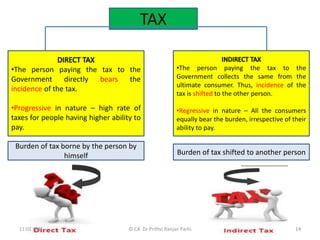
•The person paying the tax to the
Government directly bears the
incidence of the tax.
•Progressive in nature – high rate of
taxes for people having higher ability to
pay.
•The person paying the tax to the
Government collects the same from the
ultimate consumer. Thus, incidence of the
tax is shifted to the other person.
•Regressive in nature – All the consumers
equally bear the burden, irrespective of their
ability to pay.
Burden of tax borne by the person by
himself Burden of tax shifted to another person
11:01 AM 14
© CA Dr Prithvi Ranjan Parhi
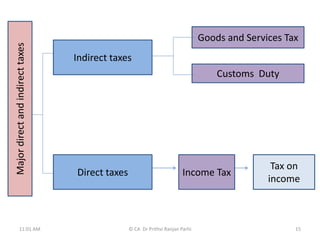
Major
direct
and
indirect
taxes
Indirect taxes
Direct taxes
Goods and Services Tax
Customs Duty
Income Tax
Tax on
income
11:01 AM 15
© CA Dr Prithvi Ranjan Parhi
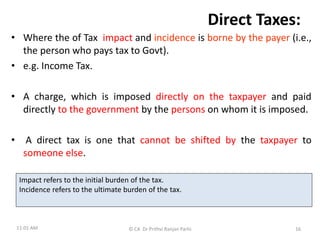
Direct Taxes:
• Where the of Tax impact and incidence is borne by the payer (i.e.,
the person who pays tax to Govt).
• e.g. Income Tax.
• A charge, which is imposed directly on the taxpayer and paid
directly to the government by the persons on whom it is imposed.
• A direct tax is one that cannot be shifted by the taxpayer to
someone else.
11:01 AM © CA Dr Prithvi Ranjan Parhi 16
Impact refers to the initial burden of the tax.
Incidence refers to the ultimate burden of the tax.
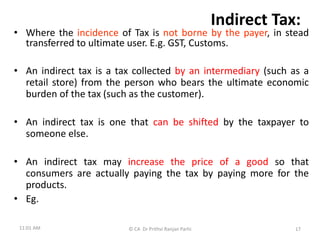
Indirect Tax:
• Where the incidence of Tax is not borne by the payer, in stead
transferred to ultimate user. E.g. GST, Customs.
• An indirect tax is a tax collected by an intermediary (such as a
retail store) from the person who bears the ultimate economic
burden of the tax (such as the customer).
• An indirect tax is one that can be shifted by the taxpayer to
someone else.
• An indirect tax may increase the price of a good so that
consumers are actually paying the tax by paying more for the
products.
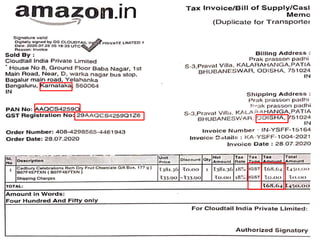
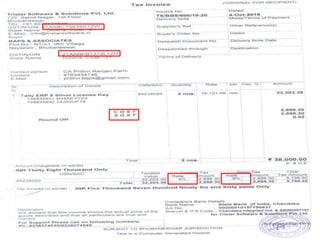
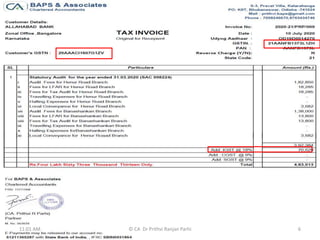
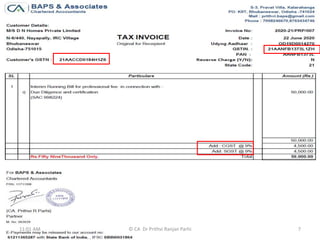
• Eg.
11:01 AM © CA Dr Prithvi Ranjan Parhi 17
11:01 AM © CA Dr Prithvi Ranjan Parhi 18
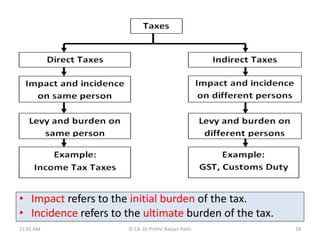
• Impact refers to the initial burden of the tax.
• Incidence refers to the ultimate burden of the tax.
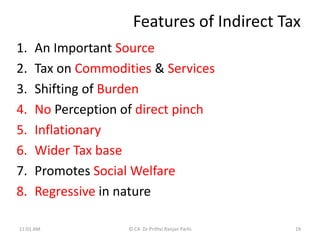
Features of Indirect Tax
1. An Important Source
2. Tax on Commodities & Services
3. Shifting of Burden
4. No Perception of direct pinch
5. Inflationary
6. Wider Tax base
7. Promotes Social Welfare
8. Regressive in nature
11:01 AM 19
© CA Dr Prithvi Ranjan Parhi
i. An important source of revenue: Indirect taxes are a major source of tax
revenues for Governments worldwide and continue to grow as more
countries move to consumption oriented tax regimes. In India indirect taxes
contribute more than 50% of the total tax revenues of Central and State
Governments.
ii. Tax on commodities and services: It is leveled on commodities at the time of
manufacture or purchase or sale or import/export thereof. Hence, it is also
known as commodity taxation. It is also levied on provision of services.
iii. Shifting of burden: There is a clear shifting of tax burden in respect of
indirect taxes For example, GST paid by the supplier of the goods is
recovered from the buyer by including the tax in the cost of the commodity.
iv. No perception of direct pinch: Since, Value of indirect taxes is generally
inbuilt in the price of the commodity most of the time the tax payer pays the
same without actually knowing that he is paying tax to the government.
Thus tax payer does not perceive a direct pinch while paying direct taxes
11:01 AM 20
© CA Dr Prithvi Ranjan Parhi
(V) Inflationary: Tax imposed on commodities and services causes an all-round
price spiral. In other words, indirect taxation directly affects the price of
commodities and services and leads to inflationary trend.
(VI) Wider tax base: Unlike direct taxes, the indirect taxes have a wide tax base.
Majority of the products or services are subject to indirect taxes with low
thresholds.
(VII) Promotes social welfare: High taxes are imposed on consumption of
harmful products (also known as ‘sin goods’) such as alcoholic but also
enables the State to collect substantial revenue.
(VIII) Regressive in nature: Generally , the indirect taxes are regressive in nature.
The rich and the poor have to pay the same rate if indirect taxes on certain
commodities of mass consumption. This may further increase the income
disparities between the rich and the poor.
11:01 AM 21
© CA Dr Prithvi Ranjan Parhi
Importance in the Context of Business
1. Revenue from Operation
2. Other Income
3. Purchases of Stock in Trade
4. Direct & Indirect Expenses
5. Asset Purchase
6. Affects Gross Profit
7. Affects Net Profit
8. Affects Current Assets & Liabilities position
9. Affects cashflow
10.Non compliances may lead to heavy penalty
11:01 AM © CA Dr Prithvi Ranjan Parhi 22
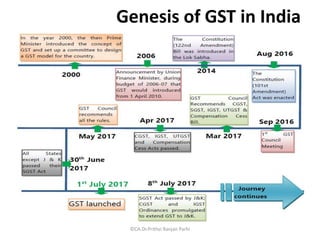
Genesis of GST in India
©CA.Dr.Prithvi Ranjan Parhi
GST laws in India
• GST in India was launched on July 1st, 2017.
• With effect from that date, the historic indirect tax reform
- GST was introduced.
• Before that legislations were passed at centre, state and
union territory levels.
• India has adopted a Dual GST model in view of the federal
structure of the country.
• Consequently, Centre and States simultaneously levy GST
on taxable supply of goods or services or both through
different legislations.
11:01 AM © CA Dr Prithvi Ranjan Parhi 24
Central GST legislations
• On 27th March, 2017, the Central GST legislations –
1. Central Goods and Services Tax Bill, 2017,
2. Integrated Goods and Services Tax Bill, 2017,
3. Union Territory Goods and Services Tax Bill, 2017 and
4. Goods and Services Tax (Compensation to States) Bill,
2017
• were introduced in Lok Sabha.
• Lok Sabha passed these bills on 29th March, 2017.
• With the receipt of the President’s assent on 12th
April, 2017, these Bills were enacted.
11:01 AM © CA Dr Prithvi Ranjan Parhi 25
State and Union Territory GST
legislations
• By 30th June, 2017, all States and Union
Territories had passed their respective SGST and
UTGST Acts except Jammu and Kashmir.
• GST law was extended to Jammu and Kashmir
on 8th July, 2017.
11:01 AM © CA Dr Prithvi Ranjan Parhi 26
Framework of GST in India
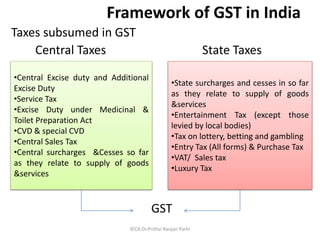
Taxes subsumed in GST
Central Taxes State Taxes
GST
©CA.Dr.Prithvi Ranjan Parhi
•Central Excise duty and Additional
Excise Duty
•Service Tax
•Excise Duty under Medicinal &
Toilet Preparation Act
•CVD & special CVD
•Central Sales Tax
•Central surcharges &Cesses so far
as they relate to supply of goods
&services
•State surcharges and cesses in so far
as they relate to supply of goods
&services
•Entertainment Tax (except those
levied by local bodies)
•Tax on lottery, betting and gambling
•Entry Tax (All forms) & Purchase Tax
•VAT/ Sales tax
•Luxury Tax
Framework of GST in India
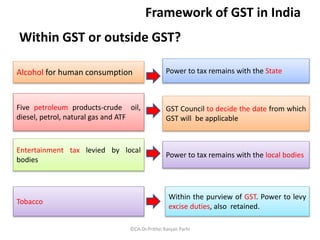
Within GST or outside GST?
©CA.Dr.Prithvi Ranjan Parhi
Alcohol for human consumption
Five petroleum products-crude oil,
diesel, petrol, natural gas and ATF
Entertainment tax levied by local
bodies
Tobacco
Power to tax remains with the State
GST Council to decide the date from which
GST will be applicable
Power to tax remains with the local bodies
Within the purview of GST. Power to levy
excise duties, also retained.
GST : Concept
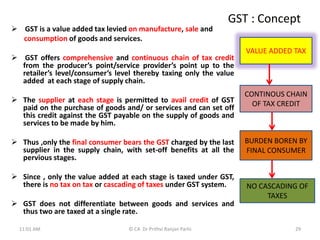
 GST is a value added tax levied on manufacture, sale and
consumption of goods and services.
 GST offers comprehensive and continuous chain of tax credit
from the producer’s point/service provider’s point up to the
retailer’s level/consumer’s level thereby taxing only the value
added at each stage of supply chain.
 The supplier at each stage is permitted to avail credit of GST
paid on the purchase of goods and/ or services and can set off
this credit against the GST payable on the supply of goods and
services to be made by him.
 Thus ,only the final consumer bears the GST charged by the last
supplier in the supply chain, with set-off benefits at all the
pervious stages.
 Since , only the value added at each stage is taxed under GST,
there is no tax on tax or cascading of taxes under GST system.
 GST does not differentiate between goods and services and
thus two are taxed at a single rate.
VALUE ADDED TAX
CONTINOUS CHAIN
OF TAX CREDIT
BURDEN BOREN BY
FINAL CONSUMER
NO CASCADING OF
TAXES
11:01 AM 29
© CA Dr Prithvi Ranjan Parhi
GST: Destination based tax
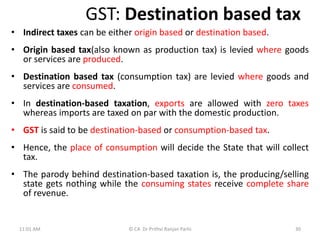
• Indirect taxes can be either origin based or destination based.
• Origin based tax(also known as production tax) is levied where goods
or services are produced.
• Destination based tax (consumption tax) are levied where goods and
services are consumed.
• In destination-based taxation, exports are allowed with zero taxes
whereas imports are taxed on par with the domestic production.
• GST is said to be destination-based or consumption-based tax.
• Hence, the place of consumption will decide the State that will collect
tax.
• The parody behind destination-based taxation is, the producing/selling
state gets nothing while the consuming states receive complete share
of revenue.
11:01 AM 30
© CA Dr Prithvi Ranjan Parhi
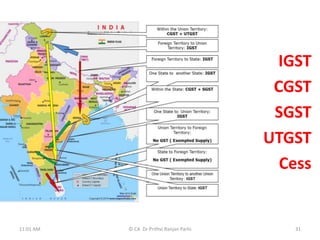
IGST
CGST
SGST
UTGST
Cess
11:01 AM © CA Dr Prithvi Ranjan Parhi 31
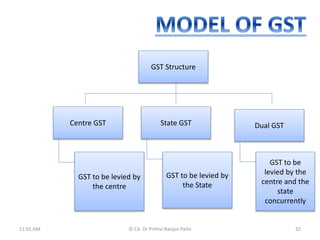
GST Structure
Centre GST State GST Dual GST
GST to be levied by
the centre
GST to be levied by
the State
GST to be
levied by the
centre and the
state
concurrently
11:01 AM 32
© CA Dr Prithvi Ranjan Parhi
Dual GST
• In India Goods and Service Tax (GST), is a dual
structure of taxation.
• Both Central GST (CGST) and State GST (SGST)
are levied on the intrastate supply of goods,
while Integrated GST (IGST) applies to interstate
supply of goods and services.
• GST extends to whole of India.
11:01 AM 33
© CA Dr Prithvi Ranjan Parhi
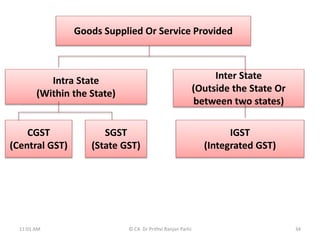
Goods Supplied Or Service Provided
Intra State
(Within the State)
Inter State
(Outside the State Or
between two states)
CGST
(Central GST)
SGST
(State GST)
IGST
(Integrated GST)
11:01 AM 34
© CA Dr Prithvi Ranjan Parhi
Legislative Framework
• There is single legislation – CGST Act, 2017 - for levying
CGST.
•
• Union Territories without State legislatures are governed by
UTGST Act, 2017 for levying UTGST.
• States and Union territories with their own legislatures [Delhi
and Puducherry] have their own GST legislation for levying
SGST.
• Though there are multiple SGST legislations, the basic features
of law, such as chargeability, definition of taxable event and
taxable person, classification and valuation of goods and
services, procedure for collection and levy of tax and the like
are uniform in all the SGST legislations, as far as feasible.
• This is necessary to preserve the essence of dual GST.
11:01 AM 35
© CA Dr Prithvi Ranjan Parhi
What is SGST/CGST/IGST?
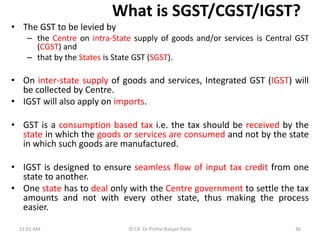
• The GST to be levied by
– the Centre on intra-State supply of goods and/or services is Central GST
(CGST) and
– that by the States is State GST (SGST).
• On inter-state supply of goods and services, Integrated GST (IGST) will
be collected by Centre.
• IGST will also apply on imports.
• GST is a consumption based tax i.e. the tax should be received by the
state in which the goods or services are consumed and not by the state
in which such goods are manufactured.
• IGST is designed to ensure seamless flow of input tax credit from one
state to another.
• One state has to deal only with the Centre government to settle the tax
amounts and not with every other state, thus making the process
easier.
11:01 AM © CA Dr Prithvi Ranjan Parhi 36
IGST
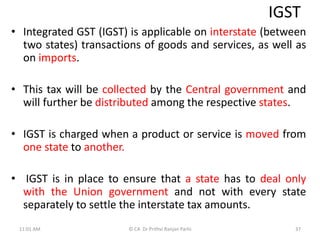
• Integrated GST (IGST) is applicable on interstate (between
two states) transactions of goods and services, as well as
on imports.
• This tax will be collected by the Central government and
will further be distributed among the respective states.
• IGST is charged when a product or service is moved from
one state to another.
• IGST is in place to ensure that a state has to deal only
with the Union government and not with every state
separately to settle the interstate tax amounts.
11:01 AM 37
© CA Dr Prithvi Ranjan Parhi
Example
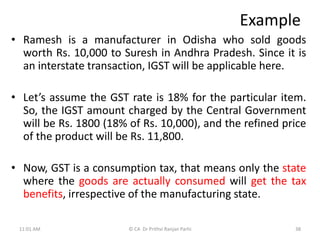
• Ramesh is a manufacturer in Odisha who sold goods
worth Rs. 10,000 to Suresh in Andhra Pradesh. Since it is
an interstate transaction, IGST will be applicable here.
• Let’s assume the GST rate is 18% for the particular item.
So, the IGST amount charged by the Central Government
will be Rs. 1800 (18% of Rs. 10,000), and the refined price
of the product will be Rs. 11,800.
• Now, GST is a consumption tax, that means only the state
where the goods are actually consumed will get the tax
benefits, irrespective of the manufacturing state.
11:01 AM 38
© CA Dr Prithvi Ranjan Parhi
SGST
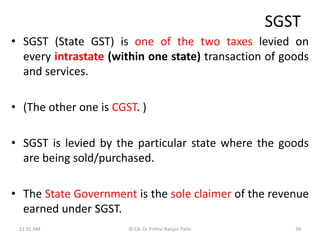
• SGST (State GST) is one of the two taxes levied on
every intrastate (within one state) transaction of goods
and services.
• (The other one is CGST. )
• SGST is levied by the particular state where the goods
are being sold/purchased.
• The State Government is the sole claimer of the revenue
earned under SGST.
11:01 AM 39
© CA Dr Prithvi Ranjan Parhi
Example
• Suresh from Cuttack wants to sell some goods
to Rakesh in Bhubaneswar.
• The product, originally priced at Rs. 10,000, will
attract GST at 18% rate comprising of 9% CGST
rate and 9% SGST rate.
• The SGST tax amount here is Rs. 900 (9% of Rs.
10,000) which is fully claimed by the Odisha
State Government.
11:01 AM 40
© CA Dr Prithvi Ranjan Parhi
CGST
• Refers to the Central GST tax that is levied by the Central
Government of India on any transaction of goods and
services tax takes places within a state.
• It is one of the two taxes charged on every intrastate
(within one state) transaction, the other one being SGST
(or UTGST for Union Territories).
• The rate of CGST is usually equal to the SGST rate.
• Both taxes are charged on the base price of the product.
11:01 AM 41
© CA Dr Prithvi Ranjan Parhi
Example
• When Suresh sales a product to Rakesh in the same
state (Odisha), he has to pay two taxes.
• CGST is for the central government while SGST is for
the state.
• The rate of CGST is 9%, same as SGST.
• After the application of CGST (9% of Rs. 10,000),
the final cost of the product will become Rs.
11,800.
11:01 AM 42
© CA Dr Prithvi Ranjan Parhi
UTGST
• The Union Territory Goods and Service Tax, commonly referred
to as UTGST, is the GST applicable on the goods and services
supply that takes place in any of the Union Territories of India.
• This UTGST will be charged in addition to the Central GST
(CGST) explained above.
• For any transaction of goods/service within a Union
Territory: CGST + UTGST
• The reason why a separate GST was implemented for the
Union Territories is that the common State GST (SGST) cannot
be applied in an Union Territory without legislature.
• Delhi and Puducherry UTs already have their own legislatures,
so SGST is applicable to them.
11:01 AM 43
© CA Dr Prithvi Ranjan Parhi
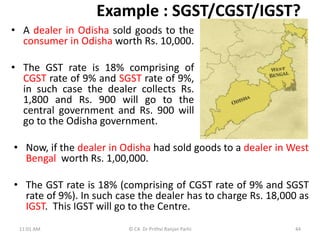
Example : SGST/CGST/IGST?
• Now, if the dealer in Odisha had sold goods to a dealer in West
Bengal worth Rs. 1,00,000.
• The GST rate is 18% (comprising of CGST rate of 9% and SGST
rate of 9%). In such case the dealer has to charge Rs. 18,000 as
IGST. This IGST will go to the Centre.
11:01 AM © CA Dr Prithvi Ranjan Parhi 44
• A dealer in Odisha sold goods to the
consumer in Odisha worth Rs. 10,000.
• The GST rate is 18% comprising of
CGST rate of 9% and SGST rate of 9%,
in such case the dealer collects Rs.
1,800 and Rs. 900 will go to the
central government and Rs. 900 will
go to the Odisha government.
Thank you
prithvi.baps@gmail.com
11:01 AM © CA. Dr. Prithvi R Parhi 45

Introduction to GST

  • 1.
    2021 Introduction To GST (Indirect Tax) Classroom Deliberations CADr Prithvi Ranjan Parhi 11:01 AM © CA Dr Prithvi Ranjan Parhi 1
  • 2.
    11:01 AM ©CA Dr Prithvi Ranjan Parhi 2
  • 3.
    11:01 AM ©CA Dr Prithvi Ranjan Parhi 3
  • 4.
    11:01 AM ©CA Dr Prithvi Ranjan Parhi 4
  • 5.
    11:01 AM ©CA Dr Prithvi Ranjan Parhi 5
  • 6.
    11:01 AM ©CA Dr Prithvi Ranjan Parhi 6
  • 7.
    11:01 AM ©CA Dr Prithvi Ranjan Parhi 7
  • 8.
    11:01 AM ©CA Dr Prithvi Ranjan Parhi 8   
  • 9.
    11:01 AM ©CA Dr Prithvi Ranjan Parhi 9 Goods and Services Tax Identification Number (GSTIN)
  • 10.
    11:01 AM ©CA Dr Prithvi Ranjan Parhi 10
  • 11.
    11:01 AM ©CA Dr Prithvi Ranjan Parhi 11 Preamble
  • 12.
    11:01 AM ©CA Dr Prithvi Ranjan Parhi 12
  • 13.
    What is aTax ? • Tax is not a voluntary payment or donation. • It is a contribution enforced by law. • It is the money that people have to pay to the Government, which is used to provide public services. • Taxes are collected to fulfill the socio-economic objectives of the Government. • Taxes are broadly classified into direct and indirect taxes. 11:01 AM © CA Dr Prithvi Ranjan Parhi 13
  • 14.
    TAX •The person payingthe tax to the Government directly bears the incidence of the tax. •Progressive in nature – high rate of taxes for people having higher ability to pay. •The person paying the tax to the Government collects the same from the ultimate consumer. Thus, incidence of the tax is shifted to the other person. •Regressive in nature – All the consumers equally bear the burden, irrespective of their ability to pay. Burden of tax borne by the person by himself Burden of tax shifted to another person 11:01 AM 14 © CA Dr Prithvi Ranjan Parhi
  • 15.
    Major direct and indirect taxes Indirect taxes Direct taxes Goodsand Services Tax Customs Duty Income Tax Tax on income 11:01 AM 15 © CA Dr Prithvi Ranjan Parhi
  • 16.
    Direct Taxes: • Wherethe of Tax impact and incidence is borne by the payer (i.e., the person who pays tax to Govt). • e.g. Income Tax. • A charge, which is imposed directly on the taxpayer and paid directly to the government by the persons on whom it is imposed. • A direct tax is one that cannot be shifted by the taxpayer to someone else. 11:01 AM © CA Dr Prithvi Ranjan Parhi 16 Impact refers to the initial burden of the tax. Incidence refers to the ultimate burden of the tax.
  • 17.
    Indirect Tax: • Wherethe incidence of Tax is not borne by the payer, in stead transferred to ultimate user. E.g. GST, Customs. • An indirect tax is a tax collected by an intermediary (such as a retail store) from the person who bears the ultimate economic burden of the tax (such as the customer). • An indirect tax is one that can be shifted by the taxpayer to someone else. • An indirect tax may increase the price of a good so that consumers are actually paying the tax by paying more for the products. • Eg. 11:01 AM © CA Dr Prithvi Ranjan Parhi 17
  • 18.
    11:01 AM ©CA Dr Prithvi Ranjan Parhi 18 • Impact refers to the initial burden of the tax. • Incidence refers to the ultimate burden of the tax.
  • 19.
    Features of IndirectTax 1. An Important Source 2. Tax on Commodities & Services 3. Shifting of Burden 4. No Perception of direct pinch 5. Inflationary 6. Wider Tax base 7. Promotes Social Welfare 8. Regressive in nature 11:01 AM 19 © CA Dr Prithvi Ranjan Parhi
  • 20.
    i. An importantsource of revenue: Indirect taxes are a major source of tax revenues for Governments worldwide and continue to grow as more countries move to consumption oriented tax regimes. In India indirect taxes contribute more than 50% of the total tax revenues of Central and State Governments. ii. Tax on commodities and services: It is leveled on commodities at the time of manufacture or purchase or sale or import/export thereof. Hence, it is also known as commodity taxation. It is also levied on provision of services. iii. Shifting of burden: There is a clear shifting of tax burden in respect of indirect taxes For example, GST paid by the supplier of the goods is recovered from the buyer by including the tax in the cost of the commodity. iv. No perception of direct pinch: Since, Value of indirect taxes is generally inbuilt in the price of the commodity most of the time the tax payer pays the same without actually knowing that he is paying tax to the government. Thus tax payer does not perceive a direct pinch while paying direct taxes 11:01 AM 20 © CA Dr Prithvi Ranjan Parhi
  • 21.
    (V) Inflationary: Taximposed on commodities and services causes an all-round price spiral. In other words, indirect taxation directly affects the price of commodities and services and leads to inflationary trend. (VI) Wider tax base: Unlike direct taxes, the indirect taxes have a wide tax base. Majority of the products or services are subject to indirect taxes with low thresholds. (VII) Promotes social welfare: High taxes are imposed on consumption of harmful products (also known as ‘sin goods’) such as alcoholic but also enables the State to collect substantial revenue. (VIII) Regressive in nature: Generally , the indirect taxes are regressive in nature. The rich and the poor have to pay the same rate if indirect taxes on certain commodities of mass consumption. This may further increase the income disparities between the rich and the poor. 11:01 AM 21 © CA Dr Prithvi Ranjan Parhi
  • 22.
    Importance in theContext of Business 1. Revenue from Operation 2. Other Income 3. Purchases of Stock in Trade 4. Direct & Indirect Expenses 5. Asset Purchase 6. Affects Gross Profit 7. Affects Net Profit 8. Affects Current Assets & Liabilities position 9. Affects cashflow 10.Non compliances may lead to heavy penalty 11:01 AM © CA Dr Prithvi Ranjan Parhi 22
  • 23.
    Genesis of GSTin India ©CA.Dr.Prithvi Ranjan Parhi
  • 24.
    GST laws inIndia • GST in India was launched on July 1st, 2017. • With effect from that date, the historic indirect tax reform - GST was introduced. • Before that legislations were passed at centre, state and union territory levels. • India has adopted a Dual GST model in view of the federal structure of the country. • Consequently, Centre and States simultaneously levy GST on taxable supply of goods or services or both through different legislations. 11:01 AM © CA Dr Prithvi Ranjan Parhi 24
  • 25.
    Central GST legislations •On 27th March, 2017, the Central GST legislations – 1. Central Goods and Services Tax Bill, 2017, 2. Integrated Goods and Services Tax Bill, 2017, 3. Union Territory Goods and Services Tax Bill, 2017 and 4. Goods and Services Tax (Compensation to States) Bill, 2017 • were introduced in Lok Sabha. • Lok Sabha passed these bills on 29th March, 2017. • With the receipt of the President’s assent on 12th April, 2017, these Bills were enacted. 11:01 AM © CA Dr Prithvi Ranjan Parhi 25
  • 26.
    State and UnionTerritory GST legislations • By 30th June, 2017, all States and Union Territories had passed their respective SGST and UTGST Acts except Jammu and Kashmir. • GST law was extended to Jammu and Kashmir on 8th July, 2017. 11:01 AM © CA Dr Prithvi Ranjan Parhi 26
  • 27.
    Framework of GSTin India Taxes subsumed in GST Central Taxes State Taxes GST ©CA.Dr.Prithvi Ranjan Parhi •Central Excise duty and Additional Excise Duty •Service Tax •Excise Duty under Medicinal & Toilet Preparation Act •CVD & special CVD •Central Sales Tax •Central surcharges &Cesses so far as they relate to supply of goods &services •State surcharges and cesses in so far as they relate to supply of goods &services •Entertainment Tax (except those levied by local bodies) •Tax on lottery, betting and gambling •Entry Tax (All forms) & Purchase Tax •VAT/ Sales tax •Luxury Tax
  • 28.
    Framework of GSTin India Within GST or outside GST? ©CA.Dr.Prithvi Ranjan Parhi Alcohol for human consumption Five petroleum products-crude oil, diesel, petrol, natural gas and ATF Entertainment tax levied by local bodies Tobacco Power to tax remains with the State GST Council to decide the date from which GST will be applicable Power to tax remains with the local bodies Within the purview of GST. Power to levy excise duties, also retained.
  • 29.
    GST : Concept GST is a value added tax levied on manufacture, sale and consumption of goods and services.  GST offers comprehensive and continuous chain of tax credit from the producer’s point/service provider’s point up to the retailer’s level/consumer’s level thereby taxing only the value added at each stage of supply chain.  The supplier at each stage is permitted to avail credit of GST paid on the purchase of goods and/ or services and can set off this credit against the GST payable on the supply of goods and services to be made by him.  Thus ,only the final consumer bears the GST charged by the last supplier in the supply chain, with set-off benefits at all the pervious stages.  Since , only the value added at each stage is taxed under GST, there is no tax on tax or cascading of taxes under GST system.  GST does not differentiate between goods and services and thus two are taxed at a single rate. VALUE ADDED TAX CONTINOUS CHAIN OF TAX CREDIT BURDEN BOREN BY FINAL CONSUMER NO CASCADING OF TAXES 11:01 AM 29 © CA Dr Prithvi Ranjan Parhi
  • 30.
    GST: Destination basedtax • Indirect taxes can be either origin based or destination based. • Origin based tax(also known as production tax) is levied where goods or services are produced. • Destination based tax (consumption tax) are levied where goods and services are consumed. • In destination-based taxation, exports are allowed with zero taxes whereas imports are taxed on par with the domestic production. • GST is said to be destination-based or consumption-based tax. • Hence, the place of consumption will decide the State that will collect tax. • The parody behind destination-based taxation is, the producing/selling state gets nothing while the consuming states receive complete share of revenue. 11:01 AM 30 © CA Dr Prithvi Ranjan Parhi
  • 31.
    IGST CGST SGST UTGST Cess 11:01 AM ©CA Dr Prithvi Ranjan Parhi 31
  • 32.
    GST Structure Centre GSTState GST Dual GST GST to be levied by the centre GST to be levied by the State GST to be levied by the centre and the state concurrently 11:01 AM 32 © CA Dr Prithvi Ranjan Parhi
  • 33.
    Dual GST • InIndia Goods and Service Tax (GST), is a dual structure of taxation. • Both Central GST (CGST) and State GST (SGST) are levied on the intrastate supply of goods, while Integrated GST (IGST) applies to interstate supply of goods and services. • GST extends to whole of India. 11:01 AM 33 © CA Dr Prithvi Ranjan Parhi
  • 34.
    Goods Supplied OrService Provided Intra State (Within the State) Inter State (Outside the State Or between two states) CGST (Central GST) SGST (State GST) IGST (Integrated GST) 11:01 AM 34 © CA Dr Prithvi Ranjan Parhi
  • 35.
    Legislative Framework • Thereis single legislation – CGST Act, 2017 - for levying CGST. • • Union Territories without State legislatures are governed by UTGST Act, 2017 for levying UTGST. • States and Union territories with their own legislatures [Delhi and Puducherry] have their own GST legislation for levying SGST. • Though there are multiple SGST legislations, the basic features of law, such as chargeability, definition of taxable event and taxable person, classification and valuation of goods and services, procedure for collection and levy of tax and the like are uniform in all the SGST legislations, as far as feasible. • This is necessary to preserve the essence of dual GST. 11:01 AM 35 © CA Dr Prithvi Ranjan Parhi
  • 36.
    What is SGST/CGST/IGST? •The GST to be levied by – the Centre on intra-State supply of goods and/or services is Central GST (CGST) and – that by the States is State GST (SGST). • On inter-state supply of goods and services, Integrated GST (IGST) will be collected by Centre. • IGST will also apply on imports. • GST is a consumption based tax i.e. the tax should be received by the state in which the goods or services are consumed and not by the state in which such goods are manufactured. • IGST is designed to ensure seamless flow of input tax credit from one state to another. • One state has to deal only with the Centre government to settle the tax amounts and not with every other state, thus making the process easier. 11:01 AM © CA Dr Prithvi Ranjan Parhi 36
  • 37.
    IGST • Integrated GST(IGST) is applicable on interstate (between two states) transactions of goods and services, as well as on imports. • This tax will be collected by the Central government and will further be distributed among the respective states. • IGST is charged when a product or service is moved from one state to another. • IGST is in place to ensure that a state has to deal only with the Union government and not with every state separately to settle the interstate tax amounts. 11:01 AM 37 © CA Dr Prithvi Ranjan Parhi
  • 38.
    Example • Ramesh isa manufacturer in Odisha who sold goods worth Rs. 10,000 to Suresh in Andhra Pradesh. Since it is an interstate transaction, IGST will be applicable here. • Let’s assume the GST rate is 18% for the particular item. So, the IGST amount charged by the Central Government will be Rs. 1800 (18% of Rs. 10,000), and the refined price of the product will be Rs. 11,800. • Now, GST is a consumption tax, that means only the state where the goods are actually consumed will get the tax benefits, irrespective of the manufacturing state. 11:01 AM 38 © CA Dr Prithvi Ranjan Parhi
  • 39.
    SGST • SGST (StateGST) is one of the two taxes levied on every intrastate (within one state) transaction of goods and services. • (The other one is CGST. ) • SGST is levied by the particular state where the goods are being sold/purchased. • The State Government is the sole claimer of the revenue earned under SGST. 11:01 AM 39 © CA Dr Prithvi Ranjan Parhi
  • 40.
    Example • Suresh fromCuttack wants to sell some goods to Rakesh in Bhubaneswar. • The product, originally priced at Rs. 10,000, will attract GST at 18% rate comprising of 9% CGST rate and 9% SGST rate. • The SGST tax amount here is Rs. 900 (9% of Rs. 10,000) which is fully claimed by the Odisha State Government. 11:01 AM 40 © CA Dr Prithvi Ranjan Parhi
  • 41.
    CGST • Refers tothe Central GST tax that is levied by the Central Government of India on any transaction of goods and services tax takes places within a state. • It is one of the two taxes charged on every intrastate (within one state) transaction, the other one being SGST (or UTGST for Union Territories). • The rate of CGST is usually equal to the SGST rate. • Both taxes are charged on the base price of the product. 11:01 AM 41 © CA Dr Prithvi Ranjan Parhi
  • 42.
    Example • When Sureshsales a product to Rakesh in the same state (Odisha), he has to pay two taxes. • CGST is for the central government while SGST is for the state. • The rate of CGST is 9%, same as SGST. • After the application of CGST (9% of Rs. 10,000), the final cost of the product will become Rs. 11,800. 11:01 AM 42 © CA Dr Prithvi Ranjan Parhi
  • 43.
    UTGST • The UnionTerritory Goods and Service Tax, commonly referred to as UTGST, is the GST applicable on the goods and services supply that takes place in any of the Union Territories of India. • This UTGST will be charged in addition to the Central GST (CGST) explained above. • For any transaction of goods/service within a Union Territory: CGST + UTGST • The reason why a separate GST was implemented for the Union Territories is that the common State GST (SGST) cannot be applied in an Union Territory without legislature. • Delhi and Puducherry UTs already have their own legislatures, so SGST is applicable to them. 11:01 AM 43 © CA Dr Prithvi Ranjan Parhi
  • 44.
    Example : SGST/CGST/IGST? •Now, if the dealer in Odisha had sold goods to a dealer in West Bengal worth Rs. 1,00,000. • The GST rate is 18% (comprising of CGST rate of 9% and SGST rate of 9%). In such case the dealer has to charge Rs. 18,000 as IGST. This IGST will go to the Centre. 11:01 AM © CA Dr Prithvi Ranjan Parhi 44 • A dealer in Odisha sold goods to the consumer in Odisha worth Rs. 10,000. • The GST rate is 18% comprising of CGST rate of 9% and SGST rate of 9%, in such case the dealer collects Rs. 1,800 and Rs. 900 will go to the central government and Rs. 900 will go to the Odisha government.
  • 45.
    Thank you prithvi.baps@gmail.com 11:01 AM© CA. Dr. Prithvi R Parhi 45