Economics
What is economics?
• The study of choice and decision making in a
world with limited resources.
• “Economics is an enquiry into the nature and
causes of wealth of nations” …..Adam Smith.
• “Economics is a study of man’s actions in the
ordinary business of life; it enquires how he
gets his income and how he uses it. Thus, it is
on one side a study of wealth and on the other
and more important side, a part of the study of
man.
• Money, goods, services, banking… Dr.Alferd
Marshal
• “Economics is the science which studies
human behavior as a relationship between
ends and scarce means which have
alternative uses.”
…….Robbins
• “Economics is the study of the
administration of scarce resources and of
the determinants of income and
employment” ……Lord J.M. Keynes
History of Economics
• Adam Smith The Wealth of Nations
• Explained how prosperous economies work
• Free Market Economy
• Self-determination
• Divisions of labor
Elements
• Production of goods and
services
• Distribution of goods and
services
• Consumption of goods
and services
Goods vs. Services
Goods
• Food
• Clothing
• Homes
• Computers
• Anything that people want
or need
Services
• Cell phone service
• Internet
• Maids
• Anything that someone
does for someone else
Products
• Goods or services
• Bought or sold
• Surplusan over abundance of goods or
services
• Imports/Exports
• Resources
Supply vs. Demand
Supply
• Amount of a goods or
services available for a
price
• Determined by income,
technology, natural
occurrences and
availability of natural
resources
Demand
• What a people want or
need
• Determined by income,
trends, and population
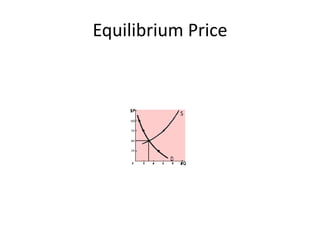
Equilibrium Price
Consumers
• People who buys goods and services
Price
• Money paid for a good or service
• Determined by Supply and Demand
• Can be done with trade or barter
• Inflation
Market
• A place where buyers and sellers go to
trade, barter or pay for goods or services
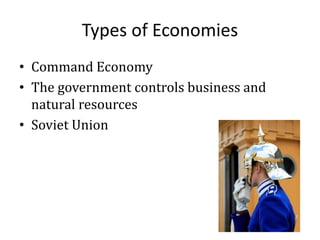
Types of Economies
• Command Economy
• The government controls business and
natural resources
• Soviet Union
Types of Economies
• Traditional Economy
• Use traditional methods
Types of Economies
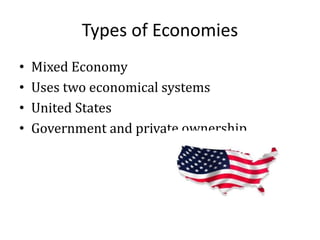
• Mixed Economy
• Uses two economical systems
• United States
• Government and private ownership
Types of Economy
Free Market (Adam Smith’s idea)
• No government intervention (or very little)
• Consumers decide what their wants and
needs are
• Consumers can buy anything they choose
• Capitalism
Competition
• Multiple businesses selling the same goods
or services
• Monopoly-when one business prevents
competition by being the only one who sells
a type of good or service.
Interest
Simple:
• Paid only on the principal
• Can be paid daily, weekly, monthly, annually
• Example:
• $100 principal
• .06 is the interest
• If it is paid annually
• 100X.06=6.00
• 6.00x12=72.00
• After one year 172.00
Interest
Compound
Paid on the principal plus interest
If it is paid monthly:
Principal 1st Month 2nd Month
$100 100x.06=$6.00
100+6.00=$106
106x.06=$6.36
106+6.36=112.36
Prime Interest
• Best interest to the best customers
• Best customers have good credit
scoresdetermined by payment history,
amount of debt and income
Government Investments
Human
• Education: loans, grants
• Health: medicaid and
medicare
• Training: Job Corps,
Military
Physical
• NASA
• Transportation
• Defense
Brainpop Videos
• www.brainpop.com
• User: Kyrene
• Password: Brainpop
• Watch “Supply and Demand” and “Interest
Rates”
• http://ecedweb.unomaha.edu/Dem_Sup/dema
nd.htm
• http://www.virted.org/ECONOMICS/EconMai
n.html
Agricultural economics
• “Agricultural economics is an applied branch
of economics in which the principles of
economics are applied to agriculture”.
• Agricultural economics includes
combination of farm enterprises, methods
of production, use of credit and capital,
marketing and inputs and outputs, resource
use at micro and macro levels.
• Welfare of country through food security.
SUBJECT MATTER OF ECONOMICS
• PRIMITIVE VIEW
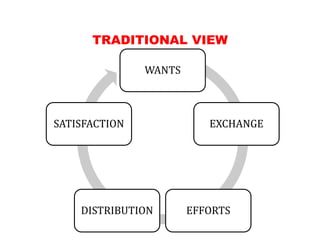
• TRADITIONAL VIEW
• MODERN VIEW
SUBJECT MATTER OF
ECONOMICS
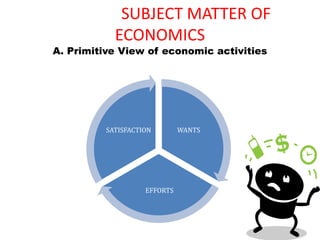
A. Primitive View of economic activities
WANTS
EFFORTS
SATISFACTION
TRADITIONAL VIEW
WANTS
EXCHANGE
EFFORTSDISTRIBUTION
SATISFACTION
MODERN VIEW
• Traditional approach is only
(Price theory/Micro Economics)
• but, Modern approach is
(Income and Employment theory/Macro
Economics)
• Now, study of economics as whole is
(Price theory/Micro Economics) + (Income and
Employment theory/Macro Economics)
• Economics of growth and Economics of
development…………real view.
SCOPE AND IMPORTANCE
• Subject matter of economics
(micro and macro economics)
• Economics is a social science
(Daily life…food, clothing, shelter)
• Economics is a science or an art
(sugarcane production 100 tonne)
• Economics is positive or normative science
(wealth poor and rich distribution)
IMPORTANCE
• A ( Theoretical importance)
• Informative (man’s behavior when he is
engaged in economic activity)
• Mental training ( news paper propaganda)
• Functioning of economic system
(inflation….functions automatically without
any central control)
• Mutual dependence
• Useful citizenship (most of the problems today
are economic in character…….)
• B PRACTICAL IMPORTANCE
• Professional value (banker, businessmen,
agriculturist, industrialist)
• Useful for household (family budget)
• Useful for labour leader (sugar factories)
• Solving problems of poverty
• GOOD “Anything which satisfies human
wants is called as good”
• “Goods means the commodity that we use,
and Services are referred to the work that
person may do”.
• Goods are tangible and services are
intangible.
• Economic goods are those goods which are
scarce and can be had only payment i.e.
money.
GOODS
EXTERNAL GOODS
MATERIAL GOODS
TRANSFERABLE GOODS
(land building, furniture)
NON TRANSFERABLE
GOODS
(degree certificate, driving
license)
PERSONAL GOODS
TRANSFERABLE GODS
(good will of business)
NON TRANSFERABLE
GOODS
(Personal qualities like
ability, intelligence,
friendship, courage)
INTERNAL GOODS
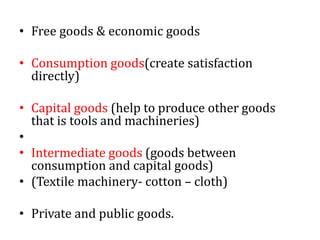
• Free goods & economic goods
• Consumption goods(create satisfaction
directly)
• Capital goods (help to produce other goods
that is tools and machineries)
•
• Intermediate goods (goods between
consumption and capital goods)
• (Textile machinery- cotton – cloth)
• Private and public goods.
UTILITY
• “The want satisfying quality in a good is called
utility”.
• Utility means the power to satisfy human
wants
• Characteristics of utility
• Utility and usefulness (opium and poison)
• Utility and pleasure (quinine as medicine)
• Utility and satisfaction (not itself satisfaction)
• Utility is subjective (blind man concern with
eyes)
FORMS OF UTILITY
• FORM UTILITY (wood to chair)
• PLACE UTILITY (Utility can be increased by
transportation i.e. forest to city….above e.g.)
• TIME UTILITY (By storing that piece of
wood and selling at time of scarcity)
MEANING OF VALUE
• “value mean the commodities or services
that we can get it return for it, it is in in
short, its purchasing power in terms of
other commodities and services”.
• Attributes in commodity (utility, scarce, and
marketable)
• Value in use and Value in exchange
• In economics “value in exchange”…..follows
• “When value is expressed in terms of money,
it is called PRICE
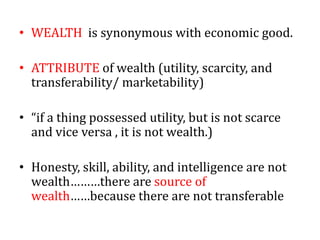
• WEALTH is synonymous with economic good.
• ATTRIBUTE of wealth (utility, scarcity, and
transferability/ marketability)
• “if a thing possessed utility, but is not scarce
and vice versa , it is not wealth.)
• Honesty, skill, ability, and intelligence are not
wealth………there are source of
wealth……because there are not transferable
• Welfare : “well being of an individual or
community “
• Wealth is a path of welfare as our desires
are satisfied by the means of wealth
• Welfare is condition of mind , hence it
differs from individual to individual.
• Wealth is mean and welfare the end
WANTS
• “MAN IS A BUNDLE OF DESIRES/WANTS”
• Some wants are natural (food clothing
shelter)
• Wants vary with individual to individual and
they multiply with civilization
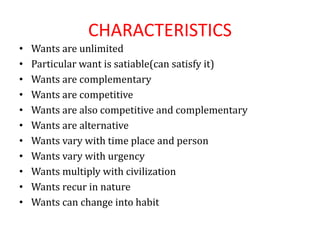
CHARACTERISTICS
• Wants are unlimited
• Particular want is satiable(can satisfy it)
• Wants are complementary
• Wants are competitive
• Wants are also competitive and complementary
• Wants are alternative
• Wants vary with time place and person
• Wants vary with urgency
• Wants multiply with civilization
• Wants recur in nature
• Wants can change into habit
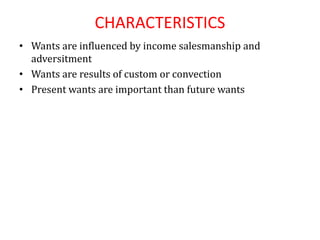
CHARACTERISTICS
• Wants are influenced by income salesmanship and
adversitment
• Wants are results of custom or convection
• Present wants are important than future wants
CLASSIFICATION OF WANTS
• NECESSARIES : (Existence, efficiency, conventional (social
custom) )
• COMFORT : (For student book and chair is necessity,
• But, cushion chair is comfort)
• LUXURIES : It is defined as a superfluous consumption
• (shower baths, silk cloths, jewellery, washing machine…..)
• IMPORTANCE OF WANTS
• Give birth to important economic laws (law of diminishing,
equimarginal utility)
• Demand and supply
• Public finance and expenditure
• Theory of interest , taxes, consumer surplus.
CONSUMPTION
• Consumption mean the satisfaction of our wants by the use
of commodities and services
• Consumption is also defined as destruction of utility.
• (satisfaction of human want, spending of money income,
expenditure of income)
• TYPES OF CONSUMPTION
• DIRECT/FINAL CONSUMPTION (FOOD)
• INDIRECT OR PRODUCTIVE CONSUMPTION
(SEWING MACHINE)
• IMPORTANCE OF CONSUMPTION
• Beginning as well as the end of economic activity
• Production is stimulated by consumption
• Without consumption there would be no exchange and
distribution
• Flow of income
• Discovery of new products and new processes
• Influence of exchange
• Direct and guide production (economic activity)
• Standard of living
Economics int.1

Economics int.1

  • 1.
  • 2.
    What is economics? •The study of choice and decision making in a world with limited resources. • “Economics is an enquiry into the nature and causes of wealth of nations” …..Adam Smith. • “Economics is a study of man’s actions in the ordinary business of life; it enquires how he gets his income and how he uses it. Thus, it is on one side a study of wealth and on the other and more important side, a part of the study of man. • Money, goods, services, banking… Dr.Alferd Marshal
  • 3.
    • “Economics isthe science which studies human behavior as a relationship between ends and scarce means which have alternative uses.” …….Robbins • “Economics is the study of the administration of scarce resources and of the determinants of income and employment” ……Lord J.M. Keynes
  • 4.
    History of Economics •Adam Smith The Wealth of Nations • Explained how prosperous economies work • Free Market Economy • Self-determination • Divisions of labor
  • 5.
    Elements • Production ofgoods and services • Distribution of goods and services • Consumption of goods and services
  • 6.
    Goods vs. Services Goods •Food • Clothing • Homes • Computers • Anything that people want or need Services • Cell phone service • Internet • Maids • Anything that someone does for someone else
  • 7.
    Products • Goods orservices • Bought or sold • Surplusan over abundance of goods or services • Imports/Exports • Resources
  • 8.
    Supply vs. Demand Supply •Amount of a goods or services available for a price • Determined by income, technology, natural occurrences and availability of natural resources Demand • What a people want or need • Determined by income, trends, and population
  • 9.
  • 10.
    Consumers • People whobuys goods and services
  • 11.
    Price • Money paidfor a good or service • Determined by Supply and Demand • Can be done with trade or barter • Inflation
  • 12.
    Market • A placewhere buyers and sellers go to trade, barter or pay for goods or services
  • 13.
    Types of Economies •Command Economy • The government controls business and natural resources • Soviet Union
  • 14.
    Types of Economies •Traditional Economy • Use traditional methods
  • 15.
    Types of Economies •Mixed Economy • Uses two economical systems • United States • Government and private ownership
  • 16.
    Types of Economy FreeMarket (Adam Smith’s idea) • No government intervention (or very little) • Consumers decide what their wants and needs are • Consumers can buy anything they choose • Capitalism
  • 17.
    Competition • Multiple businessesselling the same goods or services • Monopoly-when one business prevents competition by being the only one who sells a type of good or service.
  • 18.
    Interest Simple: • Paid onlyon the principal • Can be paid daily, weekly, monthly, annually • Example: • $100 principal • .06 is the interest • If it is paid annually • 100X.06=6.00 • 6.00x12=72.00 • After one year 172.00
  • 19.
    Interest Compound Paid on theprincipal plus interest If it is paid monthly: Principal 1st Month 2nd Month $100 100x.06=$6.00 100+6.00=$106 106x.06=$6.36 106+6.36=112.36
  • 20.
    Prime Interest • Bestinterest to the best customers • Best customers have good credit scoresdetermined by payment history, amount of debt and income
  • 21.
    Government Investments Human • Education:loans, grants • Health: medicaid and medicare • Training: Job Corps, Military Physical • NASA • Transportation • Defense
  • 22.
    Brainpop Videos • www.brainpop.com •User: Kyrene • Password: Brainpop • Watch “Supply and Demand” and “Interest Rates” • http://ecedweb.unomaha.edu/Dem_Sup/dema nd.htm • http://www.virted.org/ECONOMICS/EconMai n.html
  • 23.
    Agricultural economics • “Agriculturaleconomics is an applied branch of economics in which the principles of economics are applied to agriculture”. • Agricultural economics includes combination of farm enterprises, methods of production, use of credit and capital, marketing and inputs and outputs, resource use at micro and macro levels. • Welfare of country through food security.
  • 24.
    SUBJECT MATTER OFECONOMICS • PRIMITIVE VIEW • TRADITIONAL VIEW • MODERN VIEW
  • 25.
    SUBJECT MATTER OF ECONOMICS A.Primitive View of economic activities WANTS EFFORTS SATISFACTION
  • 26.
  • 27.
    MODERN VIEW • Traditionalapproach is only (Price theory/Micro Economics) • but, Modern approach is (Income and Employment theory/Macro Economics) • Now, study of economics as whole is (Price theory/Micro Economics) + (Income and Employment theory/Macro Economics) • Economics of growth and Economics of development…………real view.
  • 28.
    SCOPE AND IMPORTANCE •Subject matter of economics (micro and macro economics) • Economics is a social science (Daily life…food, clothing, shelter) • Economics is a science or an art (sugarcane production 100 tonne) • Economics is positive or normative science (wealth poor and rich distribution)
  • 29.
    IMPORTANCE • A (Theoretical importance) • Informative (man’s behavior when he is engaged in economic activity) • Mental training ( news paper propaganda) • Functioning of economic system (inflation….functions automatically without any central control) • Mutual dependence • Useful citizenship (most of the problems today are economic in character…….)
  • 30.
    • B PRACTICALIMPORTANCE • Professional value (banker, businessmen, agriculturist, industrialist) • Useful for household (family budget) • Useful for labour leader (sugar factories) • Solving problems of poverty
  • 31.
    • GOOD “Anythingwhich satisfies human wants is called as good” • “Goods means the commodity that we use, and Services are referred to the work that person may do”. • Goods are tangible and services are intangible. • Economic goods are those goods which are scarce and can be had only payment i.e. money.
  • 32.
    GOODS EXTERNAL GOODS MATERIAL GOODS TRANSFERABLEGOODS (land building, furniture) NON TRANSFERABLE GOODS (degree certificate, driving license) PERSONAL GOODS TRANSFERABLE GODS (good will of business) NON TRANSFERABLE GOODS (Personal qualities like ability, intelligence, friendship, courage) INTERNAL GOODS
  • 33.
    • Free goods& economic goods • Consumption goods(create satisfaction directly) • Capital goods (help to produce other goods that is tools and machineries) • • Intermediate goods (goods between consumption and capital goods) • (Textile machinery- cotton – cloth) • Private and public goods.
  • 34.
    UTILITY • “The wantsatisfying quality in a good is called utility”. • Utility means the power to satisfy human wants • Characteristics of utility • Utility and usefulness (opium and poison) • Utility and pleasure (quinine as medicine) • Utility and satisfaction (not itself satisfaction) • Utility is subjective (blind man concern with eyes)
  • 35.
    FORMS OF UTILITY •FORM UTILITY (wood to chair) • PLACE UTILITY (Utility can be increased by transportation i.e. forest to city….above e.g.) • TIME UTILITY (By storing that piece of wood and selling at time of scarcity)
  • 36.
    MEANING OF VALUE •“value mean the commodities or services that we can get it return for it, it is in in short, its purchasing power in terms of other commodities and services”. • Attributes in commodity (utility, scarce, and marketable) • Value in use and Value in exchange • In economics “value in exchange”…..follows • “When value is expressed in terms of money, it is called PRICE
  • 37.
    • WEALTH issynonymous with economic good. • ATTRIBUTE of wealth (utility, scarcity, and transferability/ marketability) • “if a thing possessed utility, but is not scarce and vice versa , it is not wealth.) • Honesty, skill, ability, and intelligence are not wealth………there are source of wealth……because there are not transferable
  • 38.
    • Welfare :“well being of an individual or community “ • Wealth is a path of welfare as our desires are satisfied by the means of wealth • Welfare is condition of mind , hence it differs from individual to individual. • Wealth is mean and welfare the end
  • 39.
    WANTS • “MAN ISA BUNDLE OF DESIRES/WANTS” • Some wants are natural (food clothing shelter) • Wants vary with individual to individual and they multiply with civilization
  • 40.
    CHARACTERISTICS • Wants areunlimited • Particular want is satiable(can satisfy it) • Wants are complementary • Wants are competitive • Wants are also competitive and complementary • Wants are alternative • Wants vary with time place and person • Wants vary with urgency • Wants multiply with civilization • Wants recur in nature • Wants can change into habit
  • 41.
    CHARACTERISTICS • Wants areinfluenced by income salesmanship and adversitment • Wants are results of custom or convection • Present wants are important than future wants
  • 42.
    CLASSIFICATION OF WANTS •NECESSARIES : (Existence, efficiency, conventional (social custom) ) • COMFORT : (For student book and chair is necessity, • But, cushion chair is comfort) • LUXURIES : It is defined as a superfluous consumption • (shower baths, silk cloths, jewellery, washing machine…..) • IMPORTANCE OF WANTS • Give birth to important economic laws (law of diminishing, equimarginal utility) • Demand and supply • Public finance and expenditure • Theory of interest , taxes, consumer surplus.
  • 43.
    CONSUMPTION • Consumption meanthe satisfaction of our wants by the use of commodities and services • Consumption is also defined as destruction of utility. • (satisfaction of human want, spending of money income, expenditure of income) • TYPES OF CONSUMPTION • DIRECT/FINAL CONSUMPTION (FOOD) • INDIRECT OR PRODUCTIVE CONSUMPTION (SEWING MACHINE)
  • 44.
    • IMPORTANCE OFCONSUMPTION • Beginning as well as the end of economic activity • Production is stimulated by consumption • Without consumption there would be no exchange and distribution • Flow of income • Discovery of new products and new processes • Influence of exchange • Direct and guide production (economic activity) • Standard of living

Editor's Notes

  • #5 Smith’s ideas explained that one person could work for him/herself and that would benefit society. However, he wasn’t the first to express the ideas of economics just the most referenced.
  • #18 Which company was in trouble within the last 10 years for a monopoly: Microsoft.