Introduction


 Group Members Basit Saeed Faiq Kamal Faisal
  Khalid
 Topic Tax system
 What is Tax system
 Methods of Taxation
 Tax System of Pakistan
 A look at some figures
What      Is Tax system ?

 Ten Principles of Economics: The Government
can sometimes improve market outcomes.
 From where does the Government gets its
  Funds ?????????????
 Taxes
 e.g. In a vegetable market the T.M.A takes
  Taxes and in return provides shades and a
  clean space
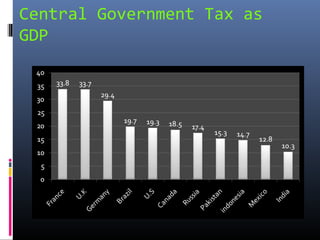
Central Government Tax as
GDP
TAXES AND EFFICIENCY

 Policymakers have two objectives in
  designing a tax system...
              Efficiency
              Equity
TAXES AND EFFICIENCY

 One tax system is more efficient than another
  if it raises the same amount of revenue at a
  smaller cost to taxpayers.
 An efficient tax system is one that imposes
  small deadweight losses and small
  administrative burdens.
TAXES AND EFFICIENCY

 The Cost of Taxes to Taxpayers
   The tax payment itself
   Deadweight losses
   Administrative burdens
Administrative Burdens
 Complying with tax laws creates additional
  deadweight losses.
   Taxpayers lose additional time and money
    documenting, computing, and avoiding taxes over
    and above the actual taxes they pay.
   The administrative burden of any tax system is
    part of the inefficiency it creates.
Dead weight losses

 If government raises the tax on cold drinkes
  people stop taking cold drinks
 Similarly if taxes are increased on earning
  people start to work less and enjoy more
  leisure
 Taxes reduces incentives and hence dead
  weight losses are increased
Methods of Taxation


Marginal taxes v/s Average Taxes
Lump sum Taxes
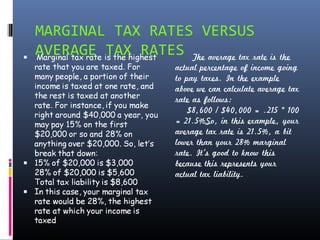
MARGINAL TAX RATES VERSUS
AVERAGE TAX RATES
Lump – Sum Taxes

 A lump sum tax is a tax of a fixed amount that
  has to be paid by everyone regardless of the
  level of his or her income. Lump sum taxes
  are considered efficient taxes because they
  do not influence a person’s decision on how
  much to work.
 But why are they no lump sum taxes ????
Lump sum Taxes a Failure in
Pakistan
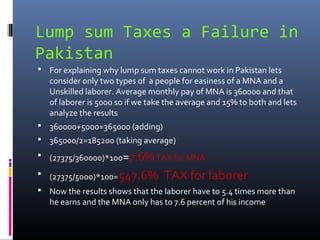
 For explaining why lump sum taxes cannot work in Pakistan lets
   consider only two types of a people for easiness of a MNA and a
   Unskilled laborer. Average monthly pay of MNA is 360000 and that
   of laborer is 5000 so if we take the average and 15% to both and lets
   analyze the results
 360000+5000=365000 (adding)
 365000/2=185200 (taking average)
 (27375/360000)*100=7.6% TAX for MNA

 (27375/5000)*100=547.6%         TAX for laborer
 Now the results shows that the laborer have to 5.4 times more than
   he earns and the MNA only has to 7.6 percent of his income
TAXES AND EQUITY


How should the burden of taxes be divided
among the population?
How do we evaluate whether a tax system is
fair?
Principles of Taxation
  Benefits principle
  Ability-to-pay principle


                              $
Benefits Principle
 The benefits principle is the idea that people
  should pay taxes based on the benefits they
  receive from government services.
 An example is a gasoline tax:
   Tax revenues from a gasoline tax are used to
    finance our highway system.
   People who drive the most also pay the most
    toward maintaining roads.
Ability-to-Pay Principle
 The ability-to-pay principle is the idea that
  taxes should be levied on a person according
  to how well that person can shoulder the
  burden.
 The ability-to-pay principle leads to two
  corollary notions of equity.
   Vertical equity
   Horizontal equity
Ability-to-Pay Principle
 Vertical equity is the idea that taxpayers with
  a greater ability to pay taxes should pay
  larger amounts.
   For example, people with higher incomes should
    pay more than people with lower incomes.
Ability-to-Pay Principle
 Vertical Equity and Alternative Tax Systems
   A proportional tax is one for which high-income
    and low-income taxpayers pay the same fraction
    of income.
   A regressive tax is one for which high-income
    taxpayers pay a smaller fraction of their income
    than do low-income taxpayers.
   A progressive tax is one for which high-income
    taxpayers pay a larger fraction of their income
    than do low-income taxpayers.
Tax Incidence—the Study Of Who
  Bears The Burden Of Taxes
 WHO PAYS THE CORPORATE INCOME TAX?
 People pay all taxes
 The owners, workers or the costumers
 E.g. if tax is increased on fertilizer company who
  will be effected
    1. Owners
    2. Workers
    3. Customers
The Federal Government
 Budget Surplus
   A budget surplus is an excess of government
    receipts over government spending.
 Budget Deficit
   A budget deficit is an excess of government
    spending over government receipts.
The Federal Government
 Financial Conditions of the Federal Budget
   A budget deficit occurs when there is an excess of
    government spending over government receipts.
     Government finances the deficit by borrowing from
      the public.
   A budget surplus occurs when government
    receipts are greater than government spending.
     A budget surplus may be used to reduce the
      government’s outstanding debts.
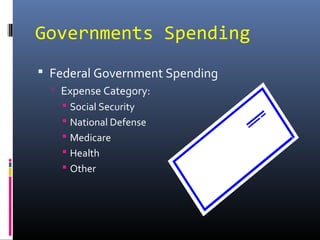
Governments Spending
 Federal Government Spending
   Expense Category:
     Social Security
     National Defense
     Medicare
     Health
     Other
Tax System Of Pakistan

 Direct taxation
 Indirect taxation
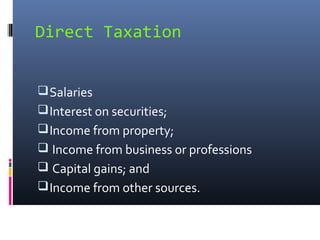
Direct Taxation


 Salaries
 Interest on securities;
 Income from property;
 Income from business or professions
 Capital gains; and
 Income from other sources.
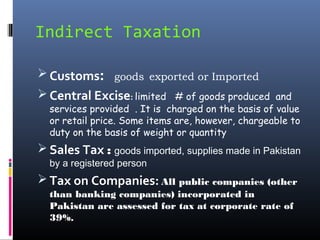
Indirect Taxation

 Customs: goods exported or Imported
 Central Excise: limited # of goods produced       and
  services provided . It is charged on the basis of value
  or retail price. Some items are, however, chargeable to
  duty on the basis of weight or quantity
 Sales Tax : goods imported, supplies made in Pakistan
  by a registered person
 Tax on Companies: All public companies (other
  than banking companies) incorporated in
  Pakistan are assessed for tax at corporate rate of
  39%.
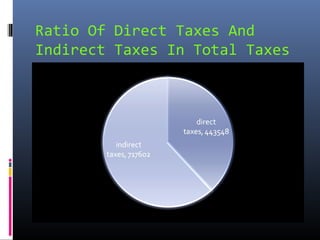
Ratio Of Direct Taxes And
Indirect Taxes In Total Taxes
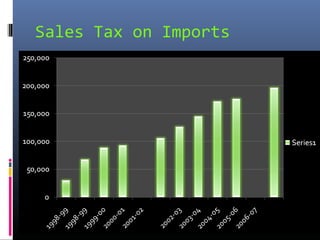
Sales Tax on Imports
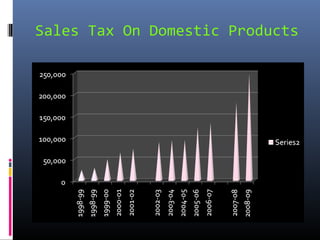
Sales Tax On Domestic Products

Micro tax system

  • 1.
    Introduction  Group MembersBasit Saeed Faiq Kamal Faisal Khalid  Topic Tax system
  • 2.
     What isTax system  Methods of Taxation  Tax System of Pakistan  A look at some figures
  • 3.
    What Is Tax system ?  Ten Principles of Economics: The Government can sometimes improve market outcomes.  From where does the Government gets its Funds ?????????????  Taxes  e.g. In a vegetable market the T.M.A takes Taxes and in return provides shades and a clean space
  • 4.
  • 5.
    TAXES AND EFFICIENCY Policymakers have two objectives in designing a tax system...  Efficiency  Equity
  • 6.
    TAXES AND EFFICIENCY One tax system is more efficient than another if it raises the same amount of revenue at a smaller cost to taxpayers.  An efficient tax system is one that imposes small deadweight losses and small administrative burdens.
  • 7.
    TAXES AND EFFICIENCY The Cost of Taxes to Taxpayers  The tax payment itself  Deadweight losses  Administrative burdens
  • 8.
    Administrative Burdens  Complyingwith tax laws creates additional deadweight losses.  Taxpayers lose additional time and money documenting, computing, and avoiding taxes over and above the actual taxes they pay.  The administrative burden of any tax system is part of the inefficiency it creates.
  • 9.
    Dead weight losses If government raises the tax on cold drinkes people stop taking cold drinks  Similarly if taxes are increased on earning people start to work less and enjoy more leisure  Taxes reduces incentives and hence dead weight losses are increased
  • 10.
    Methods of Taxation Marginaltaxes v/s Average Taxes Lump sum Taxes
  • 11.
    MARGINAL TAX RATESVERSUS AVERAGE TAX RATES
  • 12.
    Lump – SumTaxes  A lump sum tax is a tax of a fixed amount that has to be paid by everyone regardless of the level of his or her income. Lump sum taxes are considered efficient taxes because they do not influence a person’s decision on how much to work.  But why are they no lump sum taxes ????
  • 13.
    Lump sum Taxesa Failure in Pakistan  For explaining why lump sum taxes cannot work in Pakistan lets consider only two types of a people for easiness of a MNA and a Unskilled laborer. Average monthly pay of MNA is 360000 and that of laborer is 5000 so if we take the average and 15% to both and lets analyze the results  360000+5000=365000 (adding)  365000/2=185200 (taking average)  (27375/360000)*100=7.6% TAX for MNA  (27375/5000)*100=547.6% TAX for laborer  Now the results shows that the laborer have to 5.4 times more than he earns and the MNA only has to 7.6 percent of his income
  • 14.
    TAXES AND EQUITY Howshould the burden of taxes be divided among the population? How do we evaluate whether a tax system is fair?
  • 15.
    Principles of Taxation Benefits principle Ability-to-pay principle $
  • 16.
    Benefits Principle  Thebenefits principle is the idea that people should pay taxes based on the benefits they receive from government services.  An example is a gasoline tax:  Tax revenues from a gasoline tax are used to finance our highway system.  People who drive the most also pay the most toward maintaining roads.
  • 17.
    Ability-to-Pay Principle  Theability-to-pay principle is the idea that taxes should be levied on a person according to how well that person can shoulder the burden.  The ability-to-pay principle leads to two corollary notions of equity.  Vertical equity  Horizontal equity
  • 18.
    Ability-to-Pay Principle  Verticalequity is the idea that taxpayers with a greater ability to pay taxes should pay larger amounts.  For example, people with higher incomes should pay more than people with lower incomes.
  • 19.
    Ability-to-Pay Principle  VerticalEquity and Alternative Tax Systems  A proportional tax is one for which high-income and low-income taxpayers pay the same fraction of income.  A regressive tax is one for which high-income taxpayers pay a smaller fraction of their income than do low-income taxpayers.  A progressive tax is one for which high-income taxpayers pay a larger fraction of their income than do low-income taxpayers.
  • 20.
    Tax Incidence—the StudyOf Who Bears The Burden Of Taxes  WHO PAYS THE CORPORATE INCOME TAX?  People pay all taxes  The owners, workers or the costumers  E.g. if tax is increased on fertilizer company who will be effected 1. Owners 2. Workers 3. Customers
  • 21.
    The Federal Government Budget Surplus  A budget surplus is an excess of government receipts over government spending.  Budget Deficit  A budget deficit is an excess of government spending over government receipts.
  • 22.
    The Federal Government Financial Conditions of the Federal Budget  A budget deficit occurs when there is an excess of government spending over government receipts.  Government finances the deficit by borrowing from the public.  A budget surplus occurs when government receipts are greater than government spending.  A budget surplus may be used to reduce the government’s outstanding debts.
  • 23.
    Governments Spending  FederalGovernment Spending  Expense Category:  Social Security  National Defense  Medicare  Health  Other
  • 24.
    Tax System OfPakistan  Direct taxation  Indirect taxation
  • 25.
    Direct Taxation  Salaries Interest on securities;  Income from property;  Income from business or professions  Capital gains; and  Income from other sources.
  • 26.
    Indirect Taxation  Customs:goods exported or Imported  Central Excise: limited # of goods produced and services provided . It is charged on the basis of value or retail price. Some items are, however, chargeable to duty on the basis of weight or quantity  Sales Tax : goods imported, supplies made in Pakistan by a registered person  Tax on Companies: All public companies (other than banking companies) incorporated in Pakistan are assessed for tax at corporate rate of 39%.
  • 27.
    Ratio Of DirectTaxes And Indirect Taxes In Total Taxes
  • 28.
    Sales Tax onImports
  • 29.
    Sales Tax OnDomestic Products