
B Y : I V A N A G U I L A R
TASK BASED LEARNING IN
THE ENGLISH CLASSROOM
OBJECTIVES
By the end of this presentation we’ll have…
• Reviewed the evolution of Language Teaching
Methodology
• Explained the underlying principles to TBL
• Compared TBL with another language teaching model
• Experienced a language teaching activity based on TBL
• Identified ways to implement TBL principles in our
teaching
• Shared and evaluated ideas on how to implement TBL in
our classrooms
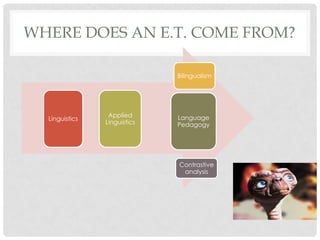
WHERE DOES AN E.T. COME FROM?
Linguistics
Applied
Linguistics
Language
Pedagogy
Bilingualism
Contrastive
analysis
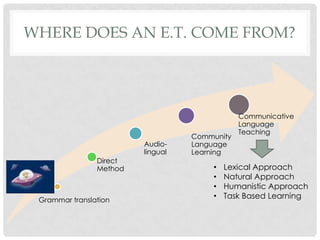
WHERE DOES AN E.T. COME FROM?
Grammar translation
Direct
Method
Audio-
lingual
Community
Language
Learning
Communicative
Language
Teaching
• Lexical Approach
• Natural Approach
• Humanistic Approach
• Task Based Learning
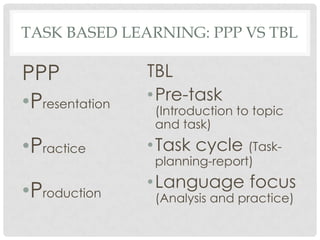
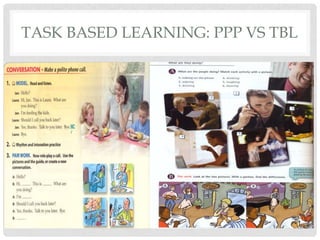
TASK BASED LEARNING: PPP VS TBL
PPP
•Presentation
•Practice
•Production
TBL
•Pre-task
(Introduction to topic
and task)
•Task cycle (Task-
planning-report)
•Language focus
(Analysis and practice)
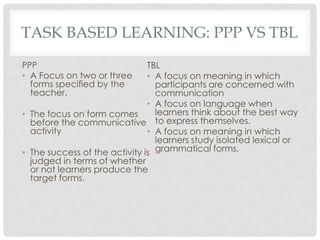
TASK BASED LEARNING: PPP VS TBL
PPP
• A Focus on two or three
forms specified by the
teacher.
• The focus on form comes
before the communicative
activity
• The success of the activity is
judged in terms of whether
or not learners produce the
target forms.
TBL
• A focus on meaning in which
participants are concerned with
communication
• A focus on language when
learners think about the best way
to express themselves.
• A focus on meaning in which
learners study isolated lexical or
grammatical forms.
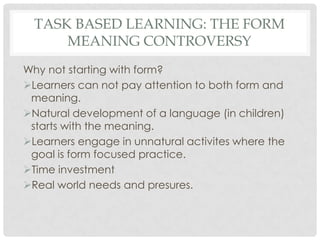
TASK BASED LEARNING: THE FORM
MEANING CONTROVERSY
Why not starting with form?
Learners can not pay attention to both form and
meaning.
Natural development of a language (in children)
starts with the meaning.
Learners engage in unnatural activites where the
goal is form focused practice.
Time investment
Real world needs and presures.
TASK BASED LEARNING: THE FORM
MEANING CONTROVERSY
This is a very popular contest in many radio stations.
The task is simple. Ask your partner as many questions
as possible. Your classmate should answer to your
questions but can not say YES or NO because this
makes him/her lose.
TASK BASED LEARNING: PPP VS TBL
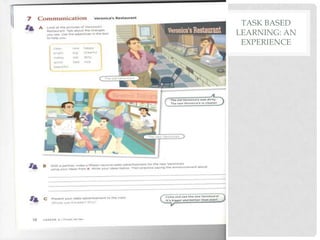
TASK BASED
LEARNING: AN
EXPERIENCE
TASK BASED LEARNING:THE
PRINCIPLES
• 1. Meaning is primary.
• 2. Learners do not regurgitate meanings from
teachers, course books or other sources.
• 3. There is a connection between a real-world
activity and the classroom task.
• 4. Task completion has some priority.
• 5. Task outcomes are the basis for assessment
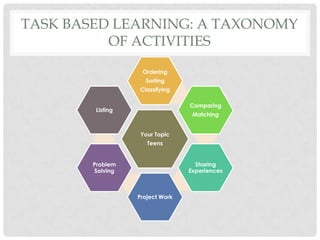
TASK BASED LEARNING: A TAXONOMY
OF ACTIVITIES
Your Topic
Teens
Ordering
Sorting
Classifying
Comparing
Matching
Sharing
Experiences
Project Work
Problem
Solving
Listing
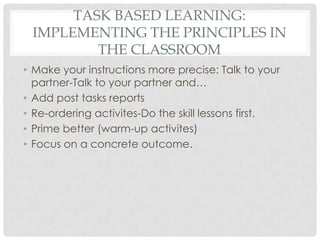
TASK BASED LEARNING:
IMPLEMENTING THE PRINCIPLES IN
THE CLASSROOM
• Make your instructions more precise: Talk to your
partner-Talk to your partner and…
• Add post tasks reports
• Re-ordering activites-Do the skill lessons first.
• Prime better (warm-up activites)
• Focus on a concrete outcome.
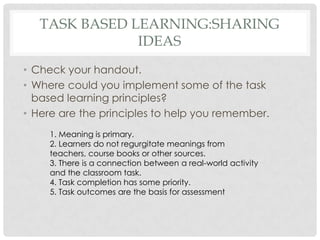
TASK BASED LEARNING:SHARING
IDEAS
• Check your handout.
• Where could you implement some of the task
based learning principles?
• Here are the principles to help you remember.
1. Meaning is primary.
2. Learners do not regurgitate meanings from
teachers, course books or other sources.
3. There is a connection between a real-world activity
and the classroom task.
4. Task completion has some priority.
5. Task outcomes are the basis for assessment
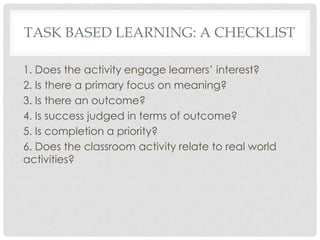
TASK BASED LEARNING: A CHECKLIST
1. Does the activity engage learners’ interest?
2. Is there a primary focus on meaning?
3. Is there an outcome?
4. Is success judged in terms of outcome?
5. Is completion a priority?
6. Does the classroom activity relate to real world
activities?
QISS
• What is a QUESTION you have in your mind?
• What is something you found INTERESTING you
found?
• How could you SUMMARIZE your learning?
• What is a SUGGESTION you have?
Task based learning in the english classroom

Task based learning in the english classroom

  • 1.
    B Y :I V A N A G U I L A R TASK BASED LEARNING IN THE ENGLISH CLASSROOM
  • 2.
    OBJECTIVES By the endof this presentation we’ll have… • Reviewed the evolution of Language Teaching Methodology • Explained the underlying principles to TBL • Compared TBL with another language teaching model • Experienced a language teaching activity based on TBL • Identified ways to implement TBL principles in our teaching • Shared and evaluated ideas on how to implement TBL in our classrooms
  • 3.
    WHERE DOES ANE.T. COME FROM? Linguistics Applied Linguistics Language Pedagogy Bilingualism Contrastive analysis
  • 4.
    WHERE DOES ANE.T. COME FROM? Grammar translation Direct Method Audio- lingual Community Language Learning Communicative Language Teaching • Lexical Approach • Natural Approach • Humanistic Approach • Task Based Learning
  • 5.
    TASK BASED LEARNING:PPP VS TBL PPP •Presentation •Practice •Production TBL •Pre-task (Introduction to topic and task) •Task cycle (Task- planning-report) •Language focus (Analysis and practice)
  • 6.
    TASK BASED LEARNING:PPP VS TBL PPP • A Focus on two or three forms specified by the teacher. • The focus on form comes before the communicative activity • The success of the activity is judged in terms of whether or not learners produce the target forms. TBL • A focus on meaning in which participants are concerned with communication • A focus on language when learners think about the best way to express themselves. • A focus on meaning in which learners study isolated lexical or grammatical forms.
  • 7.
    TASK BASED LEARNING:THE FORM MEANING CONTROVERSY Why not starting with form? Learners can not pay attention to both form and meaning. Natural development of a language (in children) starts with the meaning. Learners engage in unnatural activites where the goal is form focused practice. Time investment Real world needs and presures.
  • 8.
    TASK BASED LEARNING:THE FORM MEANING CONTROVERSY This is a very popular contest in many radio stations. The task is simple. Ask your partner as many questions as possible. Your classmate should answer to your questions but can not say YES or NO because this makes him/her lose.
  • 9.
  • 10.
  • 11.
    TASK BASED LEARNING:THE PRINCIPLES •1. Meaning is primary. • 2. Learners do not regurgitate meanings from teachers, course books or other sources. • 3. There is a connection between a real-world activity and the classroom task. • 4. Task completion has some priority. • 5. Task outcomes are the basis for assessment
  • 12.
    TASK BASED LEARNING:A TAXONOMY OF ACTIVITIES Your Topic Teens Ordering Sorting Classifying Comparing Matching Sharing Experiences Project Work Problem Solving Listing
  • 13.
    TASK BASED LEARNING: IMPLEMENTINGTHE PRINCIPLES IN THE CLASSROOM • Make your instructions more precise: Talk to your partner-Talk to your partner and… • Add post tasks reports • Re-ordering activites-Do the skill lessons first. • Prime better (warm-up activites) • Focus on a concrete outcome.
  • 14.
    TASK BASED LEARNING:SHARING IDEAS •Check your handout. • Where could you implement some of the task based learning principles? • Here are the principles to help you remember. 1. Meaning is primary. 2. Learners do not regurgitate meanings from teachers, course books or other sources. 3. There is a connection between a real-world activity and the classroom task. 4. Task completion has some priority. 5. Task outcomes are the basis for assessment
  • 15.
    TASK BASED LEARNING:A CHECKLIST 1. Does the activity engage learners’ interest? 2. Is there a primary focus on meaning? 3. Is there an outcome? 4. Is success judged in terms of outcome? 5. Is completion a priority? 6. Does the classroom activity relate to real world activities?
  • 16.
    QISS • What isa QUESTION you have in your mind? • What is something you found INTERESTING you found? • How could you SUMMARIZE your learning? • What is a SUGGESTION you have?