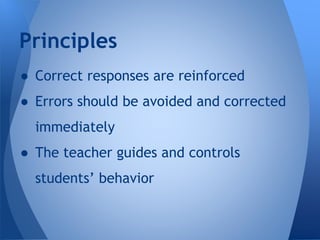
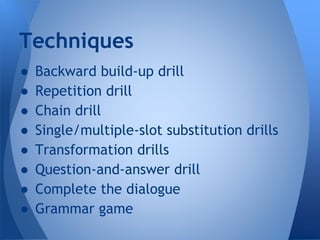
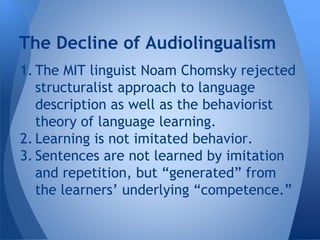
The Audio-Lingual Method was a language teaching method influenced by behaviorist psychology that claimed to transform language teaching into a science. It was based on intensive oral drilling of basic language patterns and contrastive analysis to predict and address learning difficulties. Language learning was viewed as habit formation through stimulus-response conditioning techniques like repetition drills. While it was a dominant method in the 1950-60s, it declined in popularity due to criticism of its behaviorist underpinnings and rejection of the idea that language learning is imitation rather than creative use of internalized competence.






![Teaching Vocabulary[1]](https://cdn.slidesharecdn.com/ss_thumbnails/teachingvocabulary1-1233330445671988-3-thumbnail.jpg?width=640&height=640&fit=bounds)


