Niyatiben A. Pathak
Enrollement no. . 2069108420180042
Email Id :- napathak02@gmail.com
Paper : English Language Teaching
Guide : Vaidehi Hariyani ma’am
Submitted to : Department Of English MKBU
• As teachers we always
complain about our
students do not speak in
English in our classroom .
They might feel threaten
or shy; but the fact is ,
few of them actually
dare.
• The task-based learning (
TBL) helps students to
have a meaningful
experience with language
and give them context
and the result is
motivation .
INTRODUCTION .......
TBLT started in the 1970s when scholar argued that
language instruction should teach both grammar and
meaning (skehan,2003)
The field widely takes Prabhu as one of the first
proponents for tasks or TBLT when he started the
approach in teaching secondary school classes in
Bangalore, India in the 1970s .
 from then on, TBLT began to be recognized and
widely discussed in language teaching and research
in second language Acquisition (SLA).
HISTORICAL BACKGRUND :-
Though TBLT is argued to have originated from
CLT, it has its own rationales from different
philosophies and approaches towards language
instruction .
Nowadays TBLT is a broad term , which involves
not only research and teaching , but testing and
curriculum design in SLA.
Definitions:
• A. Nunan (1989)
• “A piece of classroom work which involves
learners in comprehending, manipulating,
producing or interacting in the target language
while their attention is primarily focused on
meaning rather than form" (p. 10)
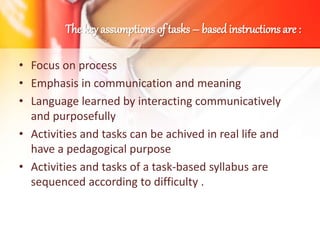
The key assumptions of tasks – based instructions are :
• Focus on process
• Emphasis in communication and meaning
• Language learned by interacting communicatively
and purposefully
• Activities and tasks can be achived in real life and
have a pedagogical purpose
• Activities and tasks of a task-based syllabus are
sequenced according to difficulty .
B. Willis (1996) –
An activity "where
the target language is used
by the learner for a
communicative purpose
(goal) in order to achieve an
outcome" (p. 23)
It is more effective to
use a meaning- based
approach than a form-
based approach.
C. Skehan (1996)-
 Tasks
primarily focus on
meaning and resemble
real-life situations.
 Since tasks are
goal-directed activities,
participants decide
which language forms
to use to achieve the
goal.
D. Van den Branden (2006)
 An activity in which a
person engages in order to attain
an objective, and which
necessitates the use of language"
(p. 4).
 It is evident in this
definition that there is a language
form needed to perform a task;
however, the language is the
means not the end. Language is
the vehicle to reach successful
communication when having real-
life communicative situations.
• Is related to communicative
language teaching (CLT).
• Some researchers argue that
TBLT is significantly different
than CLT but some thinks that
TBLT is at the very core of CLT.
• This pedalogy puts the use of
TASKS at the core of language
teaching .
What does Task- based language teaching
( TBLT) mean?
Why do we use a task based approach?
• • Tasks can be easily related to
students’ real-life language needs.
• • They create contexts that facilitate
second language acquisition.
• • Tasks create opportunities for
focusing on form.
• • Students are more likely to develop
intrinsic motivation in a task- based
approach.
• • A task-based approach enables
teachers to see if students are
developing the ability to
communicate in an L2.
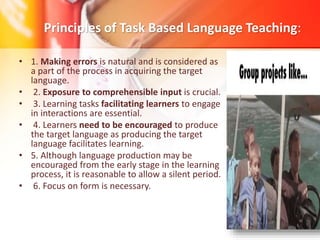
Principles of Task Based Language Teaching:
• 1. Making errors is natural and is considered as
a part of the process in acquiring the target
language.
• 2. Exposure to comprehensible input is crucial.
• 3. Learning tasks facilitating learners to engage
in interactions are essential.
• 4. Learners need to be encouraged to produce
the target language as producing the target
language facilitates learning.
• 5. Although language production may be
encouraged from the early stage in the learning
process, it is reasonable to allow a silent period.
• 6. Focus on form is necessary.
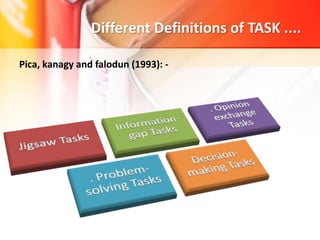
Different Definitions of TASK ....
Pica, kanagy and falodun (1993): -
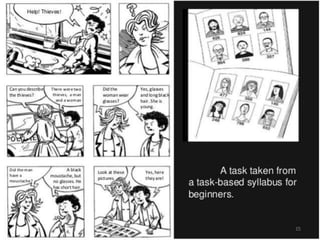
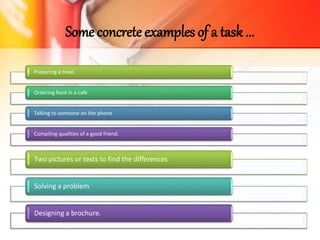
Some concrete examples of a task ...
Two pictures or texts to find the differences
Solving a problem
Designing a brochure.
Preparing a meal.
Ordering food in a cafe
Talking to someone on the phone
Compiling qualities of a good friend.
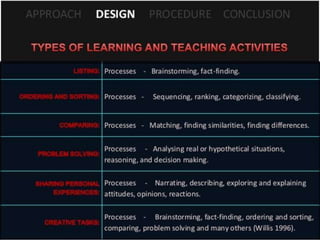
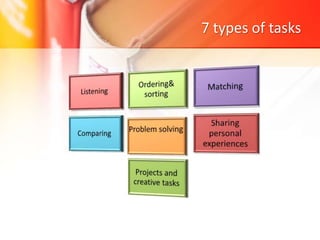
7 types of tasks
Learner’s role .......
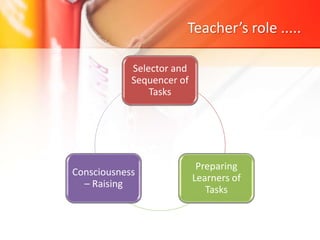
Teacher’s role .....
Selector and
Sequencer of
Tasks
Preparing
Learners of
Tasks
Consciousness
– Raising
PROCEDURE........
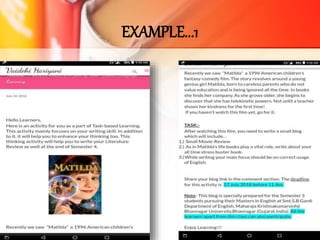
EXAMPLE...1
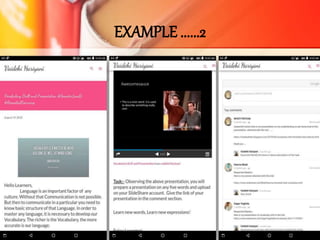
EXAMPLE ......2
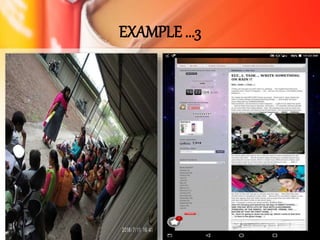
EXAMPLE ...3
Objectives of Task Based Language Teaching:
to give learners chances for negotiating turns to speak,
to engage learners in using language purposefully and
cooperatively
to give learners chances to try out communication strategies
to make learners participate in a complete interaction, not just
one-off sentences,
• TBLT is based on the principle that language
learning will progress most successfully if
teaching aims simply to create contexts n which
the learner’s natural language learning capacity
can be natured rather than making a systematic
attempt to teach the language bit by bit.
Conclusion .....
Bibliography
hariyani, vaidehi. blogspot. 10 july 2018.
<http://vaidehi09.blogspot.com/2018/07/matilda-elt1-task-2-
part-of-task-based.html>.
learning, Task-based language. Wikipedia contributors. 17 aug.
2018. <https://en.wikipedia.org/wiki/Task-
based_language_learning>.
Task based language learning

Task based language learning

  • 2.
    Niyatiben A. Pathak Enrollementno. . 2069108420180042 Email Id :- napathak02@gmail.com Paper : English Language Teaching Guide : Vaidehi Hariyani ma’am Submitted to : Department Of English MKBU
  • 3.
    • As teacherswe always complain about our students do not speak in English in our classroom . They might feel threaten or shy; but the fact is , few of them actually dare. • The task-based learning ( TBL) helps students to have a meaningful experience with language and give them context and the result is motivation . INTRODUCTION .......
  • 4.
    TBLT started inthe 1970s when scholar argued that language instruction should teach both grammar and meaning (skehan,2003) The field widely takes Prabhu as one of the first proponents for tasks or TBLT when he started the approach in teaching secondary school classes in Bangalore, India in the 1970s .  from then on, TBLT began to be recognized and widely discussed in language teaching and research in second language Acquisition (SLA). HISTORICAL BACKGRUND :-
  • 5.
    Though TBLT isargued to have originated from CLT, it has its own rationales from different philosophies and approaches towards language instruction . Nowadays TBLT is a broad term , which involves not only research and teaching , but testing and curriculum design in SLA.
  • 6.
    Definitions: • A. Nunan(1989) • “A piece of classroom work which involves learners in comprehending, manipulating, producing or interacting in the target language while their attention is primarily focused on meaning rather than form" (p. 10)
  • 7.
    The key assumptionsof tasks – based instructions are : • Focus on process • Emphasis in communication and meaning • Language learned by interacting communicatively and purposefully • Activities and tasks can be achived in real life and have a pedagogical purpose • Activities and tasks of a task-based syllabus are sequenced according to difficulty .
  • 8.
    B. Willis (1996)– An activity "where the target language is used by the learner for a communicative purpose (goal) in order to achieve an outcome" (p. 23) It is more effective to use a meaning- based approach than a form- based approach.
  • 9.
    C. Skehan (1996)- Tasks primarily focus on meaning and resemble real-life situations.  Since tasks are goal-directed activities, participants decide which language forms to use to achieve the goal.
  • 10.
    D. Van denBranden (2006)  An activity in which a person engages in order to attain an objective, and which necessitates the use of language" (p. 4).  It is evident in this definition that there is a language form needed to perform a task; however, the language is the means not the end. Language is the vehicle to reach successful communication when having real- life communicative situations.
  • 11.
    • Is relatedto communicative language teaching (CLT). • Some researchers argue that TBLT is significantly different than CLT but some thinks that TBLT is at the very core of CLT. • This pedalogy puts the use of TASKS at the core of language teaching . What does Task- based language teaching ( TBLT) mean?
  • 12.
    Why do weuse a task based approach? • • Tasks can be easily related to students’ real-life language needs. • • They create contexts that facilitate second language acquisition. • • Tasks create opportunities for focusing on form. • • Students are more likely to develop intrinsic motivation in a task- based approach. • • A task-based approach enables teachers to see if students are developing the ability to communicate in an L2.
  • 13.
    Principles of TaskBased Language Teaching: • 1. Making errors is natural and is considered as a part of the process in acquiring the target language. • 2. Exposure to comprehensible input is crucial. • 3. Learning tasks facilitating learners to engage in interactions are essential. • 4. Learners need to be encouraged to produce the target language as producing the target language facilitates learning. • 5. Although language production may be encouraged from the early stage in the learning process, it is reasonable to allow a silent period. • 6. Focus on form is necessary.
  • 16.
    Different Definitions ofTASK .... Pica, kanagy and falodun (1993): -
  • 17.
    Some concrete examplesof a task ... Two pictures or texts to find the differences Solving a problem Designing a brochure. Preparing a meal. Ordering food in a cafe Talking to someone on the phone Compiling qualities of a good friend.
  • 18.
  • 19.
  • 20.
    Teacher’s role ..... Selectorand Sequencer of Tasks Preparing Learners of Tasks Consciousness – Raising
  • 21.
  • 22.
  • 23.
  • 24.
  • 25.
    Objectives of TaskBased Language Teaching: to give learners chances for negotiating turns to speak, to engage learners in using language purposefully and cooperatively to give learners chances to try out communication strategies to make learners participate in a complete interaction, not just one-off sentences,
  • 26.
    • TBLT isbased on the principle that language learning will progress most successfully if teaching aims simply to create contexts n which the learner’s natural language learning capacity can be natured rather than making a systematic attempt to teach the language bit by bit. Conclusion .....
  • 27.
    Bibliography hariyani, vaidehi. blogspot.10 july 2018. <http://vaidehi09.blogspot.com/2018/07/matilda-elt1-task-2- part-of-task-based.html>. learning, Task-based language. Wikipedia contributors. 17 aug. 2018. <https://en.wikipedia.org/wiki/Task- based_language_learning>.