Task Based Learning
Approach (TBL)
Presenters: Shelby McNeil
Deon Harris
Nakay – Ann Douglas
Discuss the features associated with the task
based approach to language learning and
demonstrate how the language teacher can
effectively utilize this theory in the Jamaican
classroom.
What is a task?
 Willis (1996) argues that a task is “[an activity] where the
target language is used by the learner for a communicative
purpose (goal) in order to achieve an outcome” (p. 23).
 Task, based on Estaire and Zanon (1994) can be
distinguished between two main categories consequently
communication task and enabling task. (pp. 13-20)
 Nunan (2004) made a distinction between target tasks, and
pedagogical tasks.
Task Based Approach
 The Task-Based approach was first developed in 1987
by N. Prabhu in Bangladore, Southern India. Prabhu
believed that students may learn more effectively
when their minds are focused on the task , rather than
on language they are using ((Prabhu, 1987; as cited in
Littlewood, 2004).
Tasks have a specific objective that must be
achieved in a given time.
The focus of a task is primarily on pragmatic
meaning and any focus on form, i.e. grammar,
vocabulary, lexis, etc
Tasks tend to be addressed according to issues
that emerge during participation in the task
itself.
The topics discussed in task-based
environments are generally topics of
general interest to the learner.
Tasks may be complex, for example,
creating a school newspaper or easier
such as making a hotel reservation
(Lightbrown and Spada, 1999).
Task Based
Language
Learning
(TBLL)
Task based language learning is a relatively
new approach to second language
acquisition. It requires learners to complete
meaningful, real-world tasks.
 Willis (1996) argues that Task Based
Learning (TBL) combines communicative
language use with a focus on language
form.
According to Willis (2001) (as cited by
Walsh, S. (n.d), TBLL views language as
the ‘driving force in language learning’
(p.175). Put differently, while the learning
process evolves around tasks, it is the
language which remains as the focal point
of study.
Features of the Task
Based Language
Learning Approach
(TBLL)
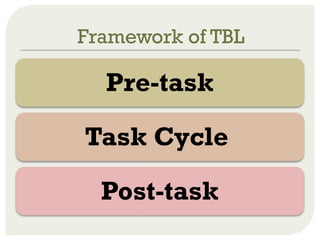
Willis (1996) believes that there are
three phases are concerned with the
Task based approach to language
learning.
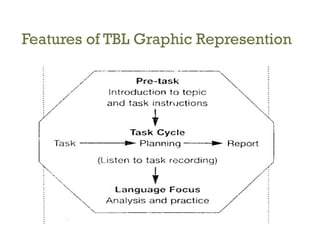
Framework of TBL
Pre-task
Task Cycle
Post-task
1. Pre – task
This is where activities are suggested by
the teacher. It also serves as an
introduction to the topic and task.
Students task notes of useful information
such as the time for the completion of the
activity.
In a task-based lesson, the teacher does
not pre-determine what language will be
studied. The lesson is based around the
completion of a central task, and the
language studied is determined
simultaneously as the students complete
the task.
Task Cycle
 Students are expected to produce natural
language, enhance fluency and confidence.
 Willis and Skehan (as cited by Rozati, n.d)
emphasized on grammatical accuracy during the
time tasks are being performed, because during
task performance the learners consider meaning
and neglect grammatical correction.
a. Task – The students complete a task in
pairs or groups using the language
resources that they have as the teacher
monitors and offers encouragement.
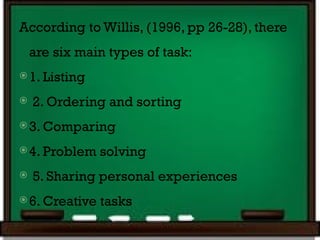
According to Willis, (1996, pp 26-28), there
are six main types of task:
 1. Listing
 2. Ordering and sorting
 3. Comparing
 4. Problem solving
 5. Sharing personal experiences
 6. Creative tasks
Planning
Having completed the task, students
prepare a short oral or written report
to tell the class what happened during
their task and on the outcome.
Report
Students then report back to the class
orally or read the written report.
The teacher chooses the order of when
students will present their reports and
may give the students some quick
feedback on the content.
Optional Post Task Listening
This phase allows students to listen to
native speakers do the same task and to
compare the language.
3. Post task/Language Focus Stage
This is the stage for ‘language focus
activities’ where the learners focus on
form and ask questions about language
features.
Practice Phase
Teacher selects language areas to practice
based upon the needs of the students and what
emerged from the task and report phases.
The students then do practice activities to
increase their confidence and make a note of
useful language.
Let’s watch and
see!
Why do Task Based Approach
to Language Learning?
Tasks can be easily related to student’s real
life language needs.
Tasks create contexts that facilitate second
language acquisition.
Tasks create opportunities for focusing on
form.
Students are more likely to develop
intrinsic motivation in a task based
approach.
It enables teachers to see if students are
developing the ability to communicate
using the second language.
Features of TBL Graphic Represention
LET’S RECAP
1. What is task?
2. What is the Task based approach to language
learning?
3. List the features of the task based approach.
4. Explain the three essential features of the
TBLL approach.
An example of the Task
Based Approach in the
Classroom
The End
Thank you for your
participation!
References
Basquile, A. (n.d).Task based learning.
Ellis, R. (2007). Task based language learning. Retrieved from http://blog.matbury.com/resources/english-language-learners-blog-
project/task-based- language-learning/#Professor_Rod_Ellis_on_Task_Based_Language_Learning_2007
Littlewood, W. (2004). The task based approach: some questions and suggestions. ELT Journal (vol.58) (4). Oxford University Press
Nunan, D. (2004) Task based language teaching. University of Hong Kong. Retrieved from
http://www.educ.ualberta.ca/staff/olenka.bilash/best%20of%20bilash/task- based%20language%20teaching.pdf
Rozati, M.S. (2004). Theory and Practice in Language Studies, Vol. 4, No. 6, pp. 1273-1278. ACADEMY PUBLISHER Manufactured
in Finland. Retrieved from http://ojs.academypublisher.com/index.php/tpls/article/download/tpls040612731278/9421
Task based learning, (1998). Tasked based learning.
Thanh, L.N & Huan, N.B, (n.d) Task-based learning. Vinh Long Community College: Vietnam. Retrieved from
http://www.camtesol.org/Download/L EiA_Vol3_Iss1_2012/LEiA_V3_I1_10_Thanh_Huan_Task_Based_Language
_Learning_and_Student_Motivation_in_Vocabulary_Acquisition.pdf
Walsh , S. (n.d). Celtic, regional and minority languages: a task-based approach to language learning (TBLL)

Task Based Language Learning PPT edited.pptx

  • 1.
    Task Based Learning Approach(TBL) Presenters: Shelby McNeil Deon Harris Nakay – Ann Douglas
  • 2.
    Discuss the featuresassociated with the task based approach to language learning and demonstrate how the language teacher can effectively utilize this theory in the Jamaican classroom.
  • 3.
    What is atask?  Willis (1996) argues that a task is “[an activity] where the target language is used by the learner for a communicative purpose (goal) in order to achieve an outcome” (p. 23).  Task, based on Estaire and Zanon (1994) can be distinguished between two main categories consequently communication task and enabling task. (pp. 13-20)  Nunan (2004) made a distinction between target tasks, and pedagogical tasks.
  • 4.
    Task Based Approach The Task-Based approach was first developed in 1987 by N. Prabhu in Bangladore, Southern India. Prabhu believed that students may learn more effectively when their minds are focused on the task , rather than on language they are using ((Prabhu, 1987; as cited in Littlewood, 2004).
  • 5.
    Tasks have aspecific objective that must be achieved in a given time. The focus of a task is primarily on pragmatic meaning and any focus on form, i.e. grammar, vocabulary, lexis, etc Tasks tend to be addressed according to issues that emerge during participation in the task itself.
  • 6.
    The topics discussedin task-based environments are generally topics of general interest to the learner. Tasks may be complex, for example, creating a school newspaper or easier such as making a hotel reservation (Lightbrown and Spada, 1999).
  • 7.
  • 8.
    Task based languagelearning is a relatively new approach to second language acquisition. It requires learners to complete meaningful, real-world tasks.  Willis (1996) argues that Task Based Learning (TBL) combines communicative language use with a focus on language form.
  • 9.
    According to Willis(2001) (as cited by Walsh, S. (n.d), TBLL views language as the ‘driving force in language learning’ (p.175). Put differently, while the learning process evolves around tasks, it is the language which remains as the focal point of study.
  • 10.
    Features of theTask Based Language Learning Approach (TBLL)
  • 11.
    Willis (1996) believesthat there are three phases are concerned with the Task based approach to language learning.
  • 12.
  • 13.
    1. Pre –task This is where activities are suggested by the teacher. It also serves as an introduction to the topic and task. Students task notes of useful information such as the time for the completion of the activity.
  • 14.
    In a task-basedlesson, the teacher does not pre-determine what language will be studied. The lesson is based around the completion of a central task, and the language studied is determined simultaneously as the students complete the task.
  • 15.
    Task Cycle  Studentsare expected to produce natural language, enhance fluency and confidence.  Willis and Skehan (as cited by Rozati, n.d) emphasized on grammatical accuracy during the time tasks are being performed, because during task performance the learners consider meaning and neglect grammatical correction.
  • 16.
    a. Task –The students complete a task in pairs or groups using the language resources that they have as the teacher monitors and offers encouragement.
  • 17.
    According to Willis,(1996, pp 26-28), there are six main types of task:  1. Listing  2. Ordering and sorting  3. Comparing  4. Problem solving  5. Sharing personal experiences  6. Creative tasks
  • 18.
    Planning Having completed thetask, students prepare a short oral or written report to tell the class what happened during their task and on the outcome.
  • 19.
    Report Students then reportback to the class orally or read the written report. The teacher chooses the order of when students will present their reports and may give the students some quick feedback on the content.
  • 20.
    Optional Post TaskListening This phase allows students to listen to native speakers do the same task and to compare the language.
  • 21.
    3. Post task/LanguageFocus Stage This is the stage for ‘language focus activities’ where the learners focus on form and ask questions about language features.
  • 22.
    Practice Phase Teacher selectslanguage areas to practice based upon the needs of the students and what emerged from the task and report phases. The students then do practice activities to increase their confidence and make a note of useful language.
  • 24.
  • 25.
    Why do TaskBased Approach to Language Learning? Tasks can be easily related to student’s real life language needs. Tasks create contexts that facilitate second language acquisition. Tasks create opportunities for focusing on form.
  • 26.
    Students are morelikely to develop intrinsic motivation in a task based approach. It enables teachers to see if students are developing the ability to communicate using the second language.
  • 27.
    Features of TBLGraphic Represention
  • 28.
    LET’S RECAP 1. Whatis task? 2. What is the Task based approach to language learning? 3. List the features of the task based approach. 4. Explain the three essential features of the TBLL approach.
  • 29.
    An example ofthe Task Based Approach in the Classroom
  • 30.
    The End Thank youfor your participation!
  • 31.
    References Basquile, A. (n.d).Taskbased learning. Ellis, R. (2007). Task based language learning. Retrieved from http://blog.matbury.com/resources/english-language-learners-blog- project/task-based- language-learning/#Professor_Rod_Ellis_on_Task_Based_Language_Learning_2007 Littlewood, W. (2004). The task based approach: some questions and suggestions. ELT Journal (vol.58) (4). Oxford University Press Nunan, D. (2004) Task based language teaching. University of Hong Kong. Retrieved from http://www.educ.ualberta.ca/staff/olenka.bilash/best%20of%20bilash/task- based%20language%20teaching.pdf Rozati, M.S. (2004). Theory and Practice in Language Studies, Vol. 4, No. 6, pp. 1273-1278. ACADEMY PUBLISHER Manufactured in Finland. Retrieved from http://ojs.academypublisher.com/index.php/tpls/article/download/tpls040612731278/9421 Task based learning, (1998). Tasked based learning. Thanh, L.N & Huan, N.B, (n.d) Task-based learning. Vinh Long Community College: Vietnam. Retrieved from http://www.camtesol.org/Download/L EiA_Vol3_Iss1_2012/LEiA_V3_I1_10_Thanh_Huan_Task_Based_Language _Learning_and_Student_Motivation_in_Vocabulary_Acquisition.pdf Walsh , S. (n.d). Celtic, regional and minority languages: a task-based approach to language learning (TBLL)