Task-Based
Language
Teaching
(TBLT)
Introduction
Task-based learning is an alternative approach to
communicative language teaching because a task
involves a primary focus on meaning, real-world
processes of language use and any of the four
language skills.
Introduction
😉 Teaching efficiency is improved when the learners
and their learning are the focus of attention instead of
the teacher.
😉 It is a communicative approach
😉 The aim of TBL is to integrate all four skills and to
move from fluency to accuracy plus fluency.
📌 Language is primarily a means of making meaning.
📌 Multiple models of language inform TBI: structural,
functional and interactional models of language.
📌 Lexical units are central in language use and
language learning.
📌 “Conversation” is the central focus of language and
the keystone of language acquisition.
Theory of language
 📌 Tasks provide both the input and output processing
necessary for language acquisition.
 📌 Task activity and achievement are motivational
 📌 Learning difficulty can be negotiated and fine-tuned
for particular pedagogical purposes
Theory of learning
“A piece of classroom work that involve
learners in comprehending, manipulating,
producing, or interacting in target
language while attention is focus on
meaning rather than form. The task
should also have a sense of completeness,
being able to stand alone as a
communicative act in its own right with a
beginning, a middle and an end.”
(Nunan, 2004)
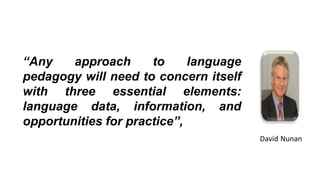
“Any approach to language
pedagogy will need to concern itself
with three essential elements:
language data, information, and
opportunities for practice”,
David Nunan
What is task?
“A task is an activity where the target language is used
by the learner for a communicative purpose (goal) in order
to achieve an outcome.”
“ A task is a piece of work that must be done,
especially one that is difficult or that must be done
regularly.”
(Longman English Dictionary)
(Willis, 1996)
“ A task is to give someone the
responsibility for doing something.”
(Longman English Dictionary)
“ A task is any activity that learners engage
in to process of learning a language.”
(Williams and Burden, 1997:168
“In contrast, exercises are activities
that call for primarily form-focused
language use. “
(Ellis, 2003)
Why Using Task-Based Approach
TBLT- Engaging Your Students
“ Students may not produce the target language during the free
practice stage because they find they are unable to use
existing language resources to complete the task”.
Richard Frost
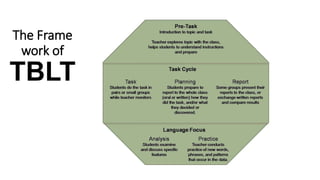
The TBL framework supports these conditions in a classroom environment.
Teacher Roles
SELECTOR AND SEQUENCER OF TASKS:
A central role of the teacher is in selecting, adapting and/or creating the tasks
themselves and then forming these into an instructional sequence in keeping
with learner neeeds, interests and language skill level.
PREPARING LEARNERS FOR TASKS:
Activities might include topic introduction, clarifying task instructions, helping
students learn or recall useful words and phrases to facilitate task
accomplishment and providing partial demonstration of task procedures.
Learner Roles
Primary roles that are implied by task work are:
GROUP PARTICIPANT: many tasks will be done in pairs or in small groups.
MONITOR: in TBL, tasks are not employed for their own sake but as a means of facilitating learning.
Class activities have to be designed so that students have the opportunity to notice how language
is used in communication.
RISK-TAKER AND INNOVATOR: many tasks will require learners to create and interpret messages for
which they lack full linguitic resources and prior experience. The skills of guessing from linguistic
and contextual clues, asking for clarification and consulting with other learners may also need to
be developed.
The Frame
work of
TBLT
Advantages
1. 1. TBL is applicable and suitable for students of all ages and
background.
2. 2. Students will have a much more varied exposure to language with
TBL.
3. 3. Students are free to use whatever vocabulary and grammar they
know, rather than just the task language of the lesson.
4. 4. Allows meaningful communication.
5. 5. Students will be exposed to a whole range of lexical phrases,
collocations and patterns as well as language forms.
6. 6. Encourages students to be more ambitious in the language.
Disadvantages
1. TBI requires a high level of creativity and initiative on the
part of the task.
2. TBI requires resources beyond the textbooks and related
materials usually found in language classrooms.
3. TBI is not teacher-centered and it requires individual and
group responsibility and commit mention the part of
students.
4. There is a risk for learners to achieve fluency at the expense
of accuracy.

METHODOLOGY I TASK BASED LANGUAGE TEACHING

  • 2.
  • 3.
    Introduction Task-based learning isan alternative approach to communicative language teaching because a task involves a primary focus on meaning, real-world processes of language use and any of the four language skills.
  • 4.
    Introduction 😉 Teaching efficiencyis improved when the learners and their learning are the focus of attention instead of the teacher. 😉 It is a communicative approach 😉 The aim of TBL is to integrate all four skills and to move from fluency to accuracy plus fluency.
  • 5.
    📌 Language isprimarily a means of making meaning. 📌 Multiple models of language inform TBI: structural, functional and interactional models of language. 📌 Lexical units are central in language use and language learning. 📌 “Conversation” is the central focus of language and the keystone of language acquisition. Theory of language
  • 6.
     📌 Tasksprovide both the input and output processing necessary for language acquisition.  📌 Task activity and achievement are motivational  📌 Learning difficulty can be negotiated and fine-tuned for particular pedagogical purposes Theory of learning
  • 7.
    “A piece ofclassroom work that involve learners in comprehending, manipulating, producing, or interacting in target language while attention is focus on meaning rather than form. The task should also have a sense of completeness, being able to stand alone as a communicative act in its own right with a beginning, a middle and an end.” (Nunan, 2004)
  • 8.
    “Any approach tolanguage pedagogy will need to concern itself with three essential elements: language data, information, and opportunities for practice”, David Nunan
  • 9.
  • 10.
    “A task isan activity where the target language is used by the learner for a communicative purpose (goal) in order to achieve an outcome.” “ A task is a piece of work that must be done, especially one that is difficult or that must be done regularly.” (Longman English Dictionary) (Willis, 1996)
  • 11.
    “ A taskis to give someone the responsibility for doing something.” (Longman English Dictionary) “ A task is any activity that learners engage in to process of learning a language.” (Williams and Burden, 1997:168 “In contrast, exercises are activities that call for primarily form-focused language use. “ (Ellis, 2003)
  • 12.
    Why Using Task-BasedApproach TBLT- Engaging Your Students “ Students may not produce the target language during the free practice stage because they find they are unable to use existing language resources to complete the task”. Richard Frost
  • 13.
    The TBL frameworksupports these conditions in a classroom environment.
  • 14.
    Teacher Roles SELECTOR ANDSEQUENCER OF TASKS: A central role of the teacher is in selecting, adapting and/or creating the tasks themselves and then forming these into an instructional sequence in keeping with learner neeeds, interests and language skill level. PREPARING LEARNERS FOR TASKS: Activities might include topic introduction, clarifying task instructions, helping students learn or recall useful words and phrases to facilitate task accomplishment and providing partial demonstration of task procedures.
  • 15.
    Learner Roles Primary rolesthat are implied by task work are: GROUP PARTICIPANT: many tasks will be done in pairs or in small groups. MONITOR: in TBL, tasks are not employed for their own sake but as a means of facilitating learning. Class activities have to be designed so that students have the opportunity to notice how language is used in communication. RISK-TAKER AND INNOVATOR: many tasks will require learners to create and interpret messages for which they lack full linguitic resources and prior experience. The skills of guessing from linguistic and contextual clues, asking for clarification and consulting with other learners may also need to be developed.
  • 16.
  • 17.
    Advantages 1. 1. TBLis applicable and suitable for students of all ages and background. 2. 2. Students will have a much more varied exposure to language with TBL. 3. 3. Students are free to use whatever vocabulary and grammar they know, rather than just the task language of the lesson. 4. 4. Allows meaningful communication. 5. 5. Students will be exposed to a whole range of lexical phrases, collocations and patterns as well as language forms. 6. 6. Encourages students to be more ambitious in the language.
  • 18.
    Disadvantages 1. TBI requiresa high level of creativity and initiative on the part of the task. 2. TBI requires resources beyond the textbooks and related materials usually found in language classrooms. 3. TBI is not teacher-centered and it requires individual and group responsibility and commit mention the part of students. 4. There is a risk for learners to achieve fluency at the expense of accuracy.