1
Theme: Medical helmintology.
Tapeworms, Class Cestoda.
2
Class Cestoda: general description
• consist of a rounded head, called a scolex, and long
strobila or chain of proglottids (multiple segments) of
varying stages of maturity.
• They have no digestive tract of its own at any point in
its life cycle.
• The scolex has specialized means of attaching to the
intestinal wall, namely suckers, hooks, or sucking
grooves.
• All species are parasitic during both the adult and
larval developmental stages.
• All cestodes have stage of oncosphere in the life
cycle.
3
General Body Shape of a
Tapeworm
a. Scolex
b. Neck
c. Strobila made up
of proglottids
4
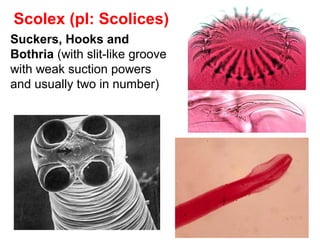
Scolex (pl: Scolices)
Suckers, Hooks and
Bothria (with slit-like groove
with weak suction powers
and usually two in number)
Sponsored
Medical Lecture Notes – All Subjects
USMLE Exam (America) – Practice
6
Neck
Undifferentiated
stem cells that
give rise to
proglottids in
strobila.
7
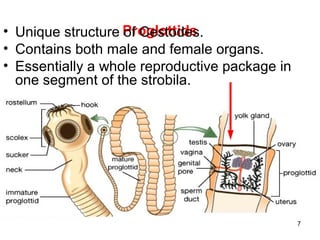
Proglottids• Unique structure of Cestodes.
• Contains both male and female organs.
• Essentially a whole reproductive package in
one segment of the strobila.
8
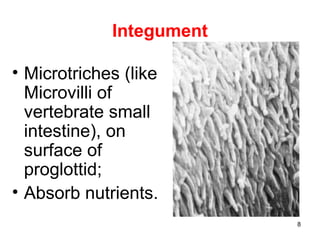
Integument
• Microtriches (like
Microvilli of
vertebrate small
intestine), on
surface of
proglottid;
• Absorb nutrients.
9
Systematics of Class Cestoda
• Order Pseudophyllidea
– Family Diphyllobothriidae
• Order Cyclophyllidea
– Family Taeniidae,
– Family Anoplocephalidae
10
Diphyllobothrium latum - the fish
tapeworm
Important parasite of man.
Definitive hosts can be
humans, dogs, foxes, cats,
mink, bears, and seals.
Localisation: small
intestine.
In humans the tapeworm can
reach a length of 10
meters (>30 feet) (it’s a
longest of the tapeworms)
and produce over a million
eggs per day!
11
Diphyllobothrium latum
• Disease: diphyllobothriasis
• Distribution: Scandinavia,
northern Russia, Japan,
Canada, USA.
• Morphology:
Diphyllobothrium latum can
be indentified by its scolex
with 2 elongated sucking
grooves by which the worm
attaches to the intestinal wall.
The proglottids are wider than
they are long, and the gravid
uterus is in the form of a
rosette.
Larva called plerocercoid.
12
Life cycle of Diphyllobothrium latum
Definitive hosts: humans
Intermediate hosts:1)
copepod crustacea, 2)
freshwater fish.
Humans infected by eating
raw or under-cooked fish
containing plerocercoids.
In the small intestine, the
larvae attach to the gut
wall and develop into adult
worms. Gravid proglottids
release fertilized eggs. The
immature eggs must be
deposited in fresh water for
the life cycle to continue.
Transmittion: fecal-oral
Invasive stage:
plerocercoid
13
• Clinical disease: infection by D. latum causes little
damage in the small intestine. In some individuals,
megaloblastic anemia occurs as a result of vitamin
B12 deficiency caused by preferential uptake of the
vitamin by the worm. Most patients are
asymptomatic, but abdominal discomfort and
diarrhea can occur.
• Diagnosis depends on finding the typical eggs,
oval, yellow-brown eggs with an operculum (lidlike
opening) at one end, in the stools.
• Prevention involves adequate cooking of fish and
proper disposal of human feces.
14
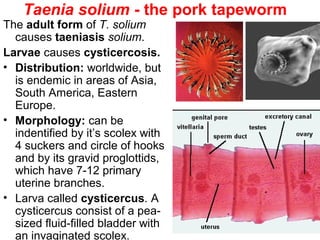
Taenia solium - the pork tapeworm
The adult form of T. solium
causes taeniasis solium.
Larvae causes cysticercosis.
• Distribution: worldwide, but
is endemic in areas of Asia,
South America, Eastern
Europe.
• Morphology: can be
indentified by it’s scolex with
4 suckers and circle of hooks
and by its gravid proglottids,
which have 7-12 primary
uterine branches.
• Larva called cysticercus. A
cysticercus consist of a pea-
sized fluid-filled bladder with
an invaginated scolex.
15
Life cycle of Taenia solium
Transmittion: fecal-oral;
• Definitive host: humans;
• Intermediate host: pigs;
• Humans can be infected
by eating raw or under-
cooked pork containing the
larvae cysticercus.
• In the small intestine, the
larvae attach to the gut
wall and take about 3
months to grow into adult
worm.
• The gravid terminal
proglottids detach daily,
are passed in the feces.
16
Taenia solium: most common
localization in organs of intermediate
host:
1. Connective tissues,
2. Eye,
3. Brain,
4. Skeletal muscles,
5. Heart,
6. Liver,
7. Lungs.
17
CYSTICERCUS IN SKELETAL MUSCLE FROM
PIG
18
• When in brain, may
cause severe central
nervous system
dysfunction.
• Most common and
distinct symptom is
sudden onset
epilepsy.
• Brain imaging can
now spot cysticercus
in brain.
19
Taenia saginata – beef tapeworm
• Most common tapeworm
in humans.
• Morphology: large
species reaching up to
20 m can be indentified
by its scolex with 4
suckers without hooklets.
Its gravid proglottids
have 17-35 primary
uterine branches. No
hooks on scolex.
• Causes taeniasis
saginata.
• Distribution: worldwide
but is endemic in areas
of Asia, South America,
Eastern Europe.
• Larva of T. saginata
20
21
Life cycle of Taenia saginata
• Definitive host: humans
• Intermediate host: cattle
• Humans can be infected by eating raw or
undercooked beef containing larvae.
• In the small intestine, the larvae attach to the gut wall.
The gravid terminal proglottids detach, are passed in
the feces, and are eaten by cattle.
• Laboratory diagnosis: gravid proglottids (with 17-35
uterine branches) may be found in the stools.
• Prevention of taeniasis saginata involves cooking
beef adequately and preventing cattle from ingesting
human feces by disposing of waste properly.
22
• Beef Tapeworms do not cause a serious
disease.
• Usually asymptomatic but may cause
dizziness, abdominal pain, diarrhea,
headache and nausea.
• Proglottids obvious in feces.
23
Clinical manifestation of teniasis soleum and teniasis
saginata: abdominal pain, nausea, diarrhea, weight loss,
infection may by asymptomatic.
24
Hymenolepis nana - dwarf tapeworm
• Distribution: worldwide,
commonly in the tropics.
• Morphology: it is only 2-3 cm
in length. Scolex has round
form and contain suckers and
hooks. A neck is very long and
thick. Strobila has 200
proglottides. The uterus has
an excretory ostium. Eggs are
released from it into the feces.
• Transmission: fecal-oral (by
the ingestion of eggs from
contaminated food or water).
25
Hymenolepis nana
• Clinical disease: asymptomatic, but diarrhea and
abdominal cramps may be present.
• Diagnosis can be proved by observing eggs in
stool.
• Prevention consists of good personal hygiene and
avoidance of fecal contamination of food and water.
26
Echinococcus granulosus - hydatid
worm or hyper tapeworm, or dog
tapeworm• Smallest tapeworms in Family
Taeniidae.
• Normally in small intestine of
Canines, as definitive hosts.
• Dogs are infected when they
eat infected herbivores
(sheep, goats, camels,
reindeer, pigs, etc.)
• Occasionally infect humans.
The hyatid cysts grow very
slowly and can overcrowd
organs.
27
Echinococcus granulosus
• Distribution: founded primarily in shepherds
living in the Mediterranean region, the Middle
East, and Australian, USA (western states).
• Morphology: worm is up to 3-5 mm. Scolex has
suckers and hooks. A neck is short. Strobila has
3-5 proglottides. Posterior segment (mature) is
the largest and contains uterus with the
haustrums, genital pore situated in the back of
the proglottid.
28
Life cycle of Echinococcus granulosus
• Transmission: fecal-oral.
• Invasive stage: egg.
• Definitive hosts: dogs, other
carnivorous mammals.
• Intermediate hosts: sheep,
other herbivorous mammals,
humans.
• Worms in the dog’s intestine
liberate thousands of eggs,
which are ingested by sheep (or
humans).
The oncosphere embryos emerge
in the small intestine and migrate
to the liver also to the lungs,
bones, and brain. The embryos
develop into large fluid-filled
hydatid cysts.
The life cycle is completed when
the entails of slaughtered sheep
are eaten by dogs.
29
30
• Diagnosis: made by clinical
manifestations.
Asymptomatic, but liver cysts
may cause hepatic
dysfunction. Cysts in the lungs
can erode into a bronchus,
causing bloody sputum, end
cerebral cysts can cause
headache and focal neurologic
sings.
• Diagnosis: made by routine X-
ray, observation of
eosinophilia, serologic tests.
• Prevention of human disease
involves not feeding the
entrails of slaughtered sheep
31
Echinococcus multilocularis - alveolar
hydatid tapeworm or the small fox tapeworm
• Distribution: Northern Europe, Siberia,
Canada, the USA.
• Morphology: a small tapeworm that is 3-
6 mm long. The segmented worm contains
a scolex with suckers and hooks.
• Localisation in a definitive hosts: small
intestine.
• Many of the features of this organism are
the same as those of E. granulosus, but
the definitive hosts are mainly foxes and
the intermediate hosts are various rodents.
Humans are infected by accidental
ingestion of food contaminated with fox
faeces.
32
Life cycle of Echinococcus multilocularis
• Definitive hosts:
foxes, wolves,
jackals, coyotes,
dogs.
• Intermediate
hosts: various
rodents.
• Invasive stage
for human: egg.
• Transmission:
fecal-oral.
33
• Disease occurs primarily in
hunters and trappers. Within
the human liver, the larvae
form multiloculated cysts
with few protoscoleces. The
cysts continue to proliferate,
producing a honeycomb
effect of hundreds of small
vesicles (without fluid).
• The clinical picture usually
involves jaundice and
weight loss.
• Diagnosis: serological and
imaging tests.
34
Thank you for attention !

Class Cestoda. Tapeworms

  • 1.
  • 2.
    2 Class Cestoda: generaldescription • consist of a rounded head, called a scolex, and long strobila or chain of proglottids (multiple segments) of varying stages of maturity. • They have no digestive tract of its own at any point in its life cycle. • The scolex has specialized means of attaching to the intestinal wall, namely suckers, hooks, or sucking grooves. • All species are parasitic during both the adult and larval developmental stages. • All cestodes have stage of oncosphere in the life cycle.
  • 3.
    3 General Body Shapeof a Tapeworm a. Scolex b. Neck c. Strobila made up of proglottids
  • 4.
    4 Scolex (pl: Scolices) Suckers,Hooks and Bothria (with slit-like groove with weak suction powers and usually two in number)
  • 5.
    Sponsored Medical Lecture Notes– All Subjects USMLE Exam (America) – Practice
  • 6.
    6 Neck Undifferentiated stem cells that giverise to proglottids in strobila.
  • 7.
    7 Proglottids• Unique structureof Cestodes. • Contains both male and female organs. • Essentially a whole reproductive package in one segment of the strobila.
  • 8.
    8 Integument • Microtriches (like Microvilliof vertebrate small intestine), on surface of proglottid; • Absorb nutrients.
  • 9.
    9 Systematics of ClassCestoda • Order Pseudophyllidea – Family Diphyllobothriidae • Order Cyclophyllidea – Family Taeniidae, – Family Anoplocephalidae
  • 10.
    10 Diphyllobothrium latum -the fish tapeworm Important parasite of man. Definitive hosts can be humans, dogs, foxes, cats, mink, bears, and seals. Localisation: small intestine. In humans the tapeworm can reach a length of 10 meters (>30 feet) (it’s a longest of the tapeworms) and produce over a million eggs per day!
  • 11.
    11 Diphyllobothrium latum • Disease:diphyllobothriasis • Distribution: Scandinavia, northern Russia, Japan, Canada, USA. • Morphology: Diphyllobothrium latum can be indentified by its scolex with 2 elongated sucking grooves by which the worm attaches to the intestinal wall. The proglottids are wider than they are long, and the gravid uterus is in the form of a rosette. Larva called plerocercoid.
  • 12.
    12 Life cycle ofDiphyllobothrium latum Definitive hosts: humans Intermediate hosts:1) copepod crustacea, 2) freshwater fish. Humans infected by eating raw or under-cooked fish containing plerocercoids. In the small intestine, the larvae attach to the gut wall and develop into adult worms. Gravid proglottids release fertilized eggs. The immature eggs must be deposited in fresh water for the life cycle to continue. Transmittion: fecal-oral Invasive stage: plerocercoid
  • 13.
    13 • Clinical disease:infection by D. latum causes little damage in the small intestine. In some individuals, megaloblastic anemia occurs as a result of vitamin B12 deficiency caused by preferential uptake of the vitamin by the worm. Most patients are asymptomatic, but abdominal discomfort and diarrhea can occur. • Diagnosis depends on finding the typical eggs, oval, yellow-brown eggs with an operculum (lidlike opening) at one end, in the stools. • Prevention involves adequate cooking of fish and proper disposal of human feces.
  • 14.
    14 Taenia solium -the pork tapeworm The adult form of T. solium causes taeniasis solium. Larvae causes cysticercosis. • Distribution: worldwide, but is endemic in areas of Asia, South America, Eastern Europe. • Morphology: can be indentified by it’s scolex with 4 suckers and circle of hooks and by its gravid proglottids, which have 7-12 primary uterine branches. • Larva called cysticercus. A cysticercus consist of a pea- sized fluid-filled bladder with an invaginated scolex.
  • 15.
    15 Life cycle ofTaenia solium Transmittion: fecal-oral; • Definitive host: humans; • Intermediate host: pigs; • Humans can be infected by eating raw or under- cooked pork containing the larvae cysticercus. • In the small intestine, the larvae attach to the gut wall and take about 3 months to grow into adult worm. • The gravid terminal proglottids detach daily, are passed in the feces.
  • 16.
    16 Taenia solium: mostcommon localization in organs of intermediate host: 1. Connective tissues, 2. Eye, 3. Brain, 4. Skeletal muscles, 5. Heart, 6. Liver, 7. Lungs.
  • 17.
  • 18.
    18 • When inbrain, may cause severe central nervous system dysfunction. • Most common and distinct symptom is sudden onset epilepsy. • Brain imaging can now spot cysticercus in brain.
  • 19.
    19 Taenia saginata –beef tapeworm • Most common tapeworm in humans. • Morphology: large species reaching up to 20 m can be indentified by its scolex with 4 suckers without hooklets. Its gravid proglottids have 17-35 primary uterine branches. No hooks on scolex. • Causes taeniasis saginata. • Distribution: worldwide but is endemic in areas of Asia, South America, Eastern Europe. • Larva of T. saginata
  • 20.
  • 21.
    21 Life cycle ofTaenia saginata • Definitive host: humans • Intermediate host: cattle • Humans can be infected by eating raw or undercooked beef containing larvae. • In the small intestine, the larvae attach to the gut wall. The gravid terminal proglottids detach, are passed in the feces, and are eaten by cattle. • Laboratory diagnosis: gravid proglottids (with 17-35 uterine branches) may be found in the stools. • Prevention of taeniasis saginata involves cooking beef adequately and preventing cattle from ingesting human feces by disposing of waste properly.
  • 22.
    22 • Beef Tapewormsdo not cause a serious disease. • Usually asymptomatic but may cause dizziness, abdominal pain, diarrhea, headache and nausea. • Proglottids obvious in feces.
  • 23.
    23 Clinical manifestation ofteniasis soleum and teniasis saginata: abdominal pain, nausea, diarrhea, weight loss, infection may by asymptomatic.
  • 24.
    24 Hymenolepis nana -dwarf tapeworm • Distribution: worldwide, commonly in the tropics. • Morphology: it is only 2-3 cm in length. Scolex has round form and contain suckers and hooks. A neck is very long and thick. Strobila has 200 proglottides. The uterus has an excretory ostium. Eggs are released from it into the feces. • Transmission: fecal-oral (by the ingestion of eggs from contaminated food or water).
  • 25.
    25 Hymenolepis nana • Clinicaldisease: asymptomatic, but diarrhea and abdominal cramps may be present. • Diagnosis can be proved by observing eggs in stool. • Prevention consists of good personal hygiene and avoidance of fecal contamination of food and water.
  • 26.
    26 Echinococcus granulosus -hydatid worm or hyper tapeworm, or dog tapeworm• Smallest tapeworms in Family Taeniidae. • Normally in small intestine of Canines, as definitive hosts. • Dogs are infected when they eat infected herbivores (sheep, goats, camels, reindeer, pigs, etc.) • Occasionally infect humans. The hyatid cysts grow very slowly and can overcrowd organs.
  • 27.
    27 Echinococcus granulosus • Distribution:founded primarily in shepherds living in the Mediterranean region, the Middle East, and Australian, USA (western states). • Morphology: worm is up to 3-5 mm. Scolex has suckers and hooks. A neck is short. Strobila has 3-5 proglottides. Posterior segment (mature) is the largest and contains uterus with the haustrums, genital pore situated in the back of the proglottid.
  • 28.
    28 Life cycle ofEchinococcus granulosus • Transmission: fecal-oral. • Invasive stage: egg. • Definitive hosts: dogs, other carnivorous mammals. • Intermediate hosts: sheep, other herbivorous mammals, humans. • Worms in the dog’s intestine liberate thousands of eggs, which are ingested by sheep (or humans). The oncosphere embryos emerge in the small intestine and migrate to the liver also to the lungs, bones, and brain. The embryos develop into large fluid-filled hydatid cysts. The life cycle is completed when the entails of slaughtered sheep are eaten by dogs.
  • 29.
  • 30.
    30 • Diagnosis: madeby clinical manifestations. Asymptomatic, but liver cysts may cause hepatic dysfunction. Cysts in the lungs can erode into a bronchus, causing bloody sputum, end cerebral cysts can cause headache and focal neurologic sings. • Diagnosis: made by routine X- ray, observation of eosinophilia, serologic tests. • Prevention of human disease involves not feeding the entrails of slaughtered sheep
  • 31.
    31 Echinococcus multilocularis -alveolar hydatid tapeworm or the small fox tapeworm • Distribution: Northern Europe, Siberia, Canada, the USA. • Morphology: a small tapeworm that is 3- 6 mm long. The segmented worm contains a scolex with suckers and hooks. • Localisation in a definitive hosts: small intestine. • Many of the features of this organism are the same as those of E. granulosus, but the definitive hosts are mainly foxes and the intermediate hosts are various rodents. Humans are infected by accidental ingestion of food contaminated with fox faeces.
  • 32.
    32 Life cycle ofEchinococcus multilocularis • Definitive hosts: foxes, wolves, jackals, coyotes, dogs. • Intermediate hosts: various rodents. • Invasive stage for human: egg. • Transmission: fecal-oral.
  • 33.
    33 • Disease occursprimarily in hunters and trappers. Within the human liver, the larvae form multiloculated cysts with few protoscoleces. The cysts continue to proliferate, producing a honeycomb effect of hundreds of small vesicles (without fluid). • The clinical picture usually involves jaundice and weight loss. • Diagnosis: serological and imaging tests.
  • 34.
    34 Thank you forattention !