Helminthes (Metazoa)
• Helminthsare multicellular (Metazoan) worms or wormlike
animals.
• They may be parasitic or free living.
• Helminths have complete systems like reproductive or
digestive or excretory system.
• Since they are multicellular, most helminths may be easily
seen by naked eyes.
• Helminths life cycle: egg, larval (juvenile), and adult stages.
• Helminths have either direct life cycle or indirect life cycle
(intermediate host or vector).
Helminths * Worms * Metazoa * Multicellular.
2.
Helminths are foundin two phyla of the subkingdom
Metazoan (multicellular animals):
a. Phylum: Platyhelminthes (flatworms)
Class I: Cestoda (Tapeworms).
Class II: Trematoda (Flukes).
b. Phylum: Aschelminthes or Nemathelminthes
Class: Nematoda (roundworms, threadworms).
3.
Genus :Taenia
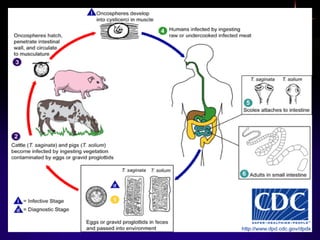
1-Taenia saginata:Beef tapeworm.
The cow is the intermediate host and
human is final host.
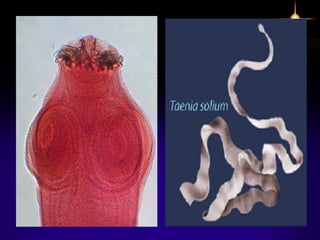
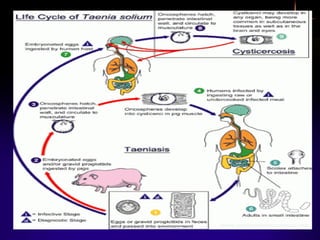
2- Taenia solium: Pork tapeworm
The pigs and human are the intermediate
host as well as human is the definitive host
which carries the adult worm.
Have two medical important species
4.
Cestoda
A- All cestodaare hermaphrodites. Both male and female
reproductive organs at the same mature segment)
B- All cestoda have stages: ovum, larva and adult. The length
of an adult worm varies, according to the species, from 3-8
mm to 25 or 30 feet.
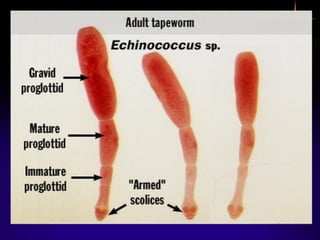
*The Cestodes main structure is divided into
1- The scolex, or head, which bears the organs of attachment. it
has either suckers with or without rostellum and hooks.
2- The neck that is the region of segment proliferation and
production of segments.
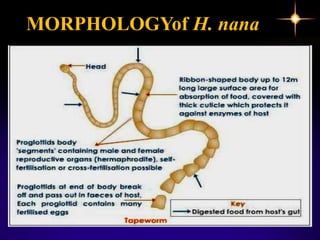
3- The chain of fragments called proglottids or segments (totally
are called strobila) or The strobila is made up of segments
called proglottids.
6.
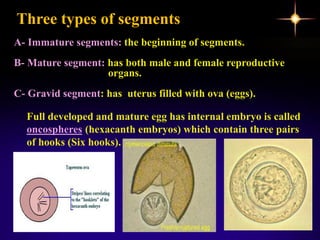
Three types ofsegments
A- Immature segments: the beginning of segments.
B- Mature segment: has both male and female reproductive
organs.
C- Gravid segment: has uterus filled with ova (eggs).
Full developed and mature egg has internal embryo is called
oncospheres (hexacanth embryos) which contain three pairs
of hooks (Six hooks).
7.
Taenia saginatacalled Beef T.W.
Taenia solium called Pork T.W.
Hymenoleps nana called Dwarf T.W.
Echinococus granulosus called Dog T.W.
Cestoda tape worm
8.
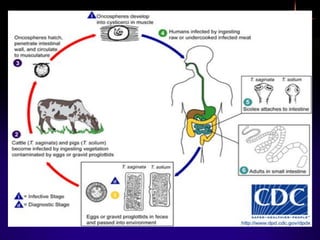
1-Taenia saginata (Beeftapeworm).
• Common name: called the beef tapeworm.
• Disease: beef tapeworm infection or beef taeniasis.
• Infective stage to human is called : cysticercus bovis is taken
by inadequate cooked meat of cows.
• Rout of infection: mouth.
• Habitat: adult worm in the small intestine of human.
• Cysticercus bovis larvae in the muscle of different organs of
cows.
10.
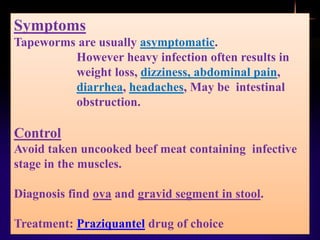
Symptoms
Tapeworms are usuallyasymptomatic.
However heavy infection often results in
weight loss, dizziness, abdominal pain,
diarrhea, headaches, May be intestinal
obstruction.
Control
Avoid taken uncooked beef meat containing infective
stage in the muscles.
Diagnosis find ova and gravid segment in stool.
Treatment: Praziquantel drug of choice
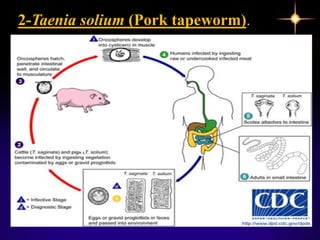
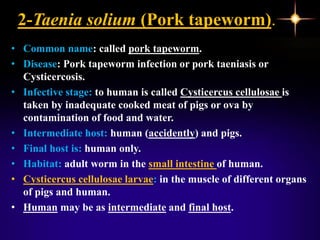
2-Taenia solium (Porktapeworm).
• Common name: called pork tapeworm.
• Disease: Pork tapeworm infection or pork taeniasis or
Cysticercosis.
• Infective stage: to human is called Cysticercus cellulosae is
taken by inadequate cooked meat of pigs or ova by
contamination of food and water.
• Intermediate host: human (accidently) and pigs.
• Final host is: human only.
• Habitat: adult worm in the small intestine of human.
• Cysticercus cellulosae larvae: in the muscle of different organs
of pigs and human.
• Human may be as intermediate and final host.
13.
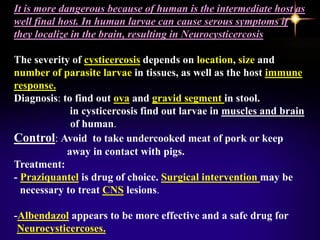
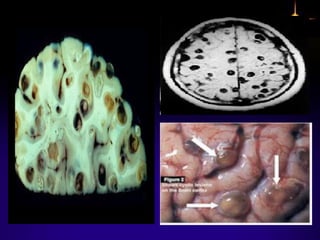
It is moredangerous because of human is the intermediate host as
well final host. In human larvae can cause serous symptoms if
they localize in the brain, resulting in Neurocysticercosis
The severity of cysticercosis depends on location, size and
number of parasite larvae in tissues, as well as the host immune
response.
Diagnosis: to find out ova and gravid segment in stool.
in cysticercosis find out larvae in muscles and brain
of human.
Control: Avoid to take undercooked meat of pork or keep
away in contact with pigs.
Treatment:
- Praziquantel is drug of choice. Surgical intervention may be
necessary to treat CNS lesions.
-Albendazol appears to be more effective and a safe drug for
Neurocysticercoses.
17.
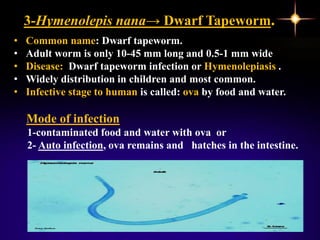
3-Hymenolepis nana→ DwarfTapeworm.
• Common name: Dwarf tapeworm.
• Adult worm is only 10-45 mm long and 0.5-1 mm wide
• Disease: Dwarf tapeworm infection or Hymenolepiasis .
• Widely distribution in children and most common.
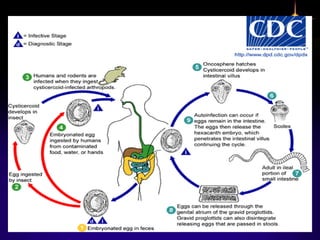
• Infective stage to human is called: ova by food and water.
Mode of infection
1-contaminated food and water with ova or
2- Auto infection, ova remains and hatches in the intestine.
• Rout ofinfection: Mouth.
• Habitat: Adult worm in the small intestine of human.
• Life cycle is direct no intermediate host.
Symptoms
• Rare symptoms include anorexia, vomiting, nausea and
behavioral disturbances.
Control
Avoid taken contaminated food and water.
• Diagnosis: By finding ova and gravid segment in stool.
• Treatment: praziquantel is the drug of choice.
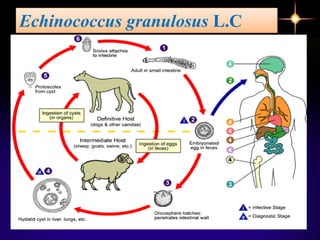
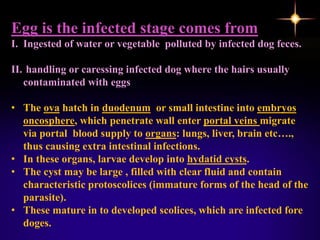
Egg is theinfected stage comes from
I. Ingested of water or vegetable polluted by infected dog feces.
II. handling or caressing infected dog where the hairs usually
contaminated with eggs
• The ova hatch in duodenum or small intestine into embryos
oncosphere, which penetrate wall enter portal veins migrate
via portal blood supply to organs: lungs, liver, brain etc….,
thus causing extra intestinal infections.
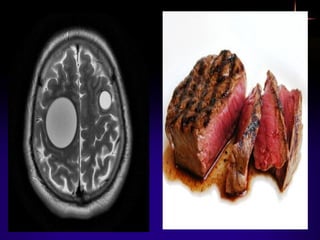
• In these organs, larvae develop into hydatid cysts.
• The cyst may be large , filled with clear fluid and contain
characteristic protoscolices (immature forms of the head of the
parasite).
• These mature in to developed scolices, which are infected fore
doges.
23.
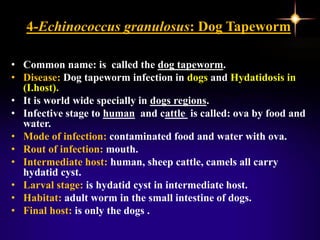
4-Echinococcus granulosus: DogTapeworm
• Common name: is called the dog tapeworm.
• Disease: Dog tapeworm infection in dogs and Hydatidosis in
(I.host).
• It is world wide specially in dogs regions.
• Infective stage to human and cattle is called: ova by food and
water.
• Mode of infection: contaminated food and water with ova.
• Rout of infection: mouth.
• Intermediate host: human, sheep cattle, camels all carry
hydatid cyst.
• Larval stage: is hydatid cyst in intermediate host.
• Habitat: adult worm in the small intestine of dogs.
• Final host: is only the dogs .
24.
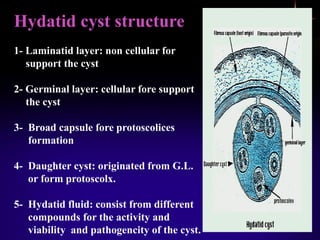
Hydatid cyst structure
1-Laminatid layer: non cellular for
support the cyst
2- Germinal layer: cellular fore support
the cyst
3- Broad capsule fore protoscolices
formation
4- Daughter cyst: originated from G.L.
or form protoscolx.
5- Hydatid fluid: consist from different
compounds for the activity and
viability and pathogencity of the cyst.
25.
Symptoms
• Rare symptomsbecause the cyst grow slowly unless it
rupture causing Anaphylactic shock due to release of
protoscolices and toxins of hydatid cyst.
* Control: Avoid taken contaminated food and water.
keep the dogs away with human contact.
* Diagnosis: Mostly X ray, CT scan or ultrasound to find the
cyst.
* Treatment: surgical intervention most common(90%)
ALBENDAZOLE DRUG OF CHOICE.