Taenia saginata (beef tapeworm)
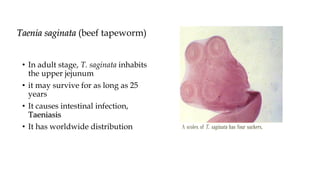
• In adult stage, T. saginata inhabits
the upper jejunum
• it may survive for as long as 25
years
• It causes intestinal infection,
Taeniasis
• It has worldwide distribution
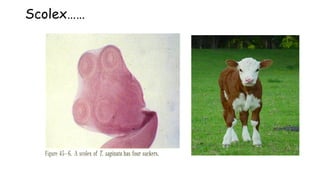
Scolex……
Taenia saginata….. Morphology
• Adult worm measures 5-10 meters in
length
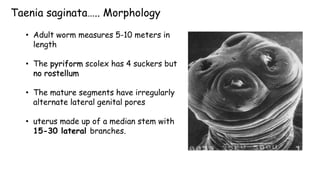
• The pyriform scolex has 4 suckers but
no rostellum
• The mature segments have irregularly
alternate lateral genital pores
• uterus made up of a median stem with
15-30 lateral branches.
Taenia saginata…….. Life cycle
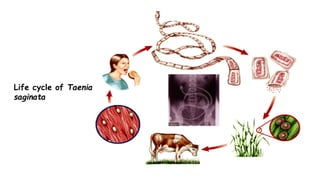
• The adult worm lives in the small intestine of man
• Gravid segments pass out in the stool and become
disintegrated and eggs come out to the soil
• The gravid proglottid uterus contains about 100,000
eggs
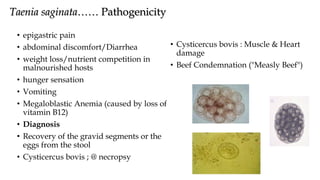
• The egg of T. saginata is round, about 40 microns in
diameter
• The 6-hooked embryo is enclosed in a radially striated
embryophore
• Eggs are ingested by an intermediate host, cattle.
Taenia saginata…….. Life cycle
• The 6 hooked embryo escapes from its shell, penetrates
through the intestinal wall into the blood vessels and is
carried to the muscles,
•
• it develops into a larval stage, cysticercus bovis (made up of an
invaginated /inverted head and spherical body).
• Infection to man takes place by the ingestion of raw or
insufficiently cooked beef
• In the small intestine of man, the head of the cysticercus-
infective, attaches to intestinal wall, gets invaginated and
the body becomes segmented.
Life cycle of Taenia
saginata
Taenia saginata…… Pathogenicity
• epigastric pain
• abdominal discomfort/Diarrhea
• weight loss/nutrient competition in
malnourished hosts
• hunger sensation
• Vomiting
• Megaloblastic Anemia (caused by loss of
vitamin B12)
• Diagnosis
• Recovery of the gravid segments or the
eggs from the stool
• Cysticercus bovis ; @ necropsy
• Cysticercus bovis : Muscle & Heart
damage
• Beef Condemnation ("Measly Beef")
Taenia saginata…… Treatment
Niclosamide (Yomesan): 2g, is given to adults and older children as
a single morning dose on an empty stomach; the tablets should be
chewed. Children of 2 to 6 years should receive 1g, and those below
250mg
Mebendazole (Vermox): 100mg PO, twice for 3days, second course
if no response after 3-4 Wks. Also Albendazole can be given
The alternative is praziquantel, 5 to 10mg/kg as a single dose after
a light breakfast. After either drug the proximal part of the worm
disintegrates in the gut and the scolex cannot be found. Failure of
proglottids to reappear within 3 to 4months indicates cure
♦ Thorough cooking of meat (above 570C)
♦ Proper disposal of human excreta
♦ Mass treatment of herd contacts, or whole adult populations
Prevention
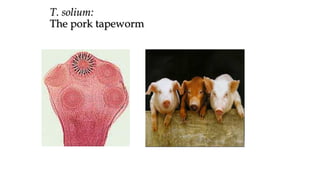
T. solium:
The pork tapeworm
•Worldwide distribution
•Large tapeworm
•Cause taeniasis due to T. solium
•Larval infection of Taenia solium
may cause serious clinical disease -
--CYSTICERCOSIS
Taenia solium
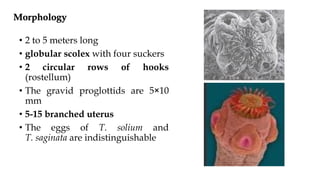
Morphology
• 2 to 5 meters long
• globular scolex with four suckers
• 2 circular rows of hooks
(rostellum)
• The gravid proglottids are 5×10
mm
• 5-15 branched uterus
• The eggs of T. solium and
T. saginata are indistinguishable
Main points of the life cycle
• Man is the only definitive host, but he can also be the
intermediate host for T. solium
• Pig is the important intermediate host for T. solium
• Adult worm reside in the lumen of the upper part of
small intestine
• The infective stage to man are both egg/gravid proglottid
and cysticercus for T.solium
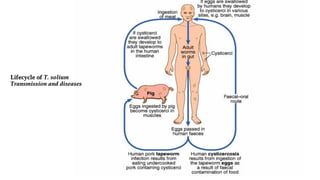
Lifecycle of T. solium
Transmission and diseases
Main points of the life cycle
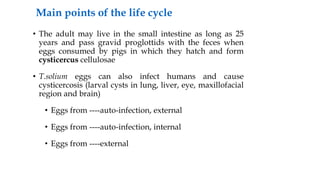
• The adult may live in the small intestine as long as 25
years and pass gravid proglottids with the feces when
eggs consumed by pigs in which they hatch and form
cysticercus cellulosae
• T.solium eggs can also infect humans and cause
cysticercosis (larval cysts in lung, liver, eye, maxillofacial
region and brain)
• Eggs from ----auto-infection, external
• Eggs from ----auto-infection, internal
• Eggs from ----external
• A tapeworm larval cyst (cysticercus) is ingested with poorly
cooked meat
• The larva escapes the cyst and passes to the small intestine
where it attaches to the mucosa by the scolex suckers
• The proglottids develop as the worm matures in 3 to 4
months
• The cysticercus stage of T. solium can be found anywhere in
the body -- subcutaneous, muscles, eye, brain
• Regardless of the tissue affected, pathological consequences
are those of a space-occupying lesion
• Cysticerci in brain tend to grow to a larger size than those in
other tissues
• The process of calcification may be accompanied by the
release of antigens -- inflammatory reaction
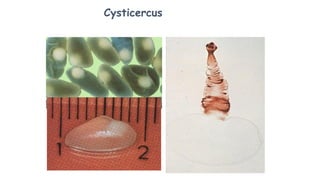
Metacestode stage – Cysticercosis
Cysticercus
Pathogenesis and clinical features
• Adult worm —Teaniasis
• Light infections remain asymptomatic
• Heavier infections may produce
abdominal discomfort, epigastric pain,
vomiting and diarrhea
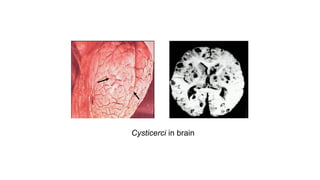
Cysticerci in brain
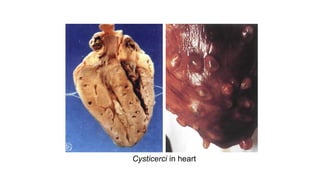
Cysticerci in heart
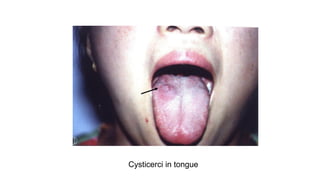
Cysticerci in tongue
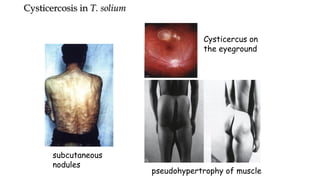
subcutaneous
nodules
Cysticercus on
the eyeground
pseudohypertrophy of muscle
Cysticercosis in T. solium
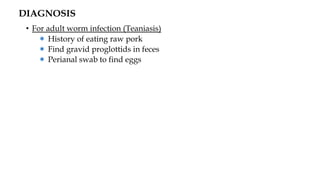
DIAGNOSIS
• For adult worm infection (Teaniasis)
* History of eating raw pork
* Find gravid proglottids in feces
* Perianal swab to find eggs
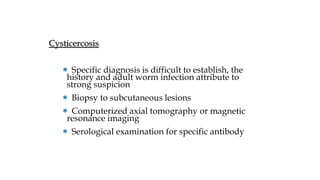
Cysticercosis
* Specific diagnosis is difficult to establish, the
history and adult worm infection attribute to
strong suspicion
* Biopsy to subcutaneous lesions
* Computerized axial tomography or magnetic
resonance imaging
* Serological examination for specific antibody
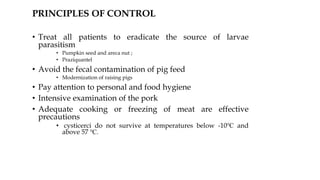
PRINCIPLES OF CONTROL
• Treat all patients to eradicate the source of larvae
parasitism
• Pumpkin seed and areca nut ;
• Praziquantel
• Avoid the fecal contamination of pig feed
• Modernization of raising pigs
• Pay attention to personal and food hygiene
• Intensive examination of the pork
• Adequate cooking or freezing of meat are effective
precautions
• cysticerci do not survive at temperatures below -10℃ and
above 57 ℃.
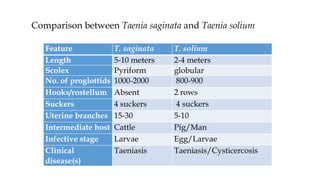
Feature T. saginata T. solium
Length 5-10 meters 2-4 meters
Scolex Pyriform globular
No. of proglottids 1000-2000 800-900
Hooks/rostellum Absent 2 rows
Suckers 4 suckers 4 suckers
Uterine branches 15-30 5-10
Intermediate host Cattle Pig/Man
Infective stage Larvae Egg/Larvae
Clinical
disease(s)
Taeniasis Taeniasis/Cysticercosis
Comparison between Taenia saginata and Taenia solium

Lect 5 Taeniasis 2021.pdf

  • 1.
    Taenia saginata (beeftapeworm) • In adult stage, T. saginata inhabits the upper jejunum • it may survive for as long as 25 years • It causes intestinal infection, Taeniasis • It has worldwide distribution
  • 2.
  • 3.
    Taenia saginata….. Morphology •Adult worm measures 5-10 meters in length • The pyriform scolex has 4 suckers but no rostellum • The mature segments have irregularly alternate lateral genital pores • uterus made up of a median stem with 15-30 lateral branches.
  • 4.
    Taenia saginata…….. Lifecycle • The adult worm lives in the small intestine of man • Gravid segments pass out in the stool and become disintegrated and eggs come out to the soil • The gravid proglottid uterus contains about 100,000 eggs • The egg of T. saginata is round, about 40 microns in diameter • The 6-hooked embryo is enclosed in a radially striated embryophore • Eggs are ingested by an intermediate host, cattle.
  • 5.
    Taenia saginata…….. Lifecycle • The 6 hooked embryo escapes from its shell, penetrates through the intestinal wall into the blood vessels and is carried to the muscles, • • it develops into a larval stage, cysticercus bovis (made up of an invaginated /inverted head and spherical body). • Infection to man takes place by the ingestion of raw or insufficiently cooked beef • In the small intestine of man, the head of the cysticercus- infective, attaches to intestinal wall, gets invaginated and the body becomes segmented.
  • 6.
    Life cycle ofTaenia saginata
  • 7.
    Taenia saginata…… Pathogenicity •epigastric pain • abdominal discomfort/Diarrhea • weight loss/nutrient competition in malnourished hosts • hunger sensation • Vomiting • Megaloblastic Anemia (caused by loss of vitamin B12) • Diagnosis • Recovery of the gravid segments or the eggs from the stool • Cysticercus bovis ; @ necropsy • Cysticercus bovis : Muscle & Heart damage • Beef Condemnation ("Measly Beef")
  • 8.
    Taenia saginata…… Treatment Niclosamide(Yomesan): 2g, is given to adults and older children as a single morning dose on an empty stomach; the tablets should be chewed. Children of 2 to 6 years should receive 1g, and those below 250mg Mebendazole (Vermox): 100mg PO, twice for 3days, second course if no response after 3-4 Wks. Also Albendazole can be given The alternative is praziquantel, 5 to 10mg/kg as a single dose after a light breakfast. After either drug the proximal part of the worm disintegrates in the gut and the scolex cannot be found. Failure of proglottids to reappear within 3 to 4months indicates cure
  • 9.
    ♦ Thorough cookingof meat (above 570C) ♦ Proper disposal of human excreta ♦ Mass treatment of herd contacts, or whole adult populations Prevention
  • 10.
  • 11.
    •Worldwide distribution •Large tapeworm •Causetaeniasis due to T. solium •Larval infection of Taenia solium may cause serious clinical disease - --CYSTICERCOSIS Taenia solium
  • 12.
    Morphology • 2 to5 meters long • globular scolex with four suckers • 2 circular rows of hooks (rostellum) • The gravid proglottids are 5×10 mm • 5-15 branched uterus • The eggs of T. solium and T. saginata are indistinguishable
  • 13.
    Main points ofthe life cycle • Man is the only definitive host, but he can also be the intermediate host for T. solium • Pig is the important intermediate host for T. solium • Adult worm reside in the lumen of the upper part of small intestine • The infective stage to man are both egg/gravid proglottid and cysticercus for T.solium
  • 14.
    Lifecycle of T.solium Transmission and diseases
  • 15.
    Main points ofthe life cycle • The adult may live in the small intestine as long as 25 years and pass gravid proglottids with the feces when eggs consumed by pigs in which they hatch and form cysticercus cellulosae • T.solium eggs can also infect humans and cause cysticercosis (larval cysts in lung, liver, eye, maxillofacial region and brain) • Eggs from ----auto-infection, external • Eggs from ----auto-infection, internal • Eggs from ----external
  • 16.
    • A tapewormlarval cyst (cysticercus) is ingested with poorly cooked meat • The larva escapes the cyst and passes to the small intestine where it attaches to the mucosa by the scolex suckers • The proglottids develop as the worm matures in 3 to 4 months
  • 17.
    • The cysticercusstage of T. solium can be found anywhere in the body -- subcutaneous, muscles, eye, brain • Regardless of the tissue affected, pathological consequences are those of a space-occupying lesion • Cysticerci in brain tend to grow to a larger size than those in other tissues • The process of calcification may be accompanied by the release of antigens -- inflammatory reaction Metacestode stage – Cysticercosis
  • 18.
  • 19.
    Pathogenesis and clinicalfeatures • Adult worm —Teaniasis • Light infections remain asymptomatic • Heavier infections may produce abdominal discomfort, epigastric pain, vomiting and diarrhea
  • 20.
  • 21.
  • 22.
  • 23.
  • 24.
    DIAGNOSIS • For adultworm infection (Teaniasis) * History of eating raw pork * Find gravid proglottids in feces * Perianal swab to find eggs
  • 25.
    Cysticercosis * Specific diagnosisis difficult to establish, the history and adult worm infection attribute to strong suspicion * Biopsy to subcutaneous lesions * Computerized axial tomography or magnetic resonance imaging * Serological examination for specific antibody
  • 26.
    PRINCIPLES OF CONTROL •Treat all patients to eradicate the source of larvae parasitism • Pumpkin seed and areca nut ; • Praziquantel • Avoid the fecal contamination of pig feed • Modernization of raising pigs • Pay attention to personal and food hygiene • Intensive examination of the pork • Adequate cooking or freezing of meat are effective precautions • cysticerci do not survive at temperatures below -10℃ and above 57 ℃.
  • 27.
    Feature T. saginataT. solium Length 5-10 meters 2-4 meters Scolex Pyriform globular No. of proglottids 1000-2000 800-900 Hooks/rostellum Absent 2 rows Suckers 4 suckers 4 suckers Uterine branches 15-30 5-10 Intermediate host Cattle Pig/Man Infective stage Larvae Egg/Larvae Clinical disease(s) Taeniasis Taeniasis/Cysticercosis Comparison between Taenia saginata and Taenia solium