T alking about the  F uture using  P resent  T enses
T alking about the  F uture using  P resent  T enses W hen you are talking about something in the future which is based on an official timetable or calender, you use the present simple tense. You usually put a time adverbial in these sentences. The train  leaves  Euston at  11.30 . The UN General Assembly  opens  in New York  this month .
T alking about the  F uture using  P resent  T enses I n statements about fixed dates, you normally use the present simple. Tomorrow  is  Tuesday. It ’s  my birthday next month. Monday  is  the seventeenth of July.
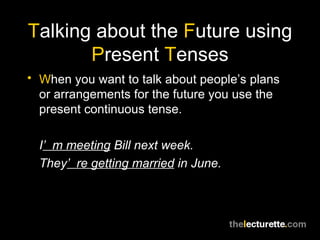
T alking about the  F uture using  P resent  T enses W hen you want to talk about people’s plans or arrangements for the future you use the present continuous tense. I ’m meeting  Bill next week. They ’re getting married  in June.
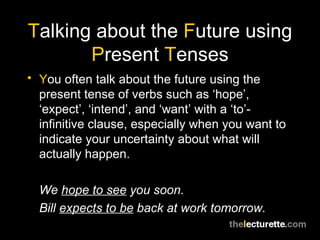
T alking about the  F uture using  P resent  T enses Y ou often talk about the future using the present tense of verbs such as ‘hope’, ‘expect’, ‘intend’, and ‘want’ with a ‘to’-infinitive clause, especially when you want to indicate your uncertainty about what will actually happen. We  hope to see  you soon. Bill  expects to be  back at work tomorrow.
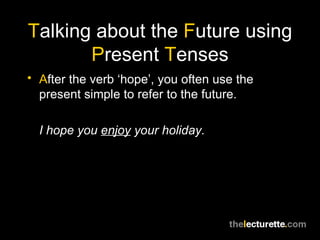
T alking about the  F uture using  P resent  T enses A fter the verb ‘hope’, you often use the present simple to refer to the future. I hope you  enjoy  your holiday.
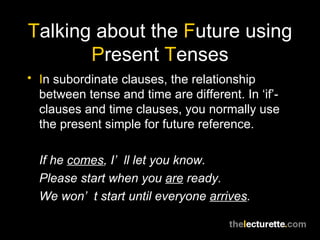
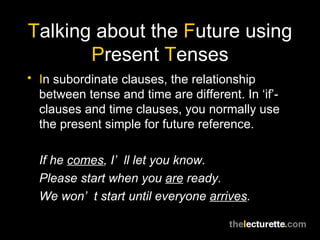
T alking about the  F uture using  P resent  T enses I n subordinate clauses, the relationship between tense and time are different. In ‘if’-clauses and time clauses, you normally use the present simple for future reference. If he  comes , I’ll let you know. Please start when you  are  ready. We won’t start until everyone  arrives .
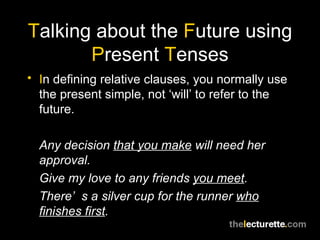
T alking about the  F uture using  P resent  T enses I n defining relative clauses, you normally use the present simple, not ‘will’ to refer to the future. Any decision  that you make  will need her approval. Give my love to any friends  you meet . There’s a silver cup for the runner  who finishes first .
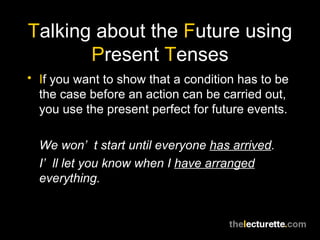
T alking about the  F uture using  P resent  T enses I f you want to show that a condition has to be the case before an action can be carried out, you use the present perfect for future events. We won’t start until everyone  has arrived . I’ll let you know when I  have arranged  everything.
Q uestions? For more slide presentations visit:

Talking about the Future using Present Tenses

  • 1.
    T alking aboutthe F uture using P resent T enses
  • 2.
    T alking aboutthe F uture using P resent T enses W hen you are talking about something in the future which is based on an official timetable or calender, you use the present simple tense. You usually put a time adverbial in these sentences. The train leaves Euston at 11.30 . The UN General Assembly opens in New York this month .
  • 3.
    T alking aboutthe F uture using P resent T enses I n statements about fixed dates, you normally use the present simple. Tomorrow is Tuesday. It ’s my birthday next month. Monday is the seventeenth of July.
  • 4.
    T alking aboutthe F uture using P resent T enses W hen you want to talk about people’s plans or arrangements for the future you use the present continuous tense. I ’m meeting Bill next week. They ’re getting married in June.
  • 5.
    T alking aboutthe F uture using P resent T enses Y ou often talk about the future using the present tense of verbs such as ‘hope’, ‘expect’, ‘intend’, and ‘want’ with a ‘to’-infinitive clause, especially when you want to indicate your uncertainty about what will actually happen. We hope to see you soon. Bill expects to be back at work tomorrow.
  • 6.
    T alking aboutthe F uture using P resent T enses A fter the verb ‘hope’, you often use the present simple to refer to the future. I hope you enjoy your holiday.
  • 7.
    T alking aboutthe F uture using P resent T enses I n subordinate clauses, the relationship between tense and time are different. In ‘if’-clauses and time clauses, you normally use the present simple for future reference. If he comes , I’ll let you know. Please start when you are ready. We won’t start until everyone arrives .
  • 8.
    T alking aboutthe F uture using P resent T enses I n subordinate clauses, the relationship between tense and time are different. In ‘if’-clauses and time clauses, you normally use the present simple for future reference. If he comes , I’ll let you know. Please start when you are ready. We won’t start until everyone arrives .
  • 9.
    T alking aboutthe F uture using P resent T enses I n defining relative clauses, you normally use the present simple, not ‘will’ to refer to the future. Any decision that you make will need her approval. Give my love to any friends you meet . There’s a silver cup for the runner who finishes first .
  • 10.
    T alking aboutthe F uture using P resent T enses I f you want to show that a condition has to be the case before an action can be carried out, you use the present perfect for future events. We won’t start until everyone has arrived . I’ll let you know when I have arranged everything.
  • 11.
    Q uestions? Formore slide presentations visit: