by Miss Stefanie Herzberg
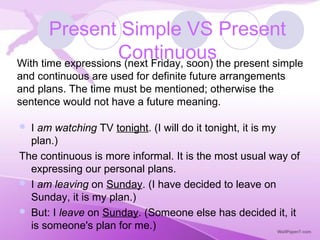
Present Simple VS Present
Continuous
Simple Present Present Continuous
Action set by a time table or
schedule
Action already arranged for the
near future
“The bus arrives at 6.55.” (it is
stated officially)
“I am going to bed in a minute.” (it
is my plan)
 I am watching TV tonight. (I will do it tonight, it is my
plan.)
The continuous is more informal. It is the most usual way of
expressing our personal plans.
 I am leaving on Sunday. (I have decided to leave on
Sunday, it is my plan.)
 But: I leave on Sunday. (Someone else has decided it, it
is someone's plan for me.)
Present Simple VS Present
ContinuousWith time expressions (next Friday, soon) the present simple
and continuous are used for definite future arrangements
and plans. The time must be mentioned; otherwise the
sentence would not have a future meaning.
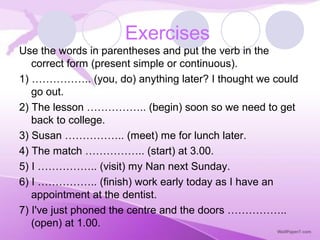
Use the words in parentheses and put the verb in the
correct form (present simple or continuous).
1) …………….. (you, do) anything later? I thought we could
go out.
2) The lesson …………….. (begin) soon so we need to get
back to college.
3) Susan …………….. (meet) me for lunch later.
4) The match …………….. (start) at 3.00.
5) I …………….. (visit) my Nan next Sunday.
6) I …………….. (finish) work early today as I have an
appointment at the dentist.
7) I've just phoned the centre and the doors ……………..
(open) at 1.00.
Exercises
References
 Flo-Joe (2013). Present Simple & Continuous as
Future Tenses. Retrieved from http
://www.flo-joe.co.uk/preliminaryenglish/grammar/pres
 Mgr. Petr Kulatý (2013). Present Tenses for
Future Going to Exercises. Retrieved from http://
www.e-grammar.org/present-tense-be-going-to-
future/
References
 Flo-Joe (2013). Present Simple & Continuous as
Future Tenses. Retrieved from http
://www.flo-joe.co.uk/preliminaryenglish/grammar/pres
 Mgr. Petr Kulatý (2013). Present Tenses for
Future Going to Exercises. Retrieved from http://
www.e-grammar.org/present-tense-be-going-to-
future/

Present simple and continuous for future

  • 1.
  • 2.
    Present Simple VSPresent Continuous Simple Present Present Continuous Action set by a time table or schedule Action already arranged for the near future “The bus arrives at 6.55.” (it is stated officially) “I am going to bed in a minute.” (it is my plan)
  • 3.
     I amwatching TV tonight. (I will do it tonight, it is my plan.) The continuous is more informal. It is the most usual way of expressing our personal plans.  I am leaving on Sunday. (I have decided to leave on Sunday, it is my plan.)  But: I leave on Sunday. (Someone else has decided it, it is someone's plan for me.) Present Simple VS Present ContinuousWith time expressions (next Friday, soon) the present simple and continuous are used for definite future arrangements and plans. The time must be mentioned; otherwise the sentence would not have a future meaning.
  • 4.
    Use the wordsin parentheses and put the verb in the correct form (present simple or continuous). 1) …………….. (you, do) anything later? I thought we could go out. 2) The lesson …………….. (begin) soon so we need to get back to college. 3) Susan …………….. (meet) me for lunch later. 4) The match …………….. (start) at 3.00. 5) I …………….. (visit) my Nan next Sunday. 6) I …………….. (finish) work early today as I have an appointment at the dentist. 7) I've just phoned the centre and the doors …………….. (open) at 1.00. Exercises
  • 5.
    References  Flo-Joe (2013).Present Simple & Continuous as Future Tenses. Retrieved from http ://www.flo-joe.co.uk/preliminaryenglish/grammar/pres  Mgr. Petr Kulatý (2013). Present Tenses for Future Going to Exercises. Retrieved from http:// www.e-grammar.org/present-tense-be-going-to- future/
  • 6.
    References  Flo-Joe (2013).Present Simple & Continuous as Future Tenses. Retrieved from http ://www.flo-joe.co.uk/preliminaryenglish/grammar/pres  Mgr. Petr Kulatý (2013). Present Tenses for Future Going to Exercises. Retrieved from http:// www.e-grammar.org/present-tense-be-going-to- future/