future tenses
future simple
going to
present continuous
present simple
future simple
USE
We use this tense to express a pure future. Actions expressed in
the simple future are bound to happen because of the course
of time. This means that the speaker has no power over the
events, that he cannot control what will happen. For this reason
this tense is also called the uncertain future..
Examples
He will be sixteen years old next Friday.
The baby will be born next month
future simple
USE
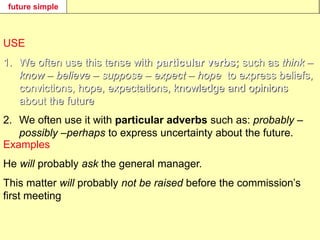
1. We often use this tense with particular verbs; such as think –
know – believe – suppose – expect – hope to express beliefs,
convictions, hope, expectations, knowledge and opinions
about the future.
Examples
I think Brazil will win.
I don’t suppose she will be promoted now
future simple
USE
1. We often use this tense with particular verbs; such as think –
know – believe – suppose – expect – hope to express beliefs,
convictions, hope, expectations, knowledge and opinions
about the future.
2. We often use it with particular adverbs such as: probably –
possibly –perhaps to express uncertainty about the future.
Examples
He will probably ask the general manager.
This matter will probably not be raised before the commission’s
first meeting
future simple
USE
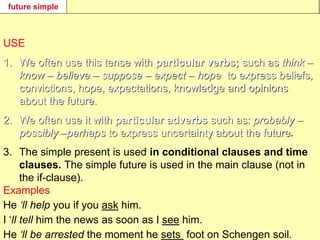
1. We often use this tense with particular verbs; such as think –
know – believe – suppose – expect – hope to express beliefs,
convictions, hope, expectations, knowledge and opinions
about the future.
2. We often use it with particular adverbs such as: probably –
possibly –perhaps to express uncertainty about the future.
3. The simple present is used in conditional clauses and time
clauses. The simple future is used in the main clause (not in
the if-clause).
Examples
He ‘ll help you if you ask him.
I ‘ll tell him the news as soon as I see him.
He ‘ll be arrested the moment he sets foot on Schengen soil.
FORM
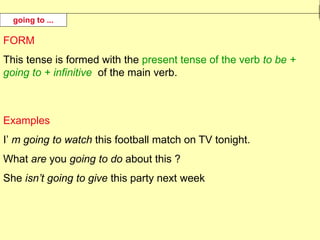
This tense is formed with the present tense of the verb to be +
going to + infinitive of the main verb.
Examples
I’ m going to watch this football match on TV tonight.
What are you going to do about this ?
She isn’t going to give this party next week
going to ...
USE
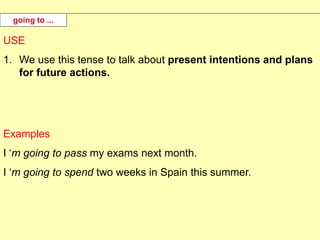
1. We use this tense to talk about present intentions and plans
for future actions.
Examples
I ‘m going to pass my exams next month.
I ‘m going to spend two weeks in Spain this summer.
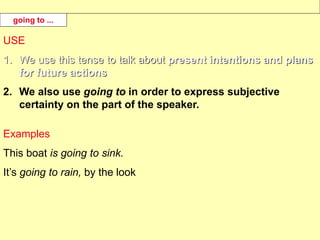
going to ...
USE
1. We use this tense to talk about present intentions and plans
for future actions.
2. We also use going to in order to express subjective
certainty on the part of the speaker.
Examples
This boat is going to sink.
It’s going to rain, by the look
going to ...
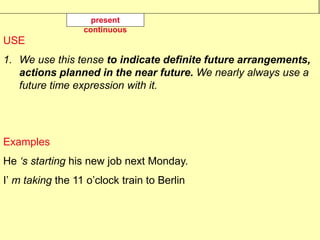
USE
1. We use this tense to indicate definite future arrangements,
actions planned in the near future. We nearly always use a
future time expression with it.
Examples
He ‘s starting his new job next Monday.
I’ m taking the 11 o’clock train to Berlin
present
continuous
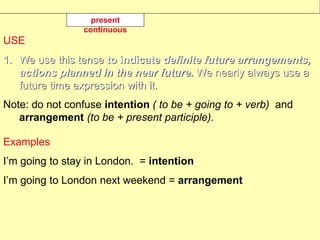
USE
1. We use this tense to indicate definite future arrangements,
actions planned in the near future. We nearly always use a
future time expression with it.
Note: do not confuse intention ( to be + going to + verb) and
arrangement (to be + present participle).
Examples
I’m going to stay in London. = intention
I’m going to London next weekend = arrangement
present
continuous
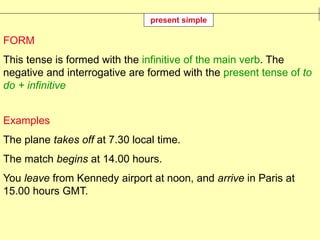
FORM
This tense is formed with the infinitive of the main verb. The
negative and interrogative are formed with the present tense of to
do + infinitive
Examples
The plane takes off at 7.30 local time.
The match begins at 14.00 hours.
You leave from Kennedy airport at noon, and arrive in Paris at
15.00 hours GMT.
present simple
USE
We use this tense to talk about planned future actions. We
usually use it to describe travel plans, time tables, departures,
arrivals.
Examples
The bus leaves at 15.30.
The reception starts at 19.00 hours.
The ferry leaves Dover at 12.30 tomorrow and we arrive at Calais
at 13.15.
present simple

Future forms presentation

  • 1.
    future tenses future simple goingto present continuous present simple
  • 2.
    future simple USE We usethis tense to express a pure future. Actions expressed in the simple future are bound to happen because of the course of time. This means that the speaker has no power over the events, that he cannot control what will happen. For this reason this tense is also called the uncertain future.. Examples He will be sixteen years old next Friday. The baby will be born next month
  • 3.
    future simple USE 1. Weoften use this tense with particular verbs; such as think – know – believe – suppose – expect – hope to express beliefs, convictions, hope, expectations, knowledge and opinions about the future. Examples I think Brazil will win. I don’t suppose she will be promoted now
  • 4.
    future simple USE 1. Weoften use this tense with particular verbs; such as think – know – believe – suppose – expect – hope to express beliefs, convictions, hope, expectations, knowledge and opinions about the future. 2. We often use it with particular adverbs such as: probably – possibly –perhaps to express uncertainty about the future. Examples He will probably ask the general manager. This matter will probably not be raised before the commission’s first meeting
  • 5.
    future simple USE 1. Weoften use this tense with particular verbs; such as think – know – believe – suppose – expect – hope to express beliefs, convictions, hope, expectations, knowledge and opinions about the future. 2. We often use it with particular adverbs such as: probably – possibly –perhaps to express uncertainty about the future. 3. The simple present is used in conditional clauses and time clauses. The simple future is used in the main clause (not in the if-clause). Examples He ‘ll help you if you ask him. I ‘ll tell him the news as soon as I see him. He ‘ll be arrested the moment he sets foot on Schengen soil.
  • 6.
    FORM This tense isformed with the present tense of the verb to be + going to + infinitive of the main verb. Examples I’ m going to watch this football match on TV tonight. What are you going to do about this ? She isn’t going to give this party next week going to ...
  • 7.
    USE 1. We usethis tense to talk about present intentions and plans for future actions. Examples I ‘m going to pass my exams next month. I ‘m going to spend two weeks in Spain this summer. going to ...
  • 8.
    USE 1. We usethis tense to talk about present intentions and plans for future actions. 2. We also use going to in order to express subjective certainty on the part of the speaker. Examples This boat is going to sink. It’s going to rain, by the look going to ...
  • 9.
    USE 1. We usethis tense to indicate definite future arrangements, actions planned in the near future. We nearly always use a future time expression with it. Examples He ‘s starting his new job next Monday. I’ m taking the 11 o’clock train to Berlin present continuous
  • 10.
    USE 1. We usethis tense to indicate definite future arrangements, actions planned in the near future. We nearly always use a future time expression with it. Note: do not confuse intention ( to be + going to + verb) and arrangement (to be + present participle). Examples I’m going to stay in London. = intention I’m going to London next weekend = arrangement present continuous
  • 11.
    FORM This tense isformed with the infinitive of the main verb. The negative and interrogative are formed with the present tense of to do + infinitive Examples The plane takes off at 7.30 local time. The match begins at 14.00 hours. You leave from Kennedy airport at noon, and arrive in Paris at 15.00 hours GMT. present simple
  • 12.
    USE We use thistense to talk about planned future actions. We usually use it to describe travel plans, time tables, departures, arrivals. Examples The bus leaves at 15.30. The reception starts at 19.00 hours. The ferry leaves Dover at 12.30 tomorrow and we arrive at Calais at 13.15. present simple