FUTURE TENSES
PIONEER B1 PLUS UNIT 5
Types of Future Tense
There are four types of future tense:
 Future Progressive Tense (Will be)
 Simple Future Tense (Will)
 Simple present as future
 Present progressive as future
 Future Perfect Tense
 Future Perfect Progressive Tense
Let us understand more about each one of them and how they can be used to
refer to the future. The future tense expresses what will happen or what the
subject will do at some time in the future. The future tense is also used after
conjunctions of time to refer to future actions.
The perfect future is the compound form of the future tense and expresses what
shall or will have been entirely completed at a given time or what will have
been completed before another future action takes place.
SIMPLE FUTURE Will + V1
Function Example
1. To express a decision made at the moment of
speaking.
A: what would you like to have?B: I’ll have an
orange juice.
2. To announce a planned future event (i.e. On the
news- in a newspaper)
The President will open the new hospital next
Friday.
3. To express a willingness or unwillingness to
carry out a future action a) To make a
promise  b) To make an offer 
A: the phone is ringing.B: I’ll get ita)-Don’t worry
we will find the right job for you.b)-I’ll take you to
airport.
4. To make a prediction a) To express
a certainty or  uncertainty (with maybe, perhaps,
I’m sure, I’m not sure, etc) b) To express thoughts,
hopes,  beliefs, and expectations about the
future
Fortuneteller: you will marry with a millionaire. a)-
According to weather forecast, it will not snow
tomorrow. (But weather forecast isn’t always
right.)b)--If he changes his mind, he’ll let us
know.b)-I hope, things will improve soon
5. To talk about an event which is certain to
happen
I’ll be 22on Monday.HINT: this is not a planned
action or event.
©Rafael
Moreno
Esteba
n
Structure: Future with Will
I
You
He
She
It
We
You
They
will ('ll) help you immediately.
won't leave soon.
Will it rain tomorrow?
Common future time expressions include:
 next (week, month, year)
 tomorrow
 in X's time (amount of time, i.e. two week's
time)
 in year, time clauses (when, as soon as, before,
after)
 simple present (example: I will telephone as
soon as I arrive.) soon, later
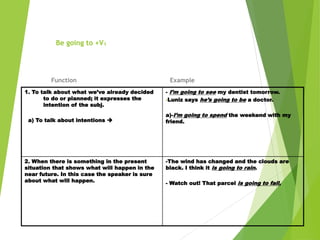
Be going to +V1
Function Example
1. To talk about what we’ve already decided
to do or planned; it expresses the
intention of the subj.
a) To talk about intentions 
- I’m going to see my dentist tomorrow.
-Luniz says he’s going to be a doctor.
a)-I’m going to spend the weekend with my
friend.
2. When there is something in the present
situation that shows what will happen in the
near future. In this case the speaker is sure
about what will happen.
-The wind has changed and the clouds are
black. I think it is going to rain.
- Watch out! That parcel is going to fall.
©Rafael Moreno Esteban
Structure: Future with Going to
I'm going to (I am)
You're going to (You are)
He's going to (He is)
She's going to (She is)
It's going to (It is)
We're going to (We are)
You're going to (You are)
They're going to (They are)
work this evening.
I'm not going to (I am not)
You aren't going to (You are not)
He isn't going to (He is not)
She isn't going to (She is not)
It isn't going to (It is not)
We aren't going to (We are not)
You aren't going to (You are not)
They aren't going to (They are not)
come this evening.
What
am I going to
are you going to
is he going to
is she going to
is it going toare we going to
are you going to
are they going to
do tomorrow?
©Rafael Moreno Esteban
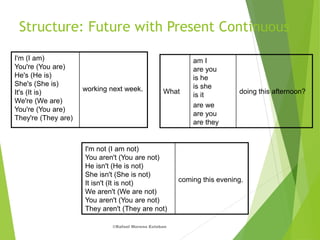
Structure: Future with Present Continuous
I'm (I am)
You're (You are)
He's (He is)
She's (She is)
It's (It is)
We're (We are)
You're (You are)
They're (They are)
working next week.
I'm not (I am not)
You aren't (You are not)
He isn't (He is not)
She isn't (She is not)
It isn't (It is not)
We aren't (We are not)
You aren't (You are not)
They aren't (They are not)
coming this evening.
What
am I
are you
is he
is she
is it
are we
are you
are they
doing this afternoon?
©Rafael Moreno Esteban
Structure: Future with Simple Present
I
You
We
They
arrive at noon.
He
She
It
arrives at noon.
I
You
We
They
don't leave at noon.
He
She
It
doesn't leave at noon.
Do
I
You
We
They
leave at noon?
Does
He
She
It
leave at noon?
©Rafael Moreno Esteban
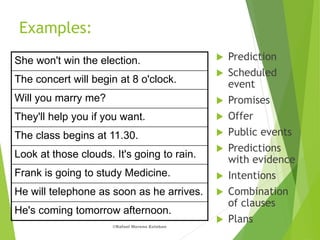
Examples:
 Prediction
 Scheduled
event
 Promises
 Offer
 Public events
 Predictions
with evidence
 Intentions
 Combination
of clauses
 Plans
She won't win the election.
The concert will begin at 8 o'clock.
Will you marry me?
They'll help you if you want.
The class begins at 11.30.
Look at those clouds. It's going to rain.
Frank is going to study Medicine.
He will telephone as soon as he arrives.
He's coming tomorrow afternoon.
The future progressive/continuous (will
be+ Ving)
Function Example
1. For an action, which will be in progress at a
time in the future.
This time tomorrow I’ll be flying to Istanbul.
Next year we’ll be living in Antalya.
2. For an action that’s part of a plan or
arrangement.
She will be leaving school in July.
3. As a polite way of asking about someone’s
plan.
Will you be watching Sunday’s film this noon?
The future perfect (will+ have+ V3)
Function Example
1. To talk about an action or event that will already
be completed by a certain time in the future.
-The program will have ended long before we get
back.
2. When something is taken for granted. -He’ll undoubtedly have made 100 runs before the
end of the game.
3. We use the future perfect with verbs which point
to completion, complete, finish, start, leave, retire etc
-Hurry up! By the time we get there the film will
have started.
4. We often use future perfect with by, and not….
till/until.
-I’ll have retired by the year 2015
-I won’t have retired till the year 2015
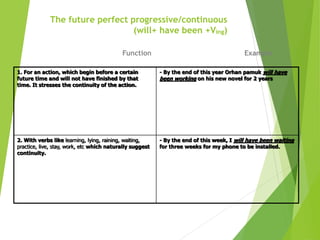
The future perfect progressive/continuous
(will+ have been +Ving)
Function Example
1. For an action, which begin before a certain
future time and will not have finished by that
time. It stresses the continuity of the action.
- By the end of this year Orhan pamuk will have
been working on his new novel for 2 years
2. With verbs like learning, lying, raining, waiting,
practice, live, stay, work, etc which naturally suggest
continuity.
- By the end of this week, I will have been waiting
for three weeks for my phone to be installed.

Future tenses unit 5

  • 1.
  • 2.
    Types of FutureTense There are four types of future tense:  Future Progressive Tense (Will be)  Simple Future Tense (Will)  Simple present as future  Present progressive as future  Future Perfect Tense  Future Perfect Progressive Tense Let us understand more about each one of them and how they can be used to refer to the future. The future tense expresses what will happen or what the subject will do at some time in the future. The future tense is also used after conjunctions of time to refer to future actions. The perfect future is the compound form of the future tense and expresses what shall or will have been entirely completed at a given time or what will have been completed before another future action takes place.
  • 3.
    SIMPLE FUTURE Will+ V1 Function Example 1. To express a decision made at the moment of speaking. A: what would you like to have?B: I’ll have an orange juice. 2. To announce a planned future event (i.e. On the news- in a newspaper) The President will open the new hospital next Friday. 3. To express a willingness or unwillingness to carry out a future action a) To make a promise  b) To make an offer  A: the phone is ringing.B: I’ll get ita)-Don’t worry we will find the right job for you.b)-I’ll take you to airport. 4. To make a prediction a) To express a certainty or  uncertainty (with maybe, perhaps, I’m sure, I’m not sure, etc) b) To express thoughts, hopes,  beliefs, and expectations about the future Fortuneteller: you will marry with a millionaire. a)- According to weather forecast, it will not snow tomorrow. (But weather forecast isn’t always right.)b)--If he changes his mind, he’ll let us know.b)-I hope, things will improve soon 5. To talk about an event which is certain to happen I’ll be 22on Monday.HINT: this is not a planned action or event.
  • 4.
    ©Rafael Moreno Esteba n Structure: Future withWill I You He She It We You They will ('ll) help you immediately. won't leave soon. Will it rain tomorrow?
  • 5.
    Common future timeexpressions include:  next (week, month, year)  tomorrow  in X's time (amount of time, i.e. two week's time)  in year, time clauses (when, as soon as, before, after)  simple present (example: I will telephone as soon as I arrive.) soon, later
  • 6.
    Be going to+V1 Function Example 1. To talk about what we’ve already decided to do or planned; it expresses the intention of the subj. a) To talk about intentions  - I’m going to see my dentist tomorrow. -Luniz says he’s going to be a doctor. a)-I’m going to spend the weekend with my friend. 2. When there is something in the present situation that shows what will happen in the near future. In this case the speaker is sure about what will happen. -The wind has changed and the clouds are black. I think it is going to rain. - Watch out! That parcel is going to fall.
  • 7.
    ©Rafael Moreno Esteban Structure:Future with Going to I'm going to (I am) You're going to (You are) He's going to (He is) She's going to (She is) It's going to (It is) We're going to (We are) You're going to (You are) They're going to (They are) work this evening. I'm not going to (I am not) You aren't going to (You are not) He isn't going to (He is not) She isn't going to (She is not) It isn't going to (It is not) We aren't going to (We are not) You aren't going to (You are not) They aren't going to (They are not) come this evening. What am I going to are you going to is he going to is she going to is it going toare we going to are you going to are they going to do tomorrow?
  • 8.
    ©Rafael Moreno Esteban Structure:Future with Present Continuous I'm (I am) You're (You are) He's (He is) She's (She is) It's (It is) We're (We are) You're (You are) They're (They are) working next week. I'm not (I am not) You aren't (You are not) He isn't (He is not) She isn't (She is not) It isn't (It is not) We aren't (We are not) You aren't (You are not) They aren't (They are not) coming this evening. What am I are you is he is she is it are we are you are they doing this afternoon?
  • 9.
    ©Rafael Moreno Esteban Structure:Future with Simple Present I You We They arrive at noon. He She It arrives at noon. I You We They don't leave at noon. He She It doesn't leave at noon. Do I You We They leave at noon? Does He She It leave at noon?
  • 10.
    ©Rafael Moreno Esteban Examples: Prediction  Scheduled event  Promises  Offer  Public events  Predictions with evidence  Intentions  Combination of clauses  Plans She won't win the election. The concert will begin at 8 o'clock. Will you marry me? They'll help you if you want. The class begins at 11.30. Look at those clouds. It's going to rain. Frank is going to study Medicine. He will telephone as soon as he arrives. He's coming tomorrow afternoon.
  • 11.
    The future progressive/continuous(will be+ Ving) Function Example 1. For an action, which will be in progress at a time in the future. This time tomorrow I’ll be flying to Istanbul. Next year we’ll be living in Antalya. 2. For an action that’s part of a plan or arrangement. She will be leaving school in July. 3. As a polite way of asking about someone’s plan. Will you be watching Sunday’s film this noon?
  • 12.
    The future perfect(will+ have+ V3) Function Example 1. To talk about an action or event that will already be completed by a certain time in the future. -The program will have ended long before we get back. 2. When something is taken for granted. -He’ll undoubtedly have made 100 runs before the end of the game. 3. We use the future perfect with verbs which point to completion, complete, finish, start, leave, retire etc -Hurry up! By the time we get there the film will have started. 4. We often use future perfect with by, and not…. till/until. -I’ll have retired by the year 2015 -I won’t have retired till the year 2015
  • 13.
    The future perfectprogressive/continuous (will+ have been +Ving) Function Example 1. For an action, which begin before a certain future time and will not have finished by that time. It stresses the continuity of the action. - By the end of this year Orhan pamuk will have been working on his new novel for 2 years 2. With verbs like learning, lying, raining, waiting, practice, live, stay, work, etc which naturally suggest continuity. - By the end of this week, I will have been waiting for three weeks for my phone to be installed.