T he  P resent  T enses
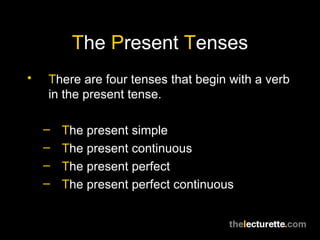
T he  P resent  T enses T here are four tenses that begin with a verb in the present tense. T he present simple T he present continuous T he present perfect T he present perfect continuous
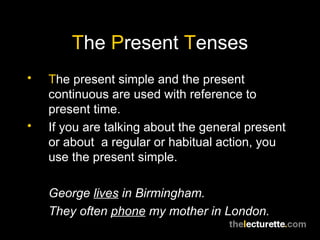
T he  P resent  T enses T he present simple and the present continuous are used with reference to present time. If you are talking about the general present or about  a regular or habitual action, you use the present simple. George  lives  in Birmingham. They often  phone  my mother in London.
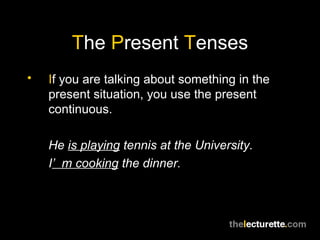
T he  P resent  T enses I f you are talking about something in the present situation, you use the present continuous. He  is playing  tennis at the University. I ’m cooking  the dinner.
T he  P resent  T enses T he present continuous is often used to refer to a temporary situation. He ’s living  in a flat at present.
T he  P resent  T enses Y ou use the present perfect or the present perfect  continuous when you are concerned with the present effects of something which happened at a time in the past, or which started in the past but is still continuing. Have  you  seen  the film at the Odeon? We ’ve been waiting  here since two o’clock.
T he  P resent  T enses I f you are talking about something which is scheduled or timetabled to happen in the future you can use the present simple tense. The next train  leaves  at two fifteen in the morning. It’ s  Tuesday tomorrow.
T he  P resent  T enses I f you are talking about something which has been arranged for the future, you can use the present continuous. When you use the present continuous like this, there is nearly always a time adverbial like ‘tomorrow’, ‘next week’, or ‘later’ in the clause. The Brown’s  are having  a party next week.
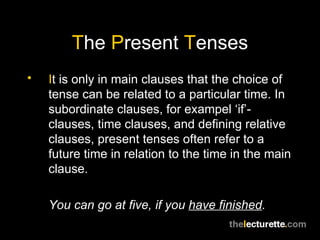
T he  P resent  T enses I t is only in main clauses that the choice of tense can be related to a particular time. In subordinate clauses, for exampel ‘if’-clauses, time clauses, and defining relative clauses, present tenses often refer to a future time in relation to the time in the main clause. You can go at five, if you  have finished .
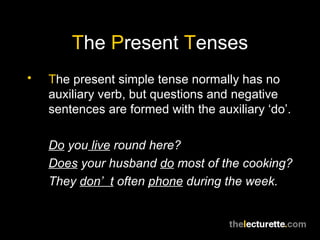
T he  P resent  T enses T he present simple tense normally has no auxiliary verb, but questions and negative sentences are formed with the auxiliary ‘do’. Do  you  live  round here? Does  your husband  do  most of the cooking? They  don’t  often  phone  during the week.
Q uestions? For more slide presentations visit:

The Present Tenses

  • 1.
    T he P resent T enses
  • 2.
    T he P resent T enses T here are four tenses that begin with a verb in the present tense. T he present simple T he present continuous T he present perfect T he present perfect continuous
  • 3.
    T he P resent T enses T he present simple and the present continuous are used with reference to present time. If you are talking about the general present or about a regular or habitual action, you use the present simple. George lives in Birmingham. They often phone my mother in London.
  • 4.
    T he P resent T enses I f you are talking about something in the present situation, you use the present continuous. He is playing tennis at the University. I ’m cooking the dinner.
  • 5.
    T he P resent T enses T he present continuous is often used to refer to a temporary situation. He ’s living in a flat at present.
  • 6.
    T he P resent T enses Y ou use the present perfect or the present perfect continuous when you are concerned with the present effects of something which happened at a time in the past, or which started in the past but is still continuing. Have you seen the film at the Odeon? We ’ve been waiting here since two o’clock.
  • 7.
    T he P resent T enses I f you are talking about something which is scheduled or timetabled to happen in the future you can use the present simple tense. The next train leaves at two fifteen in the morning. It’ s Tuesday tomorrow.
  • 8.
    T he P resent T enses I f you are talking about something which has been arranged for the future, you can use the present continuous. When you use the present continuous like this, there is nearly always a time adverbial like ‘tomorrow’, ‘next week’, or ‘later’ in the clause. The Brown’s are having a party next week.
  • 9.
    T he P resent T enses I t is only in main clauses that the choice of tense can be related to a particular time. In subordinate clauses, for exampel ‘if’-clauses, time clauses, and defining relative clauses, present tenses often refer to a future time in relation to the time in the main clause. You can go at five, if you have finished .
  • 10.
    T he P resent T enses T he present simple tense normally has no auxiliary verb, but questions and negative sentences are formed with the auxiliary ‘do’. Do you live round here? Does your husband do most of the cooking? They don’t often phone during the week.
  • 11.
    Q uestions? Formore slide presentations visit: