Future Tenses
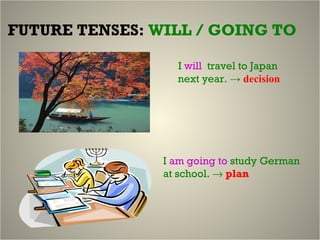
FUTURE TENSES:  WILL / GOING TO I  will   travel to Japan next year.  ->  decision I  am going to  study German at school.     plan
WILL/GOING TO The   Simple Future has two different forms in English: "will" and "be going to." Although the two forms can sometimes be used interchangeably, they often express two very different meanings as mentioned before.   I  will   probably  go to Italy next Summer. I  am going to  fly to Italy  next Saturday .
Future Tense:  Will    Form Affirmative :  I  will   travel to Madrid in October.  Interrogative  :  Will  you travel  by bus?  Negative  :  I  won’t  not travel.  (will + not =  won’t )   Will  you travel by train or by bus? I  won’t  travel by bus. I  will  probably travel by train.
1-  Instant decisions :  Ok,  I’ll see  you on Friday. Future Tense:  Uses  of Will 2-  Predictions based in what we think :  It  will rain  in the evening.  3-  Promises and offers : Don’t worry,  I’ll go  and buy some food for you.
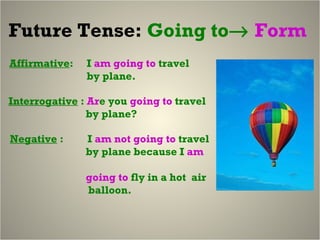
Future Tense:  Going to    Form  Affirmative :  I  am going to  travel  by plane. Interrogative  :  Ar e you  going to  travel by plane? Negative  :  I  am not going to  travel by plane because I  am  going to  fly in a hot  air balloon.
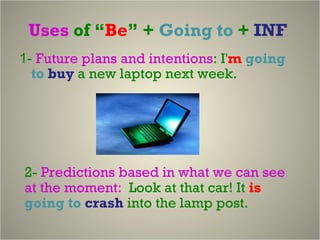
Uses  of “ Be ” +  Going to  +  INF  1-  Future plans and intentions :  I' m   going to  buy   a new laptop next week.   2-  Predictions based in what we can see at the moment:  Look at that car! It  is   going to   crash  into the lamp post.
WILL/GOING TO : COMPLETE THE SENTENCES A: Why are you holding a piece of paper?    B: I …………………….. (write) a letter to my friends back home in  Texas.    A: I'm about to fall asleep. I need to wake up!    B: I (get)………………… you a cup of coffee.  We are so excited about our trip next month to France! We ………………………. (visit) Paris, Nice and Grenoble.    I think he …………………. (be) the next British Prime Minister.
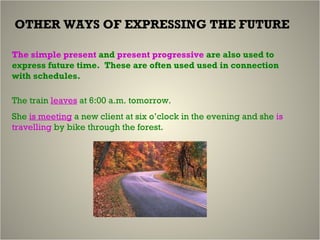
OTHER WAYS OF EXPRESSING THE FUTURE The simple present  and  present progressive  are also used to express future time.  These are often used used in connection with schedules. The train   leaves   at 6:00 a.m. tomorrow. She   is meeting   a new client at six o’clock in the evening and she  is travelling  by bike through the forest.
FUTURE PROGRESSIVE This tense is used to describe an event or action that will occur over a period of time at a specific point in the future. They  will be sailing  in the Atlantic ocean by the time you arrive at the Island.
THE FUTURE PERFECT This tense is used to describe an event or action that will be completed before another event or time in the future. We  will have finished  the exam by the time class ends tomorrow.

Future tenses

  • 1.
  • 2.
    FUTURE TENSES: WILL / GOING TO I will travel to Japan next year. -> decision I am going to study German at school.  plan
  • 3.
    WILL/GOING TO The Simple Future has two different forms in English: "will" and "be going to." Although the two forms can sometimes be used interchangeably, they often express two very different meanings as mentioned before. I will probably go to Italy next Summer. I am going to fly to Italy next Saturday .
  • 4.
    Future Tense: Will  Form Affirmative : I will travel to Madrid in October. Interrogative : Will you travel by bus? Negative : I won’t not travel. (will + not = won’t ) Will you travel by train or by bus? I won’t travel by bus. I will probably travel by train.
  • 5.
    1- Instantdecisions : Ok, I’ll see you on Friday. Future Tense: Uses of Will 2- Predictions based in what we think : It will rain in the evening. 3- Promises and offers : Don’t worry, I’ll go and buy some food for you.
  • 6.
    Future Tense: Going to  Form Affirmative : I am going to travel by plane. Interrogative : Ar e you going to travel by plane? Negative : I am not going to travel by plane because I am going to fly in a hot air balloon.
  • 7.
    Uses of“ Be ” + Going to + INF 1- Future plans and intentions : I' m going to buy a new laptop next week. 2- Predictions based in what we can see at the moment: Look at that car! It is going to crash into the lamp post.
  • 8.
    WILL/GOING TO :COMPLETE THE SENTENCES A: Why are you holding a piece of paper? B: I …………………….. (write) a letter to my friends back home in Texas.  A: I'm about to fall asleep. I need to wake up! B: I (get)………………… you a cup of coffee. We are so excited about our trip next month to France! We ………………………. (visit) Paris, Nice and Grenoble.  I think he …………………. (be) the next British Prime Minister.
  • 9.
    OTHER WAYS OFEXPRESSING THE FUTURE The simple present and present progressive are also used to express future time. These are often used used in connection with schedules. The train leaves at 6:00 a.m. tomorrow. She is meeting a new client at six o’clock in the evening and she is travelling by bike through the forest.
  • 10.
    FUTURE PROGRESSIVE Thistense is used to describe an event or action that will occur over a period of time at a specific point in the future. They will be sailing in the Atlantic ocean by the time you arrive at the Island.
  • 11.
    THE FUTURE PERFECTThis tense is used to describe an event or action that will be completed before another event or time in the future. We will have finished the exam by the time class ends tomorrow.