

Future Tenses
Miguel Ángel Rodríguez López
Future Simple (will)
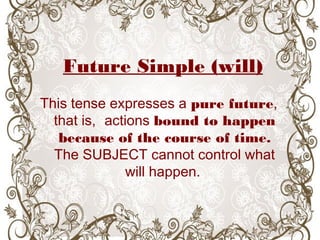
This tense expresses a pure future,
that is, actions bound to happen
because of the course of time.
The SUBJECT cannot control what
will happen.
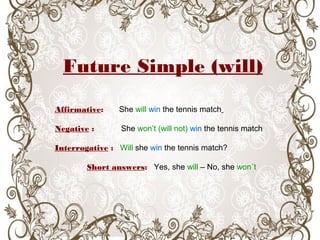
Future Simple (will)
Affirmative: She will win the tennis match
Negative : She won’t (will not) win the tennis match
Interrogative : Will she win the tennis match?
Short answers: Yes, she will – No, she won´t
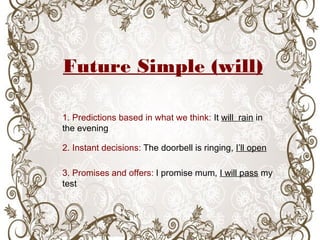
Future Simple (will)
1. Predictions based in what we think: It will rain in
the evening
2. Instant decisions: The doorbell is ringing, I’ll open
3. Promises and offers: I promise mum, I will pass my
test
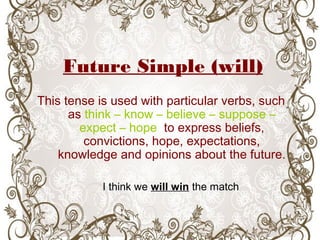
Future Simple (will)
This tense is used with particular verbs, such
as think – know – believe – suppose –
expect – hope to express beliefs,
convictions, hope, expectations,
knowledge and opinions about the future.
I think we will win the match
Future Simple (will)
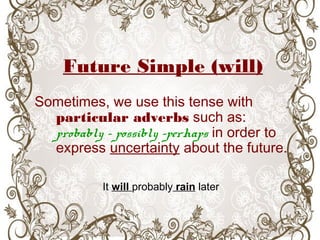
Sometimes, we use this tense with
particular adverbs such as:
probably – possibly –perhaps in order to
express uncertainty about the future.
It will probably rain later
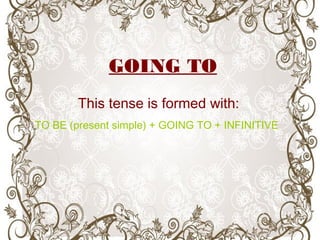
GOING TO
This tense is formed with:
TO BE (present simple) + GOING TO + INFINITIVE
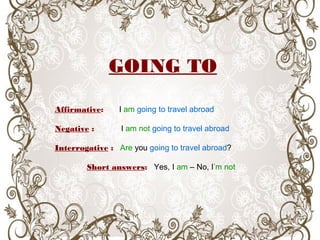
GOING TO
Affirmative: I am going to travel abroad
Negative : I am not going to travel abroad
Interrogative : Are you going to travel abroad?
Short answers: Yes, I am – No, I’m not
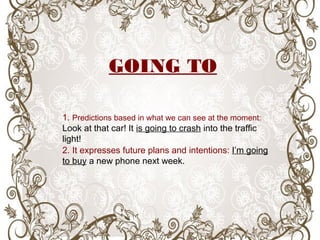
1. Predictions based in what we can see at the moment:
Look at that car! It is going to crash into the traffic
light!
2. It expresses future plans and intentions: I’m going
to buy a new phone next week.
GOING TO
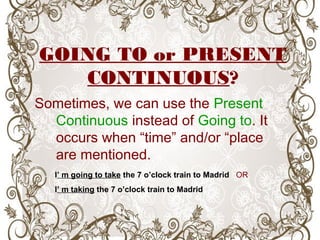
GOING TO or PRESENT
CONTINUOUS?
Sometimes, we can use the Present
Continuous instead of Going to. It
occurs when “time” and/or “place
are mentioned.
I’ m going to take the 7 o’clock train to Madrid OR
I’ m taking the 7 o’clock train to Madrid
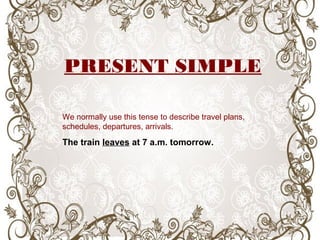
PRESENT SIMPLE
We normally use this tense to describe travel plans,
schedules, departures, arrivals.
The train leaves at 7 a.m. tomorrow.
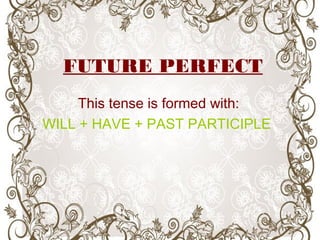
FUTURE PERFECT
This tense is formed with:
WILL + HAVE + PAST PARTICIPLE
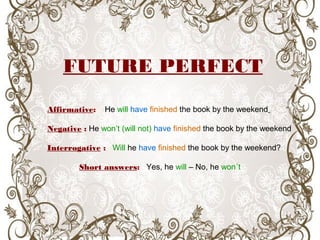
FUTURE PERFECT
Affirmative: He will have finished the book by the weekend
Negative : He won’t (will not) have finished the book by the weekend
Interrogative : Will he have finished the book by the weekend?
Short answers: Yes, he will – No, he won´t
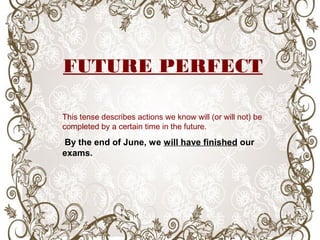
This tense describes actions we know will (or will not) be
completed by a certain time in the future.
By the end of June, we will have finished our
exams.
FUTURE PERFECT
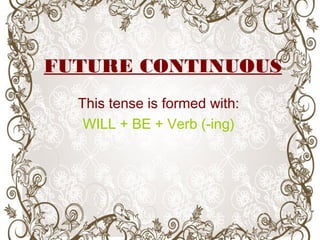
FUTURE CONTINUOUS
This tense is formed with:
WILL + BE + Verb (-ing)
FUTURE CONTINUOUS
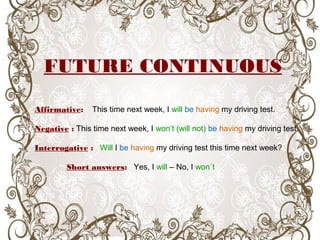
Affirmative: This time next week, I will be having my driving test.
Negative : This time next week, I won’t (will not) be having my driving test.
Interrogative : Will I be having my driving test this time next week?
Short answers: Yes, I will – No, I won´t
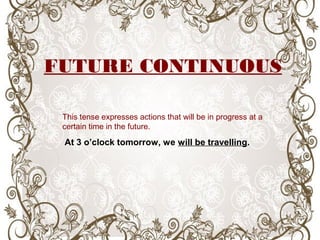
This tense expresses actions that will be in progress at a
certain time in the future.
At 3 o’clock tomorrow, we will be travelling.
FUTURE CONTINUOUS
FUTURE PERFECT
CONTINUOUS
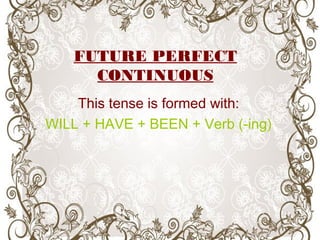
This tense is formed with:
WILL + HAVE + BEEN + Verb (-ing)
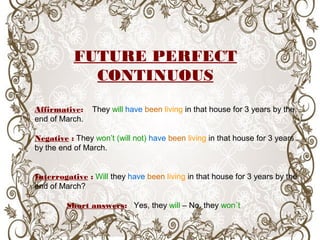
Affirmative: They will have been living in that house for 3 years by the
end of March.
Negative : They won’t (will not) have been living in that house for 3 years
by the end of March.
Interrogative : Will they have been living in that house for 3 years by the
end of March?
Short answers: Yes, they will – No, they won´t
FUTURE PERFECT
CONTINUOUS
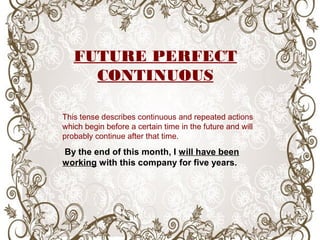
This tense describes continuous and repeated actions
which begin before a certain time in the future and will
probably continue after that time.
By the end of this month, I will have been
working with this company for five years.
FUTURE PERFECT
CONTINUOUS

Future Tenses

  • 1.
    Future Tenses Miguel ÁngelRodríguez López
  • 2.
    Future Simple (will) Thistense expresses a pure future, that is, actions bound to happen because of the course of time. The SUBJECT cannot control what will happen.
  • 3.
    Future Simple (will) Affirmative:She will win the tennis match Negative : She won’t (will not) win the tennis match Interrogative : Will she win the tennis match? Short answers: Yes, she will – No, she won´t
  • 4.
    Future Simple (will) 1.Predictions based in what we think: It will rain in the evening 2. Instant decisions: The doorbell is ringing, I’ll open 3. Promises and offers: I promise mum, I will pass my test
  • 5.
    Future Simple (will) Thistense is used with particular verbs, such as think – know – believe – suppose – expect – hope to express beliefs, convictions, hope, expectations, knowledge and opinions about the future. I think we will win the match
  • 6.
    Future Simple (will) Sometimes,we use this tense with particular adverbs such as: probably – possibly –perhaps in order to express uncertainty about the future. It will probably rain later
  • 7.
    GOING TO This tenseis formed with: TO BE (present simple) + GOING TO + INFINITIVE
  • 8.
    GOING TO Affirmative: Iam going to travel abroad Negative : I am not going to travel abroad Interrogative : Are you going to travel abroad? Short answers: Yes, I am – No, I’m not
  • 9.
    1. Predictions basedin what we can see at the moment: Look at that car! It is going to crash into the traffic light! 2. It expresses future plans and intentions: I’m going to buy a new phone next week. GOING TO
  • 10.
    GOING TO orPRESENT CONTINUOUS? Sometimes, we can use the Present Continuous instead of Going to. It occurs when “time” and/or “place are mentioned. I’ m going to take the 7 o’clock train to Madrid OR I’ m taking the 7 o’clock train to Madrid
  • 11.
    PRESENT SIMPLE We normallyuse this tense to describe travel plans, schedules, departures, arrivals. The train leaves at 7 a.m. tomorrow.
  • 12.
    FUTURE PERFECT This tenseis formed with: WILL + HAVE + PAST PARTICIPLE
  • 13.
    FUTURE PERFECT Affirmative: Hewill have finished the book by the weekend Negative : He won’t (will not) have finished the book by the weekend Interrogative : Will he have finished the book by the weekend? Short answers: Yes, he will – No, he won´t
  • 14.
    This tense describesactions we know will (or will not) be completed by a certain time in the future. By the end of June, we will have finished our exams. FUTURE PERFECT
  • 15.
    FUTURE CONTINUOUS This tenseis formed with: WILL + BE + Verb (-ing)
  • 16.
    FUTURE CONTINUOUS Affirmative: Thistime next week, I will be having my driving test. Negative : This time next week, I won’t (will not) be having my driving test. Interrogative : Will I be having my driving test this time next week? Short answers: Yes, I will – No, I won´t
  • 17.
    This tense expressesactions that will be in progress at a certain time in the future. At 3 o’clock tomorrow, we will be travelling. FUTURE CONTINUOUS
  • 18.
    FUTURE PERFECT CONTINUOUS This tenseis formed with: WILL + HAVE + BEEN + Verb (-ing)
  • 19.
    Affirmative: They willhave been living in that house for 3 years by the end of March. Negative : They won’t (will not) have been living in that house for 3 years by the end of March. Interrogative : Will they have been living in that house for 3 years by the end of March? Short answers: Yes, they will – No, they won´t FUTURE PERFECT CONTINUOUS
  • 20.
    This tense describescontinuous and repeated actions which begin before a certain time in the future and will probably continue after that time. By the end of this month, I will have been working with this company for five years. FUTURE PERFECT CONTINUOUS