Tagging
IMT530: Organization of Information Resources
             February 10, 2007

      Michael D. Braly & Geoffrey B. Froh
Overview
•   Definition and history of tagging
•   Mechanics of tagging
•   Tagging in the enterprise
•   Where tagging fits
Section One: Definitions
•   Definition and history of tagging
•   Mechanics of tagging
•   Tagging in the enterprise
•   Where tagging fits
What is tagging?
“There is no fixed set of categories or
officially approved choices. You can use
words, acronyms, numbers, whatever
makes sense to you, without regard for
anyone else’s needs, interests, or
requirements.”
           - Shirky, 2005
What is tagging?

“[Tagging] sticks it to The Man, especially if
   The Man happens to be a traditional
   taxonomist.”
“It’ll be messy and inelegant and inefficient,
   but it will be Good Enough.”
        - Weinberger, 2005
What is tagging?


“…free tagging, mob indexing, collaborative
 categorization, ethnoclassification, or
 whatever you want to call it.”
               - Morville, 2005
What is tagging?


“[T]ags represent an allocation of attention.”
      - Mejias, 2005

Of all the things in the world, I choose to
  acknowledge this thing, and I call it x.
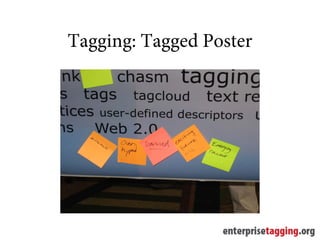
Tagging: Tagged Poster
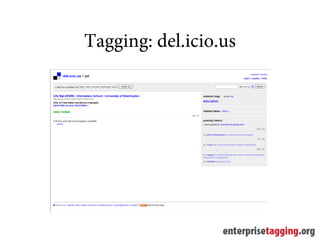
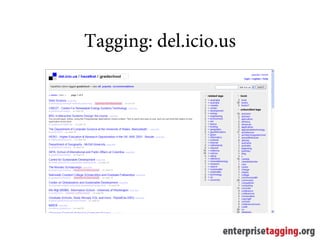
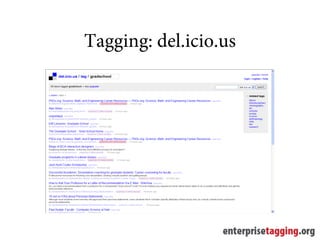
Tagging: del.icio.us
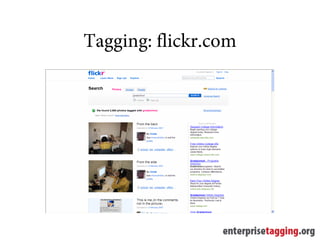
Tagging: flickr.com
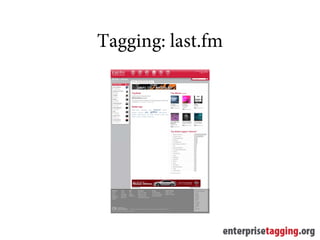
Tagging: last.fm
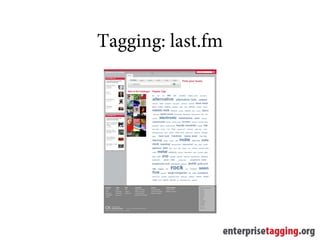
Tagging: last.fm
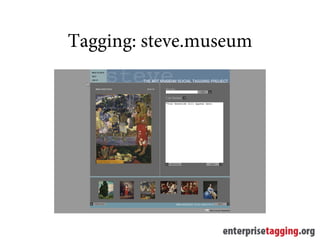
Tagging: steve.museum
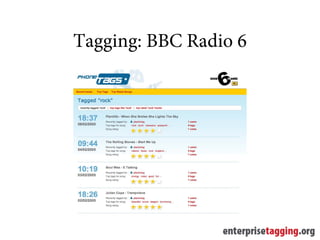
Tagging: BBC Radio 6
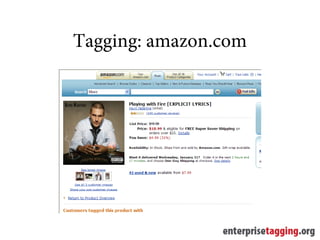
Tagging: amazon.com
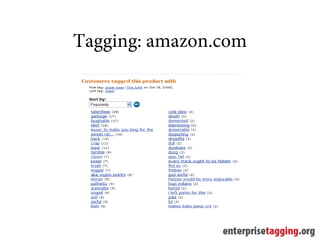
Tagging: amazon.com
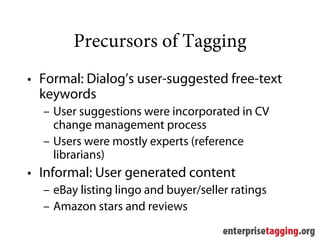
Precursors of Tagging
• Formal: Dialog’s user-suggested free-text
  keywords
  – User suggestions were incorporated in CV
    change management process
  – Users were mostly experts (reference
    librarians)
• Informal: User generated content
  – eBay listing lingo and buyer/seller ratings
  – Amazon stars and reviews
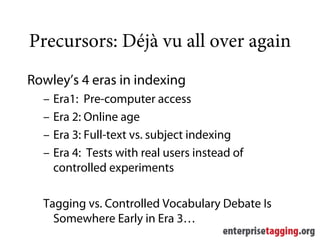
Precursors: Déjà vu all over again
Rowley’s 4 eras in indexing
  –   Era1: Pre-computer access
  –   Era 2: Online age
  –   Era 3: Full-text vs. subject indexing
  –   Era 4: Tests with real users instead of
      controlled experiments

  Tagging vs. Controlled Vocabulary Debate Is
    Somewhere Early in Era 3…
tag != keyword
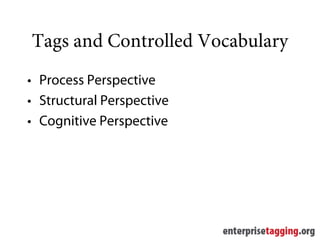
Tags and Controlled Vocabulary
• Process Perspective
• Structural Perspective
• Cognitive Perspective
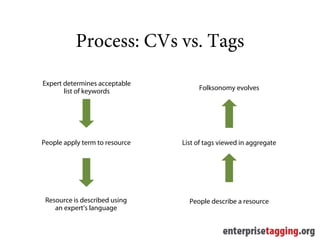
Process: CVs vs. Tags
Expert determines acceptable
       list of keywords              Folksonomy evolves


People apply term to resource   List of tags viewed in aggregate


 Resource is described using      People describe a resource
    an expert’s language
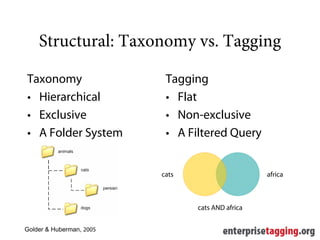
Structural: Taxonomy vs. Tagging

Taxonomy                   Tagging
• Hierarchical             • Flat
• Exclusive                • Non-exclusive
• A Folder System          • A Filtered Query


                          cats                     africa


                                 cats AND africa


Golder & Huberman, 2005
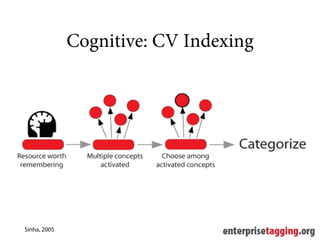
Cognitive: CV Indexing


Sinha, 2005
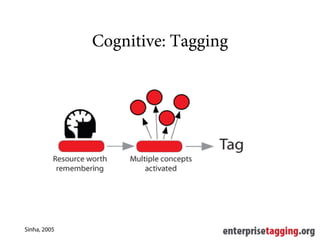
Cognitive: Tagging


Sinha, 2005
Why do individuals tag?

  •   Future retrieval
  •   Contribution and sharing
  •   Attract attention
  •   Play and competition
  •   Self presentation
  •   Opinion expression

Marlow et al, 2006
How are we doing? Questions or
      comments so far?
Section Two: Mechanics
•   Definition and history of tagging
•   Mechanics of tagging
•   Tagging in the enterprise
•   Where tagging fits
Is Phlat tagging?
Is Phlat social tagging?
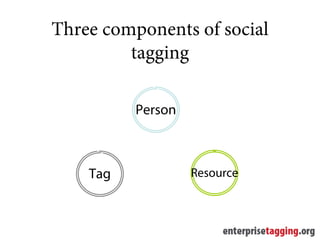
Three components of social
         tagging

          Person


    Tag            Resource
Photo: tjean314 (http://www.flickr.com/photos/tjean314/379212666/)
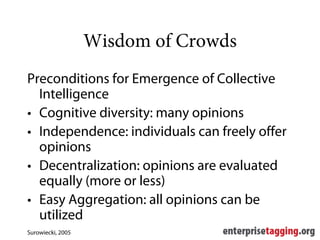
Wisdom of Crowds
Preconditions for Emergence of Collective
  Intelligence
• Cognitive diversity: many opinions
• Independence: individuals can freely offer
  opinions
• Decentralization: opinions are evaluated
  equally (more or less)
• Easy Aggregation: all opinions can be
  utilized
Surowiecki, 2005
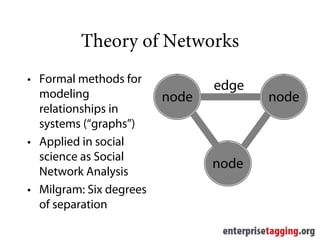
Theory of Networks
• Formal methods for
                                edge
  modeling               node          node
  relationships in
  systems (“graphs”)
• Applied in social
  science as Social
                                node
  Network Analysis
• Milgram: Six degrees
  of separation
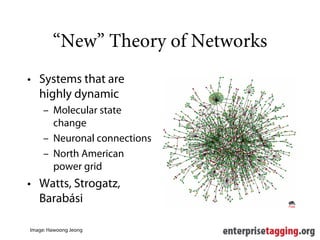
“New” Theory of Networks
• Systems that are
  highly dynamic
     – Molecular state
       change
     – Neuronal connections
     – North American
       power grid
• Watts, Strogatz,
  Barabási

Image: Hawoong Jeong
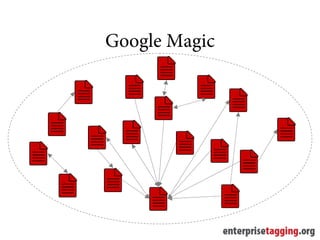
Google Magic
Social Tagging as Dynamic
                  Network?
• Social tagging presents many features of a
  dynamic network system
     – Users are joining the system
     – Users are submitting new tags and new bookmarks
     – New web resources are continually emerging to be
       bookmarked
     – Language is constantly changing
• del.icio.us easy to model as a network and
  provided access to data
Golder & Huberman, 2006
Stable patterns in dynamic systems

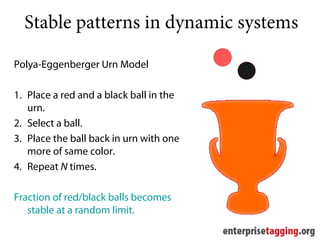
Polya-Eggenberger Urn Model

1. Place a red and a black ball in the
   urn.
2. Select a ball.
3. Place the ball back in urn with one
   more of same color.
4. Repeat N times.

Fraction of red/black balls becomes
   stable at a random limit.
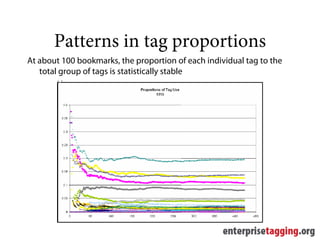
Patterns in tag proportions
At about 100 bookmarks, the proportion of each individual tag to the
   total group of tags is statistically stable
Stability in tag proportions
• Why is this happening?
  – Imitation
  – Shared knowledge
• What are the implications?
  – Collective meaning can emerge from individual
    tagging
  – Lesser used tags can coexist with more popular tags
  – Less popular URLs can produce useful tag data
Dynamic Structure of Social
         Tagging: Research
• Exposed sub-communities of users and
  inferred genre clusters in audioscrobbler
  and Last.fm (Lambiotte & Ausloos, 2005)
• Used del.icio.us to model concept of
  lightweight, self-organizing emergent
  ontology (Mika, 2005)
Questions or comments?
     Take a Break!
Section Three: Enterprise
•   Definition and history of tagging
•   Mechanics of tagging
•   Tagging in the enterprise
•   Where tagging fits
Enterprise Controlled Vocabularies
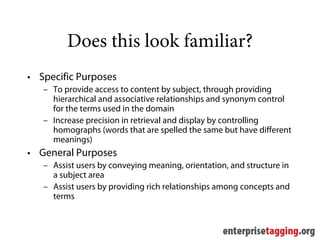
Does this look familiar?
• Specific Purposes
   – To provide access to content by subject, through providing
     hierarchical and associative relationships and synonym control
     for the terms used in the domain
   – Increase precision in retrieval and display by controlling
     homographs (words that are spelled the same but have different
     meanings)
• General Purposes
   – Assist users by conveying meaning, orientation, and structure in
     a subject area
   – Assist users by providing rich relationships among concepts and
     terms
Specific Purposes - CV
To provide access to content by subject,
through providing hierarchical and
associative relationships and synonym
control for the terms used in the domain
Specific Purposes - Tags
To provide access to content by subject,
through providing associative
relationships between the user’s own
terminology with that of other users as
well as controlled domain vocabulary
Specific Purposes - CV
Increase precision in retrieval and display
by controlling homographs (words that
are spelled the same but have different
meanings)
Specific Purposes - Tags
Increase precision and recall in retrieval by
providing a greater range of possible
subject terms than manual or automatic
indexing can produce
General Purposes - CV
Assist users by conveying meaning,
orientation, and structure in a subject area
General Purposes - Tags
Assist users by surfacing patterns of
shared meaning, orientation, and structure
in a subject area
General Purposes - CV
Assist users by providing rich relationships
among concepts and terms
General Purposes - Tags
Assist users by exposing relationships
between concepts, resources and other
users
Purposes of social tagging?
• Specific Purposes
   – To provide access to content by subject, through providing
     associative relationships between the user’s own terminology
     with that of other users as well as controlled domain vocabulary
   – Increase precision and recall in retrieval by providing a greater
     range of possible subject terms than manual or automatic
     indexing can produce
• General Purposes
   – Assist users by surfacing patterns of shared meaning,
     orientation, and structure in a subject area
   – Assist users by exposing relationships between concepts,
     resources and other users
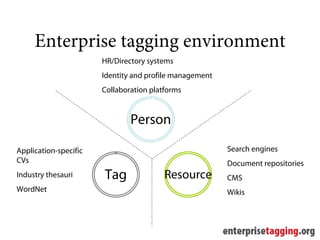
Enterprise tagging environment
                       HR/Directory systems
                       Identity and profile management
                       Collaboration platforms


                               Person

Application-specific                                     Search engines
CVs                                                      Document repositories
Industry thesauri      Tag               Resource        CMS
WordNet                                                  Wikis
How tagging can be used
• Learn the vocabulary of the people (“User
  Warrant”)
• Enhance a controlled vocabulary
• Search enhancement
How tagging can be used
• People
  – Community of Expertise
  – Community of Interest
  – “Assist users by providing rich relationships
    among concepts and terms.” (Mike C)
  – Assist users by exposing relationships
    between concepts, resources and other users.
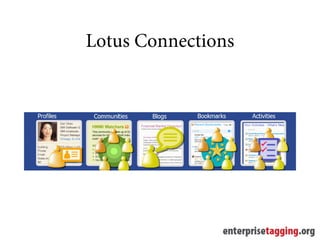
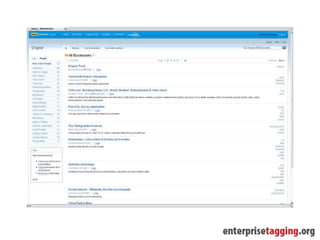
Lotus Connections
How are we doing? Questions or
      comments so far?
Section Four: Where tagging fits
•   Definition and history of tagging
•   Mechanics of tagging
•   Tagging in the enterprise
•   Where tagging fits
Surface Problems
• Problems with Language
• Problems with Users
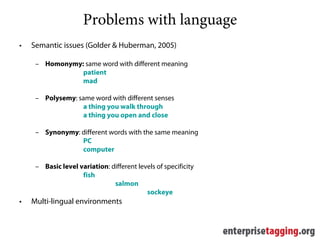
Problems with language
•   Semantic issues (Golder & Huberman, 2005)

     – Homonymy: same word with different meaning
                patient
                mad

     – Polysemy: same word with different senses
                  a thing you walk through
                  a thing you open and close

     – Synonymy: different words with the same meaning
                 PC
                 computer

     – Basic level variation: different levels of specificity
                    fish
                               salmon
                                           sockeye
•   Multi-lingual environments
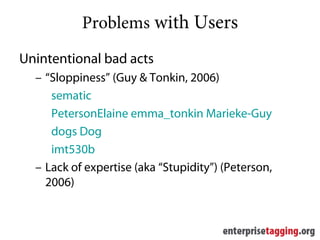
Problems with Users
Unintentional bad acts
  – “Sloppiness” (Guy & Tonkin, 2006)
     sematic
     PetersonElaine emma_tonkin Marieke-Guy
     dogs Dog
     imt530b
  – Lack of expertise (aka “Stupidity”) (Peterson,
    2006)
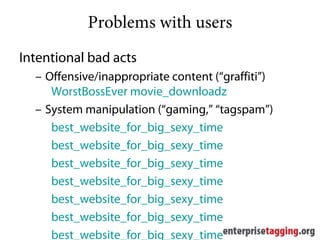
Problems with users
Intentional bad acts
  – Offensive/inappropriate content (“graffiti”)
     WorstBossEver movie_downloadz
  – System manipulation (“gaming,” “tagspam”)
     best_website_for_big_sexy_time
     best_website_for_big_sexy_time
     best_website_for_big_sexy_time
     best_website_for_big_sexy_time
     best_website_for_big_sexy_time
     best_website_for_big_sexy_time
     best_website_for_big_sexy_time
Deep problems
• Inattention
• Authority
Deep problems: Inattention
• How do you get the first tag
  – Tagging is post-hoc process
  – Valuable resources may be hard-to-find
  – Users may not be familiar with the corpus
• What happens if users don’t participate
  – System is difficult to use
  – Knowledge domain is not understood
  – Concept of tagging is not understood
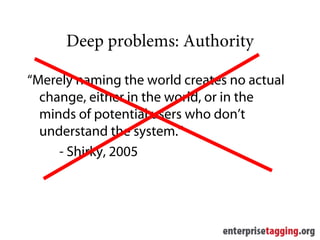
Deep problems: Authority

“Merely naming the world creates no actual
  change, either in the world, or in the
  minds of potential users who don’t
  understand the system.”
     - Shirky, 2005
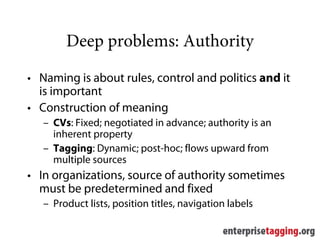
Deep problems: Authority
• Naming is about rules, control and politics and it
  is important
• Construction of meaning
   – CVs: Fixed; negotiated in advance; authority is an
     inherent property
   – Tagging: Dynamic; post-hoc; flows upward from
     multiple sources
• In organizations, source of authority sometimes
  must be predetermined and fixed
   – Product lists, position titles, navigation labels
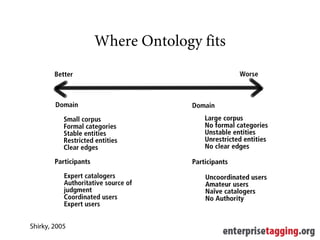
Where Ontology fits


Shirky, 2005
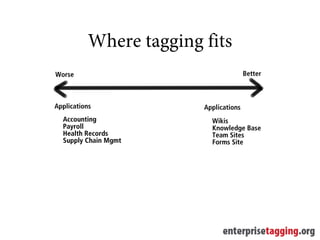
Where tagging fits
Thank You!
Discussion and Questions
References
•   Del.icio.us
•   Flickr.com
•   Last.fm
•   Amazon.com
•   Golder
•   Shirky
•   Steve.museum
•   Marlow et al
•   Sinha
•   Crandall
•   Peterson
•   Linked
•   Emergence
•   Wisdom of Crowds
•   Morville
Appendices
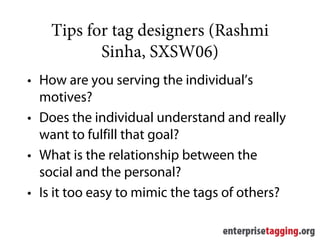
Tips for tag designers (Rashmi
           Sinha, SXSW06)
• How are you serving the individual’s
  motives?
• Does the individual understand and really
  want to fulfill that goal?
• What is the relationship between the
  social and the personal?
• Is it too easy to mimic the tags of others?
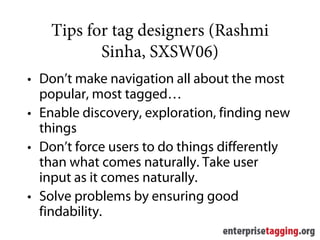
Tips for tag designers (Rashmi
           Sinha, SXSW06)
• Don’t make navigation all about the most
  popular, most tagged…
• Enable discovery, exploration, finding new
  things
• Don’t force users to do things differently
  than what comes naturally. Take user
  input as it comes naturally.
• Solve problems by ensuring good
  findability.

IMT530 Tagging Presentation

  • 1.
    Tagging IMT530: Organization ofInformation Resources February 10, 2007 Michael D. Braly & Geoffrey B. Froh
  • 2.
    Overview • Definition and history of tagging • Mechanics of tagging • Tagging in the enterprise • Where tagging fits
  • 3.
    Section One: Definitions • Definition and history of tagging • Mechanics of tagging • Tagging in the enterprise • Where tagging fits
  • 4.
    What is tagging? “Thereis no fixed set of categories or officially approved choices. You can use words, acronyms, numbers, whatever makes sense to you, without regard for anyone else’s needs, interests, or requirements.” - Shirky, 2005
  • 5.
    What is tagging? “[Tagging]sticks it to The Man, especially if The Man happens to be a traditional taxonomist.” “It’ll be messy and inelegant and inefficient, but it will be Good Enough.” - Weinberger, 2005
  • 6.
    What is tagging? “…freetagging, mob indexing, collaborative categorization, ethnoclassification, or whatever you want to call it.” - Morville, 2005
  • 7.
    What is tagging? “[T]agsrepresent an allocation of attention.” - Mejias, 2005 Of all the things in the world, I choose to acknowledge this thing, and I call it x.
  • 8.
  • 9.
  • 10.
  • 11.
  • 12.
  • 13.
  • 14.
  • 15.
  • 16.
  • 17.
  • 18.
  • 19.
    Precursors of Tagging •Formal: Dialog’s user-suggested free-text keywords – User suggestions were incorporated in CV change management process – Users were mostly experts (reference librarians) • Informal: User generated content – eBay listing lingo and buyer/seller ratings – Amazon stars and reviews
  • 20.
    Precursors: Déjà vuall over again Rowley’s 4 eras in indexing – Era1: Pre-computer access – Era 2: Online age – Era 3: Full-text vs. subject indexing – Era 4: Tests with real users instead of controlled experiments Tagging vs. Controlled Vocabulary Debate Is Somewhere Early in Era 3…
  • 21.
  • 22.
    Tags and ControlledVocabulary • Process Perspective • Structural Perspective • Cognitive Perspective
  • 23.
    Process: CVs vs.Tags Expert determines acceptable list of keywords Folksonomy evolves People apply term to resource List of tags viewed in aggregate Resource is described using People describe a resource an expert’s language
  • 24.
    Structural: Taxonomy vs.Tagging Taxonomy Tagging • Hierarchical • Flat • Exclusive • Non-exclusive • A Folder System • A Filtered Query cats africa cats AND africa Golder & Huberman, 2005
  • 25.
  • 26.
  • 27.
    Why do individualstag? • Future retrieval • Contribution and sharing • Attract attention • Play and competition • Self presentation • Opinion expression Marlow et al, 2006
  • 28.
    How are wedoing? Questions or comments so far?
  • 29.
    Section Two: Mechanics • Definition and history of tagging • Mechanics of tagging • Tagging in the enterprise • Where tagging fits
  • 30.
    Is Phlat tagging? IsPhlat social tagging?
  • 31.
    Three components ofsocial tagging Person Tag Resource
  • 32.
  • 33.
    Wisdom of Crowds Preconditionsfor Emergence of Collective Intelligence • Cognitive diversity: many opinions • Independence: individuals can freely offer opinions • Decentralization: opinions are evaluated equally (more or less) • Easy Aggregation: all opinions can be utilized Surowiecki, 2005
  • 34.
    Theory of Networks •Formal methods for edge modeling node node relationships in systems (“graphs”) • Applied in social science as Social node Network Analysis • Milgram: Six degrees of separation
  • 35.
    “New” Theory ofNetworks • Systems that are highly dynamic – Molecular state change – Neuronal connections – North American power grid • Watts, Strogatz, Barabási Image: Hawoong Jeong
  • 36.
  • 37.
    Social Tagging asDynamic Network? • Social tagging presents many features of a dynamic network system – Users are joining the system – Users are submitting new tags and new bookmarks – New web resources are continually emerging to be bookmarked – Language is constantly changing • del.icio.us easy to model as a network and provided access to data Golder & Huberman, 2006
  • 38.
    Stable patterns indynamic systems Polya-Eggenberger Urn Model 1. Place a red and a black ball in the urn. 2. Select a ball. 3. Place the ball back in urn with one more of same color. 4. Repeat N times. Fraction of red/black balls becomes stable at a random limit.
  • 39.
    Patterns in tagproportions At about 100 bookmarks, the proportion of each individual tag to the total group of tags is statistically stable
  • 40.
    Stability in tagproportions • Why is this happening? – Imitation – Shared knowledge • What are the implications? – Collective meaning can emerge from individual tagging – Lesser used tags can coexist with more popular tags – Less popular URLs can produce useful tag data
  • 41.
    Dynamic Structure ofSocial Tagging: Research • Exposed sub-communities of users and inferred genre clusters in audioscrobbler and Last.fm (Lambiotte & Ausloos, 2005) • Used del.icio.us to model concept of lightweight, self-organizing emergent ontology (Mika, 2005)
  • 42.
  • 43.
    Section Three: Enterprise • Definition and history of tagging • Mechanics of tagging • Tagging in the enterprise • Where tagging fits
  • 44.
  • 45.
    Does this lookfamiliar? • Specific Purposes – To provide access to content by subject, through providing hierarchical and associative relationships and synonym control for the terms used in the domain – Increase precision in retrieval and display by controlling homographs (words that are spelled the same but have different meanings) • General Purposes – Assist users by conveying meaning, orientation, and structure in a subject area – Assist users by providing rich relationships among concepts and terms
  • 46.
    Specific Purposes -CV To provide access to content by subject, through providing hierarchical and associative relationships and synonym control for the terms used in the domain
  • 47.
    Specific Purposes -Tags To provide access to content by subject, through providing associative relationships between the user’s own terminology with that of other users as well as controlled domain vocabulary
  • 48.
    Specific Purposes -CV Increase precision in retrieval and display by controlling homographs (words that are spelled the same but have different meanings)
  • 49.
    Specific Purposes -Tags Increase precision and recall in retrieval by providing a greater range of possible subject terms than manual or automatic indexing can produce
  • 50.
    General Purposes -CV Assist users by conveying meaning, orientation, and structure in a subject area
  • 51.
    General Purposes -Tags Assist users by surfacing patterns of shared meaning, orientation, and structure in a subject area
  • 52.
    General Purposes -CV Assist users by providing rich relationships among concepts and terms
  • 53.
    General Purposes -Tags Assist users by exposing relationships between concepts, resources and other users
  • 54.
    Purposes of socialtagging? • Specific Purposes – To provide access to content by subject, through providing associative relationships between the user’s own terminology with that of other users as well as controlled domain vocabulary – Increase precision and recall in retrieval by providing a greater range of possible subject terms than manual or automatic indexing can produce • General Purposes – Assist users by surfacing patterns of shared meaning, orientation, and structure in a subject area – Assist users by exposing relationships between concepts, resources and other users
  • 55.
    Enterprise tagging environment HR/Directory systems Identity and profile management Collaboration platforms Person Application-specific Search engines CVs Document repositories Industry thesauri Tag Resource CMS WordNet Wikis
  • 56.
    How tagging canbe used • Learn the vocabulary of the people (“User Warrant”) • Enhance a controlled vocabulary • Search enhancement
  • 57.
    How tagging canbe used • People – Community of Expertise – Community of Interest – “Assist users by providing rich relationships among concepts and terms.” (Mike C) – Assist users by exposing relationships between concepts, resources and other users.
  • 58.
  • 60.
    How are wedoing? Questions or comments so far?
  • 61.
    Section Four: Wheretagging fits • Definition and history of tagging • Mechanics of tagging • Tagging in the enterprise • Where tagging fits
  • 62.
    Surface Problems • Problemswith Language • Problems with Users
  • 63.
    Problems with language • Semantic issues (Golder & Huberman, 2005) – Homonymy: same word with different meaning patient mad – Polysemy: same word with different senses a thing you walk through a thing you open and close – Synonymy: different words with the same meaning PC computer – Basic level variation: different levels of specificity fish salmon sockeye • Multi-lingual environments
  • 64.
    Problems with Users Unintentionalbad acts – “Sloppiness” (Guy & Tonkin, 2006) sematic PetersonElaine emma_tonkin Marieke-Guy dogs Dog imt530b – Lack of expertise (aka “Stupidity”) (Peterson, 2006)
  • 65.
    Problems with users Intentionalbad acts – Offensive/inappropriate content (“graffiti”) WorstBossEver movie_downloadz – System manipulation (“gaming,” “tagspam”) best_website_for_big_sexy_time best_website_for_big_sexy_time best_website_for_big_sexy_time best_website_for_big_sexy_time best_website_for_big_sexy_time best_website_for_big_sexy_time best_website_for_big_sexy_time
  • 66.
  • 67.
    Deep problems: Inattention •How do you get the first tag – Tagging is post-hoc process – Valuable resources may be hard-to-find – Users may not be familiar with the corpus • What happens if users don’t participate – System is difficult to use – Knowledge domain is not understood – Concept of tagging is not understood
  • 68.
    Deep problems: Authority “Merelynaming the world creates no actual change, either in the world, or in the minds of potential users who don’t understand the system.” - Shirky, 2005
  • 69.
    Deep problems: Authority •Naming is about rules, control and politics and it is important • Construction of meaning – CVs: Fixed; negotiated in advance; authority is an inherent property – Tagging: Dynamic; post-hoc; flows upward from multiple sources • In organizations, source of authority sometimes must be predetermined and fixed – Product lists, position titles, navigation labels
  • 70.
  • 71.
  • 72.
  • 73.
  • 74.
    References • Del.icio.us • Flickr.com • Last.fm • Amazon.com • Golder • Shirky • Steve.museum • Marlow et al • Sinha • Crandall • Peterson • Linked • Emergence • Wisdom of Crowds • Morville
  • 75.
  • 76.
    Tips for tagdesigners (Rashmi Sinha, SXSW06) • How are you serving the individual’s motives? • Does the individual understand and really want to fulfill that goal? • What is the relationship between the social and the personal? • Is it too easy to mimic the tags of others?
  • 77.
    Tips for tagdesigners (Rashmi Sinha, SXSW06) • Don’t make navigation all about the most popular, most tagged… • Enable discovery, exploration, finding new things • Don’t force users to do things differently than what comes naturally. Take user input as it comes naturally. • Solve problems by ensuring good findability.