












Social Information Architecture IA Summit 2007 Las Vegas, Nevada March 22, 2007
Today’s Agenda 8:30 Introduction to Social IA 10:15 Tagging and Folksonomies 1:00 Designing for Social Sharing 3:30 Presentations, Q & A 5:00 Wrap-up & Drinks
About the Exercises We’ll break into small groups (5 or 6 people) Work with the same group all day Each speaker has different exercises Speakers might influence each others’ exercises Present in the afternoon
Speakers Rashmi Sinha Thomas Vander Wal Gene Smith
Information Architecture is the Structural design of shared information environments
Information Architecture is the Structural design of shared information environments Shared design of semi-structured information environments
Social information architecture User actions create some or all of the structure of an information environment Using the wisdom of crowds to solve the problems of IA Find, use and interact in information environments


Why is social IA important? Growth in online collaboration Emergence of web as social infrastructure Increasing interest in using social media for business purposes Pressure to move beyond hand-crafted IA
Recent Trends Mass amateurization Mass collaboration Online sharing Explosion of web-based social technologies
Social Software Definition Social software  enables people to rendezvous, connect or collaborate through computer-mediated communication. Wikipedia
More Social Software Definitions Software that treats groups different that individuals Stuff that gets spammed “ people will bend communications tools to social uses”  Clay Shirky
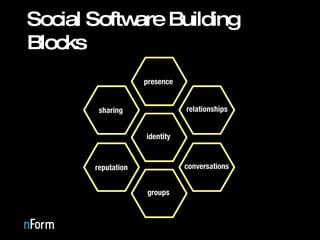
Social Software Building Blocks
Wisdom of Crowds Under the right conditions, groups are smarter than individuals Conditions Diversity Independence Decentralization Aggregation
Architectures of Participation Systems designed  For user contribution Around the culture and economics of openness For individuals, groups  and  crowds
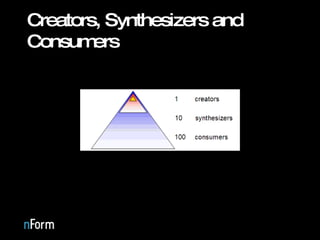
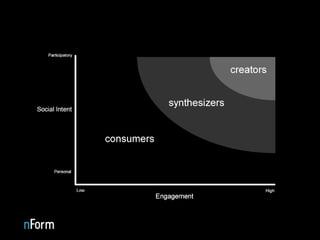
Creators, Synthesizers and Consumers
A Digression…


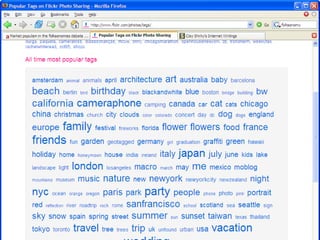
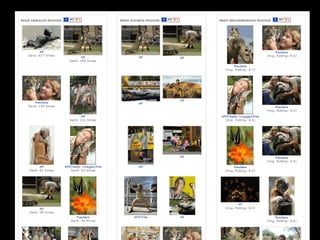
Yahoo’s Popular Photos Different actions lead to different patterns Patterns are consistent (but subtle) This  is  information architecture Need to understand them if we are to create structure from them
 
Three ingredients for social IA Capture User Actions Aggregate and Display Feedback
User Actions
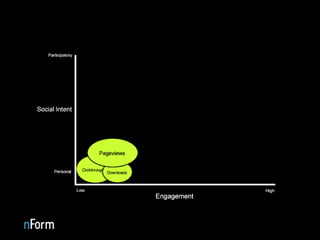
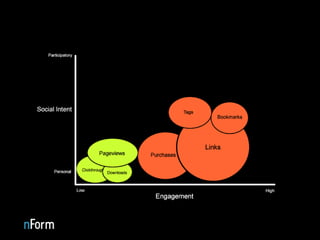
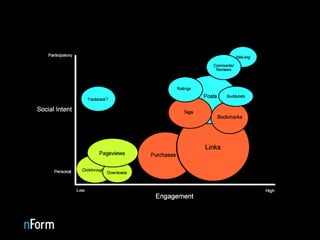
User Actions Things people do online that we can track Building blocks Popularity Community Reputation Ignore higher goals & motivations


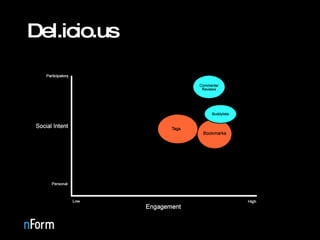
Del.icio.us
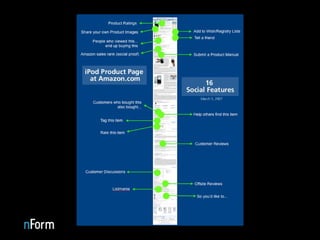
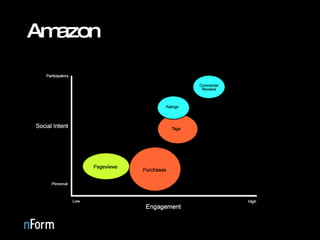
Amazon
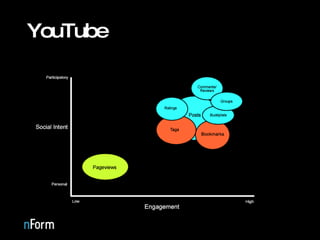
YouTube
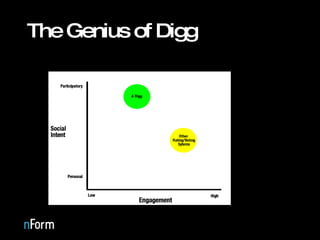
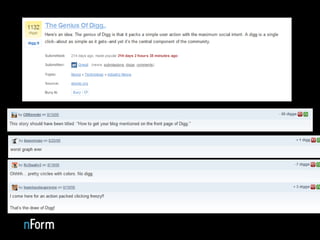
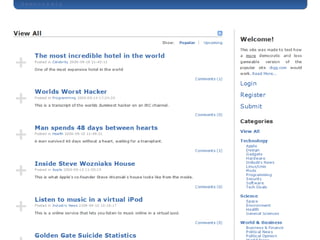
The Genius of Digg
 
Aggregation & Display Bringing together user actions in a relevant way Displaying them Rules
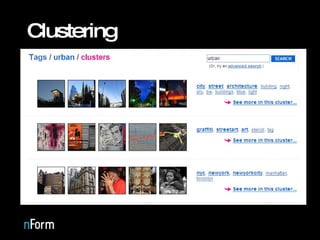
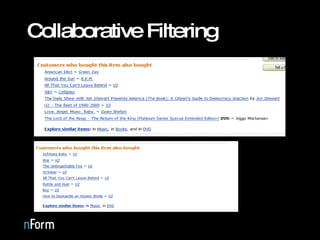
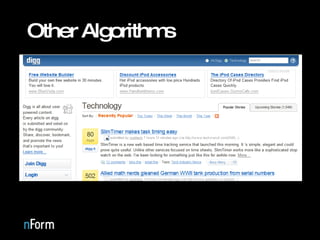
Kinds of Aggregation (not an exhaustive list) Listing Ranking Clustering Collaborative filtering Other algorithms
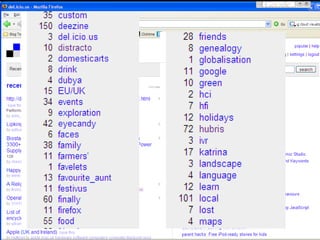
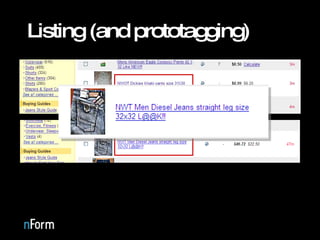
Listing (and prototagging)
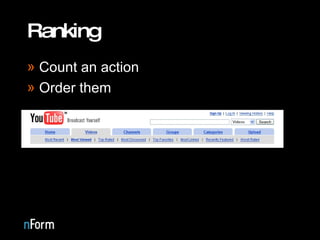
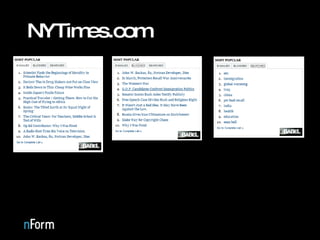
Ranking Count an action Order them
 
NYTimes.com
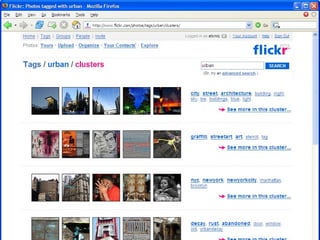
Clustering
Collaborative Filtering
Other Algorithms
Interestingness
Feedback
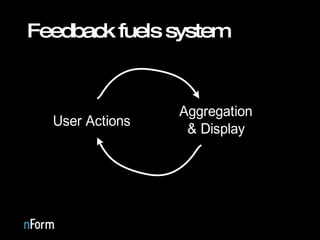
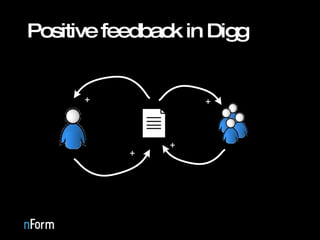
A  feedback loop  is a system where outputs are fed back into the system as inputs, increasing or decreasing effects.  -  Wikipedia
Positive Feedback First, close your eyes Listen for clapping If you hear a clap, you must also clap Try to clap within 0.5 seconds Don’t stop until I say stop
Negative Feedback First, close your eyes Listen for clapping If you hear a clap, you must also clap Try to clap within 0.5 seconds Once you’ve clapped, you can’t clap again for two seconds
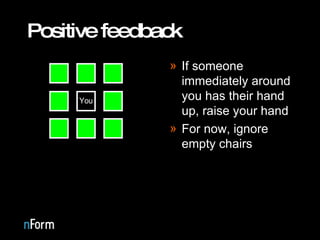
Positive feedback If someone immediately around you has their hand up, raise your hand For now, ignore empty chairs
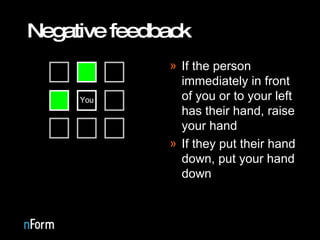
Negative feedback If the person immediately in front of you or to your left has their hand, raise your hand If they put their hand down, put your hand down
Feedback fuels system
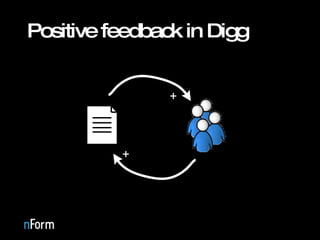
Positive feedback in Digg
 
Democradig
 
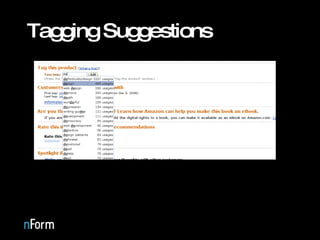
Tagging Suggestions
“ There are obvious dangers in establishing a positive feedback loop where potentially unsuitable tags may be reused due to the tag’s initial popularity and subsequent exposure as a tag recommendation.  This leads one to wonder whether it is preferable to have popular (but perhaps not intuitively obvious) tags, or to have a larger spread of relatively uncommon tags, possibly representing more accurate reflections or a wider spread of points of view” Marieke Guy & Emma Tonkin
Places to Intervene (also not an exhaustive list) Introduce delays Modify the strength of feedback loops Who has access to what information? Adjust incentives and punishments Change the system
Challenges Spam Gaming Balance Relevance Unintended consequences
Design Principles Allow for different levels of engagement Monitor and tweak feedback loops Trade-offs: transparency v. gaming Digg started simple, became more complicated to deal with gaming (but also became less satisfying to use) Participate in larger ecosystem YouTube is viral Design new actions, aggregators, display
Exercise

Social Information Architecture Workshop

  • 1.
    Social Information ArchitectureIA Summit 2007 Las Vegas, Nevada March 22, 2007
  • 2.
    Today’s Agenda 8:30Introduction to Social IA 10:15 Tagging and Folksonomies 1:00 Designing for Social Sharing 3:30 Presentations, Q & A 5:00 Wrap-up & Drinks
  • 3.
    About the ExercisesWe’ll break into small groups (5 or 6 people) Work with the same group all day Each speaker has different exercises Speakers might influence each others’ exercises Present in the afternoon
  • 4.
    Speakers Rashmi SinhaThomas Vander Wal Gene Smith
  • 5.
    Information Architecture isthe Structural design of shared information environments
  • 6.
    Information Architecture isthe Structural design of shared information environments Shared design of semi-structured information environments
  • 7.
    Social information architectureUser actions create some or all of the structure of an information environment Using the wisdom of crowds to solve the problems of IA Find, use and interact in information environments
  • 8.
  • 9.
  • 10.
  • 11.
  • 12.
  • 13.
  • 14.
  • 15.
  • 16.
    Why is socialIA important? Growth in online collaboration Emergence of web as social infrastructure Increasing interest in using social media for business purposes Pressure to move beyond hand-crafted IA
  • 17.
    Recent Trends Massamateurization Mass collaboration Online sharing Explosion of web-based social technologies
  • 18.
    Social Software DefinitionSocial software enables people to rendezvous, connect or collaborate through computer-mediated communication. Wikipedia
  • 19.
    More Social SoftwareDefinitions Software that treats groups different that individuals Stuff that gets spammed “ people will bend communications tools to social uses” Clay Shirky
  • 20.
  • 21.
    Wisdom of CrowdsUnder the right conditions, groups are smarter than individuals Conditions Diversity Independence Decentralization Aggregation
  • 22.
    Architectures of ParticipationSystems designed For user contribution Around the culture and economics of openness For individuals, groups and crowds
  • 23.
  • 24.
  • 25.
  • 26.
  • 27.
  • 28.
    Yahoo’s Popular PhotosDifferent actions lead to different patterns Patterns are consistent (but subtle) This is information architecture Need to understand them if we are to create structure from them
  • 29.
  • 30.
    Three ingredients forsocial IA Capture User Actions Aggregate and Display Feedback
  • 31.
  • 32.
    User Actions Thingspeople do online that we can track Building blocks Popularity Community Reputation Ignore higher goals & motivations
  • 33.
  • 34.
  • 35.
  • 36.
  • 37.
  • 38.
  • 39.
  • 40.
  • 41.
  • 42.
  • 43.
  • 44.
    Aggregation & DisplayBringing together user actions in a relevant way Displaying them Rules
  • 45.
    Kinds of Aggregation(not an exhaustive list) Listing Ranking Clustering Collaborative filtering Other algorithms
  • 46.
  • 47.
    Ranking Count anaction Order them
  • 48.
  • 49.
  • 50.
  • 51.
  • 52.
  • 53.
  • 54.
  • 55.
    A feedbackloop is a system where outputs are fed back into the system as inputs, increasing or decreasing effects. - Wikipedia
  • 56.
    Positive Feedback First,close your eyes Listen for clapping If you hear a clap, you must also clap Try to clap within 0.5 seconds Don’t stop until I say stop
  • 57.
    Negative Feedback First,close your eyes Listen for clapping If you hear a clap, you must also clap Try to clap within 0.5 seconds Once you’ve clapped, you can’t clap again for two seconds
  • 58.
    Positive feedback Ifsomeone immediately around you has their hand up, raise your hand For now, ignore empty chairs
  • 59.
    Negative feedback Ifthe person immediately in front of you or to your left has their hand, raise your hand If they put their hand down, put your hand down
  • 60.
  • 61.
  • 62.
  • 63.
  • 64.
  • 65.
  • 66.
  • 67.
    “ There areobvious dangers in establishing a positive feedback loop where potentially unsuitable tags may be reused due to the tag’s initial popularity and subsequent exposure as a tag recommendation. This leads one to wonder whether it is preferable to have popular (but perhaps not intuitively obvious) tags, or to have a larger spread of relatively uncommon tags, possibly representing more accurate reflections or a wider spread of points of view” Marieke Guy & Emma Tonkin
  • 68.
    Places to Intervene(also not an exhaustive list) Introduce delays Modify the strength of feedback loops Who has access to what information? Adjust incentives and punishments Change the system
  • 69.
    Challenges Spam GamingBalance Relevance Unintended consequences
  • 70.
    Design Principles Allowfor different levels of engagement Monitor and tweak feedback loops Trade-offs: transparency v. gaming Digg started simple, became more complicated to deal with gaming (but also became less satisfying to use) Participate in larger ecosystem YouTube is viral Design new actions, aggregators, display
  • 71.