Guerilla
Design
Research
    joycechou2010
You’re a DESIGNER.

So, why do you need
research and strategy?
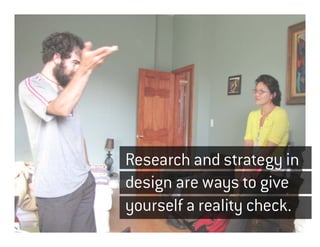
Research and strategy in
design are ways to give
yourself a reality check.
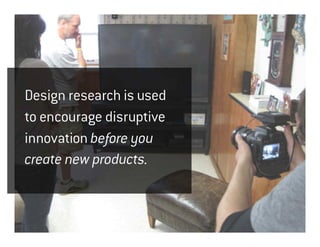
Design research is used
to encourage disruptive
innovation before you
create new products.
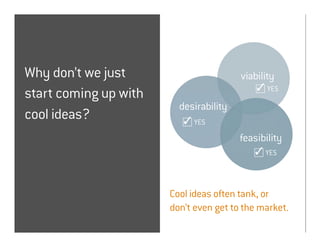
Why don’t we just                       viability
                                               YES
start coming up with
                         desirability
cool ideas?                 YES

                                        feasibility
                                              YES


                       Cool ideas often tank, or
                       don’t even get to the market.
the creation center


                                                  courtesy of xkcd.com


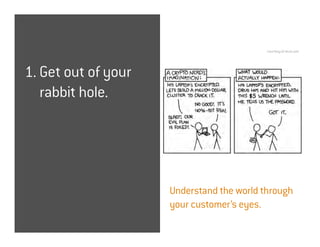
  1. Get out of your
     rabbit hole.


                            Understand the world through
                            your customer’s eyes.
T-Mobile: Creation Center
the creation center


                                               courtesy of xkcd.com


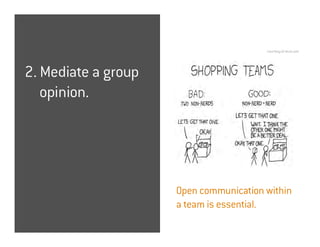
  2. Mediate a group
     opinion.


                            Open communication within
                            a team is essential.
T-Mobile: Creation Center
the creation center


                                                  courtesy of xkcd.com


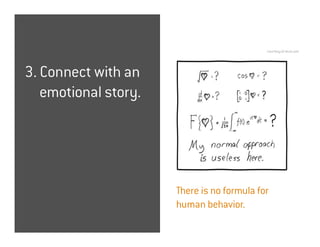
  3. Connect with an
     emotional story.


                            There is no formula for
                            human behavior.
T-Mobile: Creation Center
OK, you’re bought in.

How do you actually
do this?
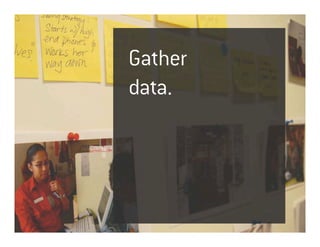
Gather
data.
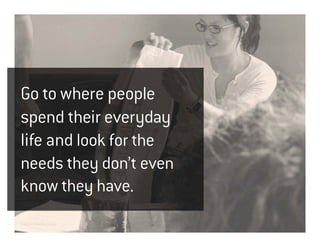
Go to where people
spend their everyday
life and look for the
needs they don’t even
know they have.
T-Mobile: Creation Center
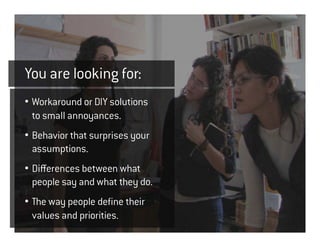
You are looking for:
• Workaround or DIY solutions
  to small annoyances.
• Behavior that surprises your
  assumptions.
• Differences between what
  people say and what they do.
• The way people define their
  values and priorities.
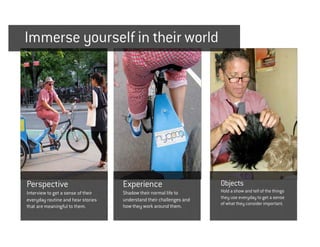
Immerse yourself in their world


Perspective                         Experience                        Objects
Interview to get a sense of their   Shadow their normal life to       Hold a show and tell of the things
everyday routine and hear stories   understand their challenges and   they use everyday to get a sense
                                                                      of what they consider important.
that are meaningful to them.        how they work around them.
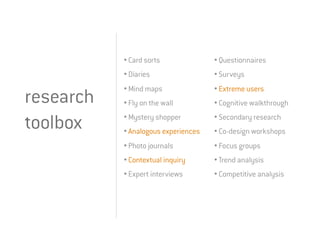
• Card sorts              • Questionnaires
           • Diaries                 • Surveys
           • Mind maps               • Extreme users
research   • Fly on the wall         • Cognitive walkthrough
           • Mystery shopper         • Secondary research
toolbox    • Analogous experiences   • Co-design workshops
           • Photo journals          • Focus groups
           • Contextual inquiry      • Trend analysis
           • Expert interviews       • Competitive analysis
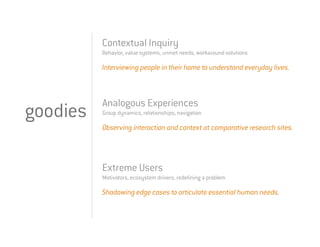
Contextual Inquiry
          Behavior, value systems, unmet needs, workaround solutions

          Interviewing people in their home to understand everyday lives.


          Analogous Experiences
goodies   Group dynamics, relationships, navigation

          Observing interaction and context at comparative research sites.


          Extreme Users
          Motivators, ecosystem drivers, redefining a problem

          Shadowing edge cases to articulate essential human needs.
Next, make data
meaningful.
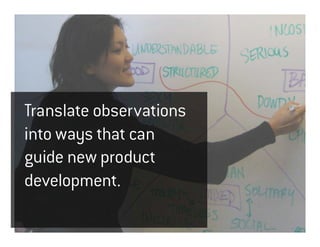
Translate observations
into ways that can
guide new product
development.
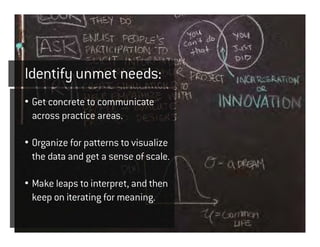
Identify unmet needs:
• Get concrete to communicate
  across practice areas.

• Organize for patterns to visualize
  the data and get a sense of scale.

• Make leaps to interpret, and then
  keep on iterating for meaning.
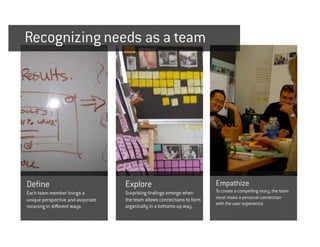
Recognizing needs as a team


Define                             Explore                               Empathize
Each team member brings a          Surprising findings emerge when       To create a compelling story, the team
unique perspective and associate   the team allows connections to form   must make a personal connection
                                                                         with the user experience.
meaning in different ways.         organically in a bottoms-up way.
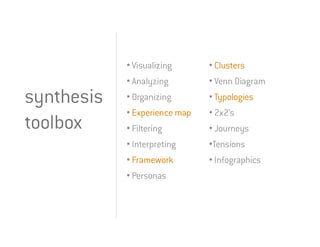
• Visualizing      • Clusters
            • Analyzing        • Venn Diagram
synthesis   • Organizing       • Typologies
            • Experience map   • 2x2’s
toolbox     • Filtering        • Journeys
            • Interpreting     •Tensions
            • Framework        • Infographics
            • Personas
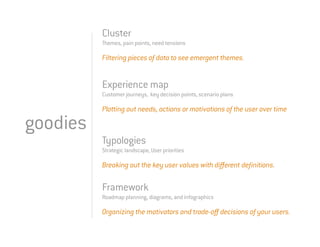
Cluster
          Themes, pain points, need tensions

          Filtering pieces of data to see emergent themes.


          Experience map
          Customer journeys, key decision points, scenario plans

          Plotting out needs, actions or motivations of the user over time

goodies
          Typologies
          Strategic landscape, User priorities

          Breaking out the key user values with different definitions.

          Framework
          Roadmap planning, diagrams, and infographics

          Organizing the motivators and trade-off decisions of your users.
Now let’s get GUERILLA.

You don’t need a corporate expense
account or a team of experts. Use
what you have and observe the world
around you.
Say you have a project
on a mobile social
networking app...
We don’t need another
Facebook, but then
what do we need?
             Understand your parameters:
             1. Your marketing stakeholder wants to
                target young adults (18-34)
             2. Your business strategy stakeholder
                wants to ensure that it is easy
                enough to learn for a mass market.
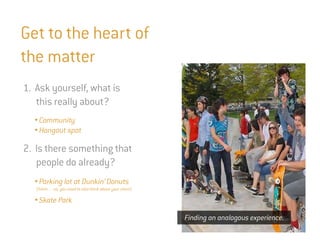
Get to the heart of
the matter
1. Ask yourself, what is
   this really about?
  • Community
  • Hangout spot

2. Is there something that
   people do already?
  • Parking lot at Dunkin’ Donuts
   (hmm… no, you need to also think about your client)

  • Skate Park

                                                         Finding an analogous experience.
Open your eyes, and
go out the door:

 Look for:
 • Roles
 • Relationships
 • Crowded/ empty spaces
 • Badges of affiliation
 • Hierarchies of status
 • Unique language
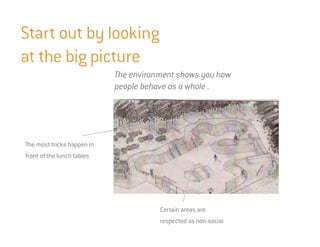
Start out by looking
at the big picture
                            The environment shows you how
                            people behave as a whole .


The most tricks happen in
front of the lunch tables


                                       Certain areas are
                                       respected as non-social
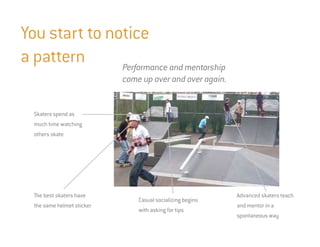
You start to notice
a pattern      Performance and mentorship
                            come up over and over again.


  Skaters spend as
  much time watching
  others skate


  The best skaters have                                     Advanced skaters teach
                                Casual socializing begins
  the same helmet sticker                                   and mentor in a
                                with asking for tips
                                                            spontaneous way
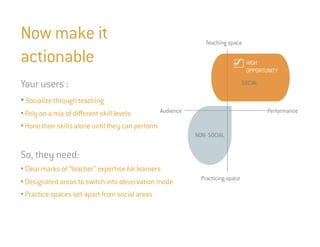
Now make it                                                      Teaching space

actionable                                                                          HIGH
                                                                                    OPPORTUNITY

Your users :                                                                       SOCIAL

• Socialize through teaching
• Rely on a mix of different skill levels          Audience                                 Performance

• Hone their skills alone until they can perform
                                                              NON- SOCIAL


So, they need:
• Clear marks of “teacher” expertise for learners
                                                                Practicing space
• Designated areas to switch into observation mode
• Practice spaces set apart from social areas
thank you!

          contact me at
joyce.hoice@gmail.com

Guerilla Design

  • 1.
  • 2.
    You’re a DESIGNER. So,why do you need research and strategy?
  • 3.
    Research and strategyin design are ways to give yourself a reality check.
  • 4.
    Design research isused to encourage disruptive innovation before you create new products.
  • 5.
    Why don’t wejust viability YES start coming up with desirability cool ideas? YES feasibility YES Cool ideas often tank, or don’t even get to the market.
  • 6.
    the creation center courtesy of xkcd.com 1. Get out of your rabbit hole. Understand the world through your customer’s eyes. T-Mobile: Creation Center
  • 7.
    the creation center courtesy of xkcd.com 2. Mediate a group opinion. Open communication within a team is essential. T-Mobile: Creation Center
  • 8.
    the creation center courtesy of xkcd.com 3. Connect with an emotional story. There is no formula for human behavior. T-Mobile: Creation Center
  • 9.
    OK, you’re boughtin. How do you actually do this?
  • 10.
  • 11.
    Go to wherepeople spend their everyday life and look for the needs they don’t even know they have. T-Mobile: Creation Center
  • 12.
    You are lookingfor: • Workaround or DIY solutions to small annoyances. • Behavior that surprises your assumptions. • Differences between what people say and what they do. • The way people define their values and priorities.
  • 13.
    Immerse yourself intheir world Perspective Experience Objects Interview to get a sense of their Shadow their normal life to Hold a show and tell of the things everyday routine and hear stories understand their challenges and they use everyday to get a sense of what they consider important. that are meaningful to them. how they work around them.
  • 14.
    • Card sorts • Questionnaires • Diaries • Surveys • Mind maps • Extreme users research • Fly on the wall • Cognitive walkthrough • Mystery shopper • Secondary research toolbox • Analogous experiences • Co-design workshops • Photo journals • Focus groups • Contextual inquiry • Trend analysis • Expert interviews • Competitive analysis
  • 15.
    Contextual Inquiry Behavior, value systems, unmet needs, workaround solutions Interviewing people in their home to understand everyday lives. Analogous Experiences goodies Group dynamics, relationships, navigation Observing interaction and context at comparative research sites. Extreme Users Motivators, ecosystem drivers, redefining a problem Shadowing edge cases to articulate essential human needs.
  • 16.
  • 17.
    Translate observations into waysthat can guide new product development.
  • 18.
    Identify unmet needs: •Get concrete to communicate across practice areas. • Organize for patterns to visualize the data and get a sense of scale. • Make leaps to interpret, and then keep on iterating for meaning.
  • 19.
    Recognizing needs asa team Define Explore Empathize Each team member brings a Surprising findings emerge when To create a compelling story, the team unique perspective and associate the team allows connections to form must make a personal connection with the user experience. meaning in different ways. organically in a bottoms-up way.
  • 20.
    • Visualizing • Clusters • Analyzing • Venn Diagram synthesis • Organizing • Typologies • Experience map • 2x2’s toolbox • Filtering • Journeys • Interpreting •Tensions • Framework • Infographics • Personas
  • 21.
    Cluster Themes, pain points, need tensions Filtering pieces of data to see emergent themes. Experience map Customer journeys, key decision points, scenario plans Plotting out needs, actions or motivations of the user over time goodies Typologies Strategic landscape, User priorities Breaking out the key user values with different definitions. Framework Roadmap planning, diagrams, and infographics Organizing the motivators and trade-off decisions of your users.
  • 22.
    Now let’s getGUERILLA. You don’t need a corporate expense account or a team of experts. Use what you have and observe the world around you.
  • 23.
    Say you havea project on a mobile social networking app...
  • 24.
    We don’t needanother Facebook, but then what do we need? Understand your parameters: 1. Your marketing stakeholder wants to target young adults (18-34) 2. Your business strategy stakeholder wants to ensure that it is easy enough to learn for a mass market.
  • 25.
    Get to theheart of the matter 1. Ask yourself, what is this really about? • Community • Hangout spot 2. Is there something that people do already? • Parking lot at Dunkin’ Donuts (hmm… no, you need to also think about your client) • Skate Park Finding an analogous experience.
  • 26.
    Open your eyes,and go out the door: Look for: • Roles • Relationships • Crowded/ empty spaces • Badges of affiliation • Hierarchies of status • Unique language
  • 27.
    Start out bylooking at the big picture The environment shows you how people behave as a whole . The most tricks happen in front of the lunch tables Certain areas are respected as non-social
  • 28.
    You start tonotice a pattern Performance and mentorship come up over and over again. Skaters spend as much time watching others skate The best skaters have Advanced skaters teach Casual socializing begins the same helmet sticker and mentor in a with asking for tips spontaneous way
  • 29.
    Now make it Teaching space actionable HIGH OPPORTUNITY Your users : SOCIAL • Socialize through teaching • Rely on a mix of different skill levels Audience Performance • Hone their skills alone until they can perform NON- SOCIAL So, they need: • Clear marks of “teacher” expertise for learners Practicing space • Designated areas to switch into observation mode • Practice spaces set apart from social areas
  • 30.
    thank you! contact me at joyce.hoice@gmail.com